Freddie Kiger ’74 (’77 MAT) – Distinguished Service Medal
Freddie Kiger’s dad came ashore on Omaha Beach on D-Day and fought his way across France and Germany in WWII. A decorated soldier who fought in the Battle of Bulge, he regularly met up with other Army veterans at reunions in the mid-Atlantic states. As a boy, Kiger accompanied his dad and sat in the back of Holiday Inn conference rooms at battle sites across South Carolina, West Virginia and Kentucky, listening to veterans recount their experiences.
“I recognized the power of the stories, the drama and the closeness that being in battle brought them,” Kiger said. “I fell in love with the ability to teach history by telling it in the form of a story.”
Kiger, a historian, teacher, writer and statistician, grew up in Rural Hall, working in tobacco fields. His acceptance letter to Carolina was his ticket to a wider world. Assigned to Teague dorm, he made lifelong friends by embracing intramural sports. He played on intramural teams and worked as an official, mentored in the office by Roy Williams ’72 (’73 MAT), which paved the way to an assignment as a statistician for men’s basketball games under head coach Dean Smith.
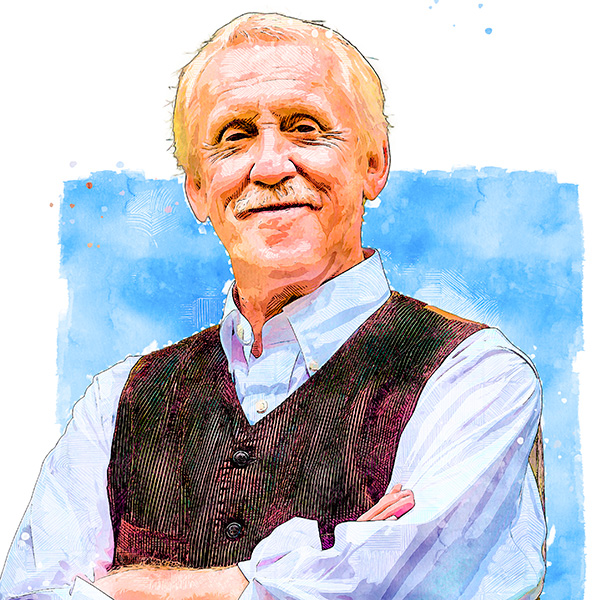 Though Kiger joined Chapel Hill-Carrboro City Schools as a high school history teacher after graduation, he never really left the scorers’ table. His connection to Carolina basketball opened doors for him as a producer, writer and on-air talent with WCHL radio and Tar Heel Sports Network. That, in turn, brought him to the attention of TV networks ABC, CBS, Fox Sports, Raycom Media and, most notably, ESPN where he has been a writer, researcher and statistician for five decades. He’s covered four Olympics as a researcher and was on the team that produced ESPN’s SportsCentury, which won three Emmys.
As a public school teacher, Kiger took on the challenge of teaching teenagers the relevance of events that happened long before they were born. In 1993, Sassy magazine named him Most Beloved Teacher in America. Students from his AP History course can cite details of the Civil War and Reconstruction decades into adulthood. Kiger tapped the power of storytelling to imprint young minds. Every year, he took a group on a field trip to Civil War battle sites, where they dressed up and acted out Pickett’s Charge and other events. Local TV stations came out to film them.
Years later, Kiger leads seminars and field trips to teach Carolina alumni about North Carolina history and the Civil War. They routinely sell out. He’s created a whole band of “Freddie followers,” people who sign up for an enrichment program just because he’s teaching it. His monthly podcasts, “Threads From the National Tapestry: Stories From the American Civil War,” have drawn more than a million views. In 2025, he was inducted into the Order of the Long Leaf Pine. One of his former students at Chapel Hill High, now-N.C. Gov. Josh Stein, signed it into being.
Kiger’s excitement about history is infectious. During COVID, a colleague met him for a summer walk around town. As they strolled through the woods near campus, Kiger pointed out where soldiers hid and bullet casings were discovered. Four hours and 7 miles later, the walk had turned into a roving history lesson about UNC, Chapel Hill, North Carolina and the Civil War.
A 7-mile walk doesn’t faze Kiger, who has walked at least five and a half miles every day for nearly 1,400 consecutive days. When UNC hires new athletics staff, the department sets them up with Kiger, who takes them on a tour to orient them to the history of the town, gown, athletics and Carolina traditions.
At the scorers’ table during Carolina games, Kiger wears a sweater vest, a tradition he started when his mom complained that all her friends would see him on TV, but she couldn’t find him. He donned the vest so she could pick him out of the lineup when the camera panned the sidelines.
Kiger is one of the first to arrive at a game and among the last to leave. He meets with on-air personalities before the game to find out what they want him to focus on for their commentary. He’s a walking encyclopedia of the Atlantic Coast Conference who goes beyond game results and stats. He can relate what’s going on now with what happened in the past, and he offers historical context for anything noteworthy that occurs during the game.
Though Kiger never draws attention to himself, people know him — and he knows them. Kiger is legendary for remembering names and faces and details about a person’s interests and family. Fans make their way down to the scorer’s table from the upper deck or thread their way through restaurant tables to say hi. He greets them with a smile and a firm handshake or a hug and almost always calls them by name. “Freddie,” a colleague said, “is one of one.”