Alexander Julian ’69 – Distinguished Service Medal
In renowned designer Alexander Julian’s dining room, overlooking a Connecticut lake, sits a long table flanked by maybe 30 chairs, each a different color, yet they all work together. An oversized color wheel hangs over the mantel. Julian has a romance with color, said a longtime friend. Julian’s wife, Meagan, declared her husband would never rest until he’d recolored all the manmade parts of the world. Julian corrected her: “Not just the manmade.”
Julian grew up in his father’s Franklin Street haberdashery, the eponymously named Julian’s. As a child he played under the sewing tables and made forts from suit boxes and sweater material. Family vacations invariably included a tour of a clothing factory or textile mill, where he learned about yarns and cloth. He designed his first shirt at age 12, his first jacket a few years later. He put outfits together for customers. Barely a teen, he became the go-to person in his dad’s shop to find a tie for a difficult suit.
Continuing a family tradition that includes his father, uncle, cousins, sister and now four of his seven children, Julian enrolled at Carolina, but the family business held his heart. After pestering his dad for a couple of years to open a high-end menswear boutique, Julian took matters into his own hands in 1969. While his father was out of town, Julian opened the branch store and dropped out of college to run it. The business was the first in a long line of Julian’s successes. Soon his designs were selling across the country.
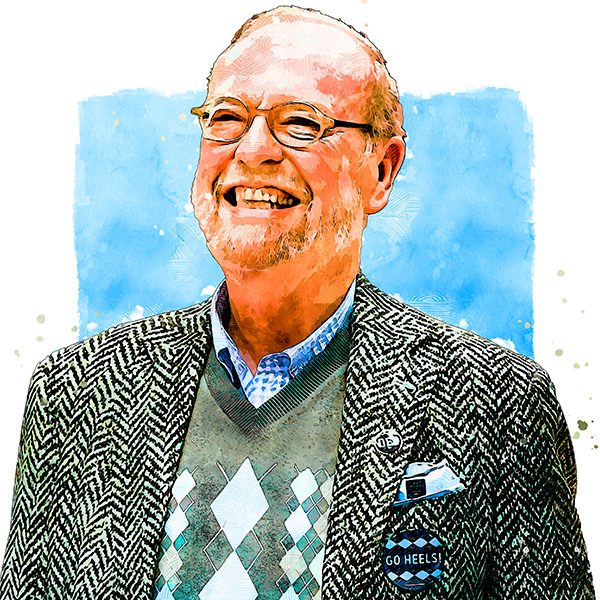 His eye for color was his genius. His business instinct came through observing his mom at the cash register. In each transaction, both she and her customer were smiling. That image stayed with him. He learned that the value of a product is more than just money. It’s about happiness.
Essentially self-taught, Julian understood that designers don’t dictate taste. He listens to and observes what consumers feel about what’s going on in the world and their own lives, and he gives them what they’re hungry for. That insight has fueled his design success in clothing, furniture, paint, wallpaper, flooring, bedding, towels and drapes.
In the early 1970s, Julian went to his first piece-goods market but couldn’t find what he wanted. So he became the first American fashion designer to create his own fabrics, some of which are now in the Smithsonian Design Museum’s permanent collection.
Soft goods manufacturer Dan River was flagging under competition from offshore textile companies until it inked a number of very successful licensing deals with Julian. Fashion changes so quickly, yet Julian’s designs are timeless. Because he knows how to make a fabric, he can see what the finished piece is going to look like as he’s developing the yarn.
In the mid-1990s, Julian entered the furniture business with his Home Colours line. John Conrad, who would later become president of the International Furniture Designers Association, went to view the collection and found it lived up to its hype. Julian would pull a design element from a wrought-iron gate and apply it to a new project or use tortoise-shell coat buttons as drawer pulls. “My impression then was I don’t think the furniture industry knows what they’ve got here,” Conrad said. “I was right.” They knew Julian could design upholstery because he knew fabrics. They didn’t know what he could do with wood and veneers. His first collection “took off like a rocket,” Conrad said.
Julian’s venture into the furniture industry circled back to his desire to make people happy. He noticed how friends’ eyes would light up when they talked about a special piece of furniture, and he wanted to be part of what puts a smile on their faces where they live every day.
Julian has “won every award around the world,” said his friend and good customer Bill Keyes ’75 (’18 PhD). Scrolling through Julian’s long list of accolades seems to prove that. He won his first Coty Award before he was 30 and went on to win the prestigious award four more times and be the youngest designer inducted into the Coty Hall of Fame. He twice received the Cutty Sark Menswear Award. He was the only fashion designer to receive the American Society of Furniture Designer’s Pinnacle Award. In North Carolina, he was inducted into the Order of the Long Leaf Pine and honored with UNC’s Distinguished Alumni Award in 1988 and an honorary doctorate in 2023.
When the Charlotte Hornets joined the NBA in 1988, the team’s owner asked Julian to design their uniform, which he did in exchange for a monthly delivery of pulled pork from his favorite barbecue spot in Charlotte.
Julian took on the challenge of designing racing crew uniforms for Paul Newman’s team in the very limited palette of fireproof materials. He became the first fashion designer to win Motorsports Designer of the Year.
For decades, Julian has left his classy mark — pro bono — on his alma mater, starting with the official Chancellor’s Club tie in 1981, bow ties and cummerbunds for The Clef Hangers, ties and scarves for The Order of the Bell Tower student volunteers, the Marching Band’s argyle T-shirts, parade ribbons for the 50th reunion classes of 1969 and 1970 and organic cotton towels for The Carolina Inn.
In 1990, Coach Dean Smith called and asked Julian to redesign the uniforms for the men’s basketball team. That design resulted in his famous argyle, which he donated to UNC and now appears on everything Carolina from team uniforms to dorm walls to popcorn boxes.
“I’m Uncle Argyle,” Julian said.