Zena Cardman ’10 (’14 MS) – Distinguished Young Alumna
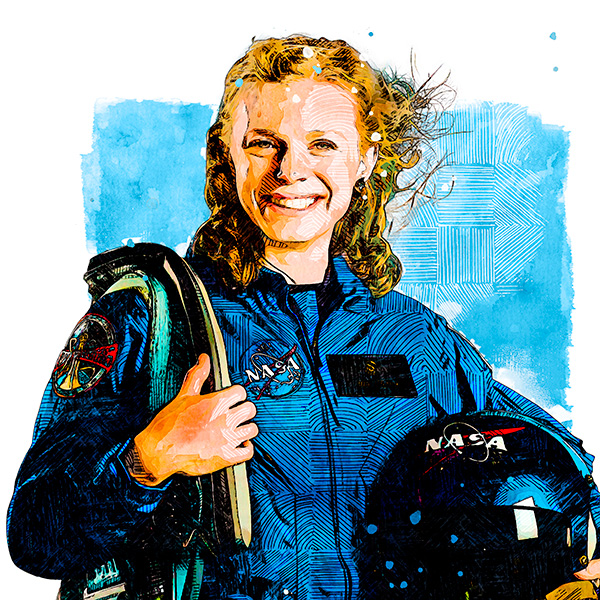
Zena Cardman ’10 (’14 MS) learned she had been selected as Carolina Alumni’s Distinguished Young Alumna on a Zoom call in outer space. Her crew gathered around the screen with her on the International Space Station, one teammate bobbing gently behind her in zero gravity and another floating in sideways horizontally. Cardman took the news in stride. She is what you’d call unflappable.
Born in Urbana, Illinois, and raised in Williamsburg, Virginia, Cardman took an early interest in the heavens when her mom woke her up after bedtime to watch meteor showers. In her application essay for Carolina, she wrote that she wanted to be an astronaut, then deleted it because she didn’t think she could explain why. She added a creative writing minor to her biology major and earned honors in poetry. If she did get to space, she’d be able to describe the experience beautifully.
Her poetry honors professor, Ross White ’97, said when people dream a big dream that not everyone will understand, they need the right language to garner support. “A big dream can be lonely,” he said. “For her, space is sacred.”
 In working on her master’s in marine sciences at UNC, Cardman studied microbial systems in hydrocarbon seeps, hydrothermal vents and the Arctic and made the first of three research trips to Antarctica as part of a team analyzing microbial ecology ecosystem changes. She focused her doctoral studies at Penn State University on geobiology and novel redox couples (chemicals transferring electrons from one to another) in the Earth’s crust, mantle and core to learn more about life in extreme conditions.
While completing her doctorate, she uploaded her resume to NASA’s website and applied to be an astronaut. Nine months later, in June 2017, after sifting through 18,000 applications, NASA selected her and a dozen others to comprise its 22nd class of astronauts.
During her two-year training, Cardman learned various aspects of spaceflight and the systems on the International Space Station, became proficient in Russian and learned to fly a T-38 supersonic jet to practice thinking quickly in rapidly changing situations.
Yet when she addressed Carolina’s class of 2024 as Spring Commencement speaker, she focused on the communication and trust astronauts build as they go through training in extreme environments. As a graduate student, Cardman worked in the earth, marine and environmental sciences lab of UNC researcher Andreas Teske. He recalled how she put her ego aside to help the entire team succeed. When astronauts go to space, he said, “if communication doesn’t work or they can’t get along with one another, that’s a disaster.”
Her encyclopedic mindset and curiosity in the more unusual regions of microbiology also made her a standout, Teske said. “The question was never would she do something unusual but what kind of unusual thing she’d do in her life,” he said.
Cardman’s astronaut class is the first to graduate under NASA’s Artemis program, which aims to put the first woman on the moon and perhaps launch a human crew to Mars by the mid-2030s. Initially, she was slated to command the SpaceX Crew-9 mission to the International Space Station, but technical issues delayed the return of two astronauts and reshuffled the lineup. Cardman was reassigned as spacecraft commander of Crew-11.
Researcher Carrie Cowardin of the University of Virginia School of Medicine has known Cardman since childhood. “She’s fearless,” Cowardin said, and a deeply loyal friend. When Cowardin went through a difficult time, “as busy as she was, she dropped everything to help a friend. That will stay with me forever.”
Cardman’s creativity is especially apparent when she’s thrust in new environments that require a lot of adaptations, Cowardin said. “Being able to think about things in a different way, bringing a creative perspective to problem-solving is very valuable.”
When Cardman signed up for the yearlong senior honors poetry writing class Professor Emeritus Michael McFee ’76 (’78 MA) taught, he wondered how she’d find time. She would need to produce a thousand lines of original poetry organized into a coherent manuscript, and the language used in science and poetry is very different. “But the creative side of her brain was very important to her,” he said.
At the end of the course, McFee issues a Postcard Challenge, asking his students to send him tacky postcards as a way to keep in touch. Cardman stepped up to the challenge, even mailing him a coconut from Florida where she was practicing deep-sea diving. After securing permission from the post office, she wrote his address in Magic Marker on the shell and put a stamp on it. It was delivered to his desk.
Cardman also did her homework before asking Dale Andersen, a researcher with NASA’s exobiology and astrobiology programs, whether she could join his study on an unusual set of microbiolites that became an operational analog for planetary research. “She brought funding with her,” Andersen said. “It’s hard for a PI to turn down an undergrad who shows up at the door with funding to help carry out the research she wanted to do.”
Andersen said Cardman fit in with the diverse team of researchers right away. “She took initiative naturally,” he said. She consistently brought strong energy to the team. She was someone you could count on.”
Her grace, poise and empathy are extremely valuable in small group settings in remote areas, like the space station or Mars.
Due to a crew member’s medical issue, the mission for Crew-11 ended before Cardman could walk in space. Though that disappointed Cardman, Andersen is convinced she has more space adventures ahead. “She’s the epitome of an explorer,” he said. “Maybe she’ll do lunar footprints, be the first woman on the moon.”