Bill Campbell – Distinguished Service Medal
Bill Campbell grew up on 400 acres of sagebrush, rocks and rattlesnakes that the federal government sold to his father, a WWII veteran, for a dollar. The U.S. Bureau of Reclamation essentially bet WWII veterans $1 that they couldn’t turn the arid land into a farm, and the Campbells took the bet on a hilly tract east of the Cascade Mountains in Oregon. Once water arrived, and later, electricity, the farm did well.
Campbell might have made a career farming had the Soviets not launched Sputnik. For the U.S. to be competitive in the space race, college scholarship money unfurled for American kids talented in math and science. Campbell was one of these gifted students. He chose to study chemistry, but he was interested in chemistry with a purpose, so he tailored his degree to pharmacy.
And he might have made a career as a retail pharmacist if his wife, Karen, also a pharmacist, hadn’t noticed his restlessness and encouraged him to go to graduate school. His doctorate in pharmacy opened opportunities to teach at the college level, and that set his life on a different path.
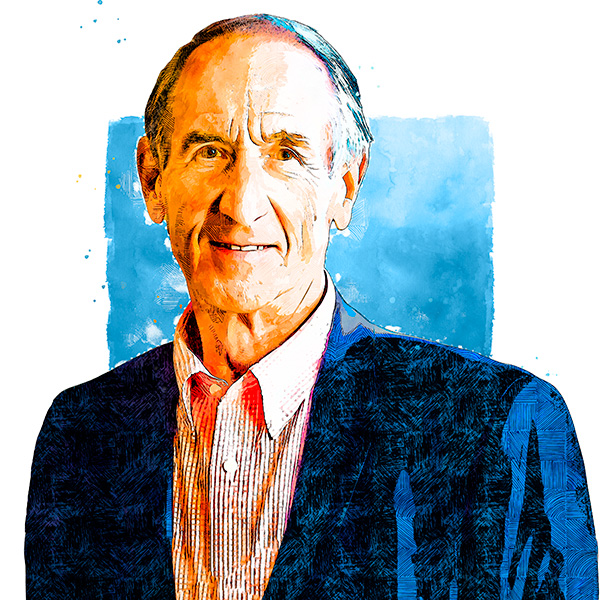 Campbell taught first at the University of Washington, where he became department chair, and then he accepted the deanship at Auburn’s pharmacy school before UNC named him dean of its pharmacy school in 1992. The pharmacy school had a respectable ranking when he arrived — tied for No. 15 out of 90 schools — and he sensed some faculty believed 15 was good enough. It wasn’t, in his eyes. The school had some excellent faculty and proximity to Research Triangle Park and was part of a university that had other top-ranked schools. He aimed for a culture change to create a structure where everyone could function at the highest level.
Kim Brouwer, now interim dean, was a junior professor on the search committee that selected Campbell. Like Campbell, she was a native Oregonian and knew the desert-dry soil that lay to the east of the Cascades. She recalls thinking: Here’s a real visionary to take that arid land and turn it into fertile crops. “I can’t imagine the amount of effort he must have invested early in his life working his family’s farm,” she said. Campbell won her respect and her vote.
Other lessons learned on the farm proved useful as dean. Rural life was self-sustaining and taught Campbell to be a problem solver. “You had to solve all your problems yourself,” he said. “You solved the problem, or you starved.”
Around the time Campbell accepted the deanship, UNC and pharmacy schools nationwide were moving from a bachelor’s degree to a doctoral program. An outside-the-box thinker, Campbell reached out to alumni working as clinical pharmacists to bring them back for a PharmD. Adding experienced practitioners to the student body underscored to younger students the importance of the course content.
The change also meant faculty had to teach evenings and weekends to accommodate the practicing pharmacists. Campbell kept faculty, staff and alumni in the loop with his Monday Morning Memos. He boosted faculty morale with themed retreats, such as “Mission Possible” — Brouwer still has her spy briefcase and fake moustache and glasses — and finding sponsors for an annual Chocolate Day, in which he scooped the ice cream for free sundaes.
Growing up surrounded by mountains, Campbell, naturally, climbed them and was part of a “Gang of 5” pharmacists who made annual expeditions to peaks around the world for 31 years. He applied some of those lessons to the deanship as well: Build trust with your partners, admit when you’re lost and be willing to backtrack, stay cool under pressure and manage risk well.
Often when he summitted a peak, he’d have someone take a photo of him holding a Carolina pennant or banner from a pharmaceutical company. He used those photos when fundraising. His pitch, “I risked my life to get this picture for you, and you have an opportunity to make a transformational gift to the school,” brought in about a million dollars a flag.
In his decade as dean, Campbell grew the school’s endowment from $3 million to $40 million. His fundraising success contributed to the construction of Kerr Hall, a research and teaching facility opened in 2002. He pushed for a “bimodal school” that excelled in research and practice. Most schools are good in one area or the other, but Campbell believed the school could be great in both. By the time he completed his second five-year term as dean, the school’s ranking had risen from 15 to 2.
Carolina is the “University of the people,” and serving North Carolinians was particularly important to Campbell, who understood that pharmacists are an important part of a high-functioning health network.
His most lasting legacy may be his mentorship. He led by example and focused on potential. By empowering those around him, he attracted good faculty and kept them. He was supportive as he challenged faculty to reach their full potential. When he retired, he designed a mentorship program that bears his name and has become a national model.
After he retired in 2003, Campbell moved back to the mountains of Washington, where he became an EMT first-responder certified for wildfires. He joined the volunteer fire department and was elected a fire commissioner. As a former dean, he said, “I can’t get away from putting out fires.”