Kevin Guskiewicz – Distinguished Service Medal
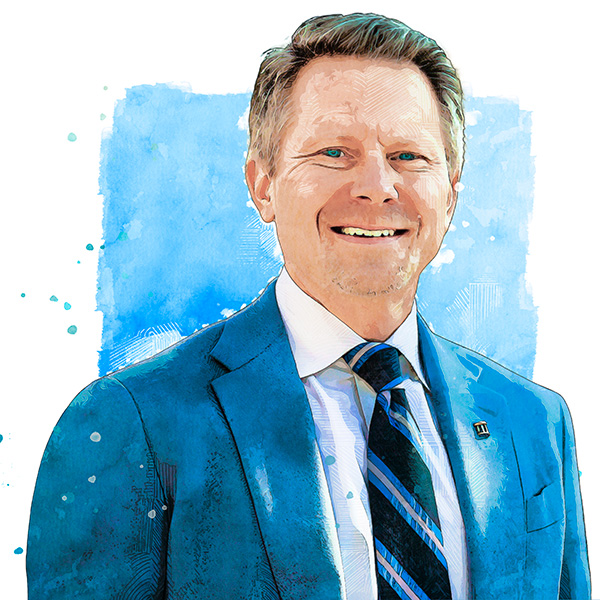
Kevin Guskiewicz started his career at UNC in 1995 “from the ankles up.” In addition to his teaching and research responsibilities in the department of exercise and sport science, he was the athletic trainer for Carolina’s first-ever women’s lacrosse team. The athletes required a lot of attention to be brought back to health after games — and a lot of tape, especially to shore up ankles.
By the time he left Carolina in 2024 to become president of Michigan State University, he’d been UNC’s chancellor for five years. In between, Guskiewicz instituted two research centers pertaining to traumatic brain injuries, developed a diagnostic tool to quickly discern and manage concussions, advocated to move the kickoff line to a safer spot in NFL and college football games, and won the MacArthur “Genius Grant.”
Guskiewicz had a brand-new doctorate from UVA when UNC’s exercise and sport science department hired him as a junior faculty member. People at Carolina who believed in him, he said, gave him opportunities to explore different avenues of teaching, research, service and leadership, and he paid it forward to students. His research on concussions led to his collaborating with the NFL Players Association to open the Center for the Study of Retired Athletes in 2001. The center provides former players with medical care through clinical research protocols.
 A decade later, Guskiewicz opened and directed the Matthew Gfeller Center for Sport-Related Traumatic Brain Injury Research, funded by the parents of a high school athlete who died after suffering a brain injury in a football game. The following year, in 2011, Guskiewicz received the highly prestigious MacArthur Fellowship.
Each success led to the next. Guskiewicz was named a Kenan Distinguished Professor and chair of a department that he grew into one of the largest majors on campus. He was promoted to senior associate dean of natural sciences and then served as dean of the College of Arts and Sciences for six years.
Always energized by a big idea, Guskiewicz loved to ask himself, his team and donors, “What if?” What if we could find resources to make this initiative real? What could it mean to the University, the state and humankind? He rallied others to see Carolina not only as a place to solve the grand challenges of today but also to identify the grand challenges of tomorrow so the University would be leading in front. He spearheaded the creation of the Shuford Program in Entrepreneurship as well as the Institute for Convergent Science.
As interim chancellor in 2019 and chancellor from later that year to early 2024, Guskiewicz led through challenges the University had never encountered in its history — a pandemic, pre- and post-vaccine; a professor gunned down in a campus lab; a Supreme Court ruling against the University, the political shifts of governing boards and the lingering fallout over Silent Sam.
Those around Guskiewicz drew inspiration from him as a leader because, as one colleague said, “he would always do the right thing, whether hard or controversial. He knew it was his duty to do the right thing.” Sometimes that would create drama and noise around his job, the colleague said, but “he would always find a way to put a stake in the ground with his conviction of what was the right thing to do.”
Guskiewicz led by example. A believer in the power of possibility, he took chances on people when he saw a glimmer of their potential. UNC is “the University of the people,” according to Charles Kuralt ’55, and Guskiewicz was the chancellor of the people, those with important-sounding titles and those without — those who show up every day to move the University forward. Recognizing the wisdom he would have to impart, the graduating class of 2024 invited him back to campus to deliver the Last Lecture.
During his five years at UNC’s helm, Guskiewicz shaped the Campaign for Carolina that raised $5.1 billion, exceeding its ambitious $4.25 billion goal. He guided the creation of a new general education curriculum that instituted a research and discovery requirement to give students skills necessary to solve problems. He expanded free tuition and increased the number of students who participated in study abroad opportunities, opening worlds to them at a critical point in their growth. To help heal an increasingly polarized society, he oversaw the development of the Program for Public Discourse and worked alongside the Parr Center for Ethics to bring departments and schools across campus into collaborative endeavors to solve big problems. Despite challenges at the federal level, UNC remains a leading global public research university.
Athletic trainers are service-oriented by nature, said a longtime lacrosse coach Jenny Levy, and Guskiewicz embodied servant leadership. He worked to find a win-win, listening to all sides, circling back to people after a tense meeting to make sure he understood the ideas and opinions different from his own. He looked people in the eye, listened to their point of view and stayed open to changing his mind. His directness could take people off guard, but it came from the heart.
And his heart bleeds Carolina blue. Now that his career has moved on to represent different colors, what legacy does he leave UNC? A colleague summed it up: “That he gave a damn.”