Lisa A. Carey, MD, ScM – Faculty Service Award
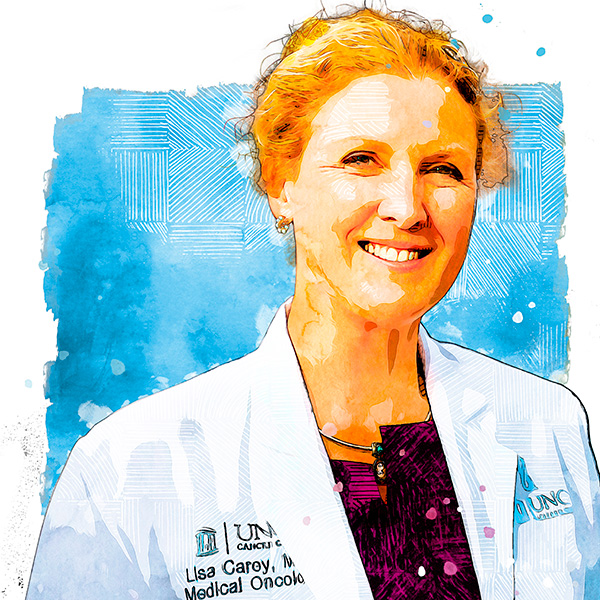
Lisa Carey wasn’t scared to take on cancer as a young doctor when she could’ve picked any field in medicine. And when UNC Health and the University wanted her to lead the new UNC Clinical Research Partners, she jumped at the chance to bolster UNC’s clinical research across the state, including rural areas.
Carey’s abilities and work ethic have shown themselves throughout her career. A Wellesley College alumna, she enrolled at Johns Hopkins University School of Medicine and was intrigued by oncology, a field where science was being translated into medicine at a fast pace. She stayed on at Johns Hopkins for a rigorous residency, where the decisions she made had to be right. She braced herself for treating patients at the cancer center, fearing it would be depressing. Instead, she found the patients to be “totally inspirational,” she said, and recognized that she had found meaningful work.
 So many advances were happening so quickly in breast cancer treatment that Carey took a step back from treating patients to understand the science. She entered a fellowship in a laboratory, even though she had no plans to run her own lab, and then she enrolled in a master’s program in clinical research. When she returned to clinical work, she had a greater ability to design clinical trials that could determine next steps for treatment.
At a medical conference in the late 1990s, Shelley Earp ’70 (MD, ’72 MS) convinced Carey to come to UNC, which had then and now the most renowned breast cancer program in the country. UNC also has the oldest SPORE (Specialized Program in Research Excellence), an award from the National Cancer Institute for bench-to-bedside research.
“The program was good when she got there,” Earp said, “and she made it better.”
Carey found the researchers collaborative — she never had to throw elbows to grab scarce resources — and the University committed to investing in the people necessary for building the clinical and research program from the clinical side.
A few years later, UNC recruited a young genetics professor, Chuck Perou, who had an interest in translational and clinical research. Perou teamed up with Carey, by then an expert in the aggressive triple-negative breast cancer, to become a formidable duo in the field. She is now director of UNC’s Center for Triple Negative Breast Cancer, funded through a $25 million donation in 2022. The number of breast cancer deaths has been cut in half during Carey’s career, and “all of that’s from research,” she said. “You only really make a difference by doing something different and learning whether it works. That’s what research is. Reducing dying and suffering is what research is all about.”
Carey navigates politically challenging issues and writes her own grants that have brought in tens of millions of dollars. She designs and operates pragmatic clinical trials that ask the right questions. She convinces patients to sign up, and the data advances knowledge, which she synthesizes into productive, actionable next steps. She sometimes must give patients difficult news, but she can say it in a way they hear what they need to hear, and she can bring them to a constructive place.
In 2005, Carey was a founding member of the Translational Breast Cancer Research Consortium, a group of 18 SPORE institutions that collaborate across the country. She led the first clinical trial the consortium ran. In 2009, she was invited to join NCI’s Breast Cancer Steering Committee, which guides investment in research initiatives. For the past decade, she has co-chaired NCI’s Alliance for Clinical Trials and Oncology, along with Ann Partridge at the Dana-Farber Cancer Institute.
A sought-after speaker with an international reputation, Carey can relay complicated topics to experts and nonexperts at the same time. She can think on her feet and works well on airplanes. Perou has seen her modify a talk she’s going to deliver to an audience of thousands five minutes before she steps to the podium, based on information she’s heard from the previous speakers. “Most people should never try that,” he said. “But she can hear things and immediately incorporate it into the bigger picture and act on it.”
Carey is the lead principal investigator on a $30 million federal grant to conduct a series of large, multiyear, innovative trials in metastatic breast cancer. She serves on a number of state and national boards and holds the Preyer Distinguished Professorship for breast cancer research and is deputy director of clinical sciences at Lineberger Comprehensive Cancer Center.
And she and her husband, neurosurgeon Matt Ewend, have raised three children. Carey often rides her bike to work and was able to pedal to the kids’ school to participate in their activities. Though she and her husband didn’t make it to every soccer game, their children grew up with a deep sense of mission-driven work. “That comes from being in a public place, by and for the people of North Carolina,” Carey said. “I gain a lot from being part of that.”
Because UNC is a public hospital, Carey cares for women from all walks of life. And she has been recognized for her work to reduce disparate breast cancer outcomes, especially among Black women. As executive director of Clinical Research Partners, she’ll expand access to clinical research and innovations for people across the health care system, including in rural areas.
Perou said Carey will advance clinical research at UNC. “She’s building on her decades of clinical trial research and moving UNC toward the future of a new landscape, in the clinical world, research world and funding world.”