Doctors in Training
Posted on Jan. 11, 2024The Royster Global conference helps prepare Carolina’s PhD students for research, networking and employment no matter where they land.
by Claire Cusick ’21 (MA)
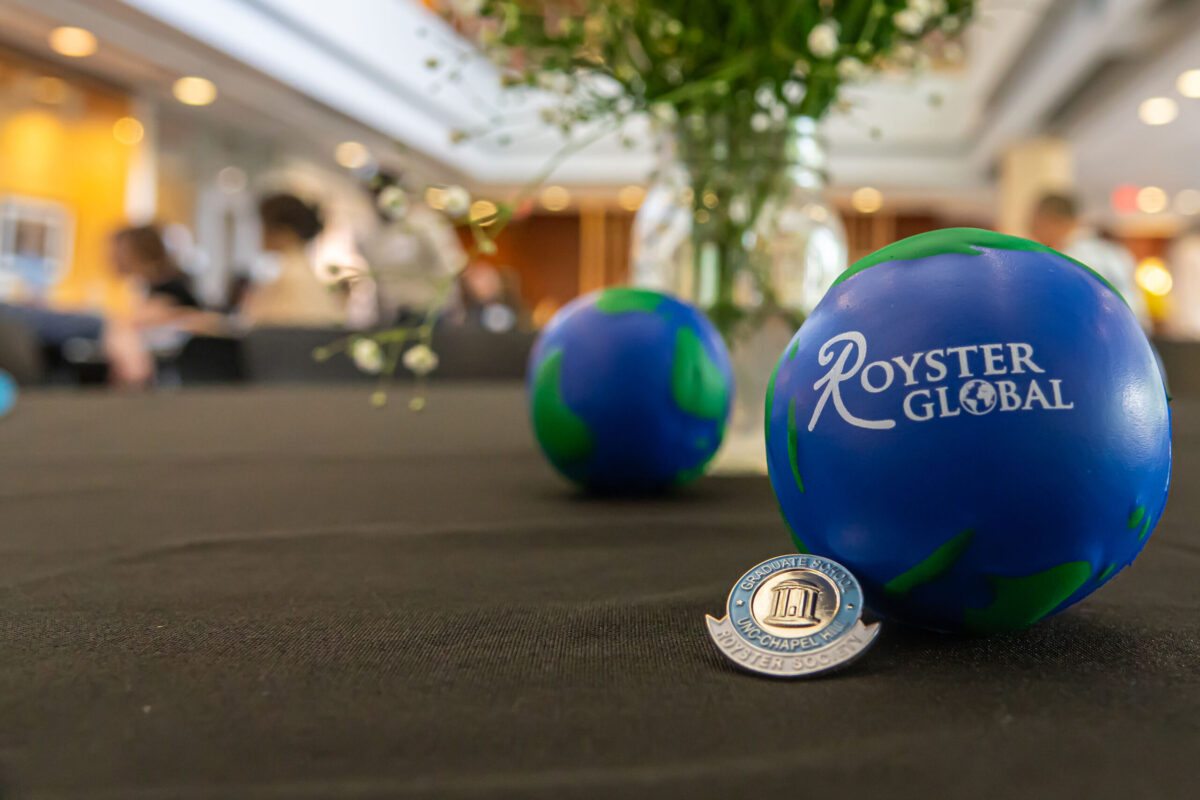
Today’s grad students are smart, but not just about their own academic area. They want to bring their whole selves to their work. (Photo: Carolina Alumni/Cory Dinkel)
This article was updated Feb. 19, 2024.
In late May, about 30 PhD students were seated at tables inside the FedEx Global Education Center engaging in a common first-day exercise for any gathering: the icebreaker. One by one, each stood, said his or her name and described his or her research in five words or less.
Chris Lane ’19 (DPT): “Disparities in physical therapy access.”
Aashka Dave, a doctoral student at the School of Information and Library Science: “Climate change impacts information seeking.”
Kierra Peak ’14, occupational science, used six words: “Black youth and activists at UNC.”
Lane, Peak and Dave (pronounced DAH-vay) are members of the Royster Society of Fellows, who hosted the seventh Royster Global conference, an interdisciplinary academic gathering for doctoral students to showcase their research. The Royster Society has partnered with universities in other countries, so also attending were PhD students from King’s College London and Universitat Tübingen in Germany.
Because of its generous financial package and accompanying programming, and because fellows come from different disciplines, the Royster is the premier doctoral fellowship at UNC. Created in 1996 by Thomas S. Royster ’40 and his wife, Caroline, Royster fellowships provide tuition, fees, health insurance for five academic years and funding for travel to present research at academic conferences.
Royster Global provided a window into what the current graduate student experience is like at Carolina. Today’s graduate students are smart, yes, but not just about their own academic area. They are eager to connect their work with the world’s problems. They are aware that all humans have biases and want to be transparent about their own. They recognize that past research practices may have often benefited the researchers and not the subjects; they want their research to be sustainable and not extractive. They want to bring their whole selves to their work.
As at many professional gatherings, the icebreaker exercise has become a standard way for attendees to get to know one another, a quick acknowledgement of who’s there before moving on to the main program. At Royster Global, it was just a warmup. Next, the students moved on to a deeper round of sharing, called “culture box.” Attendees broke into groups of five, where everyone shared three items they felt represented them.
They brought pet collars and boxing gloves and spoke openly of their mental health. One showed a job badge and a book by a favorite author and spoke of her career ambitions.
Dave discovered a love of barre exercise — a combination of yoga, ballet and Pilates — during the pandemic, so she brought a pair of grippy socks she wears during those classes. She proudly showed a bookshelf sticker highlighting Carolina’s School of Information and Library Science, and a T-shirt from the University of Georgia, her undergraduate alma mater, that read “Georgia Feminist.”
Forming trusting bonds will benefit any graduate student, said Tori Ekstrand ’03 (PhD), Royster Distinguished Professor of graduate education. The Royster Global conference promotes connections across different disciplines.
This level of sharing is purposeful at Royster Global. Organized and programmed by the Royster fellows, the initiative’s stated aim, according to its website, is “to increase awareness and understanding of graduate education across international borders, and to help prepare doctoral students — at UNC-Chapel Hill and beyond — for global opportunities for research, networking, and employment.” The networking here is meant to cultivate ties among individuals, disciplines and universities.
“At UNC, we believe in the power of uniting global universities to address those grand challenges of our time, which have no real borders,” Chancellor Kevin Guskiewicz told the attendees during his welcome speech. “We have a responsibility to work across those borders and boundaries and to learn from one another.”
Royster Global began in 2017. It’s a conference just for doctoral students: rigorous and programmed enough to resemble the subject-matter symposia that many researchers spend their professional lives attending, but not as big or consequential. Doctoral students are researchers still in training.
Like many gatherings, this one had to get creative over the past few years. COVID-19 prevented the 2020 conference from happening in person; instead, a group from UNC and King’s College London created a podcast. In 2021, attendees met online for four Fridays during the summer. In 2022, Royster Global was held in person at the Universitat Tübingen. It was there that the culture box activity debuted.
Peak, who has attended Royster Global since 2019 and served on this year’s planning committee, said the sharing is intentional. The 2019 conference had a welcoming atmosphere, she said. But by 2022, culture box allowed them to get to know one another more deeply. “We just really wanted to connect after a couple of years of the pandemic,” she said.
“A particular sacrifice”
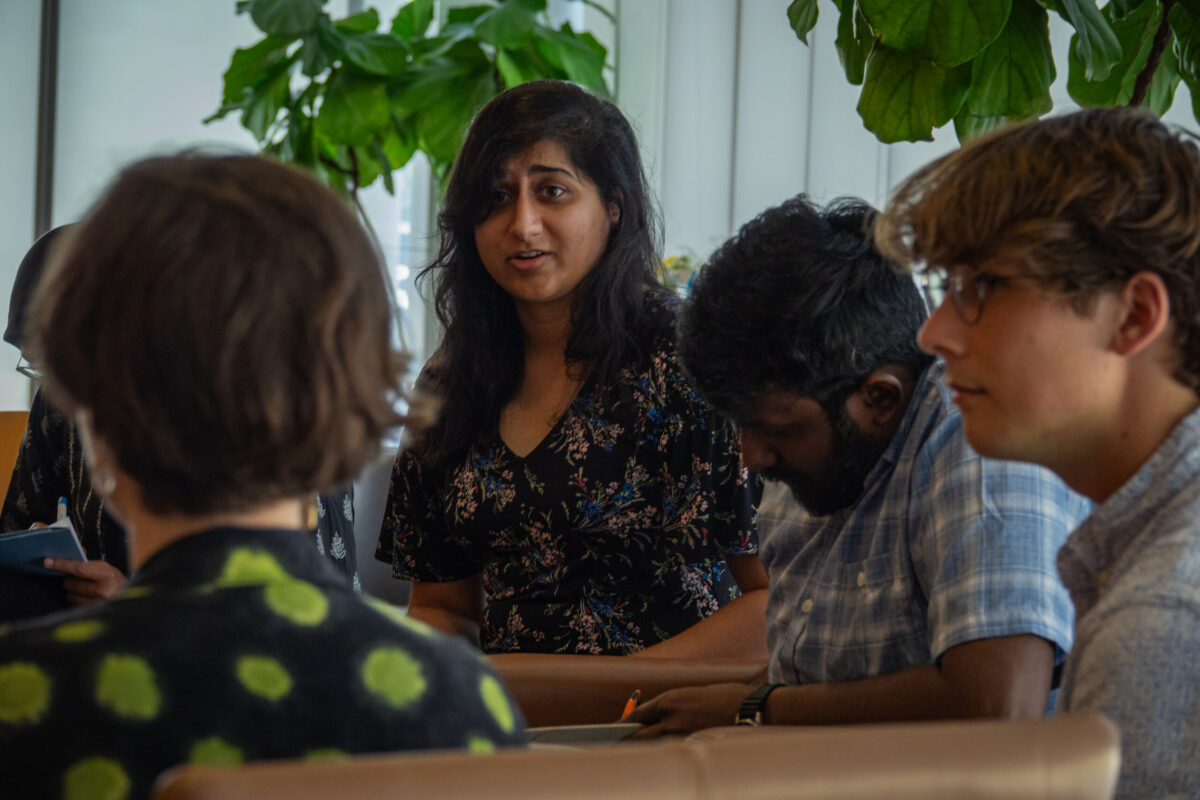
Aashka Dave (center) and other PhD students met as part of the Royster Global conference on campus in May. (Photo: Carolina Alumni/Cory Dinkel)
Peak, Lane and Dave are three of the more than 9,300 graduate students at UNC. Graduate and professional students make up about 36 percent of Carolina’s total student population, and more than a third are pursuing PhDs. Graduate students teach classes and conduct research. “Graduate students are that critical link between our star research faculty and our undergraduate students,” Guskiewicz said at the conference.
UNC is among the largest research universities in the United States. As of June 30, 2022 (the most recent figures available), UNC brought in $1.2 billion in annual research funding. Graduate students drive this engine at research universities, making them a key labor force, said Tori Ekstrand ’03 (PhD), Royster Distinguished Professor of graduate education and associate professor at the Hussman School of Journalism and Media.
Graduate students teach classes and do much of the work on research teams. At UNC, students working on master’s degrees earn a $16,000 stipend over a nine-month service period. Doctoral students earn $20,000. Health insurance isn’t included.
That pay doesn’t meet the threshold for a living wage of $16.60 per hour in Orange County, Ekstrand said. “Basically, what they are being compensated for right now is at the same level as it was when I was a PhD student in 1999,” she said. “To become a graduate student in the United States right now can be a particular sacrifice.”
Ekstrand said she worries about today’s graduate students. “Not in a way that’s worrying about them as snowflakes or children, but just as people who have to have basic needs met in order to do the work well that we are asking them to do,” she said. “Not all graduate students have that security, honestly.”
Ekstrand said she considers herself fortunate she had a fellowship and her husband paid for the remainder of her graduate education. “Our students today, more of them are single, more of them have partners who help, but who maybe aren’t in a position to support them in the way that I remember being supported financially,” she said.
Collaboration, trust
The conference’s second afternoon brought an opportunity for fellows to practice presenting their research during a poster session. Inside the Florence and James Peacock Atrium, eight fellows each stood by a 4-foot-by-5-foot poster set on an easel. The posters summarized students’ research projects. Lane’s, titled “Examining Research Disparities in Physical Therapy Delivery After ACL Injury: Assessing a Nationwide Private Practice in the United States,” contained preliminary data in text and charts from his dissertation project — including a hypothesis, methods, discussion points and top-level findings.
Lane said his goal “is to identify potential disparities in physical therapy access and develop strategies to address them.” Physical therapy helps people with a variety of conditions, “but we do not have a strong understanding of who is accessing these physical therapy services,” he said. “Disparities in treatment access will likely lead to disparities in health outcomes.”
Research groups require trust, said Tori Ekstrand ’03 (PhD). For example, research done in labs requires training and maintenance on expensive, specialized equipment. “You have to establish trust in a team if you want a really good research lab on the sciences side,” Ekstrand said. “Within the social sciences and humanities, I think the trust is important for interpretation of the research.”
Lane and two research colleagues looked at the delivery of physical therapy services among 5,000 patients in a nationwide private physical therapy practice who followed up with treatment after undergoing surgery to repair a knee ligament. The researchers hypothesized Black patients on average would have fewer number of visits, shorter duration of care and longer delays in care than white patients. Their study was designed to find out whether that was true, and if so, how big the disparity was. They found, however, few racial differences in outcomes. But they confirmed Black patients waited longer than white patients before receiving physical therapy.
Using his poster, Lane pointed out limitations in how the practice had collected the data: It had combined questions about patients’ race and ethnicity into one question, which made it difficult to measure racial differences. “[Race and ethnicity] should be separate questions because they measure different constructs, with ethnicity usually being Hispanic or not Hispanic, and then race with the other categories,” he said. “But they’re all included as just one single question, so it’s hard to really say. Some people may have identified differently if it was asked in a more appropriate way.” Also, about 40 percent of the sample didn’t answer the question.
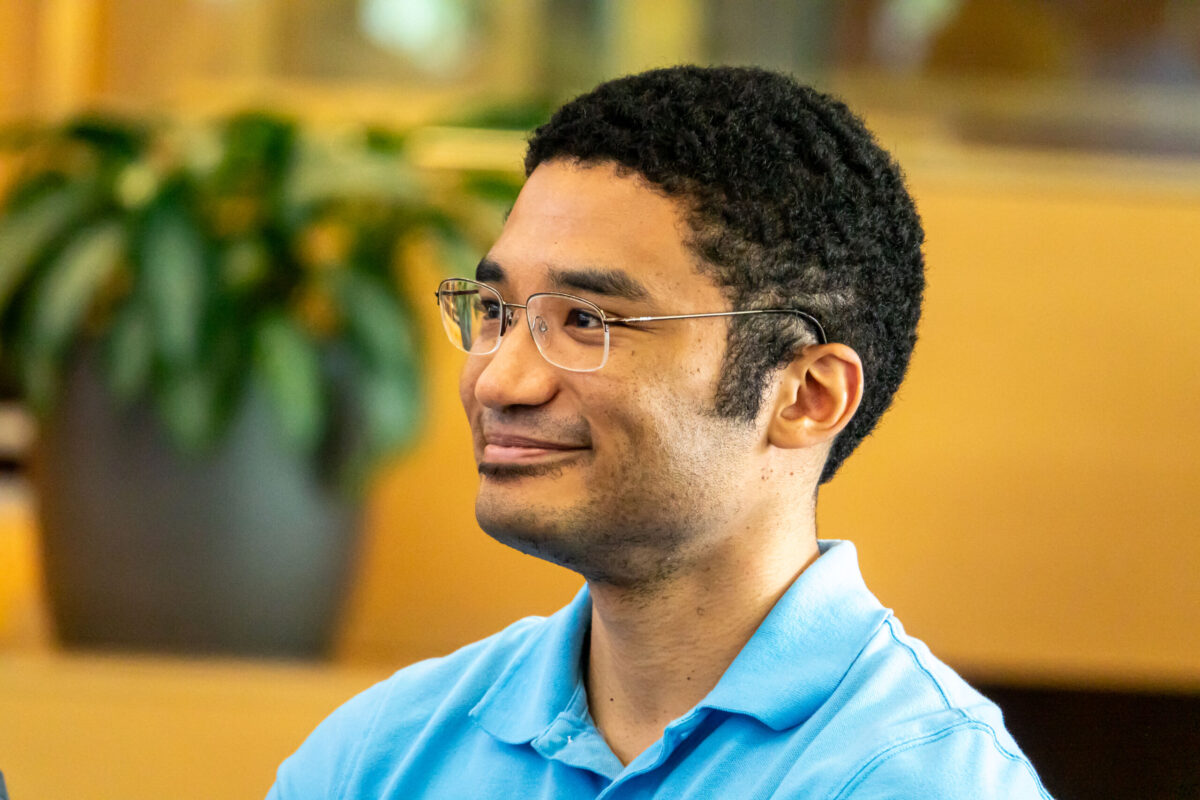
In his research, Chris Lane ’19 (DPT) found that patient surveys could be a solid research tool for researchers — if they were written more accurately. (Photo: Carolina Alumni/Cory Dinkel)
Despite its limitations, Lane said he learned from the project. “Improved data collection will improve the analyses that we can do,” he said. “This project is still a step forward in the overall research and adds to a very limited number of projects on this specific topic. Finding limited racial disparities also does not mean that no disparities exist.”
Poster sessions are common at academic conferences. The poster’s confined parameters allow research to be quickly shared, a less time-intensive alternative to a book, chapter or journal article. Posters require the researcher to discuss their work, but it’s one-on-one or with a small group, rather than a slide presentation in front of an audience.
Collaboration is key to research, because of the amount of work involved and because big ideas benefit from bringing together different minds and experiences. Beth Mayer-Davis, dean of The Graduate School, called the Royster Global conference a microcosm for interacting with scholars from different disciplines. “That interaction that they have with each other across disciplines generates new ideas and new ways to think collaboratively,” she said. “You name any major challenge that faces our society, that challenge will require an interdisciplinary approach. Because that’s just how society works.”
Research groups require trust, Ekstrand said. For example, research done in labs requires training and maintenance on expensive, specialized equipment. And for any researcher, “You want your research to be generalizable and usable, applicable, being able to be contested and worthy of peer review to get published,” she said. “You have to establish trust in a team if you want a really good research lab on the sciences side. Within the social sciences and humanities, I think the trust is important for interpretation of the research.”
Those are the practical reasons for collaboration and trust, Ekstrand said. But because researchers — including doctoral students — spend their work lives with colleagues, shouldn’t the experience be somewhat pleasant? “Who wants to do this without the fun?” she asked. “I want the fun. And that doesn’t mean you spend a ton of time or money on the fun, but you need some portion of that.”
Forming trusting bonds will benefit any graduate student, Ekstrand said, and the Royster Global conference promotes connections across different disciplines. “Whether it’s Royster or any cohort on campus, the payoffs down the line for research, the payoffs down the line for teaching, and the collaboration that occurs over the course of an academic lifetime — or just a research lifetime, if you choose not to go into academia — are huge,” she said.
Ekstrand said she became so close to her graduate school classmates that “we practically brushed each other’s teeth.” They remain in contact, she added, holding up her phone. “I wound up texting somebody yesterday about a program that another student I know is interested in,” Ekstrand said. “I have another student asking, ‘Who would you contact?’ It’s that, in any business, the importance of relationships and networking. It’s the kind of team building that you see going on in the private sphere.”
Dave said connecting with others at Royster Global in 2022 at Universitat Tübingen helped her participate in the graduate student community at SILS when she returned. In advocating for a stipend raise in 2022, the UNC-wide Graduate Student Association was interested in gathering as much data as possible on the graduate student experience; Dave surveyed her fellow SILS students for the effort.
“Last year all of the folks in Tübingen talked about how they worked, and their work contracts, and what was stated and what wasn’t,” she said. “It was part of the motivation I had for working with some of my peers and SILS student leadership to survey SILS grad students last fall. I think there are tangible impacts like that just from knowing that there are different ways of doing things.”
A culture of care
Like Guskiewicz and Ekstrand, Mayer-Davis, now a renowned diabetes researcher and the Cary C. Boshamer Distinguished Professor of nutrition and medicine, was once a graduate student. She was a single mother while completing her PhD in epidemiology at the University of California-Berkeley. Her tuition was covered by fellowships, and her son attended a school with a pre-kindergarten, kindergarten and afterschool program. She remembers having to work while her son was at school and to study after he had gone to sleep each night. Those years were isolating, she said. “I met some other parents, but not many single parents,” she said. “Now, in today’s graduate school experience, I would hope that that same person would have more support.”
That memory has found its way into the strategic plan for The Graduate School. Shortly after being appointed as dean in 2022, Mayer-Davis convened a strategic planning process that included working groups. The resulting three-year plan calls for attracting talented students and addressing the workforce needs of North Carolina. One part of the plan is “Creating a Culture of Care,” which “aims to keep students engaged and motivated during their time at Carolina.”
There are more than 9,300 graduate students at UNC. Graduate and professional students make up about 36 percent of Carolina’s total student population, and more than a third are pursuing PhDs. Graduate students teach classes and conduct research. “Graduate students are that critical link between our star research faculty and our undergraduate students,” Chancellor Kevin Guskiewicz said.
The plan calls out caregiving for children and aging parents, acknowledging that 62 percent of graduate students identify as female, and traditionally, caregiving often falls on women. It calls for several key activities to better integrate caregivers into the culture of The Graduate School. These include developing a set of early indicators for graduate students, focusing on caregiving to determine who may be at risk of dropping out so The Graduate School can intervene, and integrating the perspective of graduate students who are caregivers.
Mayer-Davis said it was her mission in taking the role of dean to support the success of graduate students. “I still mentor. I still have a doctoral student. I still have my own scholarship,” she said. “I’ve seen over my almost 16 years of being at UNC the amazing capacity that our graduate students at UNC have. And so all I can do to support their success is what I’m here to do.”
Where students’ minds are
Attendees choose the theme for every Royster Global conference — and the topic reflects what is on students’ minds at the time. Last year, students wanted to concentrate on themes of power and justice, explaining why in the conference’s program: “[I]n recent years, these have been particularly salient as citizens worldwide deal with discrimination related to migration, climate change, access to education, access to vaccines and healthcare, platform governance, censorship, voting access and elections, reproductive rights, and the consequences of slavery. The challenges are simultaneously local and international.”
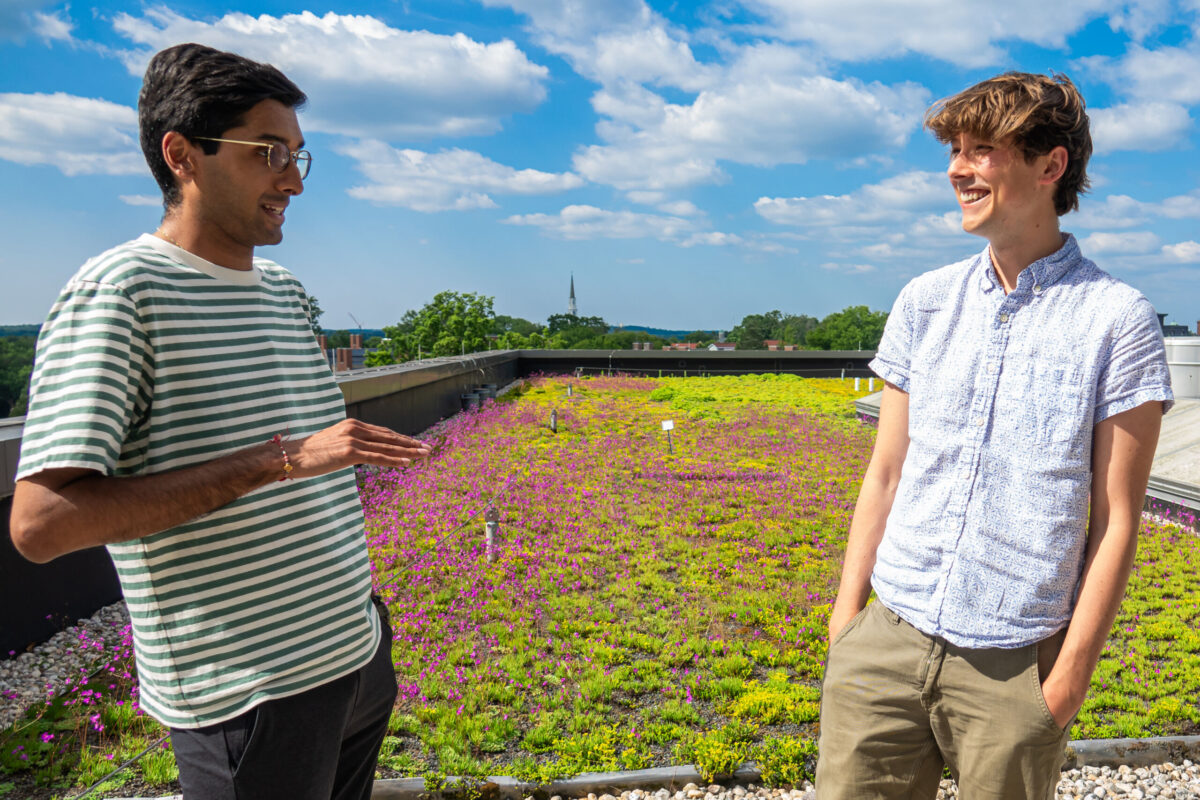
Sandip Kana (left), a history student at King’s College London, and Josh Miller, who studies nutrition at UNC, conducted a Royster conference workshop they designed, “Conceptualizing, Defining and Mapping Power.” They considered power within the venue they currently operate in, which is a university. (Photo: Carolina Alumni/Cory Dinkel)
During one afternoon session, Sandip Kana, a history student at King’s College London, and Josh Miller, who studies nutrition at UNC, conducted a workshop they designed, “Conceptualizing, Defining and Mapping Power.” They constructed the workshop like the academics they are: They assigned reading in advance, began with a survey of definitions and then held small-group discussions. They considered power within the venue they currently operate in, which is a university.
Power is a social force that shapes our world and the relations we have within it, Kana said in his introduction. “What we want you to consider today, and obviously, across the rest of the week, is how power manifests, how it influences our thoughts, our research, our community and politics,” he said. “And how individuals are attempting to study it and understand it.”
Kana and Miller then guided attendees through an interactive exercise on mapping power, which, their session abstract explained, “can be used by participants to identify actors who can be targeted for achieving desired goals across many situations, including within their university and current workplace.”
The mapping exercise used the conference itself as its example. Power at Royster Global flowed initially from the donors who fund it and The Graduate School who oversaw it, then to Ekstrand, who, as the Royster professor, is technically the conference organizer. Ekstrand appointed a steering committee, who then had the power to select presenters. Having been duly authorized by the steering committee, Kana and Miller had the power to create and conduct a workshop, but then shared power with attendees by making it interactive.
Miller offered his own experience in power mapping as a member of UE Local 150, the Workers Union at UNC. The union had advocated for a graduate student stipend raise that took effect Jan. 1, 2023. “We had been making no progress for several years on a particular campaign,” he told the workshop attendees. But once the union understood the limitations of certain power holders, it shifted its priorities and became much more successful in its efforts.
At the end of the week, after the thought-heavy sessions and the lighter programming (a ropes course and a Durham Bulls game), Peak reflected on what the emphasis on personal connections at Royster Global had meant to her — as a researcher, a student and a human being. “I’ve seen this over the past five years,” she said. “We kind of are like, look, we value you as your research, but also as a person. I think when you value someone as a person, you care that much more about their research.”
It does feel vulnerable and even weird to share so much at a conference, she said. It might even feel like you’re taking “networking” a bit far. But deeper connections with a person and their work have longer staying power. “I see the value in it because I’ve learned more about you,” she said.
Claire Cusick ’21 (MA) is a freelance writer based in Durham.