You Really Shoulda Scene It
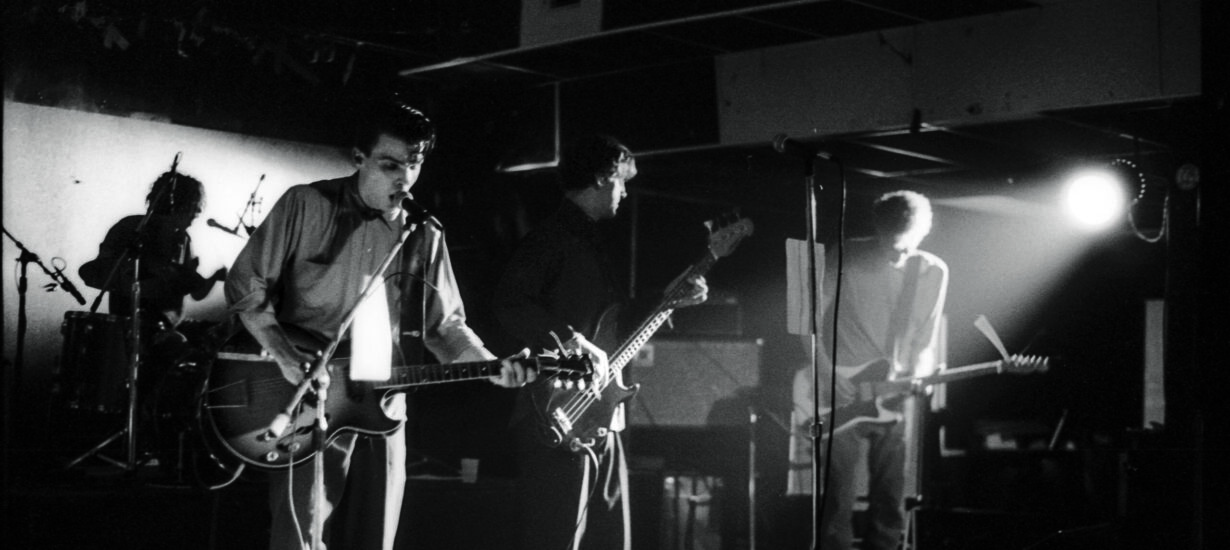
Decades ago, Chapel Hill graduated from a robust regional college music community to the vanguard of the indie music movement.
By Robert Gray ’91
“Ooooooo, ooooooo, oooooo.” The unmistakable falsetto roars through the speakers and soars above the din, combining with the driving guitar riff that propels the perfectly prototypical “college rock” song for 3 minutes and 20 seconds.
The atmosphere is electric, charged with adrenaline and hormones, free-flowing watery brew, the stale scent of spillage on sticky floors and a thick, harsh cloud of smoke (even outdoors) hanging over friends and fellow fans standing shoulder-to-shoulder and rocking out with student bands harboring big-time aspirations.
It’s pure head-bopping bliss for this sweaty college crowd tightly squeezed into a dark room, often on random weeknights, hoisting sudsy salutes stageward that slosh out of plastic cups, cans and bottles, all containing cheap swill. The merry mob sings along with every word, keenly watching four of their peers under the spotlights, playing their hearts out — enjoying every second.
It was 1989, when Dillon Fence bathed the crowd with its iconic indie rock tune “Something for You” and a growing setlist of original songs that delivered the goods to crowds in packed rooms, parking lots, basements, the Student Union, fraternity parties, then later in a sold-out Cat’s Cradle, on their way to even larger venues. The band’s bluesy-rock original was nearly ubiquitous upon its release for many Carolina students, alumni and music fans.
“That song is definitive of 1989,” said musician and author Tom Maxwell ’87, whose book documenting the village’s vibrant music scene of that time, A Really Strange and Wonderful Time: The Chapel Hill Music Scene: 1989–1999, was released this year. (See “Untold Stories,” page 45.)
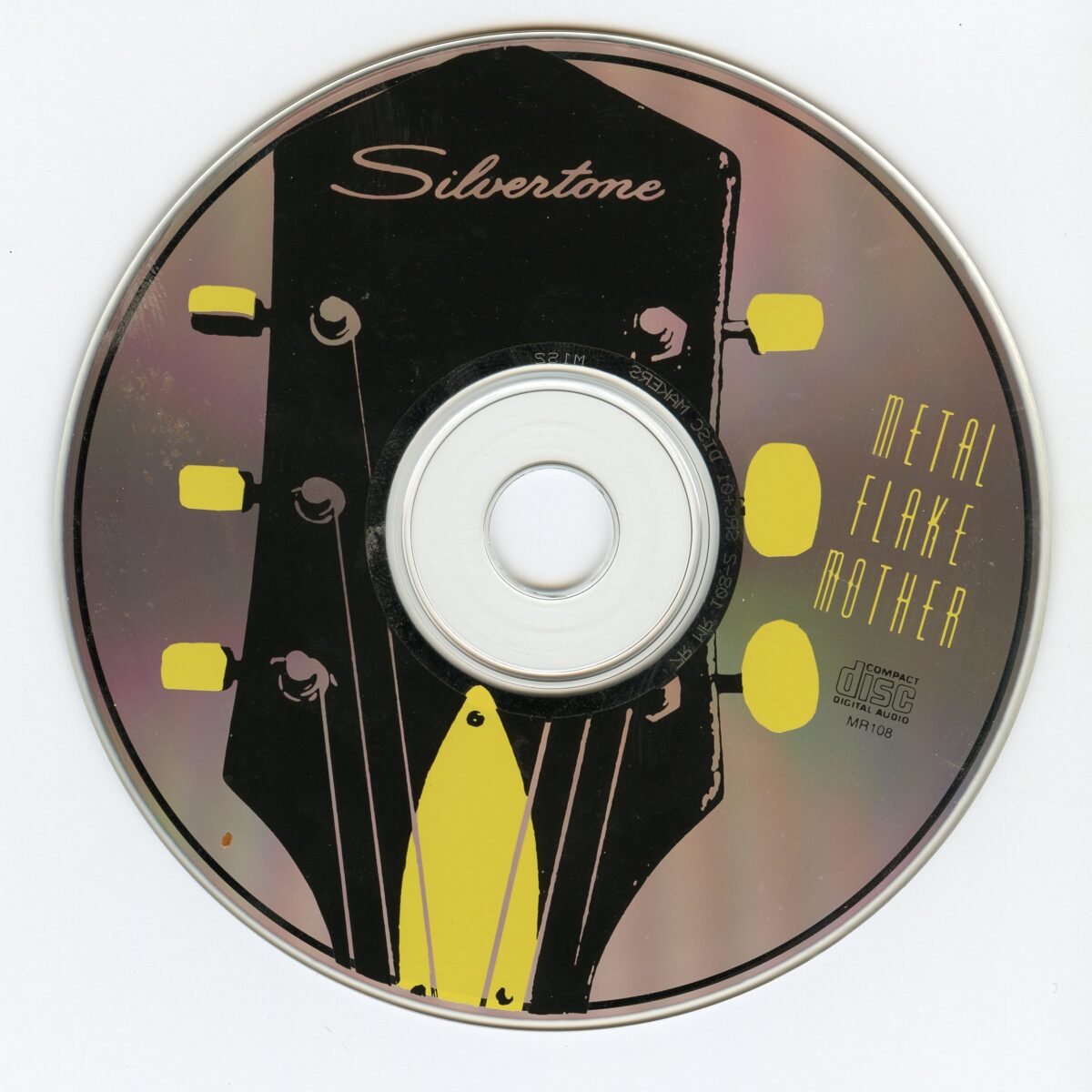
In the late ’80s and early ’90s, studio recordings were an expensive endeavor compared to today’s technology that enables artists to record an album in their bedroom. But they signaled the artists’ aspirations to go beyond the campus party circuit.
It was a memorable time for artists creating indelible musical memories for students and fans. The shows have long been a rite of passage for Tar Heels, who identify with the bands and their songs from their time on the Hill. While musical talent has always been abundant across campus and on Franklin Street, something special was brewing in the late 1980s and early 1990s, a period of particularly prolific creativity combined with a do-it-yourself ethos.
The Chapel Hill music scene began producing some of its most popular and successful bands at the time, as well as the homegrown record labels that introduced them to fans worldwide. And a confluence of events would set the stage for unprecedented growth that included launching even more commercially successful artists in the 1990s and creating a lasting legacy of great music.
Decades later, seminal tunes including “Fun & Games” by The Connells, “The Heisman” from Johnny Quest, or Superchunk’s “Slack Motherf*****” that became Carolina classics, instantly take alumni, music fans and the performers themselves back to halcyon times spent in venerable venues. (See “My Noise,” page 43.)
During this time, dozens of local and student artists played around town, including The Pressure Boys, The Popes and Satellite Boyfriend. Three early members of Dillon Fence were UNC students. “Dillon Fence were like the Beatles,” Maxwell said. “It was amazing how loudly people would scream. It’s difficult to describe.”
The reaction was intoxicating for the band. “That high of having your songs sung back to you is better than any recreational drug — and just as addictive,” Dillon Fence lead singer Greg Humphreys ’90 told the Review.
It was a memorable time for artists creating indelible musical memories for students and fans. While musical talent has always been abundant across campus and on Franklin Street, something special was brewing in the late 1980s and early 1990s, a period of particularly prolific creativity combined with a do-it-yourself ethos.
The band’s hallmark tune, along with another song Maxwell considers emblematic of its day — “My Noise,” by Superchunk (then known as Chunk) — heralded a new stage in the evolution of the local music world from a robust regional college music community to a budding entrepreneurial epicenter of the growing indie rock scene.
“It was a moment of change,” Humphreys said. “If you wanted to hear something new, live, there was a big appetite for bands to step up and provide the entertainment. There were young people starting labels, seeing opportunities for new music to rise up and make a mark.”
Label maker
Music discovery in the late 1980s was more difficult. Before digital downloads and streaming, fans either listened to the radio or bought cassettes, LPs or compact discs. CDs were rapidly gaining market share and being adopted by the music industry and fans, while cassettes were peaking and LP sales were plummeting. A growing number of Chapel Hill artists realized recording and releasing their tracks could build a fanbase through sales of self-released music, shared mixtapes, college radio airplay and the time-honored tradition of students blasting their songs down dorm hallways or out windows onto the lawns.
“The inflection point was when people figured out they could do a record on their own,” said Anne Patteson Litt ’88, who was a DJ at WXYC as an undergraduate and then later at area radio stations. She’s now program director for music and a longtime DJ for influential KCRW-FM in Los Angeles. “We started to see student and local bands make good,” Litt said. “The Connells blazed a path, along with Dillon Fence, Dexter Romweber and Flat Duo Jets, The Pressure Boys and, of course, Let’s Active.”

Dillon Fence: The band’s song “Something for You” was nearly ubiquitous for many Carolina students, alumni and fans.
The poppier Popes and punkier Superchunk were both releasing their own music and gaining popularity. Dillon Fence recruited noted local musician John Plymale, of The Pressure Boys and Sex Police fame, to produce their game-changing EP (extended play recording), capturing the band’s verve and vitality. “That record put us on the map,” Humphreys said. “Releasing a good record we were proud of, and having people react to it so strongly, certainly helped convince us into giving this music business the ol’ college try.”
The cover of the band’s six-song EP released in 1989 features the Dillon, South Carolina, fence art that inspired the band’s name. The studio recording — an expensive endeavor compared to today’s technology that enables artists to record an album in their bedroom — signaled Dillon Fence’s aspirations to go beyond the campus party circuit . It paid off. The group built a regional following and later signed a record contract with Mammoth Records, one of the area’s upstart labels.
The growing number of artists who were playing, recording, releasing and succeeding with original music spurred on more musicians to do the same. Two prominent indie record labels — Mammoth Records and Merge Records — launched locally while WXYC was spinning the homegrown tunes. Cat’s Cradle moved to a larger location that local acts would continue to sell out, and Schoolkids Records, a retail store on Franklin Street, employed musicians and sold their songs to an expanding fanbase.
“The scene had always been good, [but] by the late ’80s it really exploded. … At the time, we thought anything was possible,” said Steve Balcom ’89, who grew up in Chapel Hill, was music director at WXYC and began working full time at the then-nascent Mammoth label the day after graduating with a business degree. “It didn’t feel like a job. It was everything I wanted and assumed I had to leave Chapel Hill for.”
Mammoth and Merge both launched in 1989, and each eventually set up shop in Carrboro. But they took different approaches. Mammoth was better funded and signed mostly national bands with a few handpicked local acts, including Dillon Fence and later, the swing and hot jazz band Squirrel Nut Zippers. The bootstrapped Merge was started by Laura Ballance ’90 and bandmate Mac McCaughan to press singles for their post-punk rock group Superchunk and to release music for friends’ bands.
Both labels tapped into the local indie scene’s energy and creativity, amplifying its sounds to initially reach a larger audience of like-minded music fans nationwide and eventually around the world. The distribution raised Chapel Hill’s profile as a thriving indie rock community in the 1990s. Local bands’ albums were sold in shops from L.A. to London, their songs were played on the airwaves from the Piedmont to Prague, their videos were included in MTV’s rotation, and the artists performed on late-night talk shows.
Get the Cradle rocking
“We definitely were beneficiaries of those labels developing,” said Frank Heath ’86, Chapel Hill native and owner of Cat’s Cradle. “The labels developed in large part because of the combination of the large amount of local talent and the national music ethos. … Indie rock was coming together, and it was the end of a long process to me, where bands were forming because they heard really great bands over the course of five to 10 years leading up to that point.”
Heath made his own entrepreneurial bet on the local scene in 1988, moving the Cradle, which turns 55 this year, to a venue three times the size of its prior location. The club closed for six months until early 1989, when the new space on Franklin Street opened after renovations.
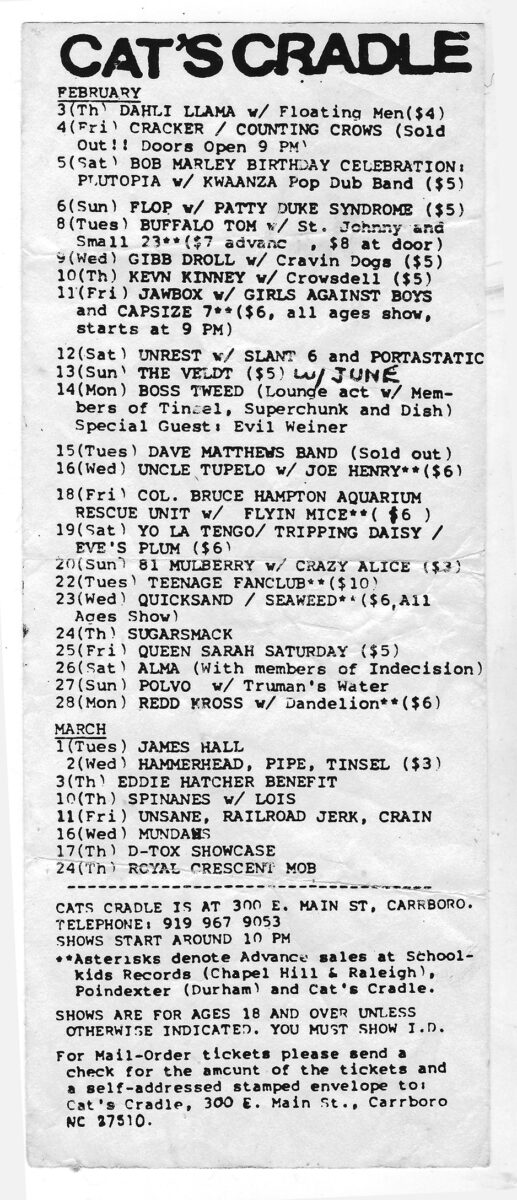
Cat’s Cradle schedule, February and March 1994. Local acts include Small 23, Portastatic, The Veldt, June, Boss Tweed, 81 Mulberry, Polvo, Pipe, Tinsel and others.
Heath rebuilt it, and they came; locals packed the larger house. “There was a lot of energy and excitement in the period once we opened there,” said Heath, who attended Haverford College but spent a semester at UNC as a transfer student in 1982. “My thinking wasn’t, ‘I’m going to be doing this until the 2020s; this will get bigger and more interesting every year,’ which it has.”
“We were just trying to keep the space open for music and bring in cool bands,” Heath added. “Back then I’d be worried if we had a bunch of good shows in the same month that we were cannibalizing our own audience.” With more than 2 million people living in the Triangle now, Heath said, “there’s an inexhaustible supply of potential customers if you keep a good variety of artists coming through.”
The Cradle was not only a proving ground for bands, it was also a place where artists showed their support for each other. “The scene has always been incredibly cooperative, not competitive,” Balcom said, recalling crowds at the newly opened club. “You’d go to the Cradle and see members of other bands there as fans.”
While bigger name bands played at the larger club and ambitious artists coveted a night onstage at the Cradle, smaller venues, including The Cave and Hardback Cafe, offered opportunities for new and emerging acts to perform.
Pop Song 89
The post-punk sound had been steadily growing in popularity during the 1980s and gaining a following nationally thanks in large part to R.E.M, formed in 1980 by students at the University of Georgia. The band’s success and past shows at the Cradle and other local venues created a template of a successful Southern “college music” band, which inspired other artists in the Triangle. “Their influence was huge and one of the biggest motivating engines that drove what everyone was doing,” Heath said. “It had a glow that permeated the region.”
Humphreys said, “When R.E.M. became one of the biggest bands in the world, that gave hope to all the little bands out there.”
R.E.M. also had Tar Heel ties. The band’s early releases were produced by prominent musicians Don Dixon ’73 and Mitch Easter ’77. Dixon’s band Arrogance and Easter’s Let’s Active were influential acts in the 1970s and 1980s.
For Mike Connell ’81 (’85 JD), R.E.M. was integral to the formation and sound of the band he would create in 1984. But he credits the two Tar Heel producers for paving the way for his band’s success and setting the tone for a connected, collaborative Carolina indie rock community. “We are standing on the shoulders of those guys,” he said. His eponymous band, The Connells, which he formed with his brother David Connell ’84, was produced by Dixon and Easter on early recordings. The band quickly graduated to playing Cat’s Cradle and other high-profile Triangle venues. By 1989, the band had ascended to new heights: a label deal, videos on MTV and touring nationally to support their third album Fun & Games. That tour included a sold-out show at UNC’s Memorial Hall, the same venue where, as a student, Connell watched R.E.M. play a few years earlier.
Mike Connell, a native of Macon, Georgia, who transferred from his hometown Mercer College to UNC, felt a personal connection to R.E.M. “I saw them open for The English Beat in Memorial Hall in March of ’83. I was floored by both bands,” he said.
Connell said while he was in high school, he’d go to parties where R.E.M. band members Mike Mills and Bill Berry were hanging out. When Connell saw R.E.M. at Memorial Hall, he said it provided further incentive to create a similar band.
When The Connells played a sold-out show at Memorial Hall six years later, the guitarist and songwriter said, “We were pinching ourselves!”
The band’s 1993 album Ring went platinum in Europe, with the single “’74–’75” topping the charts and cracking the Top 10 in nearly a dozen countries. The success led to the band opening for Def Leppard in Europe and touring stateside with Neil Young.
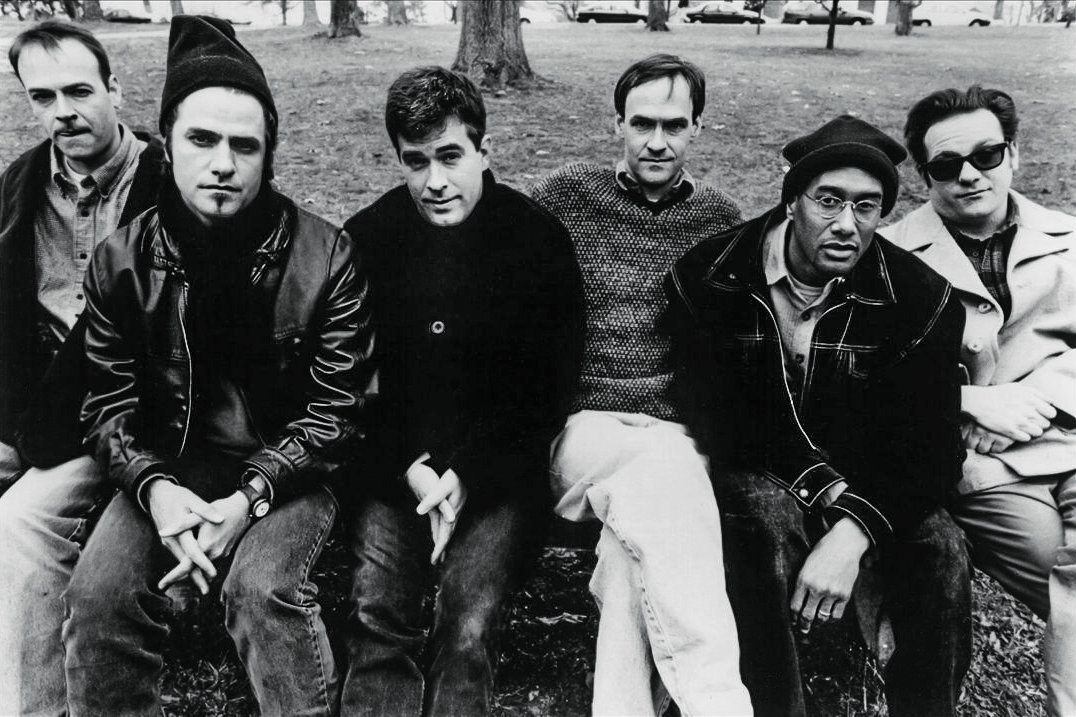
The Connells: Mike Connell ’81 (’85 JD), third from right, saw R.E.M. play at Memorial Hall in 1983 and was inspired to start a band with his brother, David Connell ’84 (far left). Soon The Connells were themselves playing Memorial Hall.
Still, Connell said he doesn’t consider his band an integral part of the late 1980s Chapel Hill scene because they moved to Raleigh after graduation. But with a lineup featuring Carolina grads — including George Huntley ’84 — fans on Franklin Street claimed them as their own.
Heath called The Connells “the gold standard” of the period’s local bands.
Hark the Sound
Post-punk, indie rock, jangle pop, garage rock, alternative rock/pop and other terms have been used to characterize the idiosyncratic Chapel Hill Sound, but there’s no definitive description, musicians said. “That question has no answer,” Maxwell said with a laugh. “Flat Duo Jets didn’t sound like The Pressure Boys who didn’t sound like The Connells, who didn’t sound like Southern Culture on the Skids.”
The author’s own musical career embodies that free-spirited, genre-fluid music locals love: Maxwell drummed in what he called “a kind of post-punk Cheap Trick pop-rock band” called What Peggy Wants (nee Teasing the Korean), then briefly in the reconstituted Metal Flake Mother (which played “surf-tinged angst rock” Maxwell said), before joining the eclectic ensemble Squirrel Nut Zippers for their meteoric 1990s rise from backyard jam sessions to playing President Bill Clinton’s second Inaugural Ball and scoring a platinum album.
In reflection, Maxwell said Chapel Hill appreciated authenticity and rewarded substance over style. “Individuality was praised,” he said. “Be your authentic self, rather than copy what’s hot at the time. That’s the great lesson.”
Many of these artists are still performing and creating new music. Superchunk’s dropping new singles and albums on its Merge imprint, and both celebrated their 35th anniversary with a festival in July. Merge has become a national label with a diverse slate of artists including 1990s Chapel Hill alt-rockers Archers of Loaf and Polvo.
It may not surprise alumni, but Maxwell said it was the people in and around the bands that made the late 20th century so special. “The real genius of the Chapel Hill scene was the community that engendered it, supported it and gave rise to it,” he said. “You were surrounded by greatness every moment. That engendered more greatness. Even at the time, people would ask, ‘What’s in the water in Chapel Hill?’ You can’t put your finger on it, it’s generative, it’s in the community.”
Influential radio DJ Litt fondly recalled the Carolina connections she forged. “My favorite people in the world were drawn there,” she said. “I’ve never met a soul in that scene who didn’t have a huge heart — the passion, the creativity, and the heart and soul. I found it incredibly supportive.”
Bam Bam Bah
Students, alumni and local music fans were the beneficiaries of the transformational time as the end of the 1980s marked the beginning of a memorable era for the Chapel Hill music scene.
With so many venues and so many bands, students could attend concerts by Satellite Boyfriend (“Bam Bam Bah”), Flat Duo Jets (“Wild, Wild Lover”) and others for free on campus or at local establishments for a fraction of today’s Ticketmaster fee.
Many of these artists are still performing and creating new music with revamped lineups, new bands or by going solo. Superchunk’s dropping new singles and albums on its notable Merge indie imprint, and both celebrated their 35th anniversary with a festival at the Cradle and other venues in July. Merge has become a national label with a diverse slate of artists including 1990s Chapel Hill alt-rockers Archers of Loaf and Polvo.
Mammoth Records was bought by Disney in 1997 for $25 million but the name disappeared a few years later when the label was folded into that company’s Hollywood Records. Schoolkids announced in August it would close its Chapel Hill location at the end of 2024. The store’s record label and Raleigh location will remain open. (Story, next page.)
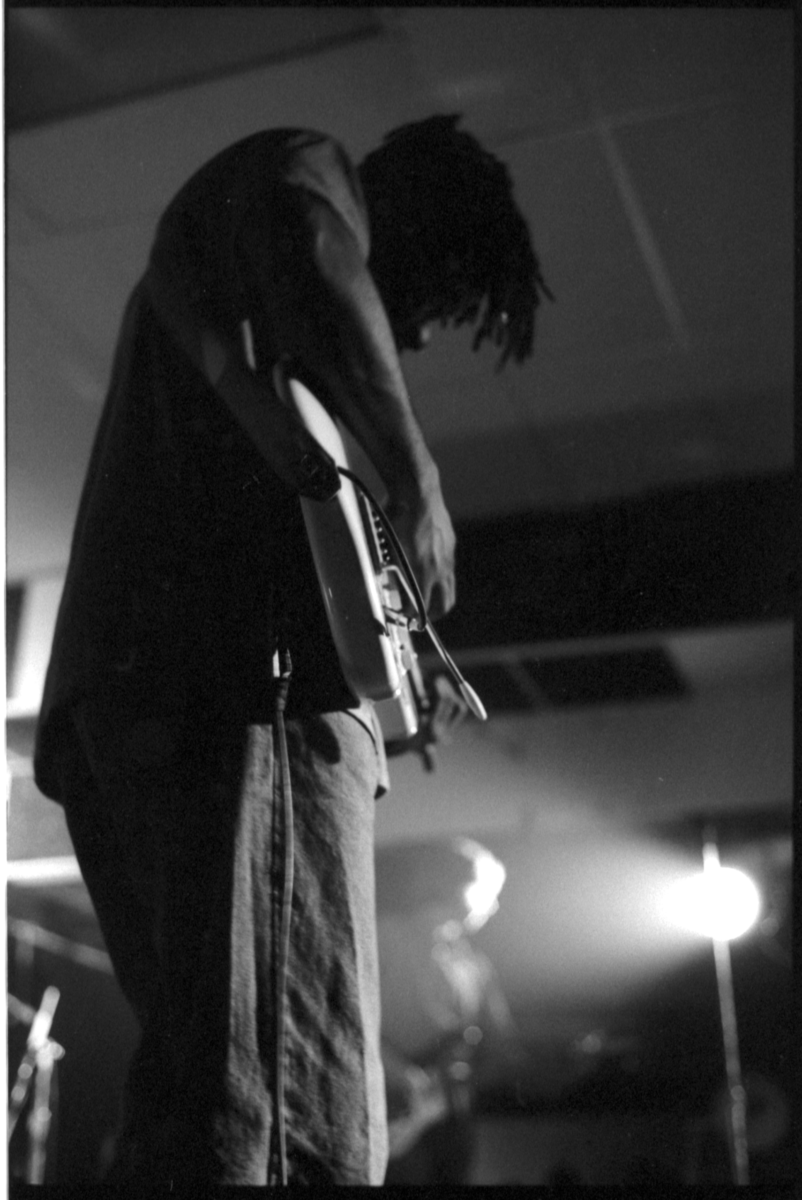
The Veldt formed in Raleigh in 1986 and are now considered pioneers of the alternative soul and shoegaze genres of rock. The band has collaborated with artists such as TV On The Radio and Mos Def, and have opened for The Pixies, Chuck D, Oasis and others.
Last year, The Veldt, a shoegaze band known for its distorted guitars and ethereal, obscured “dream pop” vocals, released its debut album Illuminated 1989, which had been shelved for 34 years by Capitol Records after it dropped the band. It sounds fresh today but would’ve been groundbreaking in its original release year. A local fan favorite, the Raleigh band is often linked to the Chapel Hill scene, and the Cradle’s Heath called the group “one of my favorites.”
Southern Culture on the Skids, formed in 1983 by Rick Miller ’84 (MFA) and known for its raucous shows and psychobilly/swamp rock hits including “Camel Walk” and “8 Piece Box,” continues releasing new music and touring the nation. The band has been featured in an exhibition by the University’s Southern Folklife Collection.
Ephemeral indie rockers Metal Flake Mother went digital this summer, releasing for the first time most of its recorded music online to download or stream. The compilation Songs 1989–1991 marks its vinyl LP debut, which was released in July with only 500 copies available for purchase. And the issuing label, Drifter’s Sympathy, is local.
Mike Connell said his band is working on new music following a fruitful few years including a new studio release Steadman’s Wake in 2021; the band’s first live collection, Set the Stage, in 2023; and last year issuing the Ring album on vinyl stateside for the first time.
The Connells played a nostalgia-fueled show at the N.C. Museum of Art’s amphitheater July 19, sharing the stage with Dillon Fence, which released a live album the same day. In September 2023, the two bands played together, energizing a large crowd of mostly older fans, some accompanied by their own grown kids, plus a number of younger folks vibing to vintage Chapel Hill sounds in the Cradle’s Back Yard.
Humphreys, who lives in New York City with his family and continues cranking out new music and performing live, mostly solo, said he’s happy to see that people still want to see Dillon Fence and that he still enjoys the reunion shows. “When we get together and play, it’s like a time machine,” he said. “We feel 21 years old, and so does our audience. It’s the same thrill for the band as for the crowd when it all comes together.”
Robert Gray is a freelance writer who lives in Los Angeles. He has previously written for the Review about Tar Heels in Hollywood and alumni cruciverbalists.
My Noise: Chapel Hill Sounds Connect Carolina Alumni
College music hits different. Whether it’s student bands that played to a house party full of friends (shoutout to The Jay Kyle’s Band) or locals busking on the street corner (R.I.P. Dex Romweber), these musicians leave an indelible imprint that forever transports us back to the days and places where those memories were made.
They’re called musical-evoked autobiographical memories. Researchers at the University of Durham (England) say music plays “an important role in reconnecting us with self-defining moments,” and while it’s often an involuntary memory, songs serve as an effective cue for remembering events years later.
In other words, the soundtrack of your life is actually a music video.
That’s why alumni of a certain vintage are transported back to memorable moments when hearing a familiar guitar riff, or involuntarily sing along with lyrics from three or four decades ago, which they remember like it was yesterday.
With that in mind, the Review created a playlist opening a portal back to Chapel Hill’s burgeoning indie rock scene of the ’80s and ’90s. Many of these artists are alumni, but check the production credits: the Carolina connection was tight in the studio with Tar Heels often producing these local acts, including the indispensable and ubiquitous late Caleb Southern ’96.
Alumni interviewed for the accompanying story helped provide period picks, including nods to the area’s influential early alternative acts.
There’s no comprehensive list, the way there is no definitive Chapel Hill sound. Enjoy!
— Robert Gray ‘91
Thanks for reading the Carolina Alumni Review
Carolina Alumni members, sign in to continue reading.
Not yet a member? Become one today.