Rivalry Royalty
Posted on Sept. 25, 2024Carolina football plays Duke this weekend in the 100th season of the rivalry between the two schools. In recognition, Carolina Alumni is making this article from the September/October 2024 issue of the Carolina Alumni Review available to all alumni. If you are not a member of Carolina Alumni and would like to receive the Review six times a year to read articles like this and more, please consider becoming a member.
Before each year’s Duke football game, Carolina for decades engaged in an august tradition: naming the Beat Dook Queen.
by John Bare ’87 (’92 MA, ’95 PhD)

The story of the Beat Dook Queen, a relic of the UNC-Duke football rivalry that turns 100 years old this fall, follows the arc of American popular culture, from the postwar promise of Frank Capra movies to the shock of the Kennedy assassination to the sudsy defiance of National Lampoon’s Animal House.
Chapel Hill was Capra’s Bedford Falls come to life in 1949. Returning GIs had nearly doubled enrollment. Students danced in Woollen Gym. Charlie “Choo Choo” Justice ’50 dazzled the football world. Students, rooting for four straight wins over Duke, mustered the biggest Beat Dook Parade the campus had ever seen, a cavalcade of 43 floats and the first-ever Beat Dook Queen: Betty Smith ’50, a Tri Delt from Charleston, West Virginia.
Smith’s reign included a one-of-a-kind moment. In the crush of fans running onto the field after the 21–20 Tar Heel victory in Durham, a Duke fan swiped a pompom from Carolina cheerleader Julia McHenry ’50. Fellow Tar Heel cheerleader Norm Sper Jr. ’50, who’d introduced the Victory Bell to the rivalry a year earlier, chased down the thief and rescued the pompom, only to have a police officer arrest Sper for fighting. Sper resisted and “stomped” the policeman, according to a newspaper account. In a Capraesque twist, Duke’s head cheerleader was among the many who showed up that evening offering to post Sper’s $100 bond.
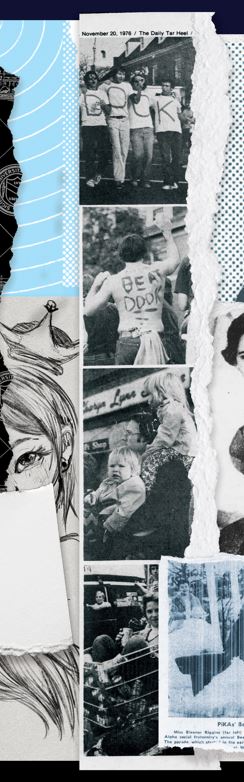
It was from that rousing football weekend the Beat Dook Queen tradition was born. It would take on the flavor of spoof — a pageant-less queen, a fleeting photo op, an honorific too trifling to be listed in senior superlatives and too fun to forget. By design, the tradition lagged the times. By 1960, when parade float riders included a cross-dressed man outfitted in a shower cap, brassiere and skirt, the queen still wore a white gown and gloves that extended past her elbows. This was no accident. Elizabeth Bronwyn Boyd, in her 2022 book Southern Beauty: Race, Ritual, and Memory in the Modern South, describes how Southerners positioned women in football-adjacent experiences to cling to “a hyperfeminine visage aligned with traditionally White, upper-middle-class standards of beauty.”
Along the way, Madison Avenue ad makers figured out they could use the same imagery to sell nearly anything. In her 2014 book Pageants, Parlors & Pretty Women: Race and Beauty in the Twentieth-Century South, Fresno State University history professor Blain Roberts ’00 (MA, ’05 PhD) explained that “individuals who bought these goods were consuming more than products that simply relaxed, clothed, or fed the body. They were consuming — and in the process, affirming — visual representations of the southern social and economic order that hid as much as they revealed.”
The Beat Dook Queen emerged alongside a wave of 1940s advertising that used pictures of women to sell Uncle Sam’s war, Lucky Strike cigarettes, Cannon towels and more. If the iconography of white womanhood could help defeat the Nazis, then surely it could help Carolina vanquish Duke. So the Beat Dook Queen’s originators skipped the hassle of a beauty pageant and simply cast a woman in the role.
The glamorous bit part, portraying Tar Heel good versus Duke evil, was nested within a parade that was nested within a football rivalry. The resulting production was a spectacle, as affirmed by The Daily Tar Heel’s coverage of the 1953 parade. The headline, “Beat Dook Spirit Takes Over Town,” heralded news of more than 1,000 celebrants, toilet paper streaming from power lines, one float set ablaze mid-parade and four students arrested for drinking beer in public. And, yes, the paper delivered a police-blotter-like description of the queen, Barbara Stone ’55, “5 feet 7 inches tall, with brown hair and green eyes.”
The whole thing turned into irresistible performance art. “I remember racing over in the afternoon as a little kid to Cameron Avenue and watching the Beat Dook parades … There was a wild comedy to those Dook parades that I could feel even as a little kid,” said Chapel Hill native Will Blythe ’79, whose 2007 book, To Hate Like This Is to Be Happy Forever, investigates the emotions of the UNC-Duke basketball rivalry. “And yes, there were beautiful Queens that I also recall.”

(Illustration: Carolina Alumni/ Haley Hodges ’19)
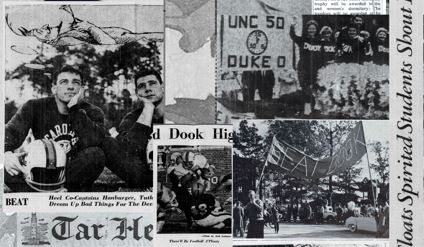
The rolling party ran for four decades, bookended by unforgettable contests with Duke. In 1949, the Tar Heels were ranked as high as No. 6 in the nation, and Art Weiner ’50 (’53 MEd) blocked a last-second field goal attempt to secure the win over Duke. The Beat Dook Queen would finally melt away after 1989, when the Tar Heels posted a 1-10 season and suffered a humiliating 41-0 loss to Duke in Kenan Stadium. In the Beat Dook Queen era, the Tar Heels celebrated 21 wins over Duke against 19 losses and 1 tie.
I married a Beat Dook Queen
Soon after I married Betsy Ross ’66 (’72 MEd), we were searching for something stored in her family home in Concord. Opening a box, I found an item more compelling than whatever we’d been trying to locate. There it was. A Beat Dook Queen trophy with Betsy’s name on it.
I was thrilled. She laughed and spoke fondly of the women who rode on the float with her in 1964. In the box with the trophy, there was an edition of The Daily Tar Heel with a photo of Queen Betsy on the front page. That day I added Beat Dook Queen archivist to my marital duties.
Like Springfest concerts, the Mic Man and a major in radio, television and motion pictures, the Beat Dook queens are now artifacts of our social archaeology. From 1949 to 1989, 41 women joined the Beat Dook Queen royal family. Records suggest 32 are still with us. NASA’s Apollo program, by comparison, sent 24 men to the moon. Beat Dook queens are indeed rare air. I know this firsthand. I lost my Beat Dook Queen in 2020. Betsy and I both contracted COVID-19. I survived. She didn’t. Now the Beat Dook Queen trophy sits on a high shelf, with the framed Daily Tar Heel edition nearby.
For many years, the Beat Dook Queen was front-page news. The tradition bobbled and wobbled in the late 1960s and was observed unevenly through the 1970s. By the 1980s, DTH coverage of the Queen was disappearing. In 1982, the Beat Dook Queen announcement arrived via a personal ad when the Kappa Alpha Theta sisters congratulated Cynthia Dellastatious ’85 on her title. In 1989, The DTH announced the Beat Dook Queen winner, Chi-O sorority sister Meg McCullen ’90 (MBA ’97). With that page-3 story, newspaper mentions of the royal line ended.
Football was everything
The Pi Kappa Alpha fraternity, or PiKAs, organized the Beat Dook events, wrapping a Mardi Gras-style party around a football game that was, for many, bigger than Homecoming. “Football was everything,” said Carolyn Kelley Eberdt ’61, who arrived on campus as a junior from Arlington, Virginia, in 1959 and was named Beat Dook Queen that fall. “There’s nothing greater than beating Duke. Everybody wants to be part of it. That’s what you play for all year long.”
Mind you, Eberdt is perhaps the lone Beat Dook Queen to marry a Duke football player — Arthur Eberdt.
It was all pretty simple. Residents of dorms and members of Greek organizations would nominate queens. There was no student body vote, no pageant. Once nominations were set, professors interviewed the candidates, asking about global politics and news of the day. No one remembers any connection between the interview topics and the boiling passion to defeat UNC’s chief rival. “It was fun. We all had beers,” said Lisa Warner Loughlin ’78, Beat Dook Queen 1977, recalling how the nominated women hung out together.
For the parade, dorms and Greek houses would build floats. The PiKA guys would secure a grand marshal. In 1968, it was William Geer ’38, history professor and director of the Student Aid Office. In 1977, disc jockey Rick Dees ’72. In 1989, it was the football legend himself, “Choo Choo” Justice. Dean Smith declined at least one invitation, explaining in a letter to the PiKAs that basketball practice conflicted with the parade schedule.
(Illustration: Carolina Alumni/ Haley Hodges ’19)
The Beat Dook Queen ritual was playful. It came with a wink. “It was just one hour for one day,” said Cynnie Parker Cook ’69, Beat Dook Queen 1968. “My family teases me about it, saying ‘Oh, you were the Beat Dook Queen.’ My husband tells people when the subject of Carolina comes up, ‘I bet you didn’t know she was the Beat Dook Queen.’ It was whimsy. It was not ultra-serious. It was a fun day.”
Some winners received a trophy. Others won crowns. Cook was given a dozen roses and tickets to the Judy Collins concert in Carmichael Auditorium that took place after the Beat Dook Parade. The Daily Tar Heel reported Cook won a trophy. She says that’s wrong. “I didn’t get a trophy, or I would have kept it,” she said.
The title came with lifetime status. Loughlin won a pewter chalice that she still brings out when Carolina plays Duke, especially when there’s a Duke fan nearby.
Everything was different in 1963. The parade was scheduled for the afternoon of Nov. 22. As floats queued up outside Woollen, “someone came racing in and said the president had been killed,” said Joanna Houston Roberts ’65, the Beat Dook Queen whose parade was lost to history. “Somewhere, I had a rhinestone crown. It had a ribbon that tied in the back. That’s long since gone.” The University canceled the parade and postponed the football game but conducted Saturday classes — a thing at the time — as usual.
The churning American culture reshaped campus life. Title IX put an end to University policies that had suppressed the number of women on campus. Gone as well: etiquette courses on how to be “a Carolina lady” and full-length gowns for Beat Dook Queens riding in parades. In 1971, students organized an Ugly Man contest and chicken races and handed out cases of beer as prizes. The same year, during Homecoming weekend, the Black Student Movement crowned its first Miss BSM, Doris Stith ’74.
Over time, students concocted new Beat Dook activities. In 1975, they wanted to kick off the parade with four members of UNC’s parachute team jumping from a Cessna 182 and landing on the field adjacent to Carmichael Auditorium. Administrators denied the request. In 1977, with Loughlin as queen, the parade featured a “gator pile” on Franklin Street, with the men of Phi Delta Theta falling to the ground, rolling onto their backs and writhing about. The DTH reported “several injuries partially stemming from the rowdiness of the crowd.” Eight months later, the gator was on the big screen, thanks to John Belushi and his Delta Tau Chi brothers in National Lampoon’s Animal House.
The movie, in which the fictitious Faber College dean placed offending students on double-secret probation, was set in 1962. That’s the year UNC nursing student Betty Caron ’64, a Kappa Kappa Gamma sister, won the Beat Dook Queen crown and Dean of Men William Long censured several fraternities and one dorm for outlaw floats cheering on the Heels to “Screw Dook” and “Dump on Dook.” That led Long to announce later a new review process requiring students to win approval for float designs. Four years later, he would reverse course and throw up his hands, informing the PiKA president that his office would no longer “pull any chestnuts out of the fire.” Prior review was gone, Long explained, and decisions — and accountability — lay with students.
The best within us
There’s an understanding in philosophy that it’s the pursuit of “the best within us” that fills our lives with purpose and meaning. Aristotle believed happiness to be a byproduct of this pursuit. Today, the imagery of a parade queen is incongruent with images of striving and stories of achievement. Yet having lived with a Beat Dook Queen, talked to several and read about many, I’m struck by the ways the women defied any constraints of the custom.
Maybe it was a Southern thing. A researcher who interviewed Southern women during the 1980s found support for the notion that the “Southern lady” maintains multiple identities. One woman told the researcher the Southern lady “might pose as garrulous and talky and silly and dotty, but at heart she was a steely, silent creature, with secrets no man could ever know, and she was always — always — stronger than any man.” The research brings to mind tales from the writer Lee Smith, a woman accomplished enough to hold an honorary degree from UNC and Southern enough to have won Miss Piggly Wiggly and Miss Hormel Ham titles.
Sharon Jarvis ’79, Beat Dook Queen 1976 and a member of the Marching Tar Heels band, showed Beat Dook steel on the field at Wallace Wade Stadium in 1977. “That year we went to Duke,” she said. “Here we were doing our majorette thing and strutting around, and a guy hits me in the head with a water balloon. We wore a lot of hair spray to hold everything together, and the water from the balloon and the hair spray made a syrup in my face. You keep going like nothing’s wrong.”
The 1971 queen, Lucy Lowder Schimmelfing ’74 (MA ’75) played basketball and volleyball for Carolina, so she had the stuff to beat Duke herself. “It was an awesome honor for a girl Tar Heel born and bred,” Schimmelfing said.
For 1968 Beat Dook Queen Cook, who was from Washington, D.C., the tradition was a wonderful part of her immersion into the South. “The South was more formal in the way women dressed. It was a lovely, wonderful culture that I grew to love,” she said. “Within the context of what it was, I don’t think it was in any way demeaning to women. … I don’t think people took it seriously. Today, people would look at it differently.”
For any among us who believe a woman is capable of steely or silly but not both, the Beat Dook queens delivered a dose of reality. Pat Wilson Dixon ’61 didn’t know a thing about football when she was crowned Beat Dook Queen in 1958 and showed up to Kenan Stadium to see UNC fall to Duke, 7–6. “But once you get that feeling …” she said, her voice trailing off.
(Illustration: Carolina Alumni/ Haley Hodges ’19)
Dixon, who’d go on to a career counseling middle and high school students, watched the 1959 nationally televised Thanksgiving Day game against Duke at home with her father. Carolina won 50–0, and Dixon cheered as any Beat Dook Queen would. “After the game, my dad said, ‘I don’t think that was very ladylike to yell like you were yelling,’ ” she said.
Betsy, my Beat Dook Queen, sang country ballads and operettas. She was a Bronze Life Master in bridge and the first to put on a funny hat. She taught children in her first career and prosecuted criminals in her second. She dripped with jewelry when she operated in good-old-boy courtrooms and was fiercer than any man in the room. Beat Dook queens are like that. They can reign over parades where women ride on glittery blue and silver floats, circa 1950, or in a metal shopping cart filled with beer cans, circa 1976. I hear Betsy’s voice in the voices of many Beat Dook queens, the women who can comfort a child in one breath and curse bad officiating in the next.
Reflecting on the Beat Dook Queen tradition challenges us to wonder whether it’s useful at all to dredge up cultural fossils. Maybe lore that was the product of outdated systems is lore that is best left unacknowledged. Or maybe by digging into the past we can find insights. In 1976, Sheri Parks ’78, a scholar and writer, became UNC’s first Black Homecoming queen. But that headline doesn’t tell the full story. “I’m not a Homecoming queen type,” Parks said. “It was really a political movement by a number of white and Black people on campus to get that done.”
Her Homecoming queen campaign called for students to “vote for a change” and positioned her to run for student body president in 1977, when the National Commission on the Observance of International Women’s Year would host a National Women’s Conference in Houston. Revisiting history is the only way to unearth all of the pieces to the puzzle.
“It’s very important to look at everything that happened in our culture and to examine it and ask why things happened this way. We need to face our history. I would not have torn down the confederate monuments. I would have simply told the truth about them,” said Parks, the author of Fierce Angels: Living with a Legacy from the Strong Dark Feminine to the Strong Black Woman. “Universities are important cultural institutions. They value history. They create histories. Students often demand tradition, and colleges often create traditions for that reason. The Duke rivalry — it wasn’t just about football. It was about culture and state identity.”
For Loughlin, the 1977 queen, the Beat Dook part of the tradition is what should endure. “It could be anybody,” she said, suggesting today’s student body select a Beat Dook Human. What mattered was rallying students to a common cause. “It was unifying,” Loughlin said. “We need to get back to that feeling. It’s what keeps us cohesive.”
At the UNC–Duke football rivalry’s centennial, the floats and crowns are gone. Woollen gym dances and gator piles are gone, and Justice is gone. The enmity for Duke lives on. Come the last Saturday in September, listen close to hear it in the echoes of cheering Beat Dook queens. The Queen is dead. Long live the Queen.
John Bare, a writer and photographer based in Concord, is the author of My Biscuit Baby, a novel set in Chapel Hill.
What Came After the Crown?
1949: Betty Smith Pittman ’50 earned a master’s degree in counseling and guidance from West Virginia University and an EdD from Western Colorado University. By 1976, she’d worked as a kindergarten teacher, a counselor and a home-visitation professional. At the time, she was the only professional in the state of West Virginia recognized to train therapists in transactional analysis.
1952: At UNC, Carman Nahm Goldsmith ’53 was chair of the Women’s Council, an office of student government that adjudicated honor code and campus code violations; a member of the Valkyries; and a Phi Beta Kappa and summa cum laude graduate. She performed in water ballets as a synchronized swimmer. She was a longtime resident of Savannah, Georgia, where she led the integration of Bethesda Academy and volunteered with the Historic Savannah Foundation.
1955: Eleanor Riggins Brawley ’59 (MA) was a graduate student studying radio, television and motion pictures when she won the Beat Dook Queen title. She became a documentary filmmaker, television producer, photographer and poet. During school desegregation fights in Charlotte, she produced a TV series that built community support for integration of public schools. After the 9/11 attacks, the Levine Museum of the New South hosted Brawley’s photo-documentary show, Families of Abraham, which explores diversity and faith in the American South. She described her 2021 book of poetry, The Floating Bridge, as a “memoir in poems.”
1956: Lucinda Holderness ’58 was a founding board member of the Chapel Hill YMCA and the Chapel Hill-Carrboro Public School Foundation and dressed as a “reading angel” to deliver books to children. She helped fund restoration and maintenance of the Bell Tower and donated to the Holderness Medical Fellowship at UNC School of Medicine.
1957: Nan Schaeffer Graham ’58 arrived at Chapel Hill after considering schools in Tennessee and Alabama, and fell in love with UNC. She was married to Earnest Heap Graham ’50 for 53 years. “I don’t think my husband knew I was the Beat Dook Queen. He may have. His mother may have told him. She knew, of course,” Graham said. She earned a master’s degree from the Citadel, taught school and for 30 years has delivered commentaries on Wilmington’s public radio station, WHQR. She’s published two books of essays and has another in the works. Graham discovered Wilmington when the 1958 Azelea Festival invited all the North Carolina universities to send their May queens to the festival. UNC, without a May Queen at the time, sent Graham. There she met Andy Griffth ’49 and actress and competitive swimmer Esther Williams and found the city she would call home.
1962: Betty Caron Tackney ’64 earned a graduate degree at University of Southern Mississippi and became an assistant professor of nursing at Southeastern Louisiana.
1964: Betsy Ross Bare ’66 (’72 MEd) taught school and earned two master’s degrees in education before completing law school at Wake Forest University. She worked as a local prosecutor and as assistant attorney general. She was among a group of leaders recognized by the White House in 1995 for the use of Drug Courts that provided treatment as an alternative to incarceration.
1968: Cynnie Parker Cook ’69 majored in art history, minored in archaeology and later worked at the National Geographic Society and LIFE magazine. For nearly two decades, she served as a docent at The Metropolitan Museum of Art.
1976: Sharon Jarvis ’79 received an appointment from President Ronald Reagan to serve at the U.S. Government Printing Office and worked in pharmaceutical sales and as a tour director. Following the deaths of her brother Dan Jarvis ’77 and sister-in-law Linda Jarvis ’75 in the 1996 ValuJet crash in the Florida Everglades, she worked with other bereaved family members to secure improvements to aviation safety laws. She is a member of The Order of the Long Leaf Pine.
1977: Warner Loughlin ’78 became a film and television actor, writer and producer and then an acting coach. In her bestselling book, The Warner Loughlin Technique: An Acting Revolution, released in 2018, she describes the methods she used as an acting coach for Ryan Reynolds, Kyra Sedgwick and other Oscar- and Emmy-winning actors. For Walt Disney Co. animated films such as Frozen and Frozen 2, Loughlin trained writers and animators to create cartoon characters that portray lifelike movements and emotions.