The Negotiator
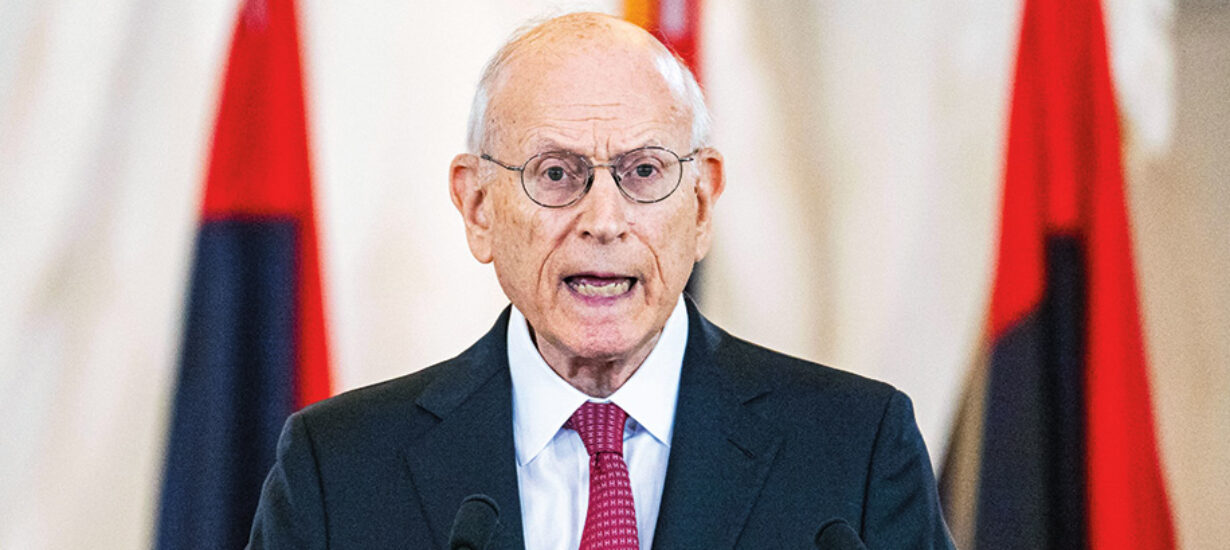
If anyone knows how to negotiate effectively, it’s Stuart Eizenstat ’64. Serving as chief White House domestic policy adviser to President Jimmy Carter and later as U.S. ambassador to the European Union in the Clinton administration, Eizenstat has been at the negotiation desk for decades, including brokering deals between the U.S. and other countries to compensate victims of the Holocaust.
His most recent book, released last year, details the diplomatic complexities of some of the most important moments in recent U.S. history, the majority being deals he didn’t work on personally. The Art of Diplomacy: How American Negotiators Reached Historic Agreements That Changed the World reveals what went right, and wrong, with negotiations ranging from extricating the U.S. from the Vietnam War to brokering peace between Israel and Egypt. More than 60 key diplomatic figures —including former Secretary of State and National Security Advisor Henry Kissinger, former U.K. Prime Minister Tony Blair, former U.S. Sen. and Secretary of State Hillary Clinton and former U.S. Ambassador to the United Nations and National Security Advisor John Bolton — share their perspectives on successful strategies that eventually led to a shaking of hands with opponents.
The book includes hard looks at diplomatic agreements that “are often fascinating and, based as they are on extensive interviews with participants such as former Secretary of State Condoleezza Rice and the former C.I.A. director Leon Panetta, they contain a great deal of useful research material,” according to a New York Times review last year, which wasn’t altogether flattering. (The Times described the book as “sharp on the mechanics of negotiations but hazy on the wider political environments.”)
Eizenstat, an attorney and former special adviser for Holocaust issues in the Biden administration, said he wrote the book to show “that American diplomacy over the last 50 years had solved equally daunting problems, and therefore could do [so] again.”
One of the many lessons he shares in his book, applicable to not just diplomats but anyone looking to artfully craft a deal, is to treat others as fellow human beings and find out their interests. As an example, Eizenstat pointed to how former Secretary of State Jim Baker, while serving in the George H.W. Bush administration, invited former Soviet Foreign Minister Eduard Shevardnadze to Baker’s personal retreat in Jackson Hole, Wyoming, where he developed a personal relationship with Shevardnadze and eventually convinced him to agree that a reunified Germany could join NATO.
Eizenstat grew up in Atlanta, where he was an All-American high school basketball player. With hoops on his mind, he wanted to attend a university with a strong basketball program. He said Carolina was attractive not just due to its basketball legacy but also because of its academic reputation and bucolic campus.
Eizenstat said he found his calling at UNC after listening to a speech by then-President John Kennedy, who came to Chapel Hill in October 1961, when Eizenstat was a sophomore, to receive an honorary degree. Kennedy, speaking at a time when the relationship with the Soviet Union was particularly tense, urged students “to recognize the contribution which you can make as educated men and women to intellectual and political leadership in these difficult days.”
“He challenged our generation to do some public service and try to make the world a better place,” Eizenstat said. “I was very stirred by his words.”
A year later, Eizenstat was one of five UNC students who worked as a summer intern at the U.S. House of Representatives. “That opened up the whole world of national politics to me, and it was so eye-opening,” he said.
Eizenstat earned a political science degree at UNC and later a law degree at Harvard University. He soon found work as the issues director for Carter’s 1970 gubernatorial campaign in Georgia, and after Carter was elected president, Eizenstat became his chief domestic policy adviser. He served as the U.S. ambassador to the European Union from 1993 to 1996 in the Bill Clinton administration and as co-chairman of the European-American Business Council.
Writing books came naturally to the studious diplomat, and Eizenstat enjoyed documenting his experiences, exemplified by his 2012 book The Future of the Jews: How Global Forces are Impacting the Jewish People, Israel, and Its Relationship with the United States and President Carter: The White House Years, published in 2018.
Eizenstat had direct contact in negotiating deals. In The Art of Diplomacy, he recounts his time discussing an agreement with Swiss, German and Austrian authorities and commercial institutions to secure reparations and restitution for Holocaust survivors by returning Nazi-looted art to their rightful heirs. Along the way, he accumulated enough experience and political connections to share an array of insight into deal-making at an international level.
History can teach us how to negotiate with respect and tact, Eizenstat said, citing the 1998 Good Friday agreement in Northern Ireland that ended the 30-year violent conflict known as the Troubles. “Countries have to have the courage to depart from established positions, such as how Catholic and Protestant leaders had to leave entrenched positions from what their political bases may have wanted in order to find peace,” he said.
An underrated characteristic in brokering deals is endurance, Eizenstat noted. “These discussions are like a marathon,” he said. “They can last years, and they always end with a sprint at the very end, at like two in the morning. You’ve got to be able to think clearly and have the stamina through it all.”
Diplomats involved in negotiations can find fulfillment in not just the outcome but hearing from those who benefit from a successful agreement. It’s a feeling Eizenstat has experienced when he negotiated Holocaust restitutions. “When I brokered the agreement in 2014 for $60 million from the French government as reparations for Holocaust victims deported to concentration camps on French trains, that was enormously satisfying, even more so because I met a number of people who benefited from that deal,” he said.
You don’t have to be a political maven to glean lessons from masterful negotiations, Eizenstat said. “We all negotiate all the time, such as with our spouses, our children, with our colleagues at work,” he said. “And I think many of the lessons in my book of what makes a successful international negotiator could have a role in the ways in which we negotiate throughout our lives.”
— David Silverberg