- Membership
- Perks
- Things To Do
- Resources
- News
- About
- Shop
Related Content
In Dolly’s Honor
Aug. 27, 2026
In 1957, at the age of 11, Dolly Parton recorded her first commercial record, Puppy...
Read MoreWilson Library, NC Museum of History Collaborate on American Revolution Exhibit
June 30, 2026
Wilson Library is hosting an exhibition in collaboration with the NC Museum of History through...
Read MoreLibrary AI Studio Opens at Davis Library
Feb. 4, 2026
University Librarian María Estorino has called artificial intelligence a “cultural technology,” one that passes knowledge...
Read More-
2026
-
2025
-
2024
-
2023
-
2022
-
2021
-
2020
-
2019
-
2018
-
2017
-
2016
-
2015
-
2014
-
2013
-
2012
-
2011
-
2010
-
2009
-
2008
-
2007
-
2006
-
2005
-
2004
- Academics and Athletics
- Admissions
- Alumni Profiles
- Alumni Recognition
- Around Town
- Arts
- Books
- Campus Profile
- Campus Safety
- Carolina Alumni Awards
- Carolina Alumni Leadership
- Carolina Alumni Programs and Outreach
- Carolina Alumni Reunions
- Carolina Alumni Review
- Celebrations
- Championships
- College and Costs
- Commencement
- Coronavirus
- Discovery
- Extracurricular
- Faculty
- Faculty Awards
- For the People
- Go Heels
- Greek Life
- Hark the Sounds
- Higher Education
- Homecoming
- In Class
- In Memoriam
- Innovation and Technology
- Issues
- Object Lesson
- On View
- Philanthropy
- Podcast
- Public Service
- Race and Reckoning
- Research
- Serving Our State
- Sexual Assault
- Silent Sam
- Sports
- Structures
- Student Achievement
- Students
- Timelines
- Tuition and Financial Aid
- UNC Libraries
- UNC’s History
- Undergraduate Spotlight
- University Achievements
- University Awards
- University Budget Issues
- University Development
- University Leadership
- University News
- University Rankings
- What We Do
- Who We Are
- Young Alumni
- Yours at Carolina
The UL’s Next Chapter
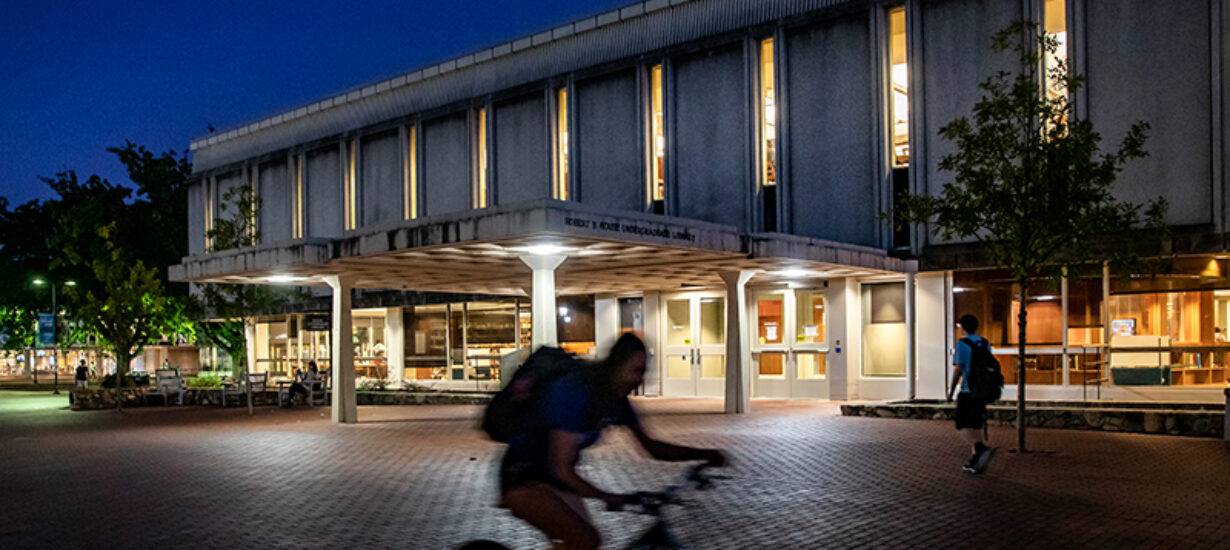
The Robert B. House Undergraduate Library will close for renovations at the end of this semester as the library adds more seating and the Center for Student Success relocates to the library’s upper level. The work is estimated to cost $8.25 million.
The Undergraduate Library, commonly known as the UL, is scheduled to reopen in the fall of 2026. University Librarian María Estorino said she hopes the inconvenience is “rapidly forgotten” once the renovations create incredible new opportunities for students.
The Center for Student Success, which is run by the College of Arts and Sciences, operates The Writing Center, The Learning Center and other programs for student academic support. The Center for Student Success is currently housed in the Student and Academic Services Building North, which is located on the corner of Ridge Road and Manning Drive. Despite its name, it is far from north campus, the hub of student life.
The UL is located in the center of campus, sandwiched between the Pit and Wilson Library. The three-story library opened in 1968, marking the first time undergraduates at Carolina were allowed into library stacks on campus. Today, it lends mostly popular books, as opposed to niche research tomes, and each year serves thousands of students, most of whom use the library as a quiet place to study.
Estorino said the idea to move the center to the UL began during conversations in 2018 with former Chancellor Kevin Guskiewicz, who was then dean of the College of Arts and Sciences. The project was driven by the assumption that students might use support resources more often if they were physically closer to where they frequently study.
Estorino said she’s constantly asking herself, “ ‘How do we partner in ways that advance not just the mission of the University but the success of every Tar Heel?’ This project is going to give us one very clear way of doing that.”
She said study space is a critical need, especially as the University enrolls 5,000 additional students over the next 10 years. During the first week of class this semester, 12 percent more people used the libraries than the same period last year, according to Estorino. Wilson Library saw the greatest jump at 18 percent, she said.
To most students today, libraries are a place to sit to complete homework rather than a place to check out a book and leave. As a result, during the renovations to the UL, Davis Library will open six new study rooms and add more seating to its atrium, but Estorino knows that won’t be enough to meet student demand.
“We have a lot of work to do,” she said. “We are already under the peer average in terms of the seating we provide across our locations.” Increasing study space remains a priority across the dozen libraries on campus, she said. It was one tenet of an indefinitely delayed plan to renovate Wilson Library (See “The Nation’s Toolbox,” March/April 2024 Review).
To that end, the renovation to the UL will repurpose lower-level offices and some stacks into more study space for students. A campuswide email said the upgrades to the UL will feature “an aesthetic that combines modern elements with some of the best-loved features of the library’s current design.”
“You’re going to continue to see a reduction in the collections footprint and a growth in the people footprint,” Estorino said. “This has been going on for several decades — it’s not directly in response to enrollment growth, but it’s definitely more needed with enrollment growth.”
The libraries are also extending Davis Library’s hours and adding additional seating in the Health Sciences Library at the medical school. Estorino hopes some students discover new favorite spots to study during the renovations and take advantage of other library locations across campus.
— Ira Wilder ’24
© 2026 Carolina Alumni