Carolina’s Artificial Intelligence Czar Gets to Work
Posted on Nov. 19, 2025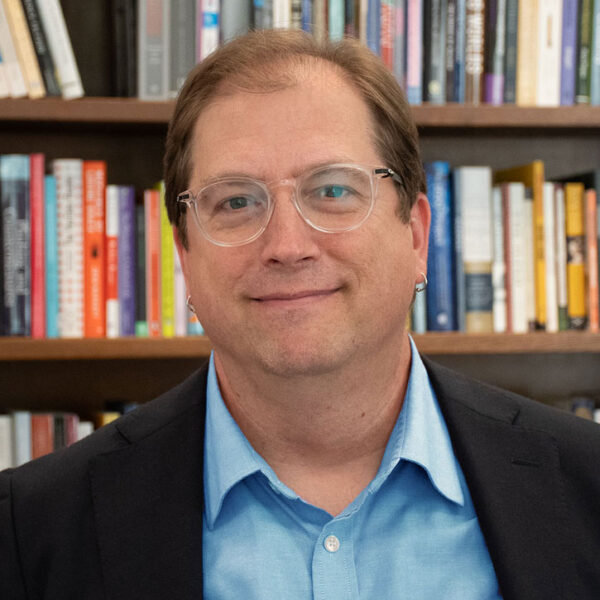 Jeffrey Bardzell expected to remain the dean of the School of Information and Library Science (SILS) until it merged with the School of Data Science and Society (SDSS) next summer. Instead, he was promoted Tuesday to become the University’s first chief artificial intelligence officer. The University said the accelerated timeline recognized “the urgency of a comprehensive artificial intelligence plan across the University’s academic mission.”
Bardzell told reporters Monday higher education should be leading in the implementation of the emerging technology. “We need to catch up,” he said. “It’s as if we’re behind.”
Diane Kelly, a Distinguished Professor in SILS, is now interim dean until the school merges with SDSS next summer. The new school is yet to be named, but it will focus “on preparing students for work in information- and data-intensive professions and settings, including libraries and archives,” according to the University.
First arriving at Carolina in 2004, Kelly was a professor at SILS until 2016, when she left to direct the School of Information Sciences at the University of Tennessee. In 2020, she became Tennessee’s vice provost for faculty affairs, leading the school’s academic personnel services, before returning to Carolina in 2024.
“One of my main reasons for coming back to Carolina was to be able to use my administrative and leadership experience in a way to help the school, and more specifically, the people that I care about so deeply,” Kelly said in a statement.
Kelly’s experience as an academic leader puts the library school in good hands, Bardzell said. Before he became vice provost for artificial intelligence, he was a comparative literature scholar, a medievalist, to be more specific. He then became a design researcher, examining how humans interact with computers, which led him to his recent leadership positions.
“[Bardzell’s] background gives him a unique perspective on AI strategy, one that the University needs if we are going to succeed at responding to the evolving needs of our students, faculty and staff,” Interim Provost James Dean said in a statement.
Chancellor Lee Roberts said Bardzell will work to prepare students for a rapidly evolving workforce, one in which at least a basic knowledge of artificial intelligence is required for many entry level positions. Bardzell said he will first prioritize developing teaching and learning strategies that bolster the use of artificial intelligence across campus, even in departments that aren’t computer related. To achieve this, Bardzell plans to explore creating “courses in basic AI literacy as part of the general education curriculum, courses covering technical and responsible use of AI that cross-cut numerous professional tracks, and technically focused courses for students interested in working in AI-related or -adjacent fields,” according to the University.
“AI brings considerable opportunities and also risks,” Bardzell said in a statement. “Higher education has a critical role to play in shaping how AI unfolds, and preparing students for a world where its use is ubiquitous is one of the most impactful ways we can do so. I am excited to collaborate with faculty, staff and students to help shape that future.”
University Librarian María Estorino said students lack clear direction around what they can and cannot use AI technology for. Detecting computer-generated writing can be difficult, so Bardzell hopes to reframe the way students and faculty think about cheating. He also wants faculty to raise their expectations for student writing and for some faculty to shift toward portfolio-based rather than test-based evaluations. “My belief is that [AI] really is a collaboration between a human and a tool, and if the tool replaces what the human does, it defeats the purpose,” he said. “It’s like going to the gym and pretending to lift weights.”
Roberts and newly named provost Magnus Egerstadt, who will begin March 2, listed artificial intelligence as one of their top priorities for Carolina, alongside enrollment growth and development of an engineering program. Artificial intelligence will, to some extent, be a component of the new school merging data and library science.
Faculty at both schools were informed of the merger one day before the public announcement in October. Bardzell told faculty that no one would lose their job and that the school would remain accredited by the American Library Association. Dean told the faculty executive committee Nov. 17 that several task forces consisting of faculty, staff and students from both schools were drafting the operations and identity of the merged unit, including its name.
Stanley Ahalt will remain dean of the School of Data Science and Society until becoming dean of the new school. He told The DTH, “[Artificial intelligence] is not going to be just in teaching or just in research or just in operations, but all of the above, and it’s going to change the way we think about organizing and orchestrating our classrooms.
Roberts said, “Over time, [AI] will reach and reshape just about everything that we do … fairly dramatically, but our north star remains our mission of service to the people of North Carolina.”