Remembering Konrad Jarausch
Posted on Sept. 4, 2026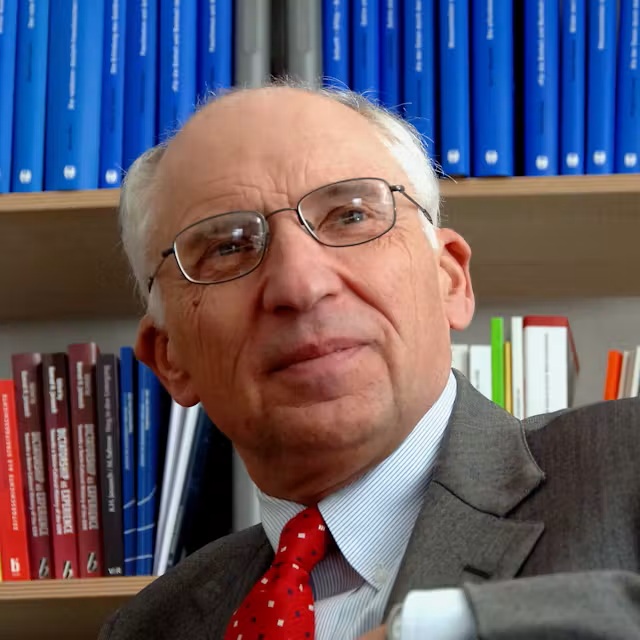
Konrad Jarausch
A former UNC history professor went for a swim in a lake near his Chapel Hill home Tuesday and never returned. Konrad Jarausch, who had spent more than four decades in Carolina’s history department, was found dead after a three-hour search led by police. He was 85.
Jarausch swam regularly in Eastwood Lake, which is part of a private community in east Chapel Hill. He often swam with his wife Hannelore Jarausch, former professor of Romance languages at UNC, who accompanied him as usual Tuesday around 11 a.m. She later told police she swam a little farther than her husband, and when she returned, she couldn’t find him. She asked for help from a neighbor, who called 911. Around 2:30 p.m., police found Jarausch’s body. Media outlets reported the death as a drowning, but Chapel Hill police and the Orange County medical examiner have not issued an official cause of death.
Jarausch was born in Magdeburg, Germany, in 1941. Raised by his mother, he never met his father, who was a scholar before being drafted in 1939 as a reservist soldier to fight in World War II. The elder Konrad Jarausch never joined Hitler’s National Socialist Party but did become a cog in the Nazi war machine. He tried to leave military service to no avail. After a brief stint back home, he was sent to the Eastern Front, where he was put in charge of a field kitchen in the Soviet Union. Stricken with typhoid in late 1941, he died in a field hospital in January 1942.
In adolescence, the younger Jarausch was uninterested in his father and sickened by the Nazi regime. He left Germany as soon as he could, heading to the University of Wyoming for a bachelor’s degree before earning a master’s degree and doctorate from the University of Wisconsin. He became a U.S. citizen and joined the University of Missouri as an assistant professor of history, rising to full professor over the course of 15 years. In 1983, he came to UNC as the Lurcy Professor of European Civilization, and he taught in Hamilton Hall for the next 41 years. He also co-founded the Center for European Studies at Carolina.
Over the course of his career, he wrote and edited dozens of books, but none as personal and revealing as Reluctant Accomplice: A Wehrmacht Soldier’s Letters from the Eastern Front, which tells his father’s story through the lens of letters sent home.
For many years, Jarausch refused to read the letters his father sent his mother during the war. But as a debate lingered in Germany about the role of ordinary soldiers — like his father — in Nazi atrocities, including political executions, reprisals and the killing of Jewish civilians and Russian prisoners of war, Jarausch wondered whether his father’s letters contained evidence about the regular German army’s culpability.
In 2005, Jarausch began reading. What he discovered led to 2011’s Reluctant Accomplice. In the book, Jarausch didn’t let his father off the hook. “His values led him to become an accomplice in something we have to reject,” Jarausch said. But the letters revealed aspects of his father that Jarausch didn’t expect. His father had turned away from the nationalistic fervor that led him to believe the war was justified. Instead, according to the letters home, the elder Jarausch’s humanity and Christian ethics took hold. He called the prisoner-of-war camp where he worked “a tragedy.”
In October 1941, the elder Jarausch wrote home: “The running of the camp has fallen in large part on me … I’m constantly reminded of Matthew 25:42-43: [“For I was hungered, and ye gave me no meat: I was thirsty, and ye gave me no drink.”] I can’t stop thinking about the passage. I’m trying to do what I can. It’s not much in the face of the worst suffering I’ve encountered in my life. But perhaps I can prevent further calamities. The Russians are helping me … I would like to be able to focus again solely on securing provisions. But at the moment the question is simply: Who is your neighbor?”
At UNC, where Jarausch worked into his 80s, he wrote four more books, including his final work, The Burden of German History: A Transatlantic Life, which was in part a personal essay.
The preface begins as an ode to gratitude: “My triple bypass surgery came as a shocking surprise. In November 2019, I was getting a visa to travel to China … where I would present a paper on German memory politics. But before leaving I noticed it took me longer than usual to catch my breath after climbing all 88 stairs to my office. An immediate checkup … revealed irregularities in my heartbeat and the subsequent catheterization showed massive blockages of three arteries. The attending cardiologist insisted on triple bypass surgery, arguing that my otherwise excellent state of health would reduce the risk. Nonetheless, before the anesthesia started to work, I said goodbye to my wife Hannelore, unsure of whether I would ever wake up again.
“This unexpected reminder of mortality has made me reflect with gratitude on my somewhat unusual transatlantic academic life.”
— Mark Derewicz