In Exercise of Civility, Students Debate Affirmative Action
Posted on Oct. 28, 2024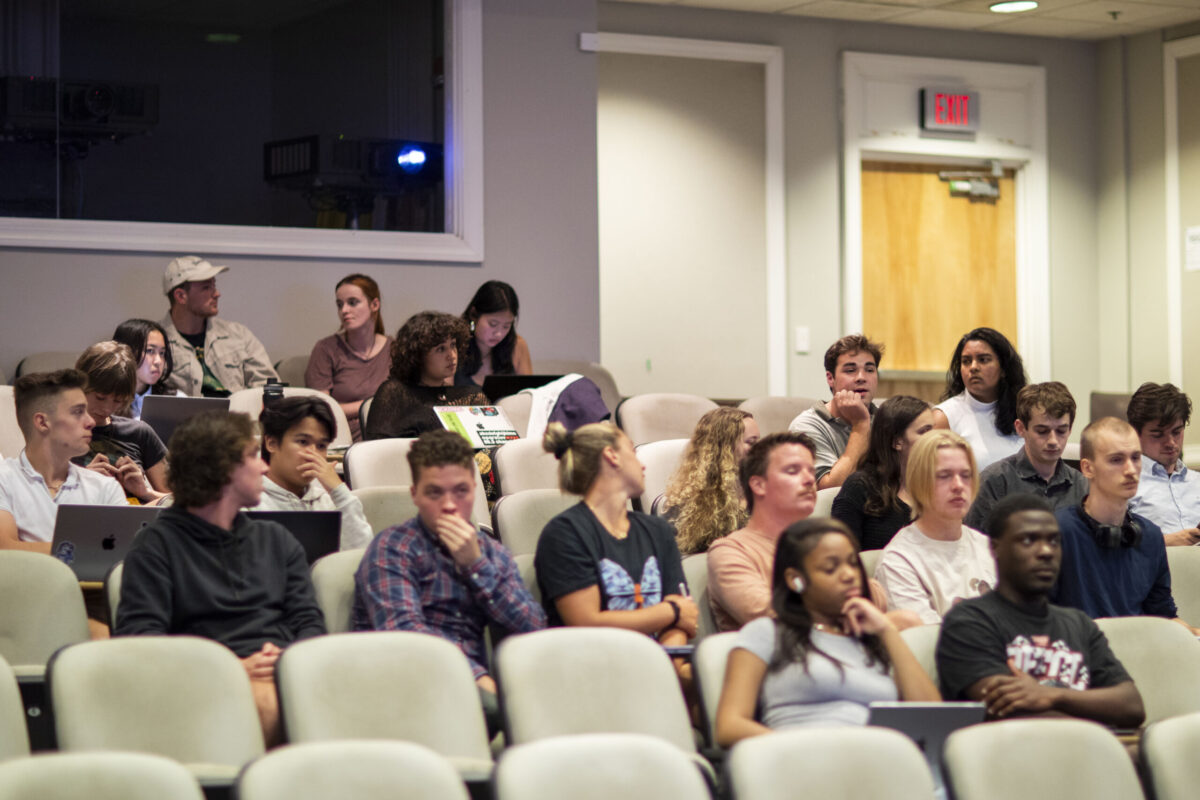
Students pose questions during a debate on affirmative action co-hosted by the Program for Public Discourse and the College Debates and Discourse Alliance (Photo: Carolina Alumni/ Ira Wilder ’24)
About 45 students gathered in Murphey Hall Oct. 23 to debate a controversial topic that has reached both campus leaders and the U.S. Supreme Court: affirmative action and the consideration of race in college admissions.
The event, hosted by the Agora Fellows, a fellowship of students under the Program for Public Discourse, aimed to bring together the campus community to respectfully debate a difficult issue, and students offered respectful nuance on both sides of the program’s question for the evening: “As North Carolina’s flagship institution, does UNC have a responsibility to ensure its student demographics reflect those of the state?” The debate has been at the center of admissions policy at Carolina since the Supreme Court ruled last June, in a case that involved UNC as a defendant, that considering race in admissions was unconstitutional.
Six attendees spoke in favor of Carolina pursuing a policy that would aim to assemble a student body that reflects North Carolina’s demographics, and four attendees spoke against the concept. Some students cited legal precedents such as the will of the taxpayer to either support affirmative action or not, some cited personal experiences such as the value of diverse perspectives in the classroom, and others pointed to admissions data to support their particular view.

Graduate student Neil Sharma ’24 speaks in favor of affirmative action. (Photo: Carolina Alumni/ Ira Wilder ’24)
Arguing in support of affirmative action, public policy graduate student Neil Sharma ’24 said the state should represent the demographics of the taxpayers who fund the University. “This isn’t just about the diversity we often hear about in terms of race or ethnicity,” he said. “It’s about the broader fabric of our society, like those who face economic disparities or those in rural communities.”
Other students argued affirmative action leads to a more enriching and intellectually stimulating classroom experience, one that reflects the diversity in society. Several students said people with varied backgrounds and experiences offer different, and potentially more effective, solutions to social problems.
Freshman Ekene Ezenwa said as the University trains future leaders, it must include voices of people who have struggled through poverty or disenfranchisement.
A Black student shared how isolated he felt in a predominantly white freshman orientation group. He argued that affirmative action should be just the first step to encourage valuing diverse voices at Carolina, and the University should implement more policies to assist minority groups once they arrive on campus.
Students against affirmative action argued that a policy aiming to assemble a student body that reflects the state’s demographics would actually decrease the share of minorities who are currently overrepresented at the University, such as Asian and Jewish students. Further, a student argued that affirmative action benefits middle-income people of color, which in turn discriminates against low-income minorities.
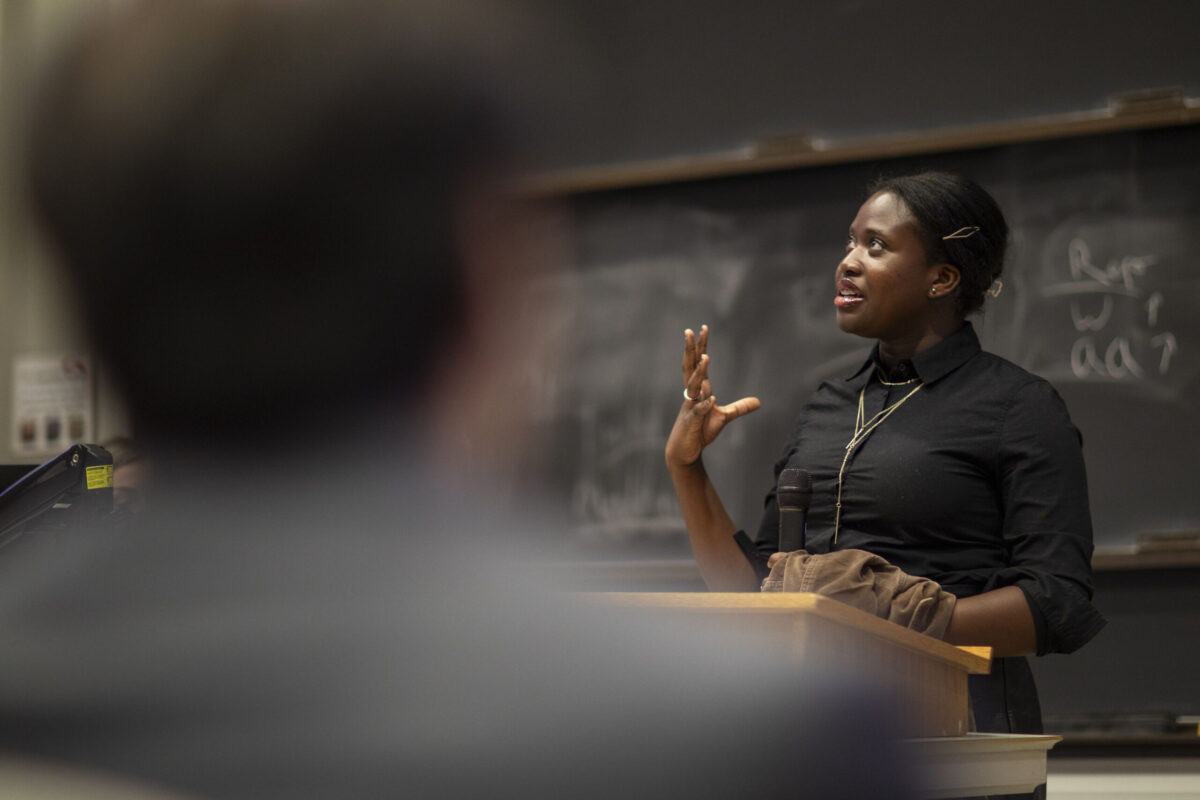
Freshman Ekene Ezenwa speaks in favor of affirmative action. (Photo: Carolina Alumni/ Ira Wilder ’24)
Others said affirmative action devalues the achievements of minority students, and it addresses the symptom rather than the cause of deeper systemic issues.
Sophomore Rebecca Cory cited statistics from various colleges that suggest the loss of considering race in admissions didn’t decrease diversity because the data is inconclusive. For example, UNC reported a 0.7 percent decrease in Hispanic students after the Supreme Court’s decision whereas the University of Virginia reported a 2.2 percent increase.
Senior Elijah Parish, a philosophy major, argued that although uplifting representation is an admirable initiative, it is not the role of the public education system to do so.
Along with students, faculty and staff gathered to participate or observe the debate moderated by Kayla Johnston, a program coordinator at College Debates and Discourse Alliance, a national nonprofit fostering civil discourse on college campuses co-hosting the event. Johnston invited students in attendance to use “debate as a collective search for truth.”
After the debate concluded, moderator Johnston asked the crowd what they learned from each other. Several students said they found themselves agreeing with points made on opposing sides, and they found common ground. Students said the format of the debate allowed them to move forward without getting bogged down in the heat that often plagues open arguments.
The Agora Fellows is a program overseen by Kevin Marinelli, the executive director of the Program for Public Discourse and a teaching assistant professor of communication. According to its website, students in the program meet regularly to deliberate timely, public issues. The fellowship is in its third year. “This is how democracy is done,” he said.
Marinelli said the fellowship has created a “proto-public space,” allowing students to engage in thoughtful discourse “more effectively and more responsibly.”
— Ira Wilder ’24