- Membership
- Perks
- Things To Do
- Resources
- News
- About
- Shop
Related Content
Top-Tier Military Friendly
Nov. 16, 2026
Military Friendly has awarded Carolina its gold ranking, placing the University in the top 10...
Read MoreAlumnus Confirmed as State’s Chief Information Officer
June 22, 2026
Governor Josh Stein selected a Carolina alumnus as North Carolina’s secretary of the Department of...
Read MoreWhy Shelby Bass Builds a Strong Queer Carolina Community
March 26, 2026
Shelby Bass ’15 came to Carolina because they found its diverse community intriguing. Raised in...
Read More-
2026
-
2025
-
2024
-
2023
-
2022
-
2021
-
2020
-
2019
-
2018
-
2017
-
2016
-
2015
-
2014
-
2013
-
2012
-
2011
-
2010
-
2009
-
2008
-
2007
-
2006
-
2005
-
2004
- Academics and Athletics
- Admissions
- Alumni Profiles
- Alumni Recognition
- Around Town
- Arts
- Books
- Campus Profile
- Campus Safety
- Carolina Alumni Awards
- Carolina Alumni Leadership
- Carolina Alumni Programs and Outreach
- Carolina Alumni Reunions
- Carolina Alumni Review
- Celebrations
- Championships
- College and Costs
- Commencement
- Coronavirus
- Discovery
- Extracurricular
- Faculty
- Faculty Awards
- For the People
- Go Heels
- Greek Life
- Hark the Sounds
- Higher Education
- Homecoming
- In Class
- In Memoriam
- Innovation and Technology
- Issues
- Object Lesson
- On View
- Philanthropy
- Podcast
- Public Service
- Race and Reckoning
- Research
- Serving Our State
- Sexual Assault
- Silent Sam
- Sports
- Structures
- Student Achievement
- Students
- Timelines
- Tuition and Financial Aid
- UNC Libraries
- UNC’s History
- Undergraduate Spotlight
- University Achievements
- University Awards
- University Budget Issues
- University Development
- University Leadership
- University News
- University Rankings
- What We Do
- Who We Are
- Young Alumni
- Yours at Carolina
A Collaboration in Plants
Posted on Sept. 2, 2026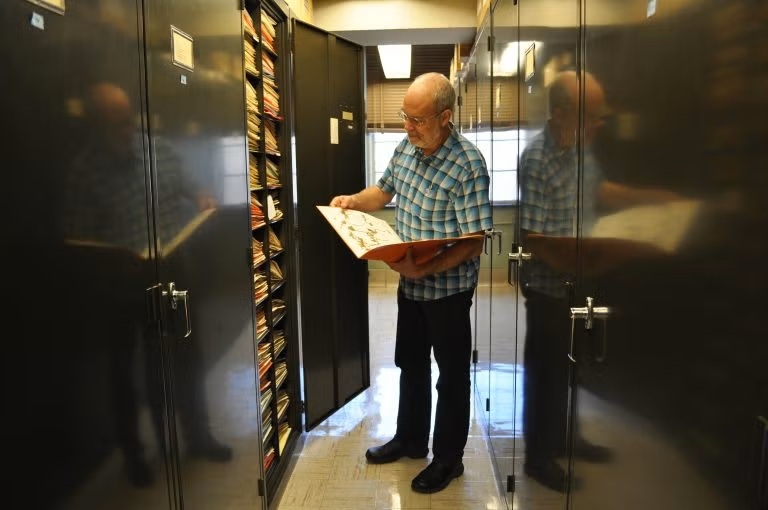
Alan Weakley ’78 director of UNC Herberium
UNC and Duke have agreed to combine their plant collections into one herbarium, creating the third-largest university flora archive in the United States, one that will be unmatched for studying plant diversity in the southeastern United States.
Herbaria preserve plant specimens and serve as irreplaceable scientific collections that enable researchers to study biodiversity, long-term climate shifts, invasive species and other flora changes across generations.
The joint UNC-Duke herbarium will be managed by the North Carolina Botanical Garden in Chapel Hill and will comprise about 1.7 million specimens. Only Harvard University and the University of California, Berkeley have larger herbaria.
Plants are fundamental to all life on Earth, supporting our ecosystems and providing clean air, water, food and medicine that are essential to human and environmental health. Herbaria help scientists track and protect plant biodiversity by documenting where species grow and how they change over time.
As scientists increasingly use AI, digitization and DNA sequencing to study plant life, herbaria are becoming even more valuable as physical records, helping researchers identify species, compare traits and better understand how plants have changed over time.
“The preservation of plant biodiversity will shape human well-being for generations to come,” said Damon Waitt, director of the N.C. Botanical Garden. “This consolidation will preserve a scientific legacy dating back to 1802, keep the combined collection a vital resource for studying plant diversity in the Southeast and ensure it continues to advance our understanding of plant life as new tools transform plant research.”
Duke announced plans in 2024 to relocate its herbarium due to outdated facilities that would require years of work and extensive disruption to the collection.
“Duke’s herbarium is a highly valuable research collection that has been expertly curated and studied by Duke faculty, staff and students, as well as many scholars beyond campus,” said Amy Herring, dean of natural sciences at Duke. “This agreement will keep Duke’s herbarium intact and locally accessible to scientists, curators and students, as well as the citizens of the state and region.”
The Duke collection will initially be housed in two currently vacant floors of the former Frank Porter Graham Child Development Center in Chapel Hill. Carolina has a long-term plan to build a dedicated plant biodiversity research center to accommodate the Duke collection and the UNC collection, which has already exceeded the storage capacity of its campus home at Coker Hall.
Renovations to Frank Porter Graham have already begun, and the Duke collection is expected to move there in June 2027.
© 2026 Carolina Alumni