A Powerful Dreamer
Posted on Sept. 25, 2024Jed Atkins, the new dean of the much-debated School of Civic Life and Leadership, likes to take on initiatives others might reject as being too difficult. That may make him a perfect fit.
by Robert J. Bliwise
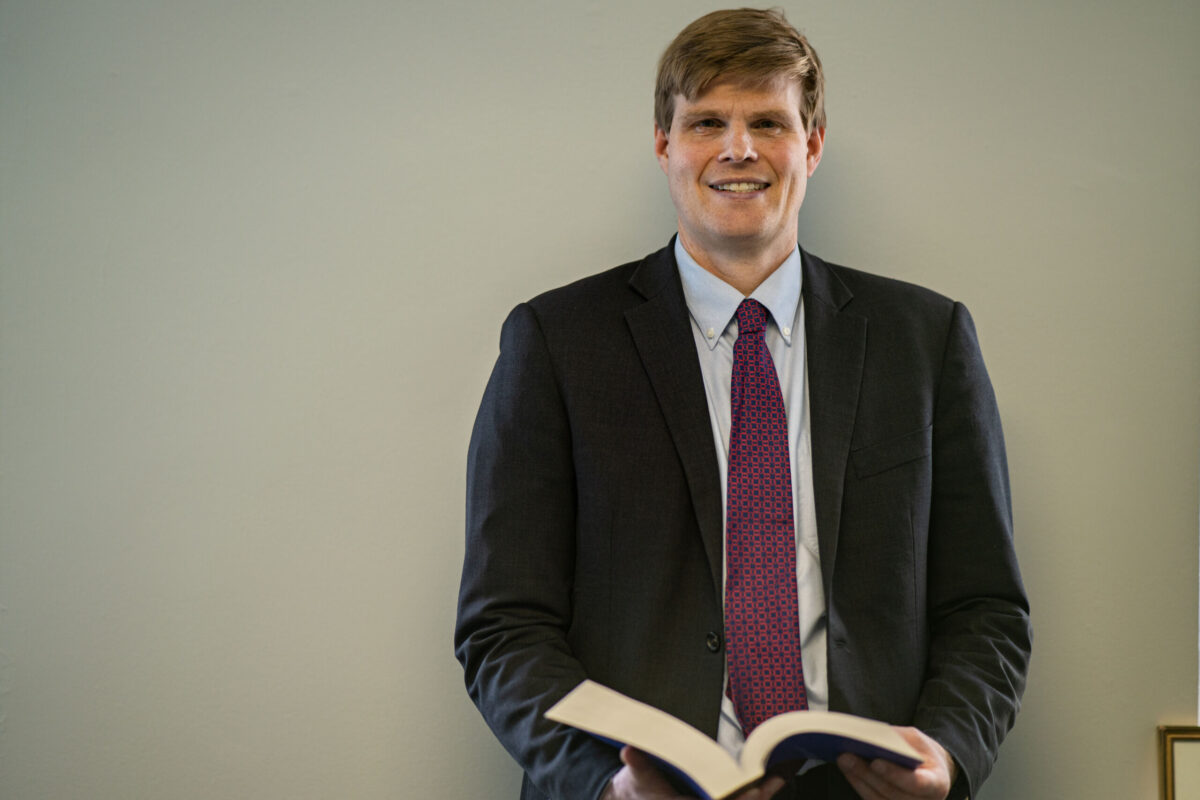
Atkins likes to see his students wrestle with big questions: Can standards outside a particular community regulate life within the community? Where should we look for acceptable claims outside our own traditions? (PHOTO: Carolina Alumni/Cory Dinkel)
It’s late April and the official Last Day of Classes for the semester at Duke University. On floor zero, as it’s called, of a divinity school building, 10 students, a mix of undergraduates and graduate students, are seated around a seminar table. The classroom is eclectically (or eccentrically) outfitted: On one wall, a print inspired by Flemish artist Peter Paul Rubens and generically labeled “Mythological Scene.” Another wall, Gothic stone. A nonworking fireplace stuffed with artificial flowers. A disconnected Zoom cart. A clock stuck at 2 o’clock.
At one end of the seminar table is Jed Atkins, just back from screening job candidates at Carolina. He announces — as if it isn’t obvious — that along with a dark suit and white shirt, he’s wearing a Tar Heel tie. At the time, Atkins was toggling between two jobs: A 15-year faculty member at Duke and the inaugural director and dean of Carolina’s School of Civic Life and Leadership.
Atkins likes to see his students wrestle with big questions, and this “Tradition and Moral Philosophy” seminar, for which he is one of three co-instructors from different disciplines, is no exception. For this last class, he brings up Max Weber’s “iron cage,” a metaphor for never looking beyond a creativity-inhibiting, rules-based environment; the distinctions between a social contract and a covenant, the latter placing more emphasis on the collective and less on state authority; and whether standards outside a particular community might regulate life within the community. Where should we look for acceptable claims outside our own traditions? “Maybe in mathematics,” offers one of the students.
In a sense, there’s a long intellectual tradition attached to the school at Carolina Atkins is leading. But it had a difficult birth.
The N.C. General Assembly allocated $4 million over two years toward development of a leadership school, while the UNC Board of Trustees unanimously adopted a resolution requesting that the University administration “accelerate” its development. A starting point would be the existing Program for Public Discourse, whose work included, according to its website, supporting “a culture of robust public argument through curricular and extracurricular engagement.” Faculty members, though, complained about being left out; some of them drew a contrast to the earlier process that led to the School of Data Science and Society. Some also worried that the school might be a politically motivated gesture to bring more conservative professors to campus.
For his part, around the time he was beginning his new role, Atkins, in an interview with the website RealClear Education, said, “I can’t speak for others, but I can speak for myself. I am in the business of education, not politics.” He went on to observe: “This is not the first time that an initiative in state education involved legislation, and some of this legislation was initially contentious, including the legislation that created the current UNC state system. But origins are not destiny, and I can’t think of anything much less contentious than the idea that we should be providing students with a liberal arts education that prepares them for the weighty responsibilities of democratic citizenship.”
Atkins’ preparation for a life in higher education began when he was growing up in central Pennsylvania, where his father held various facilities-related support roles at Penn State University; his late mother came from generations of family farmers. His father worked at Penn State with heating, cooling and ventilation systems, including those at the football stadium, giving Atkins, who played tight end in high school, an opportunity to experience a storied football tradition. (“My career in football ended with a two-point conversion where I tore my ACL,” he said. “I went sliding, my feet buckled under, and that was the last thing I did on a football field.”)
As a high school senior, with two years of home-schooling behind him, he joined his father in a daily commute to Penn State and took all his courses there. “My high school was not high-performing,” Atkins recalled. “There were no Advanced Placement courses, for example, and so I could see all the benefits of a public university. That part of my story has loomed large — the fact that what made my journey possible was a public university.”
He grew up with two siblings, both sisters, who, along with him, have PhDs with academic careers. “We came from a very nonacademic background,” he said. “But our parents really valued education. They read to us a lot, encouraged us to challenge ourselves academically and facilitated in us a spirit of intellectual curiosity. They gave us the freedom to explore and take intellectual risks, even if it meant moving on from the world they were comfortable in.”
“Democratic hope”
As a first-generation college student, Atkins needed some time to feel comfortable at Bowdoin, a small liberal arts college in Brunswick, Maine. He recalled a hometown friend challenging his decision to align himself with “those preppies.” But he had previewed Bowdoin as a high-schooler: A Penn State professor, an entomologist, had befriended his father after the elder Atkins was assigned to the entomology department. The family spent a vacation in the professor’s Maine summer home, and Bowdoin was a place they checked out.
For Atkins, the classroom provided a confidence-booster. Socioeconomic privilege became irrelevant. “Aristotle, Machiavelli, Kant — for most students, this was their first time encountering these texts,” he said. Atkins also found support from a pair of faculty advisers, both of them political theorists. “Those conversations with professors, people who were committed to seeing students flourish inside and outside the classroom, have informed everything since then I’ve ever done.” One of them steered him to a Latin course; he loved it, and he followed it with Greek. “I didn’t know anything about classics, but I was interested in philosophical and political texts,” he said. “Reading Plato or Cicero or St. Augustine in the original language was really attractive to me.”

“Increasingly we have been moving away from a narrow focus on Greece and Rome to a focus on the wider world,” Atkins said. “Greece and Rome didn’t exist in a vacuum but in a set of interlocking relationships with other city-states and people from the Mediterranean world and beyond. (PHOTO: Carolina Alumni/Cory Dinkel)
The first-century B.C. Roman statesman and philosopher Cicero became a focus for Atkins as an undergraduate. And Cicero — whose life coincided with civil wars and dictatorship, even as he pushed for a return to republican government, and whose writing helped shape the development of Latin — has remained a key figure in his scholarship, including his book Cicero on Politics and the Limits of Reason.
Questions that seem enduringly urgent, like how to aim for peaceful coexistence and how to navigate through differences, are very Ciceronian. Atkins sees Cicero, who stood for open dialogue and debate, as an example for the School of Civic Life and Leadership. Like Cicero, the school, as he put it, is “based in democratic hope”: the twin impulses of intellectual humility, the expectation that we can learn from one another; and charity, or understanding and thinking the best of someone else and his or her arguments.
Cicero “believed you got at truth by hearing all sides on a particular question,” Atkins said. “His dialogues are constructed so some representative of each position would present the stronger arguments, then the participants would critique each other, and what might emerge would be a fresh understanding.”
Cicero also modeled that system in his own life. He was an academic skeptic, and his best friend, Atticus, was an Epicurean, someone who held that happiness was achieved by maximizing pleasure and minimizing pain. Skeptics by definition are against dogma, and Epicureans are deeply dogmatic. “Yet Atticus was the subject of multiple dialogues by Cicero, and Cicero saw him as a founder of the best practical regime, even though he was someone with whom he had deep disagreements,” Atkins said. “He strongly believed in friendship across differences. In his day, as in our own, people who have the capaciousness and the willingness to change their mind are undervalued.”
In his own mind, Atkins was struggling to figure out a path beyond Bowdoin. One fall afternoon in his senior year — a typically splendid New England fall afternoon — he was sitting in his dorm room and was startled to receive a call from a professor. The professor told Atkins about a fellowship, geared to students at a small number of select colleges, that would fund graduate study in England. The deadline was the following day. Atkins pulled an unusual all-nighter, ended up getting the fellowship and headed to Cambridge. Working toward a master of philosophy, he did an interdisciplinary course of study in classics, philosophy, politics, political economy and history.
Encouraged by his adviser, and enamored of Cambridge’s rustic setting, he went on to earn a PhD in classics. He returned to Cicero for his dissertation, looking through a Ciceronian lens at such questions as whether a science of politics is really possible, to what extent we can understand human behavior and what it takes to engineer a good and just society.
Cambridge was also where Atkins reconnected with Bowdoin classmate Claire Black, his future wife, who was the first hire for the university’s investment office; both had ended up in England, he for school, she for work. She now is co-leader of a large home-schooling cooperative. Her father, Merle Black, is a former political science professor at Carolina. “We talk a lot about leadership and institution-building, how to encourage young people to flourish,” he said. (They have two children, pre-teens William and Caroline.)
A big tent
Atkins became an assistant professor of classical studies at Duke in 2009, shortly after earning his doctorate. He was hired as part of a young cohort meant to renew the department, said Mary “Tolly” Boatwright, now a professor emerita and a former department chair. She recalled the lecture he gave as part of the interview process, which included political scientists along with classical studies professors in the audience. In presenting material, Atkins skillfully navigated between the disciplines, and he used questions to spark extended discussions. “Everybody was impressed by his equanimity, the breadth of his knowledge and his ability to convey information across multiple avenues,” Boatwright said. “It was super easy to work with him, and students really loved him from the get-go.”

Atkins thinks the School of Civic Life and Leadership might have a transformative impact on North Carolina and beyond. Beginning this fall, the school is offering two newly developed courses. Both are fully enrolled. (PHOTO: Carolina Alumni/Cory Dinkel)
During the search, Boatwright reached out to a family friend who was teaching at Bowdoin and who had fond memories of Atkins’ time there as an undergraduate. “Bowdoin really prides itself on its teaching,” she said. “Jed was somebody who had been taught there, and he was also somebody who internalized the importance of teaching and connecting with undergraduates.”
In 2020, less than a dozen years after arriving at Duke and not yet 40 years old, Atkins was named chair of the classical studies department. Boatwright noted that his chairmanship coincided with COVID-related complexities, and she said his steadiness served the department well.
Atkins was seeing some major rethinking within the discipline. “Increasingly we have been moving away from a narrow focus on Greece and Rome to a focus on the wider world,” he said. “Greece and Rome didn’t exist in a vacuum but in a set of interlocking relationships with other city-states and people from the Mediterranean world and beyond.”
Along with a more expansive geography, classical studies has been incorporating a longer chronology. “When I was in college, the study of Greece and Rome ended with the supposed fall of a civilization,” Atkins said. “Now there’s an emerging subdiscipline, reception studies, which acknowledges that the way these cultures have been read is itself an interesting and important part of the classical world.”
Both of those approaches have shown up in his teaching and scholarship. One of his Duke courses, which originated in classical studies, examined, along with the familiar Greece and Rome lineup, the origins of Islamic civilization and Chinese Confucianism. And some of his writing has considered how two philosophers on opposing sides of the French Revolution, Edmund Burke and Gabriel Bonnot de Mably, reached different conclusions according to their varying interpretations of Cicero. Classical studies has received a boost, Atkins said, from the fact that the field has become “more capacious and inclusive across the board.”
Atkins’ latest book, published this past spring, zeros in on a time and place, even as it grapples with the underpinnings of modern secular society. In The Christian Origins of Tolerance, he takes the discussion of tolerance beyond the typical focus on British philosopher John Locke. Locke’s Enlightenment-era A Letter Concerning Toleration, from 1689, is generally taken to be the most influential statement of liberal tolerance for religious beliefs. Atkins goes back in history and examines the position staked out by North African Christians living within the Roman Empire — the earliest defenders of the virtue of tolerance.
Much like the time when Locke was writing, the milieu that gave rise to this early view of tolerance was marked by fervent intellectual, theological and philosophical debate, along with political instability and violence. God could be both justice-minded and patient, according to this early Christian perspective, and humanity was obliged to strike the same balance. “Tolerance within this tradition … urges patience within the necessary pluralities that mark this world,” Atkins writes, “even as it asks the tolerant to consider their obligations to justice within their communities.”
A dreamer
Serving as department chair requires tolerating academic bureaucracy. Atkins, though, took to the role enthusiastically. Seeing himself as a community-builder, he found joy in connecting people with one another, in what he said was “finding the resources to help colleagues do even better what they were hired to do and wanted to do.” Atkins worked to bring the department to agreement around its mission and vision. And from the example of his father, he knew that in the hierarchy-minded setting of a research university, individuals in support-staff roles don’t always get a fair shake. So he also put a lot of effort into upgrading the compensation package for staff.
Atkins believes his greatest legacy at Duke is the Transformative Ideas program, which touches student lives inside and outside the classroom. Launched in spring 2022, the program is meant to encourage students to explore “the deep questions of meaning, value, purpose and spirit that confront us as human beings and citizens,” as its mission statement describes it.
John Rose, a faculty colleague with Duke’s Kenan Institute for Ethics, pointed out that the program was very much an expression of Atkins’ vision; it wasn’t a top-down initiative from the academic administration. Rose has worked with Atkins in Duke’s Civil Discourse Project, which, like its counterpart at Carolina, sponsors courses, events and scholarship. It’s earned attention in higher education media for a summer workshop, open to faculty across the country, that advertises itself as exploring “potential course content and best practices for effectively promoting civil discussion over sensitive topics in the classroom.”
In a different life, Rose said, Atkins might have been an architect designing seemingly impossible buildings. “Jed is a powerful dreamer,” he said. “He comes up with ideas for grand structures or initiatives that others might reject out of hand as being too difficult to do, or as facing too many administrative obstacles, or as impractical because nothing like it has been done before. Jed, through force of will and his idealism, will set about building these things. Somehow, he gets it done.”
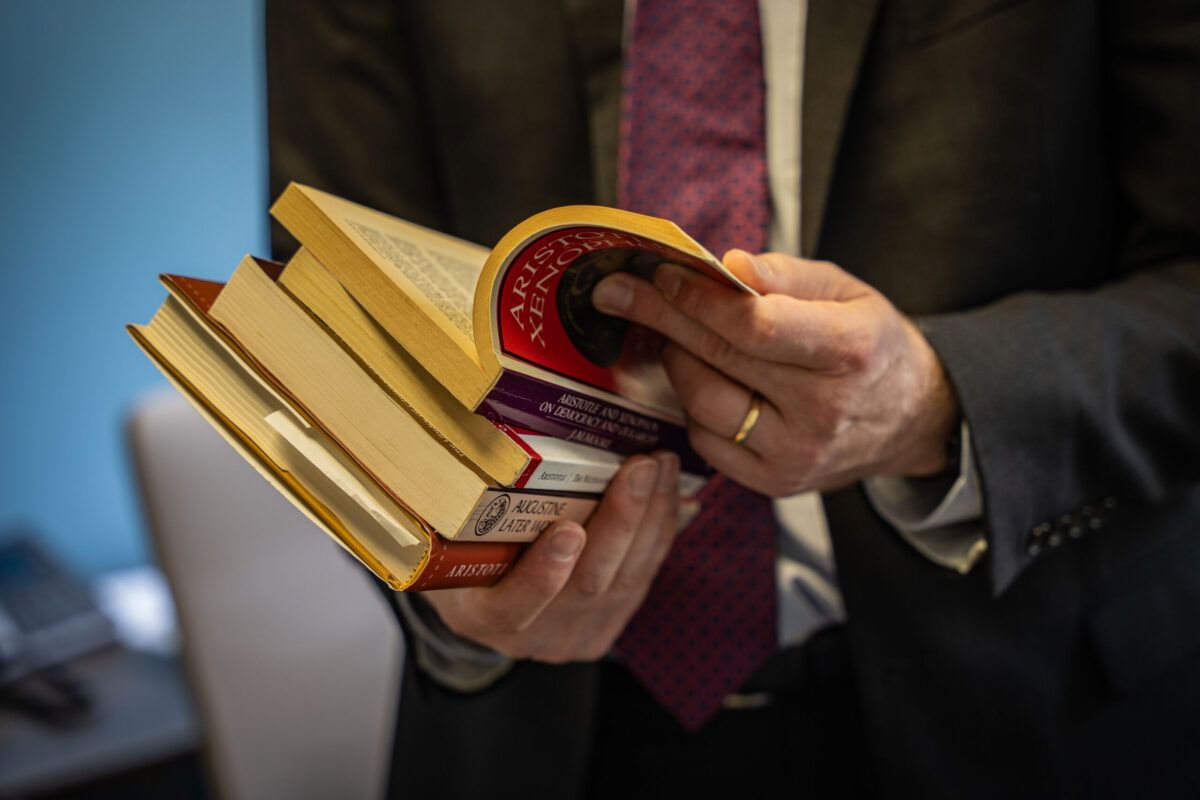
“If done right,” Atkins said, “the American university is the best place to equip young people from varied backgrounds to have meaningful conversations across differences.” (PHOTO: Carolina Alumni/Cory Dinkel)
The academic side of Transformative Ideas is a set of courses geared to sophomores; enrollment limits in the individual courses tend to be reached quickly, and the total enrollment is typically 250 to 300. Offerings include “How to Rule the World: Empire and Global Governance From Greece to America,” “Human Flourishing in a Digital Age” and “How to Think in an Age of Political Polarization,” which Rose teaches. (Rose recently left Duke to join the School of Civic Life and Leadership as a professor of the practice.)
Atkins’ entry in the mix was “The Good Life: Religion, Philosophy and Life’s Ultimate Concerns.” The course looked at how philosophical or religious traditions — Stoicism, Christianity, Islam, Confucianism, Buddhism, scientific naturalism, utilitarianism — have answered life’s biggest questions, based on their starting points and assumptions. Atkins pulled in philosophers and other scholars in those traditions and, in a typical class session, put two of them in dialogue, say, around Islam and scientific naturalism.
A former student in the course, Kate Donofrio, now a Duke senior, said Atkins is “a very intentional instructor. He strikes the perfect balance between nourishing student voices and promoting discussion, while always being in control of the classroom. It’s a hard line for a lot of professors to walk, but he does it very well.”
She was especially intrigued by the discussions of Stoicism, a philosophy that considered living a virtuous life as the key to happiness. Donofrio said she continues to linger over those discussions in considering her own life. It’s a philosophy for powering through challenges, she noted, but it has limitations. One of her class papers argued that in walling off individuals from things they can’t control, Stoicism, in Roman times, was hardly an effective prescription for challenging state power.
Discussion sessions for “The Good Life” were held in a dorm, rather than a classroom, and led by students who had already taken the course. A former discussion leader, senior Bianca Ingram, said, “Taking ‘The Good Life’ my sophomore year was a game-changer for me,” when she was seeking out business-related internships. “At the time it seemed that my peers and I were thinking more about what happens directly after college and not as much about the grand scale of our lives. When picking classes for the semester, I think a lot of students ask themselves, ‘How will this help me get a job?’ instead of ‘How will this help me develop as a human being?’
“I wanted to be a discussion leader because I love it when students are given space to develop their ideas, have those ideas challenged and grow because of it,” Ingram said. “In my discussion section, I noticed that a lot of the students would discuss both Stoicism and Christianity, but despite the two disciplines being very different, they were able to interpret meaning and value from both.”
Often the theme of fate would come up — maybe because the students were facing fraught decisions about an undergraduate major and the path beyond graduation. “From day one in my section, I set a tone for our discussions by telling my students that disagreement is OK, and you can add value by disagreeing because you could be bringing a new perspective that no one else has considered to the table,” Ingram said.
A call to lead
There are other sides to Transformative Ideas. Early in the fall semester, every student in the program is invited to a weekend retreat in Black Mountain. The retreat has the aura of summer camp: communal meals, archery, rock climbing, water sports, singing around a campfire, spontaneous conversation. “As a student, you’re often convincing yourself that you’re too busy to take time off,” Ingram said. To push back against that anxiety, Atkins has had the students read Marcus Aurelius, the Roman philosopher-king, on the value of leisure. Aurelius viewed leisure as indispensable to deep personal reflection, which in turn would contribute to the good life.
Transformative Ideas supports a “living-learning community” in a Duke West Campus dorm; this fall, it has 20 residents. “I knew it was going to be a good, lively space,” a setting for students with “a shared commitment to discussion,” said Luca Adamo, a junior who lives in the dorm. Adamo considers Transformative Ideas, in all its iterations, “the big defining thing of my time at Duke.”
“The students there want to get more out of their education,” added Jason Murray Jr., a junior and dorm resident. “They don’t want to just do their economics or computer science degree and leave. They want to absorb themselves in deeper questions, in a community that’s politically and religiously diverse. It’s all about truth-seeking and intellectual curiosity. It’s like being in class outside of class.”
Some of those dorm-based discussions take place through social activities, including pizza-suffused movie nights: Forrest Gump, The Matrix, The Pursuit of Happiness. Somewhat more formally, the dorm last year provided the setting for a half-credit student-taught course, “The Crisis of Meaning.” Can money buy happiness? (Atkins came in to help lead that discussion.) Do political identities provide meaning? What about the power of beauty in our lives? Is love the true path to fulfillment? Students worked through short readings, from Plato’s Republic to Tolstoy’s The Death of Ivan Ilyich. The 13 who enrolled last year, Adamo and Murray said, all showed up for every meeting of the house course.
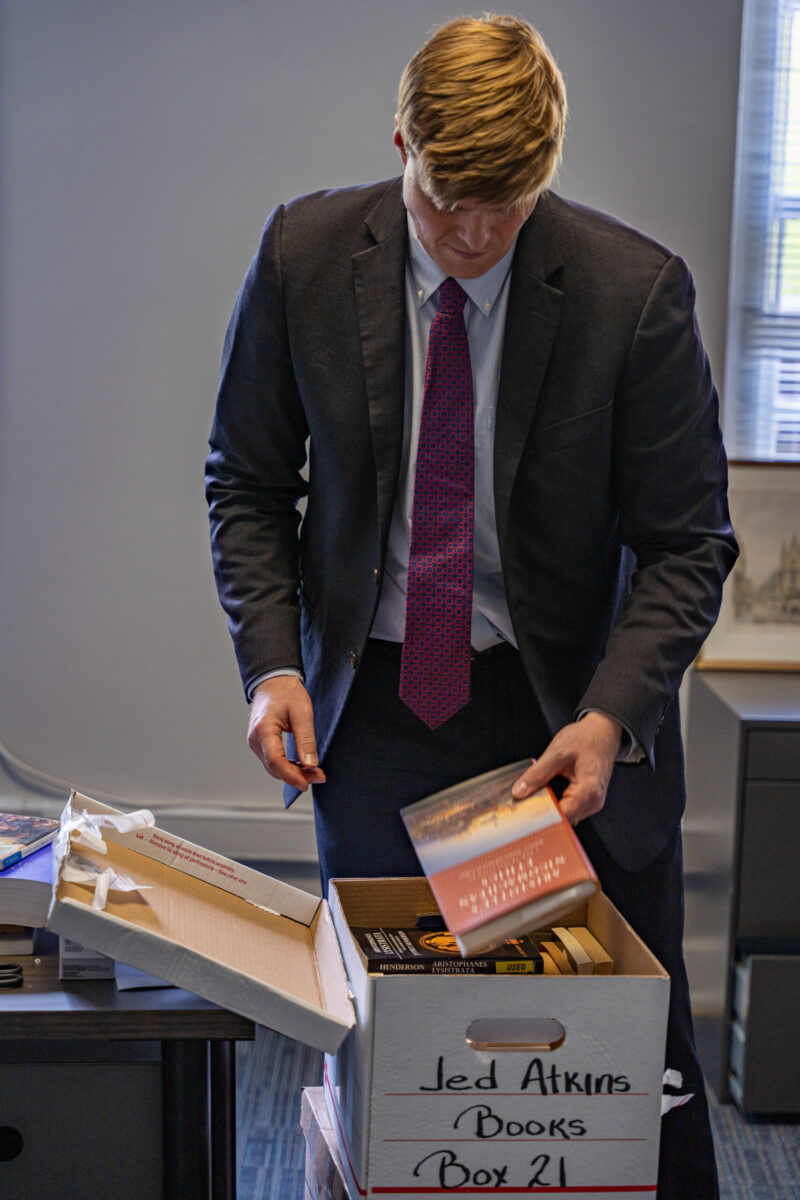
“When I was in college, the study of Greece and Rome ended with the supposed fall of a civilization,” Atkins said. “Now there’s an emerging subdiscipline, reception studies, which acknowledges that the way these cultures have been read is itself an interesting and important part of the classical world.” (PHOTO: Carolina Alumni/Cory Dinkel)
Last year Adamo and Murray were co-teachers, new roles for them. And Atkins was a role model. “Professor Atkins is a very inspiring person,” Adamo said. “He embodies the values of Transformative Ideas by faithfully representing all the traditions he teaches and giving them the depth and nuance they deserve. It feels good to be in service to his mission.”
Adamo reaches back to Plato for a transformative idea that has guided his way through college: Virtue is a prerequisite for happiness. And wisdom is a prerequisite for virtue.
Rose, Atkins’ colleague, said Atkins feels the call to lead, particularly at a vulnerable moment for the country and higher education. “He’s somebody who feels higher education could be better, that it could be an important instrument in making America better,” he said. “He’s attuned to the ways in which America is hurting — the tribalism, the siloing, the polarization. He feels universities can and should be doing more to remedy these ills. And he thinks the solutions have to be at a scale comparable to the problems, which is to say, big.”
Atkins built on that idea at Carolina this past January, as part of the search process for the founding dean. “If done right,” he said, “the American university is the best place to equip young people from varied backgrounds to have meaningful conversations across differences.”
Some universities, including Carolina, were established for that very purpose, he noted. When members of the N.C. General Assembly met in 1789 to establish UNC, they committed themselves to promoting the happiness of a rising generation and to equipping them “for an honorable discharge of the social duties of life.” Civic education, as Atkins sees it, at once recaptures historic principles and represents a shift in the work of the modern-day research university.
A couple of days before teaching his last Duke class, Atkins makes a morning stop at a coffee house located, appropriately, between Duke and Carolina. While his colleagues describe him as a workaholic, he resists a routine of constant caffeination; coffee breaks twice a day or so are “great to break up my many meetings.”
Atkins talked about how this still-forming School of Civic Life and Leadership, a school that embraces education, mentoring, engaging with leaders who model civil discourse and practical experience through internships, might have a transformative impact on North Carolina and beyond. Beginning this fall, the school is offering two newly developed courses, one exploring the foundations of American democracy and the other looking at how civil discourse in the classroom might be promoted. Both are fully enrolled. One model he’s researched is James Madison College at Michigan State University, a liberal arts college embedded in a state research university. Instructional space is integrated into residential space. Students choose among four majors in the college; classes are small and discussion-rich.
The discussion-rich life of Cicero, along with the faith in respectful conversation that it represented, serves as a guidepost for Atkins. He wouldn’t want his children to grow up in a culture that isn’t practicing civil discourse, he said. So taking on the leadership of this new school is, to him, a statement of personal integrity — and of optimism.
“I knew this was going to be a big and challenging job. It has been as big and as challenging as I ever could have imagined,” he said. “But it’s better than I could have imagined. I’m energized by what we’re building. I’m having the time of my life.”
Robert J. Bliwise is founding editor and editor emeritus of Duke Magazine and author of The Pivot: One Pandemic, One University.
Thanks for reading the Carolina Alumni Review
Carolina Alumni members, sign in to continue reading.
Not yet a member? Become one today.