Best-Laid Plans
Posted on Jan. 27, 2025Bland Simpson ’70 has retired after 40 years teaching English at Carolina, having put an indelible mark on the University and the state he loves.
He’s not finished.
by Mark Derewicz
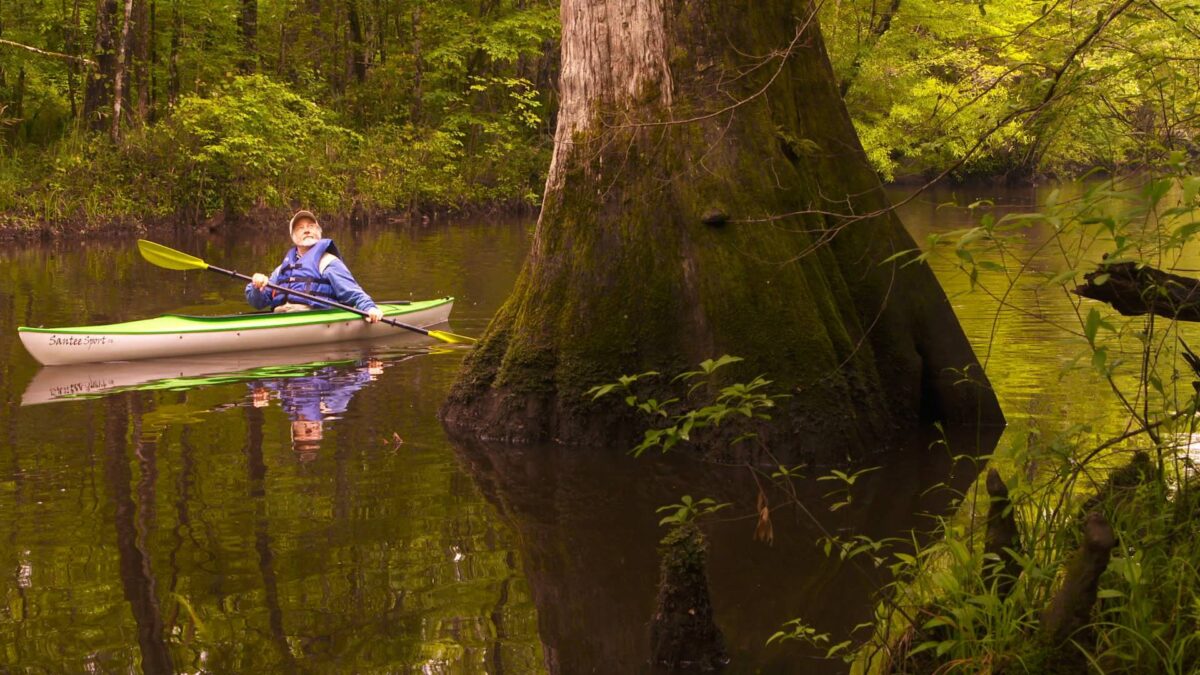
Simpson never had planned on becoming a part-time instructor, let alone a distinguished professor or director of Carolina’s creative writing program or chair of the English department. (Photo: Bland Simpson)
Bland Simpson ’70: Writer. Piano player. Singer. Professor. Red Clay Rambler. Suspected spy for the Islamic Salvation Front in Algeria?
The year was 1992, and the Tony Award-winning, Durham-based string band Red Clay Ramblers had landed in Algiers for a concert. The then-44-year-old Simpson, never one to wait around all afternoon for an evening show, wandered from the hotel alone, a camera slung around his shoulder.
Along a shady lane, he noticed two long lines of oddly shaped pine trees with branches bending and twisting, drooping almost like willows, creating a canopy over the pavement that stretched into the distance. Simpson, a naturalist at heart, was mesmerized. Nothing like those pine trees grew stateside. He snapped photos from different angles until he noticed four men in plain clothes swiftly approaching.
“Monsieur,” one said, waving a hand in the air. “Who are you?”
Startled, Simpson said, “Uh, my name is Bland Simpson, and I’m — ”
The men flashed police badges. Simpson eyed their IDs while handing over his passport and said, “I’m a guest of your minister of — ”
“Why are you taking pictures?” one man snapped.
“The trees,” Simpson said, looking and pointing. “The trees are beautiful.”
The men looked at the trees, unimpressed, then suspiciously at Simpson, salt-and-pepper bearded, bespectacled and innocent as pie.
One of them said, “You must come with us.”
Fortunes in his favor
Bland Simpson: The Trees Are Beautiful. This could be the title of his memoir. The trees: solid, rooted, beautifully unique capturers of light and water, forever here with us as long as we tend to them, like Simpson, the accidental professor, and the friends he’s made throughout decades spent celebrating and chronicling wooded places and waterways of the Old North State and the stalwart people who call North Carolina home.
He’s authored 11 books — 10 with UNC Press since 1990, five of them collaborations with his wife, Ann Cary Simpson ’78, as photographer — including North Carolina: Land of Water, Land of Sky, winner of the 2021 North Caroliniana Society Book Award. He seems to write music and lyrics as effortlessly as most of us have simple thoughts. He and his Rambler bandmates have scored films, performed on Broadway, toured the world and appeared on the most popular television and radio shows in the country.
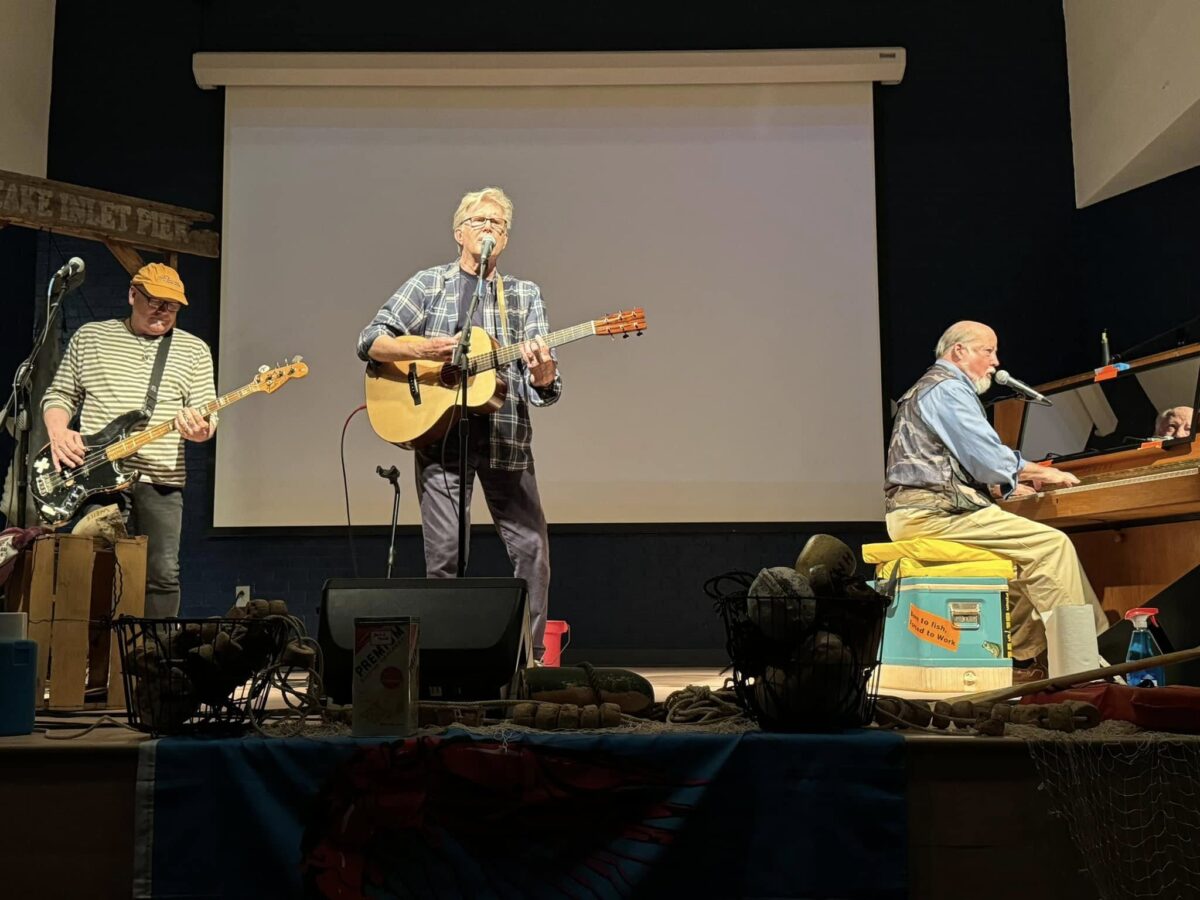
Simpson (far right) in May 2024 performing King Mackerel & The Blues Are Running with Don Dixon ’73 (left) and Jim Wann ’70 in Morehead City
With musician/singer-songwriter stalwarts Don Dixon ’73 and Jim Wann ’70, Simpson created in 1985 the popular theatrical performance King Mackerel & The Blues Are Running. After scores of shows in North Carolina and New York City in the 1980s and 1990s, the trio continued to perform their unique blend of stories and songs of the sea for the next 40 years, culminating in performances later this year to celebrate the show’s 40th anniversary.
Simpson is also a mentor, a man who forged an impressive professorial career at Carolina, including the creation of several writing courses and the musical writing concentration within the creative writing minor.
Anyone ever lucky enough to spend hours talking to Simpson, they’d hear stories of the people who’ve enriched his life. He’d talk about something uplifting about the person, as if it was his pleasure to have known them, and that they are a “great friend.” One is singer/songwriter Tift Merritt ’00, who, during a creative writing course 25 years ago, asked Simpson to guide her through an independent study for songwriting. He agreed.
“Everything Bland does is full of kindness and a lot of warmth,” Merritt said. “There is just a golden-hearted initiation awaiting you. You’ll find this with him as a friend, a teacher and a performer. There is nothing territorial with him. It’s all invitation, and that’s such a wonderfully generous place to come from. He’s endlessly generous.”
Case in point, last summer Simpson thought he’d write the bulk of a book about his life on the road with the Ramblers. Instead, he worked with friends to help save the waterfront in Beaufort, a coastal town where he and his wife, Ann, have a modest home. He helped write letters to the editor, worked his connections and helped the locals ward off (for now) a corporation trying to take over the Front Street Town Docks, a move Simpson and others believe would not serve Beaufort well.
While talking with Simpson about his life, it’s clear he believes he’s been fortunate, even though he’s taken risks. Who knows what his life would’ve been like without Carolina. He gives hints, some not so subtle. “Virtually everything good that’s happened to me has to do with this University and the life my alma mater has inspired me to lead,” he said.
Simpson, 76, retired this past semester, not because he’s tired of it or just too tired, but because, “it’s time,” he said. “I think it’s part of the responsibility of a professor to make way for others, and I’ve stayed on longer than the average professor.”
Simpson never had planned on becoming a part-time instructor, let alone a distinguished professor or director of Carolina’s creative writing program or chair of the English department. Nor had he planned on living in the pastoral landscape west of Chapel Hill, a place called Clover Garden, which he’s called home since the 1970s and is the subject of his latest book, Clover Garden, A Carolinian’s Piedmont Memoir. Plans that work out as expected don’t seem to be Simpson’s strong suit. And for that he’s grateful.
“John Lennon was right,” Simpson said. “Life is what happens when you’re busy making other plans. And it’s been a great life.”
The accidental professor
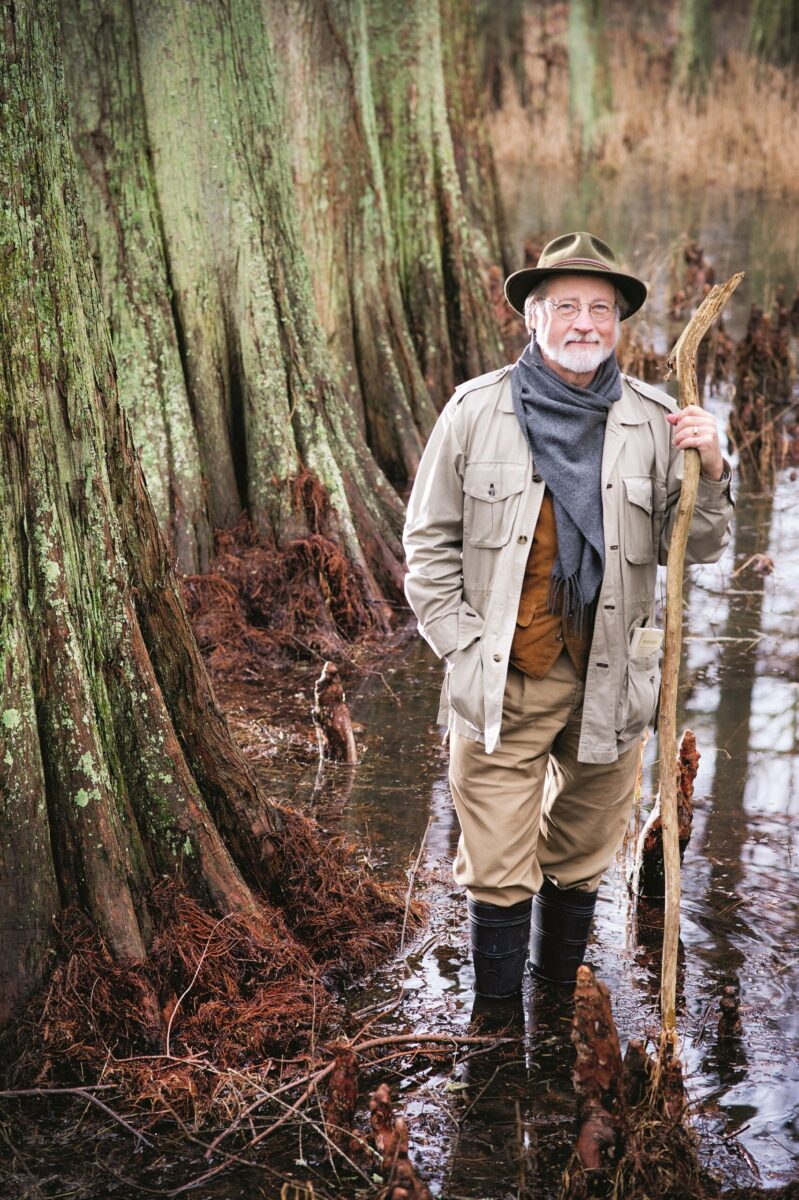
Simpson in 2013. He was born in Durham but grew up in Elizabeth City, among the swamplands of northeastern North Carolina. (Photo: Steve Exum ’92
Simpson was born in Durham but grew up in Elizabeth City, among the swamplands of northeastern North Carolina. He came to Chapel Hill as an undergraduate in 1966 and served as freshman class president for a year before finding homes at The Daily Tar Heel and the downtown Methodist Church, where he served as custodian so he could have access to a piano.
A political science major, he was never in danger of becoming a politician or pundit or policy wonk. But he sure loved writing about the people and stories of politics, such as the 1964 and 1966 N.C. District 4 races between Democrat Harold Cooley (class of 1920) and Republican Jim Gardner, races Simpson captured in a 5,000-word paper available in the N.C. Collection of Wilson Library, “if you want to know what a 19-year-old college kid thought back then,” Simpson said.
Simpson loved the act of working on a project for hours, days, weeks. “It’s why I like writing books,” he said. “I like pouring myself into something at high concentration for hours and hours.”
While a student at Carolina, Simpson didn’t take a theater class, never performed in a play and didn’t think about writing musicals. He did, though, prefer theatrical professors, such as Lew Lipsitz ’87 (MSW) in political science, Ruel Tyson Jr. in religious studies, Tom Stumpf in English and Walter Spearman ’29 (’37 MA) in journalism. Each one moved and told stories in ways Simpson described as theatrical. Each one encouraged Simpson to write his music. And so he did, so much so that he left Chapel Hill for New York City in 1969 without a degree to sign a record deal with legendary Grammy Award-winning music producer Clive Davis at Columbia Records.
Carolina was in his rearview mirror. Simpson had a plan. He was on the same label as Bob Dylan, the Band, Janis Joplin, and Peter, Paul and Mary. But after Simpson’s debut album, simply titled Simpson, Davis dropped him from the label along with jazz pianists Bill Evans and jazz saxophonist Sonny Rollins. “I was in good company,” Simpson recalled. “Producer Ed Freeman suggested I go and woodshed back home and come back to the city when I had new material.”
While writing music back in North Carolina, Simpson became a freelance reporter and earned an N.C. Press Association Award for a three-part investigative series in the Carolina Financial Times about the lack of city planning on the Outer Banks. He finished up his degree at Carolina that same year, at 24, thinking once again that that was the end of his close connection with the University. He had more plans.
Never losing his zeal for writing music, Simpson and friend Jim Wann wrote a musical called DIAMOND STUDS: The Life of Jesse James, a Saloon Musical, which wound up off-Broadway in 1975. It was a huge hit, and Simpson said it ushered in his and his collaborators’ “real contribution to American musical theater.”
Simpson took theater residencies throughout the 1970s, and in 1983 he published his first book, Heart of the Country: A Novel of Southern Music. That’s when Max Steele ’46, head of Carolina’s creative writing program at the time, asked Simpson to join the English department as an instructor. He jumped at the chance.
“But whatever you’re doing on the outside, keep on doing it,” Steele told him, “because this job won’t ever amount to anything.”
Naturalists in love
Simpson rented a cabin west of Chapel Hill from Eric Schopler, co-founder of UNC TEACCH, the world-renowned autism program Simpson called “one of the most heroic things I’ve ever seen anyone accomplish.” (See “TEACCH Your Children Well,” January/February 2024 Review.)
Simpson said Schopler became a “great friend” and offered to subdivide a chunk of land so Simpson could build a house. Simpson, though reluctant to plant such expensive roots, couldn’t help but fall in love with the southwest-facing forested slope of the Carolina Piedmont locals called Clover Garden. And so, in 1983, as his lecturing career took shape, Simpson built a white Cajun-style cottage a mile down a gravel road that would become his place of solace for decades.
A year later, while consulting and ghostwriting for the local chapter of the Nature Conservancy, he met Ann Cary Kindell, the conservancy’s communications director. Simpson noted how good her work was, and the next time he was at the conservancy office, he learned she had been promoted to the national office in Washington, D.C. He hadn’t planned on seeing her again and thought he never would.
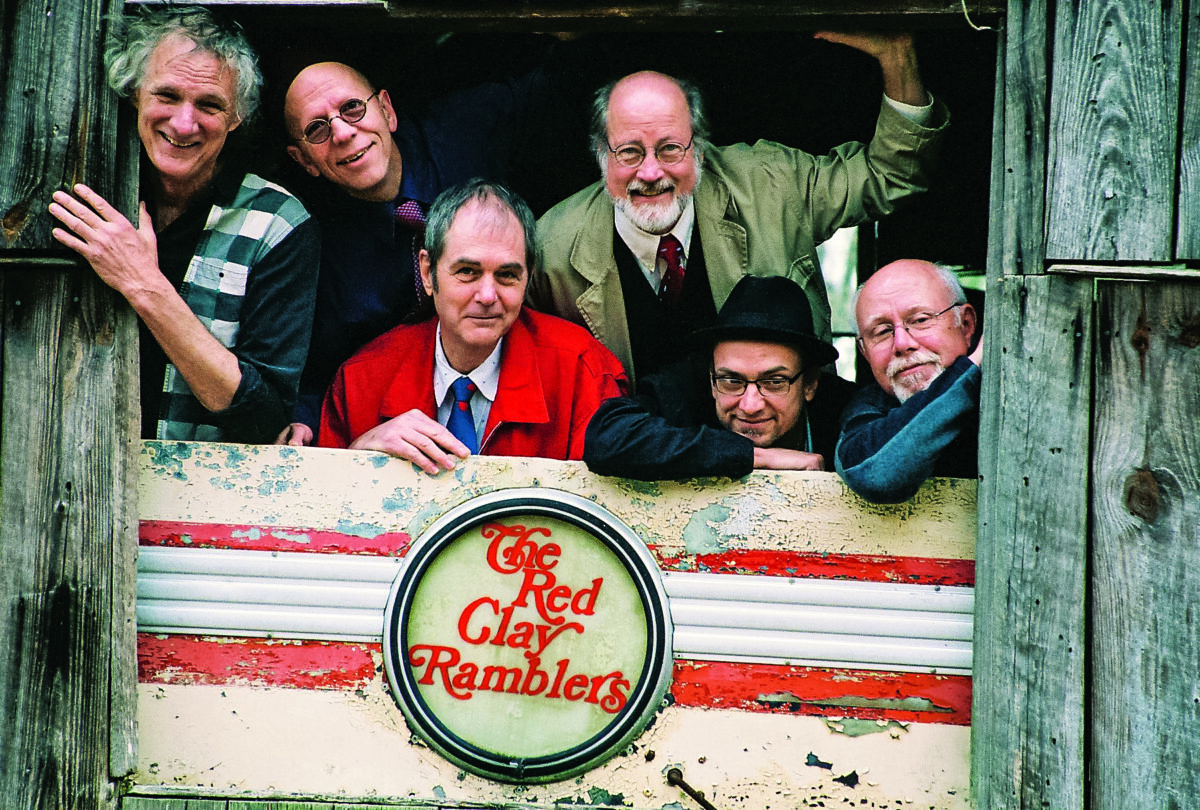
Simpson (top row, right) officially joined the Durham-based string band The Red Clay Ramblers in 1986 after having worked with them for several years. His intitial stint as pianist, singer, songwriter and communications director kept him so busy that he gave up his UNC lecturing job.
Two years later, Simpson joined The Red Clay Ramblers as a pianist, singer, songwriter and communications director, which kept him so busy that he gave up his UNC lecturing job. Life at Carolina, once again, had been fun while it lasted.
One day in 1986, as Simpson thumbed through mail at a country store that doubled as a post office not far from his home, a woman blurted out, “I know you.” Simpson looked up, and it was Ann. “I know you too,” he said. The two naturalists, who hadn’t seen each other in more than two years, caught up briefly before she had to leave. Simpson couldn’t stop thinking about her, and so when he learned she was still working in Washington, he sent her a personal invitation to a Ramblers show in Alexandria, Virginia. “I thought I might get to see her and find out what I thought I needed to know,” Simpson said, coyly.
Kindell did show up, and she did meet Simpson after the show. She did accept a second invitation to another Ramblers concert. And they did have a picnic in the Virginia countryside hours before a concert that summer. A coupledom was forming, and they saw each other when they could while Simpson continued to Ramble, including a stint scoring the soundtrack for the Sam Shepard movie Far North, released in 1988.
After work on the movie was completed, Shepard hosted a dinner in New York City. “Sam was an extremely cool, gifted man, who knew how to make entrances and exits,” Simpson said. “But this time I had to leave dinner first. He shook my hand to say goodbye, and as he fell back into his seat he said, ‘Next time, I’m putting you guys on screen.’ We all heard it, and I said, ‘We’ll be there when you need us, captain.’ ”
Later that year, on a 70-degree Christmas Eve afternoon in Chapel Hill, Ann and Bland were married. The following spring, Simpson sensed a possible lull in the Ramblers’ schedule later that year, so he poked his head into Carolina’s creative writing program, directed by “great poet and friend” Jim Seay, who hired Simpson for another stint as a lecturer in July 1989. That was the year before Simpson published his second book, The Great Dismal, A Carolina Swamp Memoir, from UNC Press, led by editor-in-chief David Perry Jr. ’70, a college friend of Simpson’s.
The Ramblers’ schedule did subside, but it didn’t fade away, especially in the mind of Shepard, who in spring 1992 asked — more like demanded — that the Ramblers come to New Mexico to play the music for, and make an appearance in, the movie Silent Tongue, about a grieving husband played by River Phoenix refusing tradition after the death of his Indian wife. It also starred Richard Harris, Dermot Mulroney and Alan Bates. Simpson told this to Laurence Avery, chair of the UNC English department and admirer of American theater. “Let me get this straight,” Simpson recalled Avery saying. “You have a chance to score the film and appear in a Sam Shepard movie?”
“Yes sir,” Simpson recalled saying.
Simpson said Avery smiled and replied, “Just cover your classes.”
Professors Steele and Jake Mills ’60 did so for three weeks so their friend could play a “medicine show band performer” and frolic with Shepard’s cast, including two clowns Bill Irwin and David Shiner, who, as fate would have it, were putting together a comedy show for two summer nights at Lincoln Center in New York City. “We’d love you guys to join us, do the music on stage as we do our act,” Shiner pitched to Simpson. “It’s in July.”
That was perfect for the Ramblers and Simpson. All they had to do was survive a monthlong spring trip to the Middle East as part of the U.S. State Department’s Arts America tour in Syria, Jordan, Tunisia, Morocco and Algeria, where rumors swirled of a rising political movement the government was trying to keep at bay.
The turning point
In Algeria, four months prior to The Red Clay Ramblers heading abroad, the Islamic Salvation Front, also known as FIS, won 50 percent of the country’s parliamentary seats. A runoff election was imminent, and the party in power feared FIS would win another seat, giving them a parliamentary majority. The government, not necessarily keen on the idea of pure democracy, called off the election. FIS, though largely a political movement, did have a wing of supporters who viewed violence as a tool to influence policy.
American officials briefed the Ramblers. “I do recall the State Department telling us to take no pictures of anything having to do with the military,” Simpson said. On the way to his hotel, Simpson said he noticed jeeps everywhere fixed with 50-caliber guns, but he had no interest in military weaponry, vehicles or even soldiers. But he did have a keen interest in nature, which is why he started snapping photos of those unique pine trees.
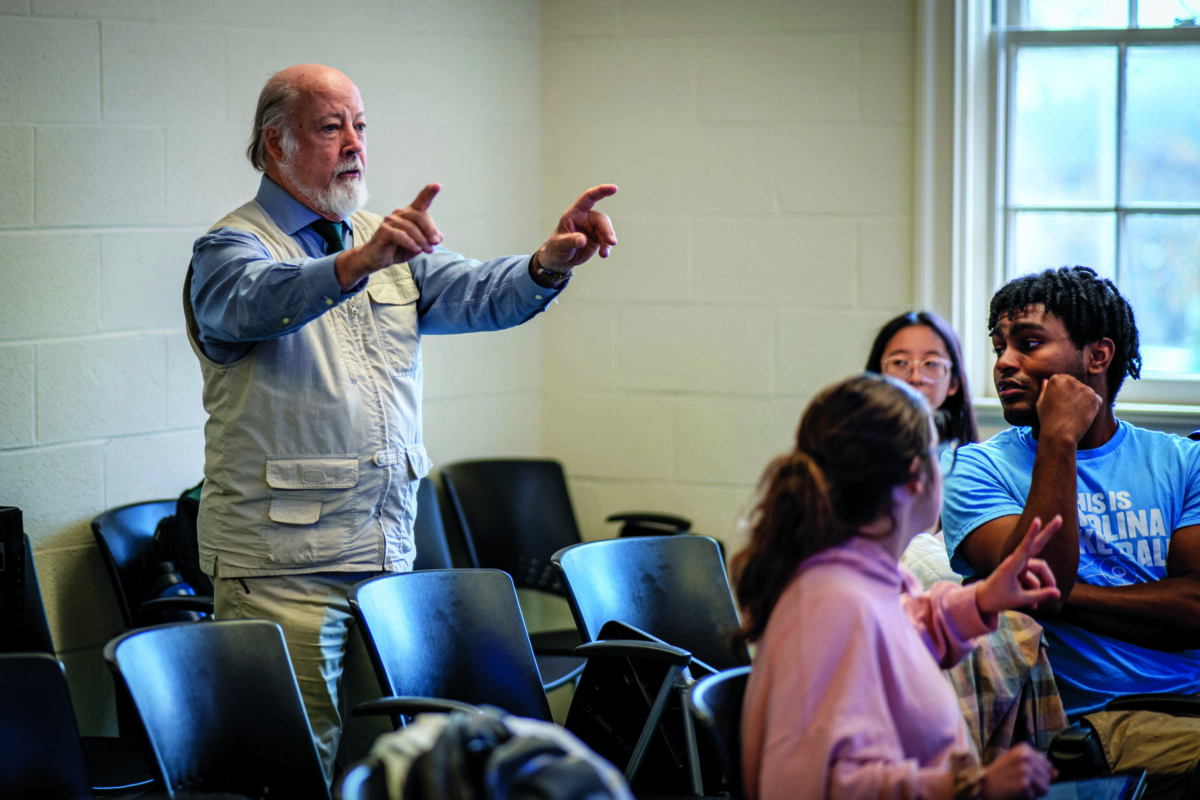
Simpson never planned on becoming a distinguished professor at Carolina. But plans that work out as expected don’t seem to be his strong suit. (Photo: Carolina Alumni/Cory Dinkel)
When four police officers escorted him to the station, they kept asking him why he was taking pictures, expecting Simpson would mess up and say something to confirm their suspicions that he was a spy for FIS. But all Simpson could do was tell the truth; he was taking pictures of trees because he thought they looked interesting.
“They questioned me for more than an hour before their supervisor came in,” Simpson said. “And he asked me the same questions, and I gave him the same answers, to which he said, ‘You do not have trees in your country?’ ”
Simpson said, “Yes, we do, but ours don’t grow like that. Ours grow straight. I love pine trees. These are unusual. That’s why I was taking pictures.”
Simpson learned his interrogators didn’t appreciate his appreciation of nature. “Please,” Simpson repeated, “call your minister of culture. Call the American Embassy. I’m a guest of your minister of culture. I have a show in three hours.”
Eventually the supervisor relented, handed over Simpson’s passport, and told him, “You are free to go. Stop taking pictures.”
Simpson scurried to the concert hall, where the American Ambassador to Algeria Mary Ann Casey said, “So you’re the one who almost caused an international incident.” Paler than usual, Simpson begged for pardon, “Madam ambassador, I can explain. See, I was —”
Casey burst out laughing. Simpson smiled as Casey said, “Of course they thought you were a spy for the FIS because no one in Algeria would take photos of trees and bushes. They only take pictures of themselves, their families and their cars. To them, you were way out of bounds.”
Casey explained that down the road from the trees was a military installation. Flying out the next day, Simpson noticed lines of machine-gun-clad helicopters at the end of the shady lane where he took the photos. He sighed in relief.
After a show in Morocco, Simpson and the Ramblers returned to New York to perform in Fool Moon, the clowns’ comedy sketch and slapstick show. Shortly after, Broadway producer Liz McCann phoned Simpson, who was still the Ramblers’ public relations face, and blurted out (as Simpson recalled), “Bland, I just want you to know that I spent this afternoon trying to get the rights to the clown show, and I want you to know we think your band is a piece of the triangle, essential to the show. I just want you to know we are trying to get the rights.” Simpson was floored.
It was the first and only time a Broadway producer had phoned Simpson to say they were trying to buy the rights to a show, which is why Simpson remembered verbatim what McCann told him. He also remembers it so well because of what happened next.
He hung up the phone and said to his wife, “Honey, the show is going to Broadway!”
And there was Ann, holding their 2-month-old baby. Simpson, in his mid-40s, immediately felt hesitant. “I had already been fortunate, I mean to the point of luck, to get back into the teaching lineup in 1989,” Simpson said. “And here was another ‘I’m gonna join the circus’ moment.”
Fellow Rambler Tommy Thompson ’63 tried his best to cajole Simpson out of his reticence. “It’ll be fun,” Thompson said. “It’ll be a hit.” Simpson knew he was right. “We’ll make a ton of money,” Thompson added. And that’s when Simpson grimaced. By then, in 1992, Simpson could run the numbers on a Ramblers project. He figured if the show flopped, he would lose about $10,000. Or, if the show ran for maybe six months, he would wind up about $10,000 in the black.
“I just couldn’t do this to my UNC colleagues or my family,” Simpson said. “And I did not think I would be allowed back into the teaching lineup again.”
The show did go on, beginning in February 1993, in the heart of the spring semester. The Ramblers, with a rejiggered lineup, performed Fool Moon for nearly eight months on Broadway that year and returned in 1995 and 1998. It won a Tony Award in 1999. Simpson, though, chose to stay at Carolina to teach creative writing as scheduled that semester — and all subsequent semesters in the 1990s, earning tenure in 1998 and receiving many awards and honors of his own, including induction into the N.C. Literary Hall of Fame.
Epilogue
In the late 1990s, Simpson met Merritt, one of many students who took Simpson’s lessons to heart. “I found myself at home in Greenlaw Hall and in the creative writing and American studies departments,” Merritt said. “All my favorite people were there, and Bland was one of them.”
Merritt’s pursuit of an independent study led Simpson to realize he could create a musical writing course, as well as a musical theater writing course. “Unless you go to music school, there usually isn’t a workshop mentality around songwriting,” Merritt said. “It’s something you do in private.”
With Simpson, though, Merritt found someone to push her as a songwriter. “I’ll never forget what he said that stuck with me the most,” Merritt said. “If you’re going to be a musician your whole life, you need to write a lot of different kinds of songs. He was exactly right. I’ve taken it to heart every day since.”
Others couldn’t seem to get enough of Simpson, either. Joseph Terrell ’13, the singer-songwriter guitarist for the string quartet Mipso, took five classes with Simpson prior to the band’s breakthrough album Dark Holler Pop in 2013. Before he took Simpson’s classes, Terrell had no plans to become a professional musician. “I was a religious studies major, but I feel like I minored in Bland Simpson,” said Terrell.

Simpson at his retirement party. His teaching career has ended, but he still plays music and doesn’t plan to stop writing (Photo: Carolina Alumni/Cory Dinkel)
Terrell said he was drawn to Simpson because of his varied experiences. “Bland was 100 percent a professor, 100 percent a musician and 100 percent a writer, a great reminder of what the creative life affords you and maybe requires of you,” he said. “He was a great example for me.”
Terrell and three undergraduate friends formed Mipso for fun, with no career in music in mind. But they were very good — featuring close harmonies and combining traditional string band and modern music sensibilities — and they became popular. By Terrell’s senior year, he told Simpson the band were thinking of going all in, even though they thought it would be really hard to make it, and none was sure they should even try. “Bland was so matter of fact about it,” Terrell said. “He was the only professor who was like, ‘Yeah, of course. You’ll make it work. It’ll be great.’ ”
Terrell’s band has produced a slew of albums and have toured worldwide for a decade. Last year, Terrell finished producing Mipso’s second volume of live music based on 50 of its most recent shows. He has a burgeoning solo career, and he was a guest lecturer last fall at Davidson College, where he taught the history of lyric. “I thought a lot about Bland Simpson,” he said.
Simpson’s teaching career has now ended, but he still plays music, and he doesn’t plan to stop writing. One book idea he is considering is about boats of North Carolina, a possible collaboration with “great friend and brilliant historian” David Cecelski, he said. Another book idea is on North Carolina farming, with a focus on small agriculture and “the energetic younger generation,” he said, and added he has a “picaresque novel” in him, about a senior high school class beach weekend in 1961.
He’s also working on a book of essays and stories about his life as a traveling musician, including vignettes about the times he wandered off alone, like he did in Algiers in 1992. “That story, and many others, will be in there,” he said.
And the beautiful trees? Will they be pictured in the book, too?
“Unfortunately, no,” he said. “The Algerian police took my film that day.”
Maybe curiosity will get the best of him; maybe he’ll make a plan to fly to Algiers and have his wife take photos, as she has for half of her husband’s books. Then again, maybe he shouldn’t. Plans seem best left to others.
Mark Derewicz, the former director of research and national news for UNC Health Communications and News Team, joined the Review as senior associate editor in January. His previous article about Bland Simpson ’70, “Allure of the Forbidden Water,” appeared in the March/April 2013 issue of the Review.
Thanks for reading the Carolina Alumni Review
Carolina Alumni members, sign in to continue reading.
Not yet a member? Become one today.