Carolina Curios
Posted on April 3, 2025From Dean Smith’s hand-drawn plays to a long-lost brass plate, Wilson Library’s artifacts tell the University’s story in a new exhibit.
Story and Photos by Ira Wilder ’24
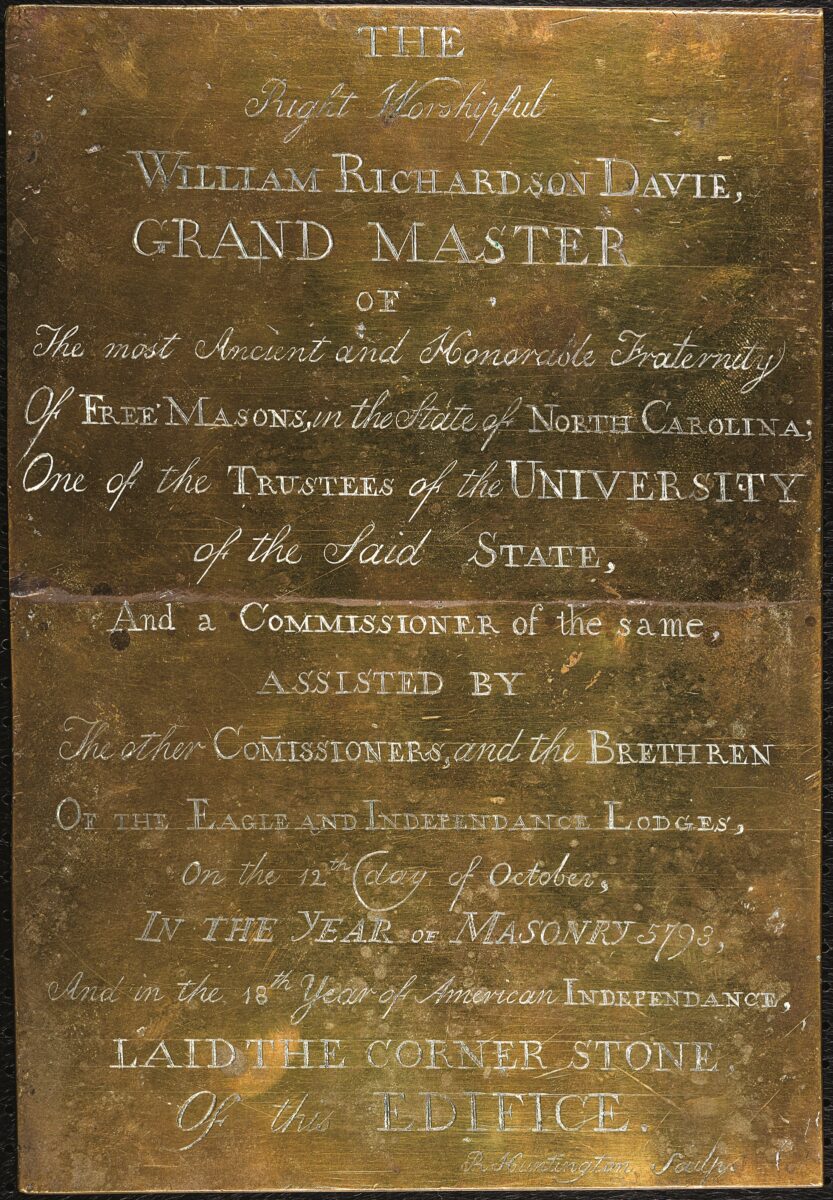
Brass plate, 1793: Laid with the cornerstone of the first University building, which is now Old East, Oct. 12, 1793. Engraved by Hillsborough silversmith Roswell Huntington, one side is inscribed in English and the other in Latin, both referring to the date as “the year of Masonry, 5793.” Many of the University’s founders were Masons; William Richardson Davie, named at the top of the plate, was the leader of the Freemasons of North Carolina. The plate and the cornerstone disappeared in the late 1870s, but decades later it was discovered in a foundry in Tennessee. The owner of the foundry, Thomas Foust (class of 1903), recognized it and knew it was of importance. The plate was returned to the University in October 1916, just in time for University Day.
In 1792, the University’s founders commissioned Hillsborough silversmith Roswell Huntington to engrave a brass plate commemorating the University’s founding. On Oct. 12, 1793, a crowd gathered to watch the cornerstone of Carolina’s first building, what is now Old East, lowered into position from a timber tripod. William R. Davie, the University’s founder and North Carolina’s Grand Master Mason, placed Huntington’s 5-inch-by-7-inch brass plaque into a carved slot in the cornerstone on the southeast corner of the building. The plate’s engraving includes a brief description of the event and marked the date for future generations to remember. (See “What Happened to Old East Cornerstone?” April 1990 University Alumni Report.)
Carolina’s founders intended the plaque to be a testament to the occasion’s significance: the physical beginning of the nation’s first public university. But the permanence they sought to symbolize proved elusive.
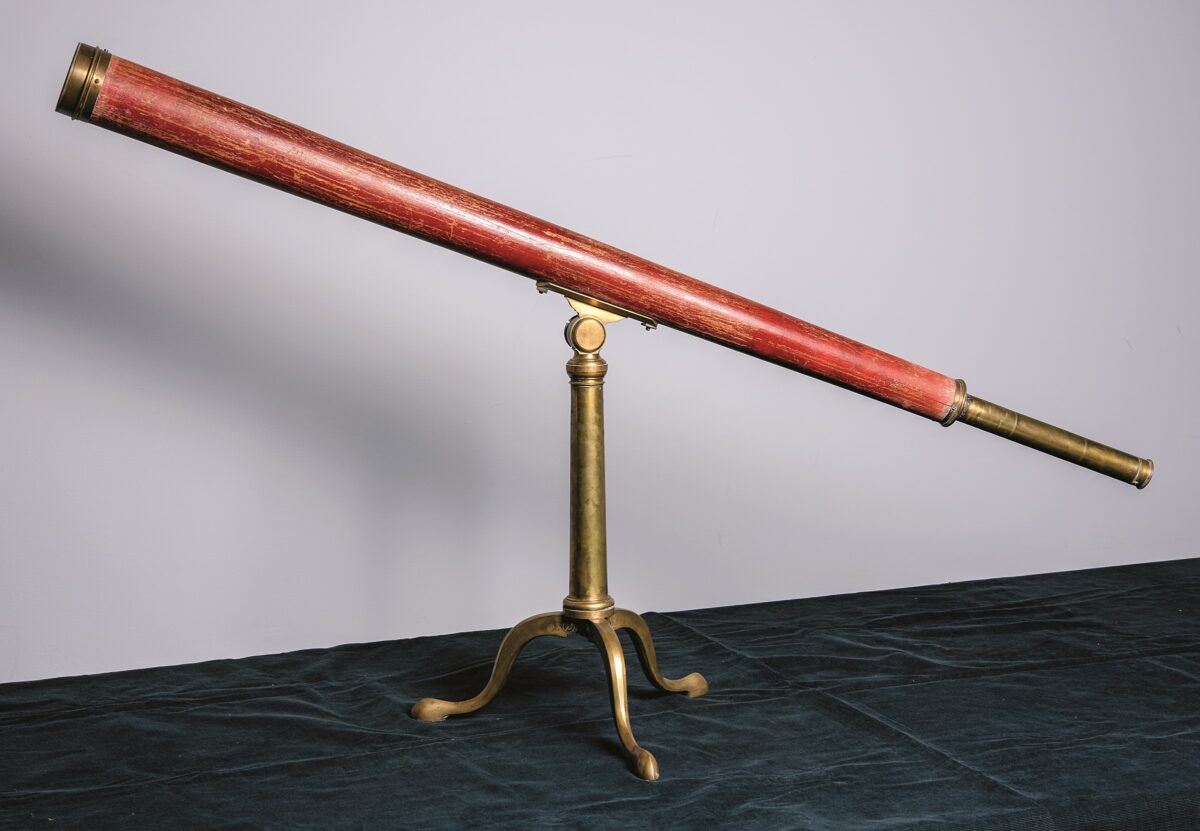
Telescope, 1824: University president and math Professor Joseph Caldwell sailed to Europe in 1824 to purchase books and scientific equipment for the University (its trustees allotted him $6,000 to do so). This refracting telescope was one of thousands of items he acquired, and Caldwell oversaw the construction of the first astronomical observatory on campus to house his purchases. The observatory was completed in 1827, and was the country’s first astronomical observatory on a college campus. It was a single-roomed brick building, located near the cemetery. It fell into disrepair after Caldwell’s death in 1835 and was dismantled.
By the late 1870s when the University reopened after five years of closure during Reconstruction, the original cornerstone and its plate were missing. Some blame the disappearance on the Union soldiers who occupied Chapel Hill; others blame mistakes during renovations to the building decades prior. The cornerstone’s whereabouts remain unknown.
In September 1916, a foundry foreman in Clarksville, Tennessee, was preparing to melt a pile of scrap brass when he noticed an interesting-looking plate. He showed it to the owner of the foundry, Thomas Foust (class of 1903), who recognized University founder William Davie’s name engraved on the plate. Astonished, Foust knew it must be significant to his alma mater. The plate was returned to the University that year, and it has been housed in the stacks of Wilson Library ever since. (See “The Presentation of the Plate,” November 1916 Alumni Review.)
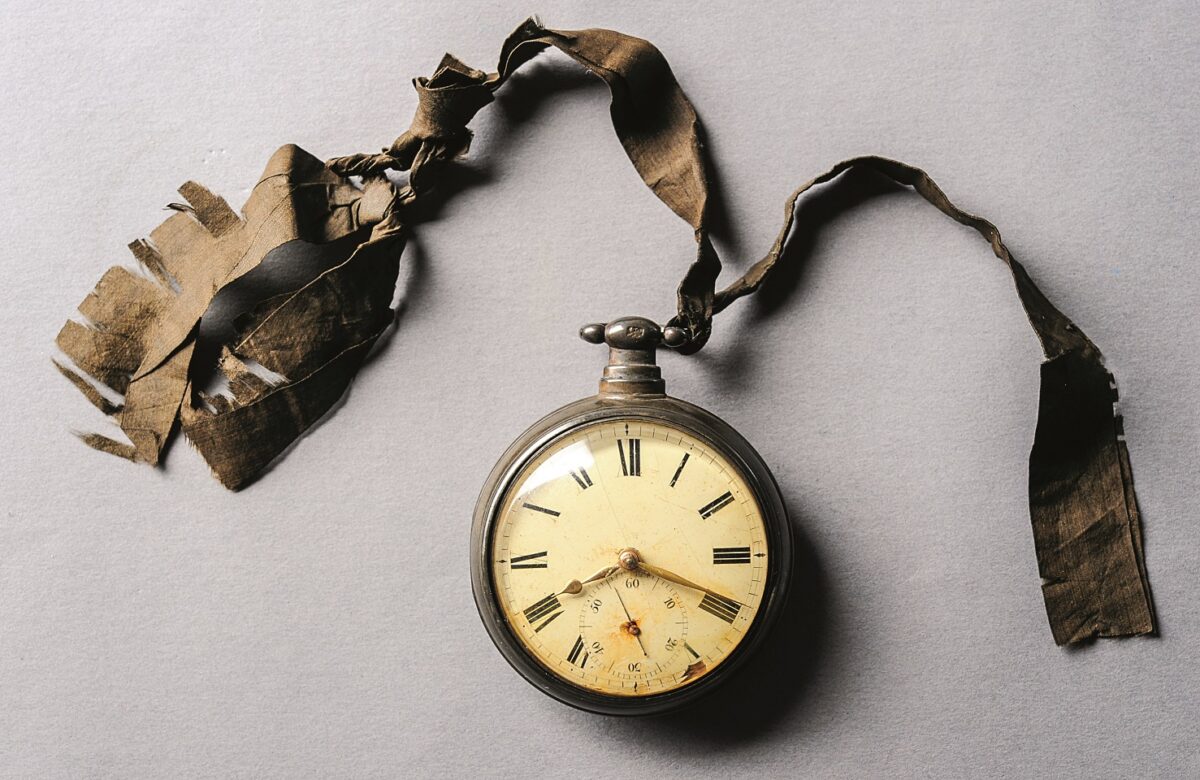
Mitchell pocket watch, 1857: Elisha Mitchell worked as a geology, mineralogy and chemistry professor at UNC from 1818 until his death in 1857. Over several decades, he surveyed a peak in the Black Mountain range he believed to be the highest point in the eastern United States. While proving his theory, he slipped while walking after dark, hit his head on a rock and fell into a pool of water, where he drowned. His pocket watch broke on impact and recorded the exact time of his death, 8:19:56. The mountain, later verified as the highest east of the Mississippi River, was renamed Mount Mitchell in his honor. The pocket watch was donated to the library by Mitchell’s great-grandson in 1929 and is one of the items most requested by visitors.
The plate is now one of 23 University-related artifacts on display in “Priceless Gems: Treasures from Carolina’s Past,” a special collections exhibition in Wilson Library that will run through May. The exhibit is in the North Carolina Collection Gallery on the main floor of the library and is open to the public during business hours Monday through Friday.
Collection curators chose the items and audio clips for their uniqueness, historical significance and the compelling stories they tell about the University.
Linda Jacobson, keeper of the gallery, said each of the artifacts is a priceless gem — hence the gallery name that harkens to Carolina’s official school song, “Hark the Sound” by William Starr Myers (class of 1897). Appropriately, an early 1900s typewritten copy of the song’s lyrics are on display. (The original manuscript is too fragile to display for a long period of time.)
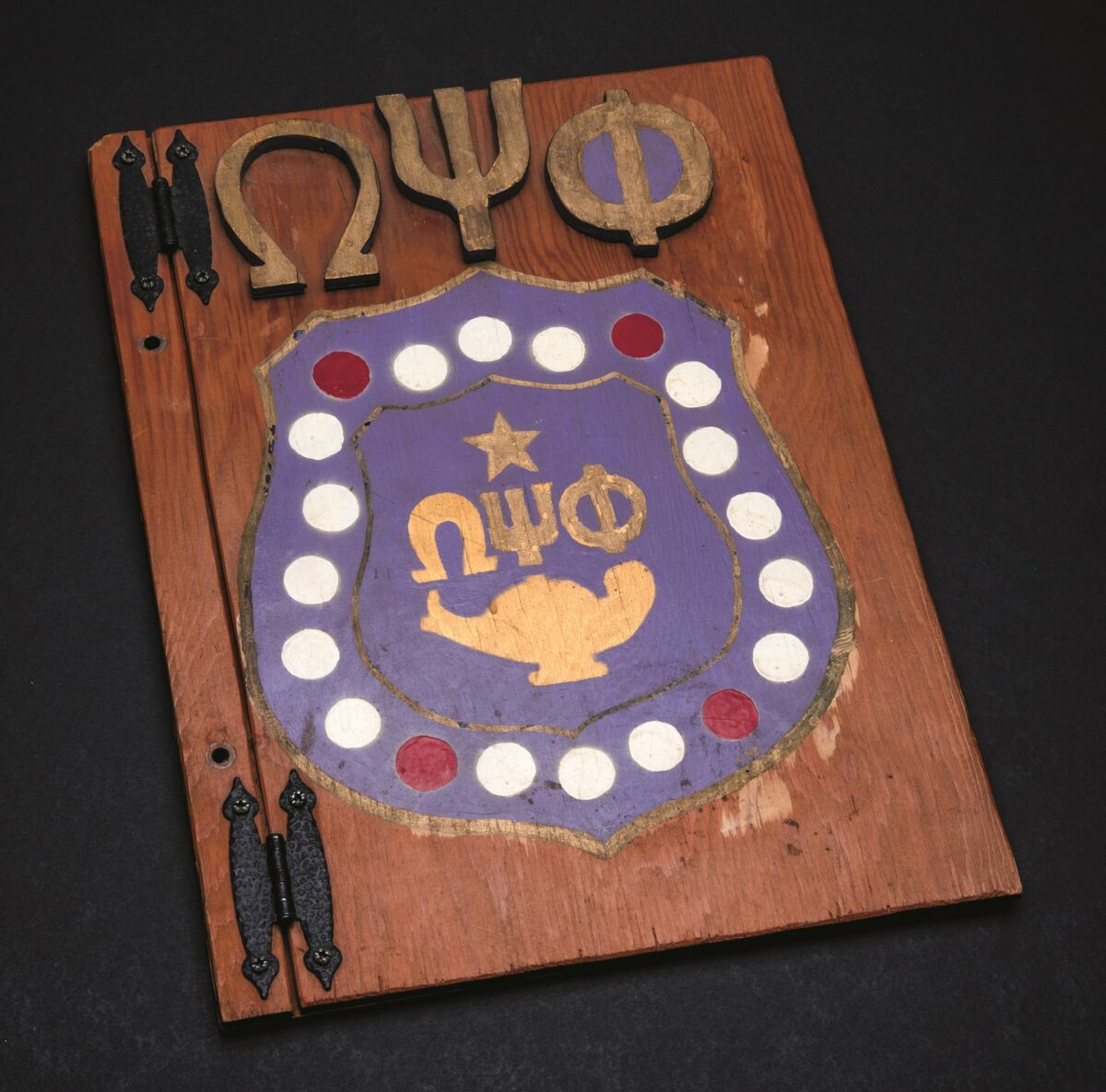
Psi Delta Chapter of Omega Psi Phi fraternity scrapbook, 1973: This scrapbook documents through photos, news clippings and other ephemera the first semester of Carolina’s first historically Black Greek organization, chartered Feb. 16, 1973. The chapter was founded by Paul Woods and Herbert Davis ’73 (MS, ’80 MPA, ’88 EdD), with assistance from John Scott ’73. That semester, the chapter initiated nine brothers, “The Nasty Nine.”
Jacobson invited each of Wilson Library’s five special collections — the North Carolina Collection, the Rare Book Collection, the Southern Folklife Collection, the Southern Historical Collection, and the University Archives and Records Management Services — to nominate items that illustrate the exhibit’s themes: The First 100 Years, Student Life, Student Organizations, Athletics and Notable Tar Heels.
The 23 items are a tiny fraction of the thousands of linear feet of University-related collections in Wilson Library’s stacks. (See “The Nation’s Toolbox,” March/April 2024 Review.) Jacobson said the curators chose items off the top of their heads, most of which are those frequently requested by library visitors.
The artifacts create continuity among students, alumni, the institution and the public, Anna Chen, director of Wilson Library, said in a statement. “At the same time, University records ensure that the institution remains accountable and transparent to its constituents.”
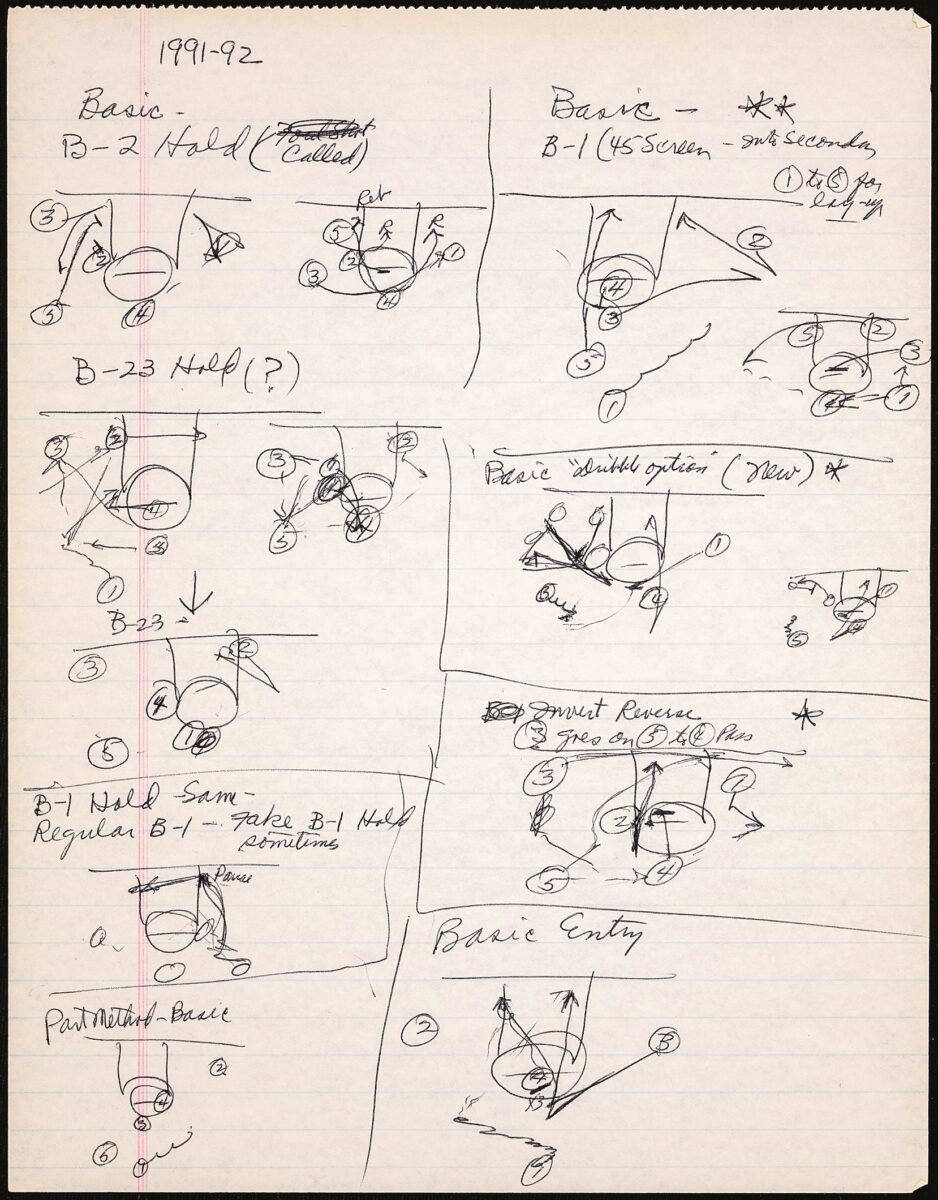
Play diagrams drawn by Dean Smith, 1992–93: In 2017, the family of legendary basketball coach Dean Smith donated his extensive archive of papers to the Southern Historical Collection at the Wilson Special Collections Library. These play diagrams were hand-drawn by Smith during the 1992–93 NCAA championship season. The Dean Smith Papers include about 13,500 items and take up 55.5 linear feet of space.
The exhibit includes a 1939 letter from Pauli Murray, a descendant of enslaved people and enslavers, to UNC President Frank Porter Graham (class of 1909). Murray sought admission to the University’s graduate school, which remained segregated until 1951. She was denied admission on account of her race. Murray went on to graduate first in her class from Howard University and dedicated most of her adult life to activism against racism and sexism.
Also included is Henry Owl’s diploma, believed to be the first awarded to a Native American student. Owl ’29 (MA) used his graduate education to fight the literacy test that was used by western North Carolina officials from 1900 until after World War II to disenfranchise Cherokee voters. (The literacy test remains in North Carolina’s constitution today, as it was never officially repealed, despite repeated and ongoing efforts.) Lolita Rowe, an assistant university archivist, said the diploma holds a special place for her because it’s an example of a student using education to combat injustice and advance his people.
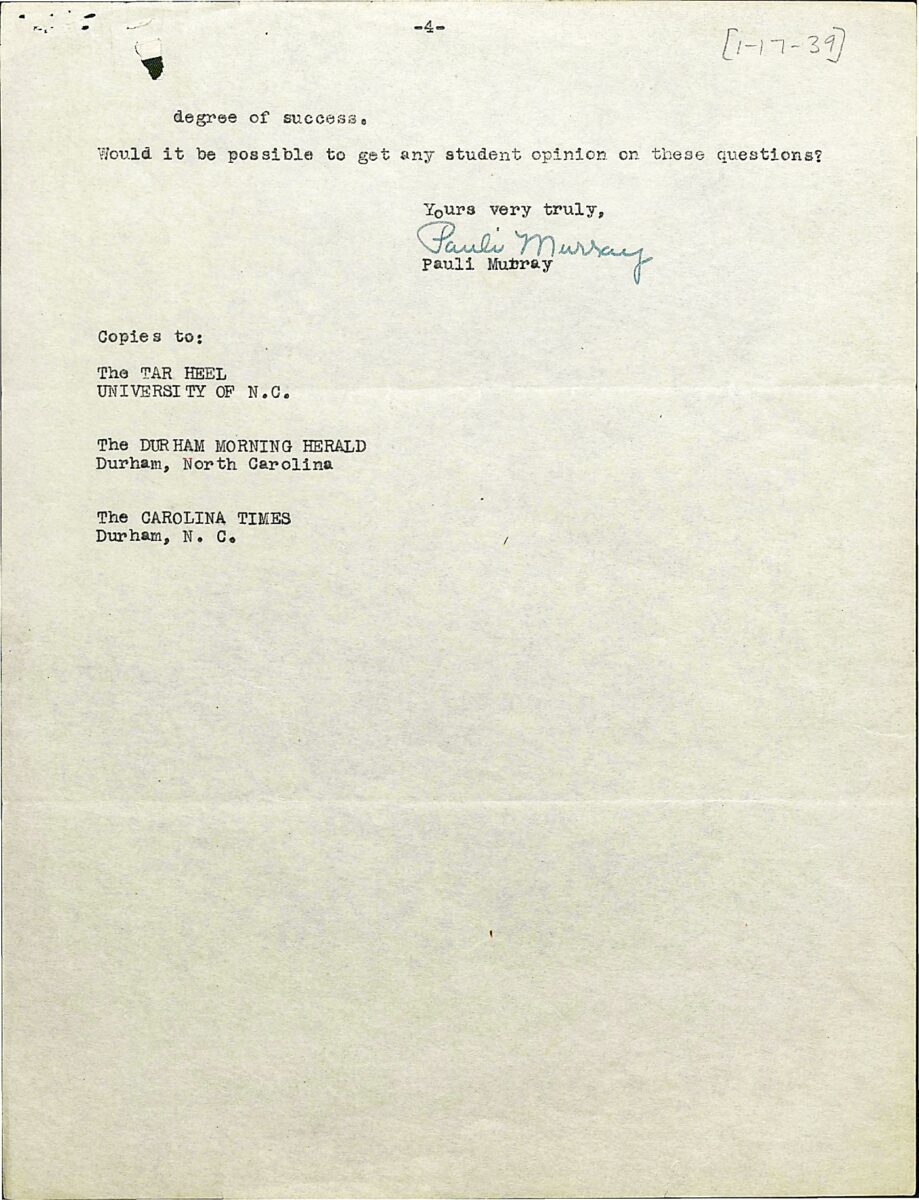
Last page of a letter from Pauli Murray to UNC President Frank Porter Graham (class of 1909), Jan. 17, 1939: In late 1938, Murray was rejected by the University’s graduate school because of her race. The dean of the graduate school, W.W. Pierson, wrote her a letter that simply said, “members of your race are not admitted to the University.”
Murray wrote to President Graham to appeal her rejection. She wrote, “It would be a victory for liberal thought in the South if you were favorably disposed toward my application instead of forcing me to carry the issue to the courts.” The University remained segregated until 1951. Murray, who was a descendant of enslaved people and enslavers (including an early trustee of the University), went on to receive a law degree from Howard University (graduating first in her class), a master’s in law from UC-Berkeley and became the first African American to receive a law degree from Yale University.
“We’re telling Carolina’s story, and each individual makes up who we are today,” Rowe said. “What these stories do is connect everyone. You’ll see items from different people who were not considered to be a part of our community, to people who are now a part of our community. I think that’s what the story tells us — what community is for us today.”
Christian Edwards, assistant keeper of the North Carolina Collection Gallery, said a student left the exhibit “beaming” after seeing in the display case Dean Smith’s hand-drawn plays from the 1992–93 national championship season and the net Smith cut down after the 1982 championship. “He immediately wanted to go to the research room and pull the entire Dean Smith collection to explore,” Edwards said. The exhibit “sparks the imagination, the interest, the desire to learn more, to connect more deeply with our past and why we are who we are and those people before us that made us this way.”
Another item in the exhibit prompted Edwards to share a personal connection to another item: the campfire story her parents, who were North Carolina history teachers, told her about Elisha Mitchell’s pocket watch. Mitchell was a professor at Carolina from 1818 until his death in 1857. While on a hike to prove Black Dome was the highest peak east of the Rocky Mountains, Mitchell fell over a cliff after dark. The watch in his pocket broke on impact, recording the exact moment he died — 8:19:56. In 1881, the mountain was named Mount Mitchell in his honor.
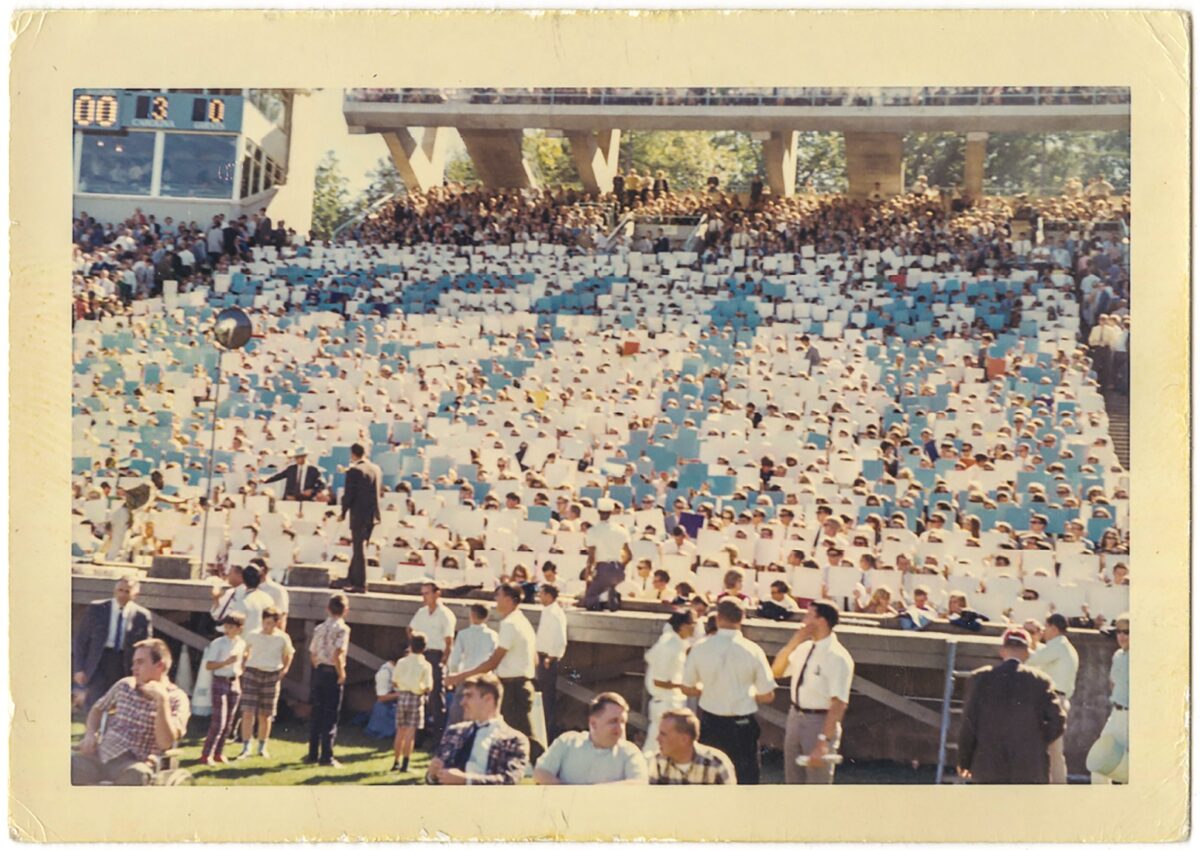
Carolina Cardboard performs at the UNC vs. N.C. State game in 1966: The UNC Cardboard Club planned and executed card stunts during halftime at home football games, flipping colored cards to make designs and spell out words. (The most recurring phrase was “Go to Hell, State.”) The club was founded in 1948 by head cheerleader Norman Sper ’50. By the early 1950s, more than 2,000 students participated in the stunts, and UNC’s card section was believed to be the largest in the eastern United States. The club was disbanded in 1987 in part because students often threw their cardboard panels to the field at the end of games, hitting spectators, most of whom were faculty seated in the section below the students.
Mitchell’s great-grandson donated the watch in 1929 to Wilson, and it is one of the most requested by visitors.
The items on display haven’t been lost to history because of the library’s preservationists and cataloguers. They go to great lengths to ensure the materials are safely stored in the stacks yet provide visitors interested in engaging with the historical materials access to the artifacts.
“What’s the point of preserving them unless you’re sharing them with students and researchers?” Jacobson asked.
Another artifact too delicate to display is a baseball signed in 1943 by Ted Williams, the Boston Red Sox Hall of Famer. He was a cadet in the Navy Pre-Flight School, which trained pilots in Chapel Hill during World War II. While at Carolina, Williams, who went on to fly 39 combat missions during the Korean War, formed a baseball team called the Cloudbusters with other professional baseball players at the Pre-Flight School and competed against local teams. After one game, Williams signed a baseball for John Boring, a teenager at the time. Boring donated the ball to University Libraries last year. Jacobson was eager to showcase the ball in the exhibit, but it didn’t make the cut because the fading signature likely wouldn’t have survived the months of light exposure.
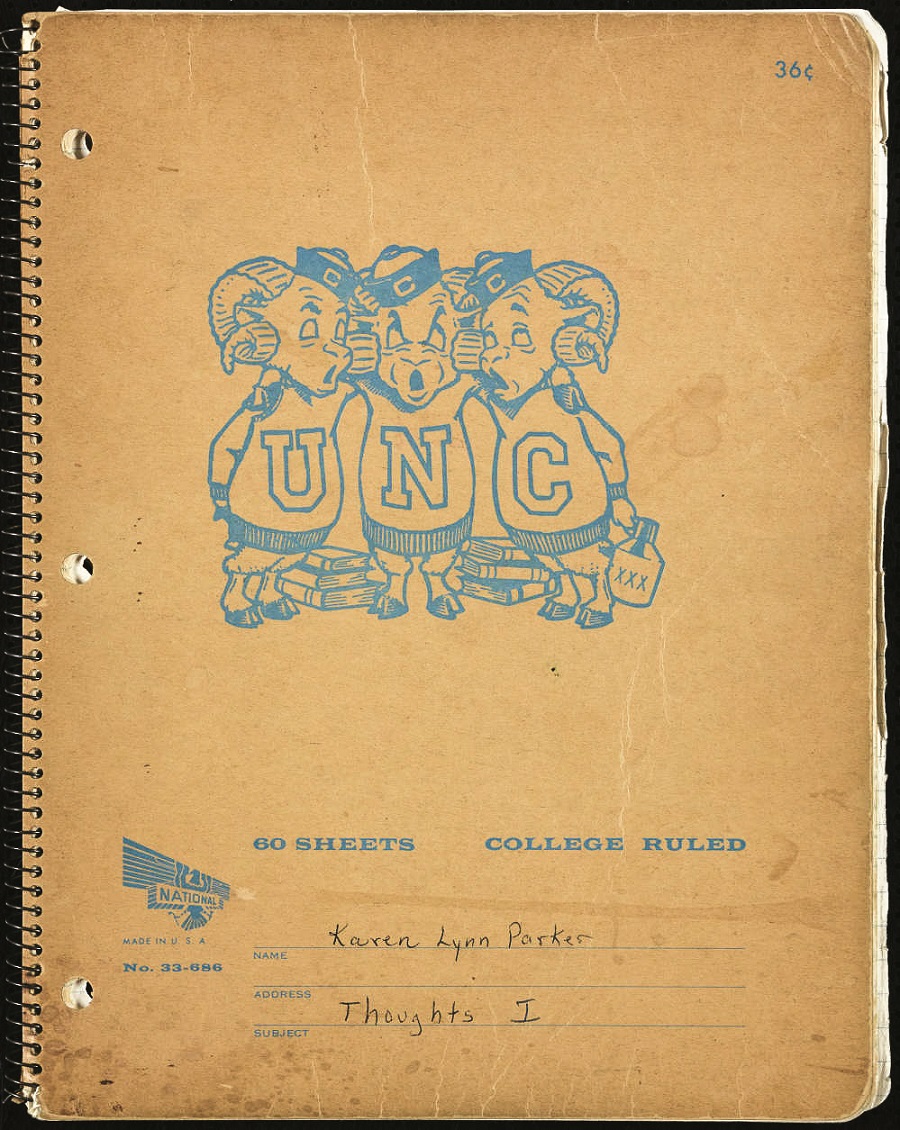
Personal diary of Karen Parker, 1963–66: In 1963, Karen Parker ’65 became the first African American undergraduate woman to attend Carolina. She chronicled her experiences in this diary, in which she expresses her feelings of isolation on campus, and chronicles balancing both being a full-time student and a civil rights activist. She participated in sit-ins, marches and protests in Chapel Hill and was jailed twice for it. “Behaving myself was not my nature,’’ Parker said to a University publication in 2015. After earning her bachelor’s degree in journalism, Parker went on to have a successful career in the newspaper industry, working as a reporter and a copy editor.
The curators said they are pleased other artifacts could be shown, and they welcome alumni and visitors, who will hopefully see themselves and their Carolina memories in the exhibit.
“I hope that the exhibit inspires visitors to think about objects that hold value for them,” Chen said. “And how they might be part of history someday, too.”
Each of Wilson Library’s five special collections nominated items that illustrate the exhibit’s themes: The First 100 Years, Student Life, Student Organizations, Athletics and Notable Tar Heels.