Dorrance World
Posted on Dec. 5, 2024Notwithstanding 22 national championships and 934 wins, Anson Dorrance ’74 evolved to prioritize human development over athletic achievement.
By Tim Crothers ’86
Listen to this story as read by ElevenLabs AI.
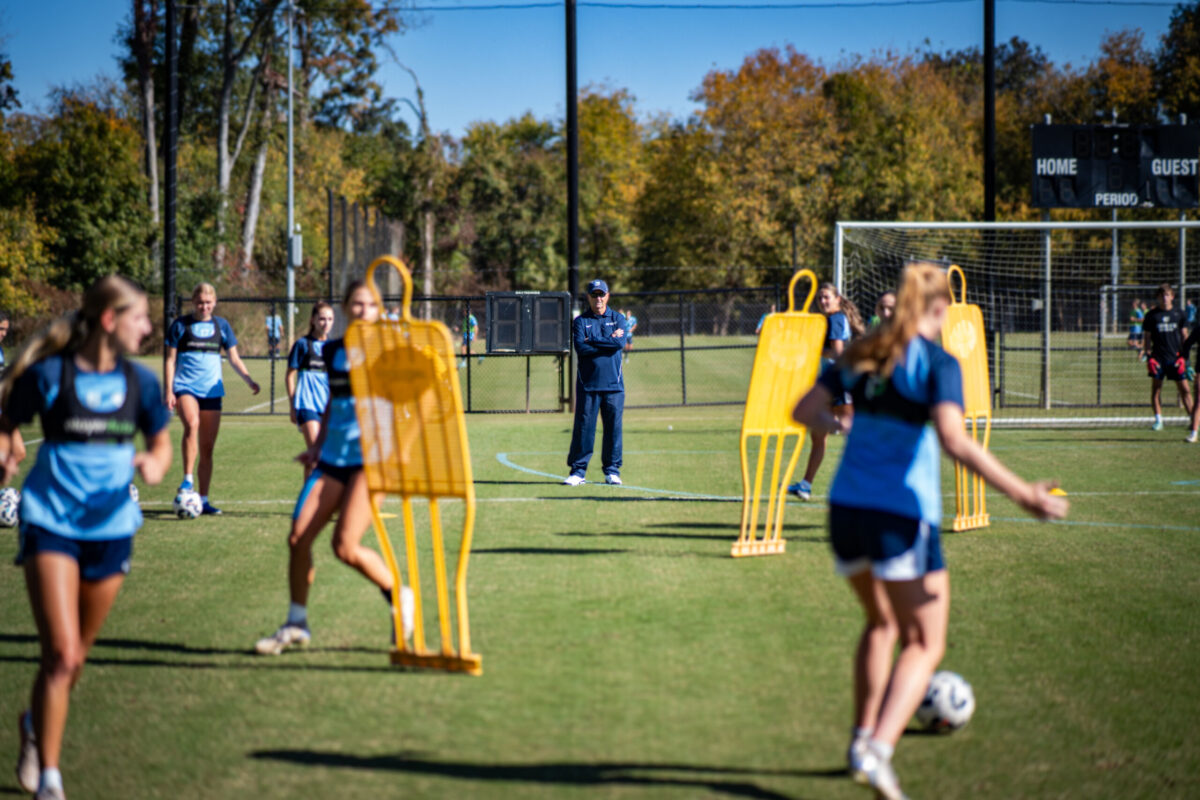
Dorrance admits he was clueless about how to coach women when he first took the job in 1979. As his career progressed, he preached core values, emboldening his congregation to conduct their lives as a never-ending ascension, a concept he borrowed from a comic strip. (Photo: Carolina Alumni/Cory Dinkel)
Anson Dorrance ’74 sat restlessly during an August night as he watched UNC women’s soccer in its 2024 season opener.
From a couch.
In his den.
The Tar Heels, his Tar Heels since forever, were playing their first match without the only coach the program had ever known. For the first time in 46 seasons, 1,076 games, Dorrance was not coaching the Tar Heels.
Sort of.
The 73-year-old Dorrance did regularly bark at the TV, encouraging and excoriating the players like he always has, until his wife, M’Liss, finally said, “Anson, you know they can’t hear you, right?”
When asked how he felt about “couching” instead of coaching, Dorrance replied dryly, “Well, watching on TV, I certainly don’t have as big an impact.”
It had been four days since Dorrance stunned many in the collegiate soccer world by suddenly retiring, following the blueprint of his mentor Dean Smith, who with energy ebbing and anxious to pass the torch to a successor, made a similarly unexpected preseason departure in 1997.
There is history to suggest that Dorrance not only disdains organization, but sabotages it. He not only welcomes chaos, he works to create it. … Dorrance breeds players who evolve to share his love of the unknown because they ultimately have no other choice. “I was so stressed when I first joined the program,” Leslie Gaston [’02] says. “But I honestly feel like being a part of something that’s so crazy all the time makes you cool about everything.”
After a game on September 29, 2002, when the Tar Heels headed to the Portland airport with four hours to spare before an 11:45 p.m. red-eye flight home, it was Gaston who asked Dorrance if the team could go see a movie. Dorrance loved the idea. The team dropped off its bags at the airport and then went to the 8:55 show. At 11:05 the team was still in the theater. With the movie just reaching its climax, Dorrance looked at his watch and announced, “All right, we’re outta here!” With just forty minutes until takeoff and a ten-mile drive to the airport, the Tar Heels made the flight with seconds to spare, giggling as usual at their folly.
So for those patrons at the Century 16 Eastport movieplex that Sunday night who wondered why 25 people stood up at once and dashed out of Sweet Home Alabama with just five minutes left in the film, understand this: It isn’t that they disliked the movie, it’s just that they had a plane to catch.
— excerpt from The Man Watching by Tim Crothers
There’s no whining in soccer
Dorrance retired 23 years to the day since I first walked into his office in August 2001. I asked him that morning whether he’d be interested in collaborating on a biography of his life and the construction of the greatest dynasty in the history of college sports. He agreed. Not because he cared to celebrate past glory, but because he saw it as a future opportunity to dispel myths about his program that his recruiting rivals used against him. He promised to grant me a season of full access, and then he said, “I should warn you, the book will never sell.”
I couldn’t tell back then if he was kidding.
Dorrance was never the coach I expected him to be. That was the fun part. I arrived at his office that day anticipating military organization. Instead, I could barely see him over the pile of paper on his desk. If there was any doubt that he relished his disorder, peeking out of the rubble was a placard featuring the Albert Einstein quote: If a cluttered desk is the sign of a cluttered mind, of what then is an empty desk?
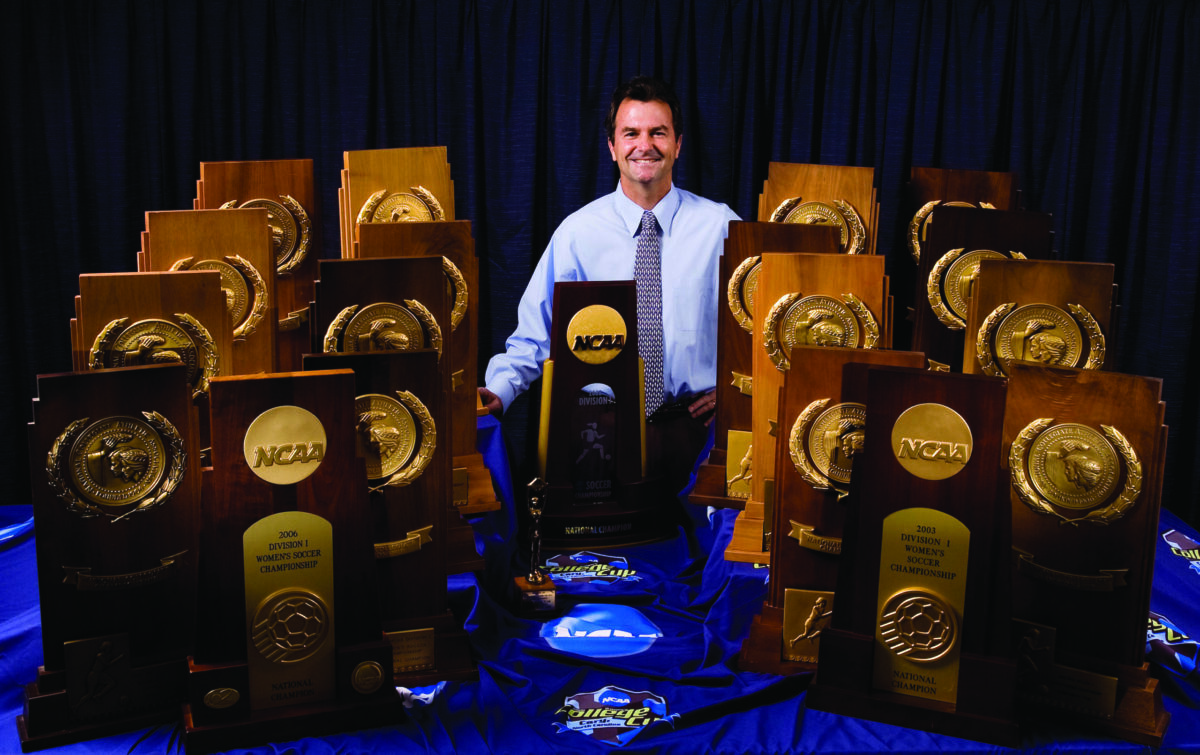
The numbers in his win-loss record are so stupid good that his entire women’s team coaching bio reads like a misprint: 934 victories. 88 defeats. 22 national championships, more than any other Division I coach — in any sport. (Photo: UNC Women’s Soccer)
Chapter 14 in the eventual book, The Man Watching, would be titled “Chaos,” and it details how Dorrance’s dynasty often got lost on road trips, occasionally arrived late to games and sometimes left people behind afterward, including Dorrance himself. The GOAT rarely showed up for our interviews on time, didn’t have voicemail on his office phone and struggled to operate his computer and cell phone.
He admits he was similarly clueless about how to coach women when he first took the job in 1979 (he’d begun his career as the men’s coach two years earlier), treating his players like anonymous pawns moving around his soccer chessboard. As his career progressed, he gradually evolved to prioritize their human development over their athletic achievement. He preached core values, emboldening his congregation to conduct their lives as a never-ending ascension, a concept he borrowed from a comic strip. He also asked them to read Holocaust survivor Viktor Frankl’s book Man’s Search for Meaning and memorize its seminal quote: If there is meaning in life at all, then there must be a meaning in suffering. … The way in which a man accepts his fate, and all the suffering it entails, the way in which he takes up his cross, gives him ample opportunity — even under the most difficult circumstances — to add a deeper meaning to his life.
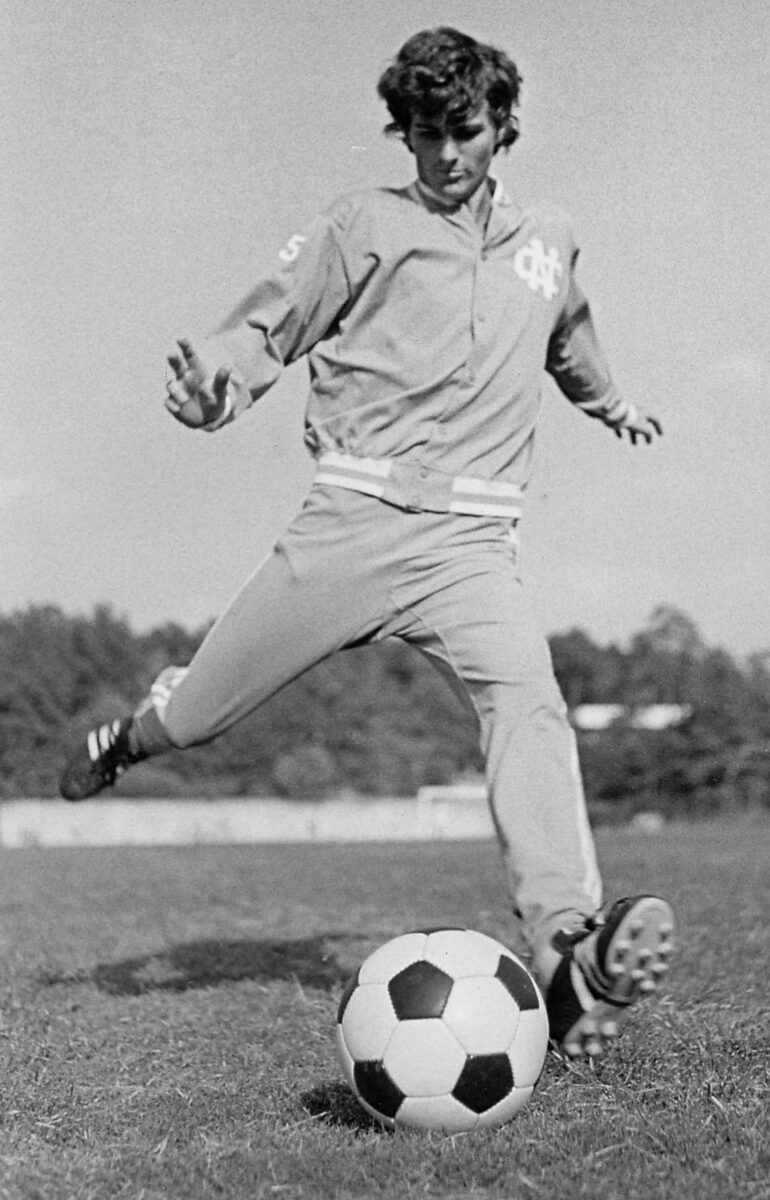
Dorrance as a player at UNC, early 1970s
Most of his players embraced his anti-whining message. Others thought they read the wrong book.
Dorrance transformed himself into a poet who presented roses and handwritten notes to his seniors, reading those tributes to his teary-eyed flock before each national championship game. He has attended more than 50 weddings of former Tar Heels, including Tracey Bates Leone ’89, who asked Dorrance to walk her down the aisle. On the day before he announced his retirement, Dorrance proudly cheered Crystal Dunn ’14 and Emily Fox ’21 to the Olympic gold medal as if they were his own daughters.
In my 40 years as a journalist, Dorrance is the most fascinating subject I have ever encountered. Many of our conversations began with an interview question about something like his team’s formation and morphed into a historical discussion of Winston Churchill. Before I knew it, my one season embedded in the program swelled to five.
To me, the least compelling aspect of Dorrance’s story is his incomparable women’s team coaching record that once famously prompted Dean Smith to call UNC “a women’s soccer school.” The numbers are so stupid good that his entire coaching bio reads like a misprint:
934 victories.
88 defeats.
22 national championships, more than any other Division I coach — in any sport.
“What odds would you have gotten that this guy with no coaching experience above Rainbow Soccer would be hired to coach the brand-new women’s team at UNC and would go on to win half the national titles for the next 45 years?” Dorrance mused. “One in a million?” Then quoting his go-to line from the movie Broadcast News, he added: “What do you do when your real life exceeds your dreams?”
Yet his most cherished accomplishment doesn’t appear on his coaching resume because it’s less about winning or losing than simply grinding. For a quarter century from 1986 to 2010 — a total of 629 games — UNC women’s soccer never lost a game by more than one goal. Think about that. It’s the most powerful testament to Dorrance that for 25 seasons his Tar Heels were competitive in every single game until the final whistle. They never mailed one in. Never said today just isn’t our day. Never, ever, caved. The warrior in Dorrance adores that feat.
As the locker room door closes behind the final exiting senior, Dorrance pulls several photocopied sheets of paper out of the breast pocket of his jacket. As is his custom, he has worked through much of the previous night in his hotel room, writing and rewriting a personal letter to each of his seniors in his barely legible longhand. Then he has awakened early this morning to polish his words, editing until the last possible moment, because that is the only way the letters can be genuine, the only way they can express what he sincerely feels at that instant. Then he has delivered the original letters to each of the seniors a few hours before the pregame talk.
He knows that this could be his last chance to make sure each senior knows how much he cares about them. He wants each young woman to know that even though he has spent four years telling her this isn’t good enough, that isn’t good enough, she isn’t good enough, that what he’s been secretly searching for all along is what really is good enough in her. When he recounts a personal story or two about her that she’d never expect him to remember, he wants her to know what he thinks is her finest quality — and this is never a soccer quality, but a human quality — because he believes that’s what his women appreciate most. When he reads the copies of the senior letters to the underclassmen left behind in the locker room, he wants his admiration to resonate. As he shares the words he has written to each senior, no matter how large or small her role on the team, Dorrance wants everyone inside that room to be in awe of her.
— excerpt from The Man Watching by Tim Crothers
“That is why I coach”
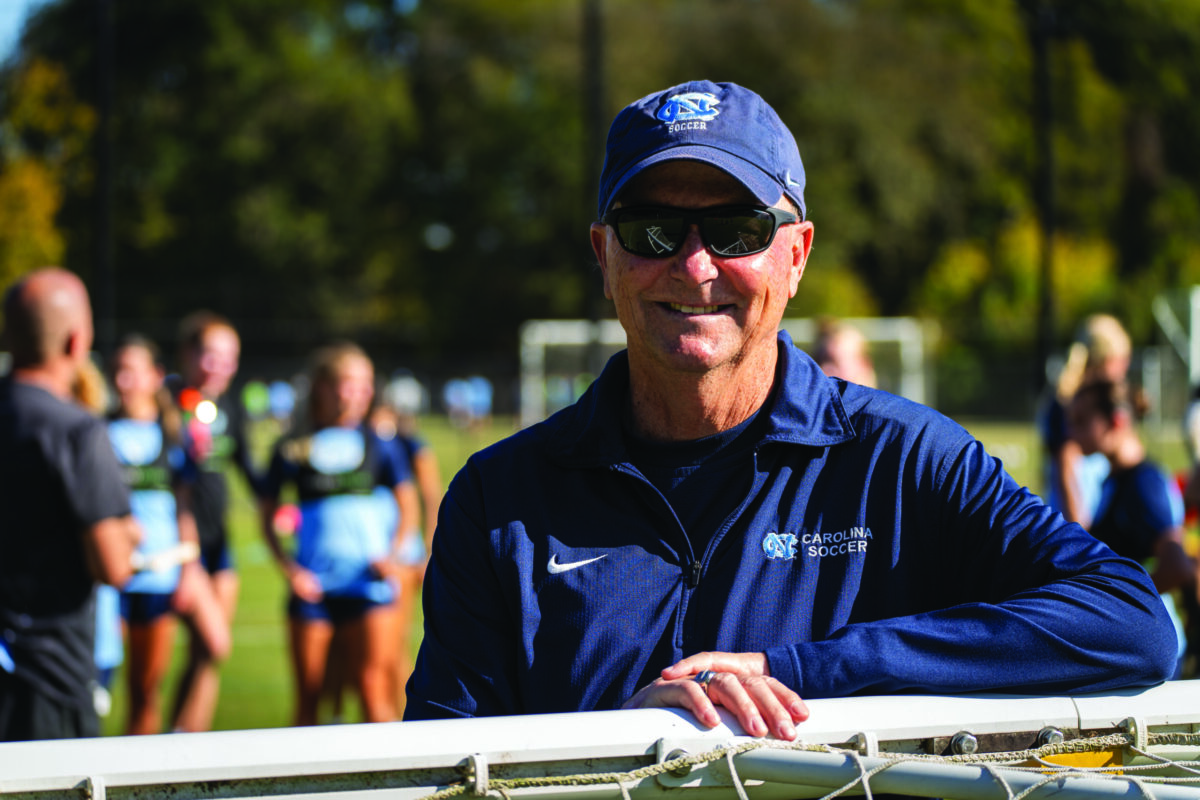
He maintained a public bravado but remained humble behind the scenes. Taking another cue from Dean Smith, Dorrance never big-timed anybody. (Photo: Carolina Alumni/Cory Dinkel)
While some of Dorrance’s methods could be polarizing, which famously provoked a decadelong lawsuit and an apology for inappropriate participation in conversations among his players about their sexual relationships, he always unabashedly spoke his truth.
He maintained a public bravado but remained humble behind the scenes. Taking another cue from Dean Smith, Dorrance never big-timed anybody. He always answered his phone and was generous with his time in an effort to promote his sport. (He recently participated in a podcast hosted by two middle school students.) This summer I cold-called him to ask whether he could spare a few minutes for a journalism-class interview about one of his players. He was on vacation in Tuscany, and despite his family waiting for him to go to dinner, he spoke to me for 15 minutes, generally ignoring my questions in favor of sharing his opinion on how the player could improve, knowing she would read his comments and hoping to motivate her.
It reminded me of my most memorable day in Dorrance World, a random afternoon in October 2003 when two of his prized first-years, Heather O’Reilly ’09 and Libby Guess ’14, suddenly showed up at his office. Our book interview immediately ended, and the three began talking in a stream of consciousness about how O’Reilly should start reading more than Cosmopolitan and romance novels as Guess asked about self-discipline, and Dorrance told her to follow O’Reilly’s example, triggering O’Reilly to ask whether leaders are born or can be bred, and Dorrance replied by asking, “What do you think?,” and she said she didn’t see herself as a born leader, and Dorrance told her to study some of Guess’ leadership qualities, and they debated whether study hall is really how two hours can best be spent and about which cereal is better, Raisin Bran or Cocoa Krispies, and they talked about climbing Mount Everest and kung fu movies and dieting, and during their whole time together Dorrance was subtly trying to instill O’Reilly’s discipline into Guess and Guess’ intellectual curiosity into O’Reilly, investing in their futures and his own in a way, and before they all knew it, they had dorked off more than two hours, none of the three uttering a single word about soccer.
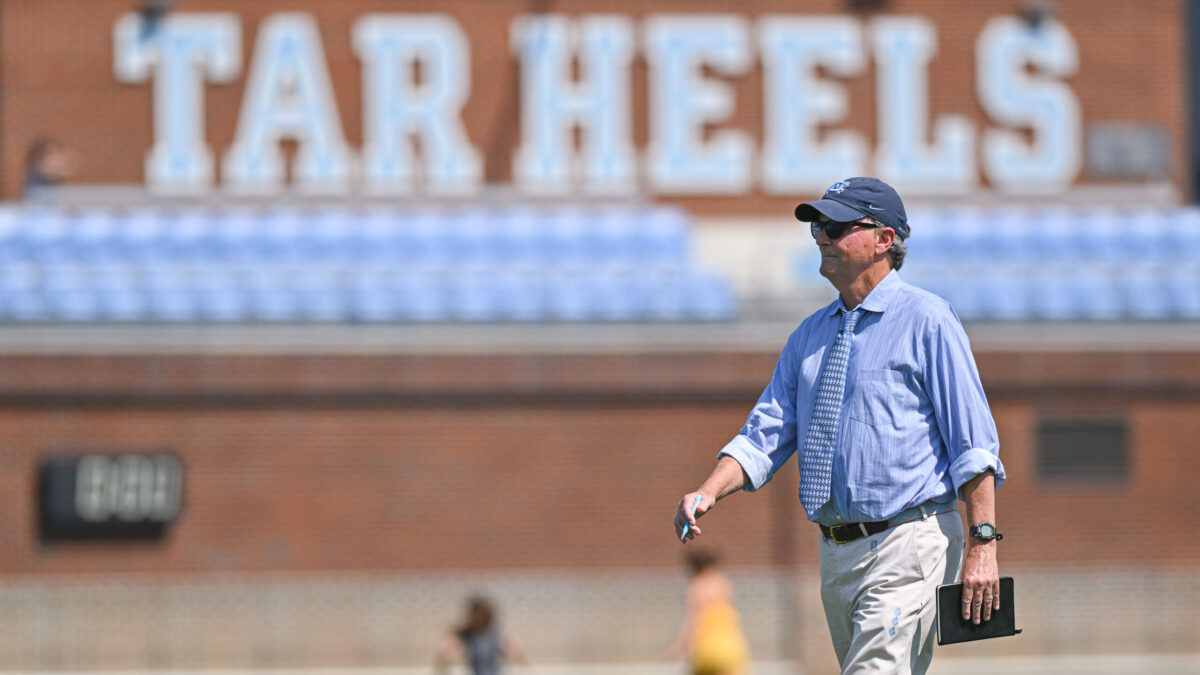
Dorrance has said he despises nothing more than vacations and speaking engagements and has regularly joked about how he expected to draw his final breath on the UNC sideline during a game.
It was a mentoring master class, and I remember Dorrance leaving his office saying, “That is why I coach.”
Two decades later, it’s not unreasonable to think that O’Reilly, a three-time Olympic gold medalist, could someday switch chairs with him. Dorrance has empowered dozens of his soccer alumni to become coaches, and Cindy Parlow Cone ’07, who as a youth player was once too shy to approach Dorrance during an autograph signing, is now the first female president of U.S. Soccer.
Dorrance’s impact has been both macro and micro. Shortly after The Man Watching was published in 2006, Dorrance began forwarding me emails he received from readers, including four remarkable notes in one week. The first came from a soldier fighting the war in Iraq who wrote to Dorrance that he had read the book and was applying some of UNC’s training techniques with his platoon. The second came from a medical professor at Duke University who said he was adopting some of Dorrance’s ideas about different ways to manage men and women in his classes. The third came from a high school soccer coach in Florida who had recently quit his job, but after reading the book had asked to be reinstated because Dorrance’s journey reminded him of a coach’s value in shaping the lives of young people. The last came from a Pennsylvania high school valedictorian who had highlighted her favorite passages in the book and then shared many of those excerpts with her classmates during her graduation speech.
It is an example of the dichotomy of Dorrance that he has often told his players that he subscribes to Karl Marx’s theory that “religion is the opiate of the masses,” yet he is a regular Sunday school teacher. It is the dichotomy of Dorrance that this learned man who has built much of his coaching philosophy through reading the philosophical tomes of Aristotle and Kierkegaard and Viktor Frankl sees his approach to life in a Sunday comic taped to his office door. He is a relentless optimist who loses one game and wonders if he will ever win again. He is a man who wears sweats to the office almost every day, but wears a tie for every game to honor his former coach Marvin Allen. He is a man who lets his NCAA trophies collect dust but won’t let his wife throw away his boarding school yearbooks. He is a man so distrusting of doctors that he once super-glued one of his false front teeth back into his gum rather than visit his dentist, yet he submitted to acupuncture treatment one day in his office from a total stranger who guaranteed it as a cure for tendonitis. He is an inveterate teaser who, his players lament, is impervious to ribbing about his short shorts, his poofy hair, his garish sneakers, or his bug-eyed sunglasses, but who privately admits that he dislikes his first name Albert so much that he uses the initial A on most official documents. He is a man who admits to leading a life of chaos, yet he is still such a rigid perfectionist that when he was asked to throw out the first pitch at a UNC softball game, he wasn’t satisfied with the accuracy of his first effort. Or his second. So Dorrance actually threw out the first three pitches.
— excerpt from The Man Watching by Tim Crothers
Postgame
Following the program for as long as I have (Dorrance even offered to hire me at one point), I was surprised to hear the news of his retirement. This is a guy who often told me he despised nothing more than vacations and speaking engagements and regularly joked about how he expected to draw his final breath on the UNC sideline during a game. So, now what?
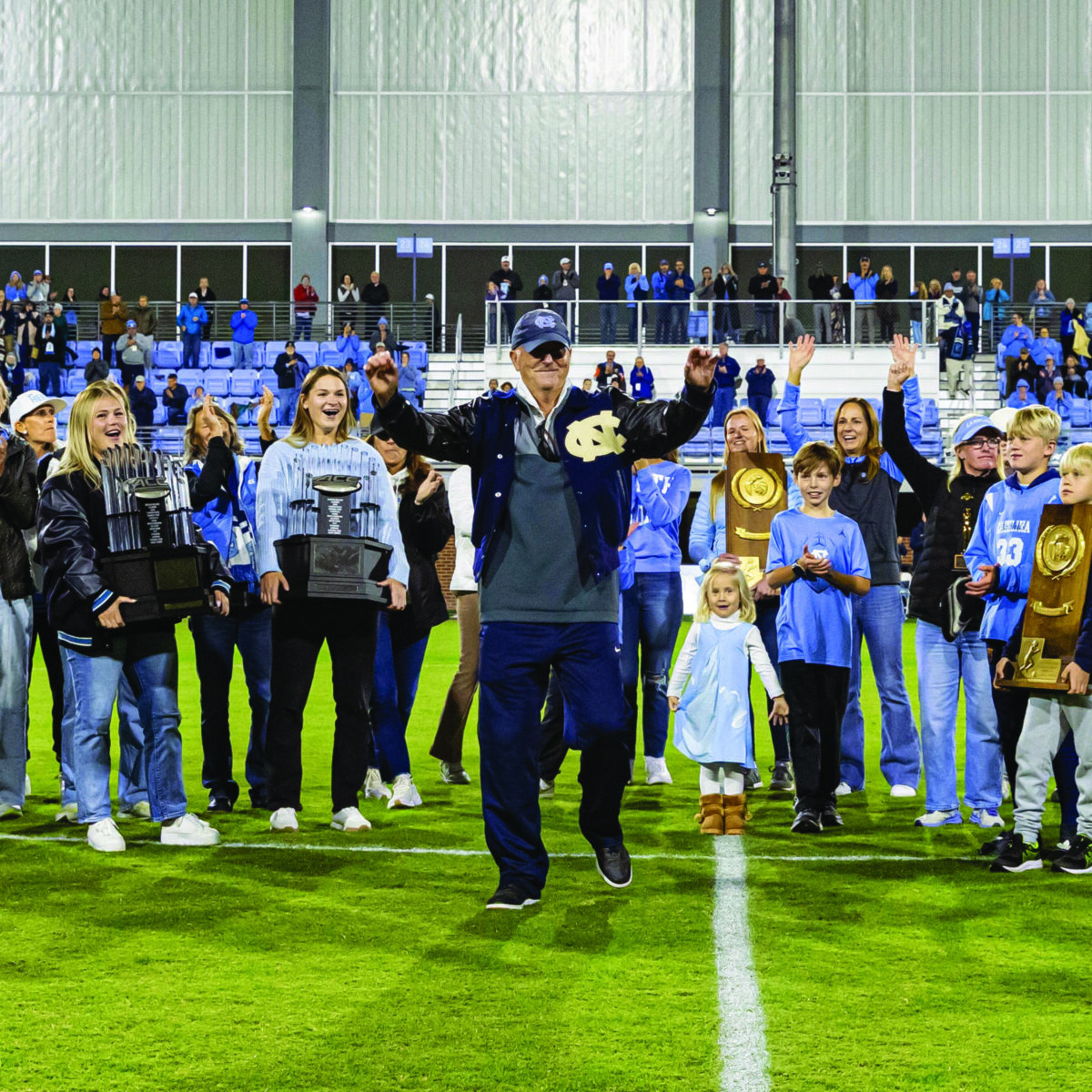
When Carolina honored him as part of its Dorrance Day festivities Oct. 17, Dorrance wore his varsity letterman jacket onto the field.
Until another coach is hired to replace him, Dorrance is still part of the UNC staff. He attends most soccer practices, bouncing from player to player with tactical advice. At the field that bears his name, he watches home games from the front row behind the goal just outside his office, a coach emeritus hollering positive reinforcement to his former Tar Heels who say they find comfort in still hearing his voice. He often discusses UNC games afterward with his successor, Damon Nahas, just like Dean Smith once did with Bill Guthridge. “I had no idea how stressed out I was until I finally stopped,” Dorrance said. “It is extraordinarily relaxing to do what I want to do and not what I have to do.”
Dorrance plans to gradually unplug from the program and said he is looking forward to more time with his family, sleeping late, reading books and playing copious amounts of pickleball to satisfy his competitive urges.
It was already evident to me back in August while he watched from his couch as the Tar Heels earned their first victory under Nahas that Dorrance is at peace with his decision to retire. The man who for so many years asked his players to read Man’s Search for Meaning has clearly found his own.
Tim Crothers ’86 is a former senior writer at Sports Illustrated and teaches writing at the UNC Hussman School of Journalism and Media. His book The Man Watching chronicles how Dorrance built the UNC women’s soccer dynasty.
Thanks for reading the Carolina Alumni Review
Carolina Alumni members, sign in to continue reading.
Not yet a member? Become one today.