R. Jude Samulski, Faculty Service Award Citation
Posted on March 31, 2025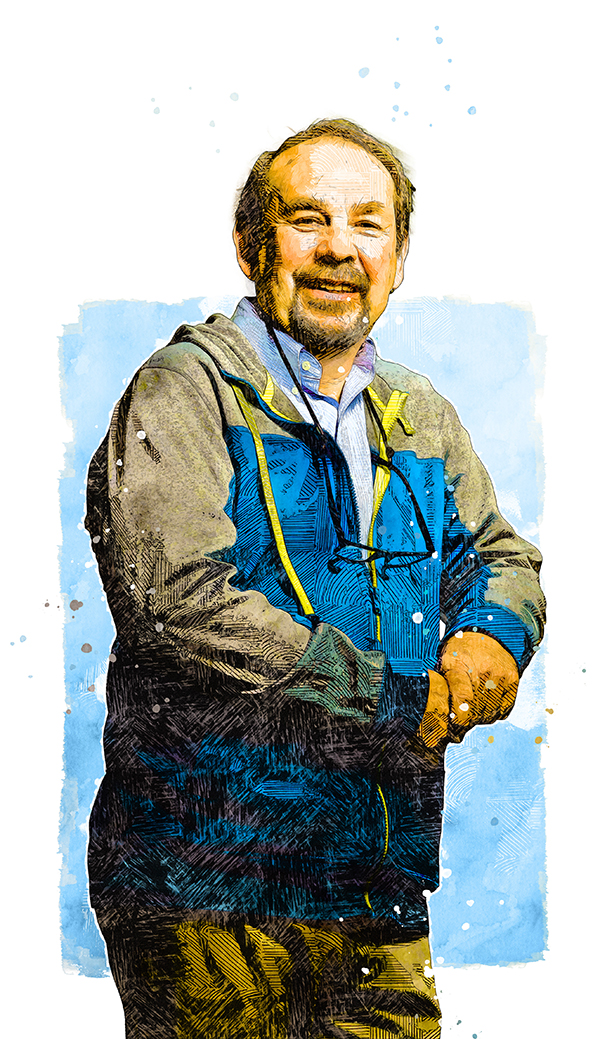
R. Jude Samulski
UNC researcher Jude Samulski, a gardener in his spare time, walked through the rows of flora at a garden store until he came upon a cluster of wilting plants that had an air of you-go-on-without-me. He loaded them into his cart, paid for them and brought them home.
Samulski taking plants a nursery had abandoned and nurturing them back to life, fits with his life’s work of using gene therapy to find treatments for orphan diseases that big pharmaceutical corporations reject as unprofitable.
As a doctoral student in medical microbiology and immunology at the University of Florida, Samulski purified the adeno-associated virus (AAV) — a small virus that infects humans but is so harmless our immune systems barely respond — and figured out how to turn it into a microscopic FedEx truck, load it with gene packages and label them to ensure they got delivered to the correct address on a genome to treat what was once thought to be incurable diseases. to cure incurable disease. Not treat symptoms or slow degeneration but change the individual muscle cells to enable the lame to walk, the deaf to hear, the blind to see. His discovery saves lives.
In 1993, UNC enticed Samulski to come to Chapel Hill to direct a new biotechnology program, in part because of Carolina’s reputation as a leader in animal models. Nobel Laureate Oliver Smithies, who developed mouse models that mimicked human diseases, had a lab at Carolina. The head of UNC Hospitals offered Samulski space to develop his AAV vectors, the first time the hospital had proactively made a commitment to invest in a long-term clinical research program, even though physicians didn’t see his work as a treatment.
But parents of children with incurable diseases such as cystic fibrosis, hemophilia and muscular dystrophy did. These parents — who had been told by physicians that there was nothing they can do for their child — sought out Samulski and encouraged him to keep working. They held bake sales, sponsored long-distance runs, hosted fundraisers and made calls to glean donations so Samulski could hire lab techs, postdocs and students to advance Samulski’s work until major grants came through.
In a few years, UNC’s Gene Therapy Center became an AAV-vector core facility for major research universities, converting hopes and promises into therapeutic reality. Eventually, researchers around the world would use Samulski’s groundbreaking research to create therapies for various rare conditions.
Throughout his career, Samulski has recruited the best and the brightest who shared his belief in what could be achieved. Life sciences attorney Sheila Mikhail said he convinced her to join him by declaring, “I can’t pay you; but if we’re successful, we’ll change the world.” Mikhail worked with Samulski without a paycheck for a decade, co-founding Asklepios BioPharmaceutical, or AskBio, with him. “He fulfilled his promise,” Mikhail said. “We have changed the world.”
Samulski changed Conner Curran’s world. He has Duchenne muscular dystrophy, a relentlessly atrophying disease. Those afflicted rarely live beyond their 20s. He was 7 in 2018 when his parents took a leap of faith and enrolled him as the first person in the clinical trial of Samulski’s gene therapy treatment. To produce enough of the therapeutic viruses to treat a person, Samulski needed the infrastructure of a major pharmaceutical company. He partnered with Pfizer, who acquired the AskBio spinout, Bamboo Therapeutics, for $645 million in 2016. The treatment gave Conner, a teenager now, several years of mobility he would not have had otherwise.
“We trusted Jude,” said Conner’s mother, Jessica Curran. “He thinks about his patients night and day. He put tangible hope in Conner’s heart.”
Samulski gives opportunities to those who work with him, too. He grew up in a big family in a small town in South Carolina. The seventh of nine children, all but one a boy, Samulski likens his family to a joint venture, where everyone’s contribution is essential — an ethos he carried into his lab. If the lab tech doesn’t do his job, the research scientist can’t do hers.
Sam Young, who in 2024 was named director of UNC’s Gene Therapy Center, which will be renamed the Center for Molecular Medicine in the spring, was a first-generation college graduate and captain of Princeton University’s football team, a priority reflected in his grades. But Samulski recognized Young’s drive and took him on as a doctoral student. “There’s a lot of smart people in the world,” Young said, “but not a lot of smart people with vision. Jude is a visionary. He’s not willing to accept the way things are. He believes in pursuing the way things ought to be. Jude could take an idea and translate it into a multi-billion-dollar industry.”
And he did. Bayer acquired AskBio in 2020 for $4 billion. Samulski and Mikhail used the proceeds to fund Columbus Children’s Foundation, which provides regenerative medicine and gene therapy without charge to children with ultra-rare diseases.
After nearly half a century in the lab, Samulski could retire. But he hasn’t. He’s working on a retreatment for children like Conner who have benefited from his original gene therapy but need additional therapies to treat new muscle cells that have formed. They would risk a massive autoimmune response if they received the original treatment twice.
Samulski has received awards along the way — the Sune Bergstrom Award at the Lund Symposium in Sweden in 2023 and the inaugural Founder’s Award from the European Society of Gene and Cell Therapy in 2022. In 2024, he was inducted into the National Academy of Inventors.
But Samulski measures his success by the scientists he has trained and sent out in the world. And, of course, his patients. “My awards are the families and kids we’ve been able to help,” he said. “You can’t put that feeling on a plaque.”
Read a story about Samulski in the January/February 2022 Carolina Alumni Review:
- From the Ashes, a Cure: Jude Samulski’s 40-year gene therapy odyssey has led to beneficial treatments for kids with serious single-gene disorders. This is the story of how it happened — but almost didn’t.
The Faculty Service Award is presented by the Carolina Alumni Board of Directors.