Storm Swamps Eastgate Businesses
Posted on Oct. 13, 2025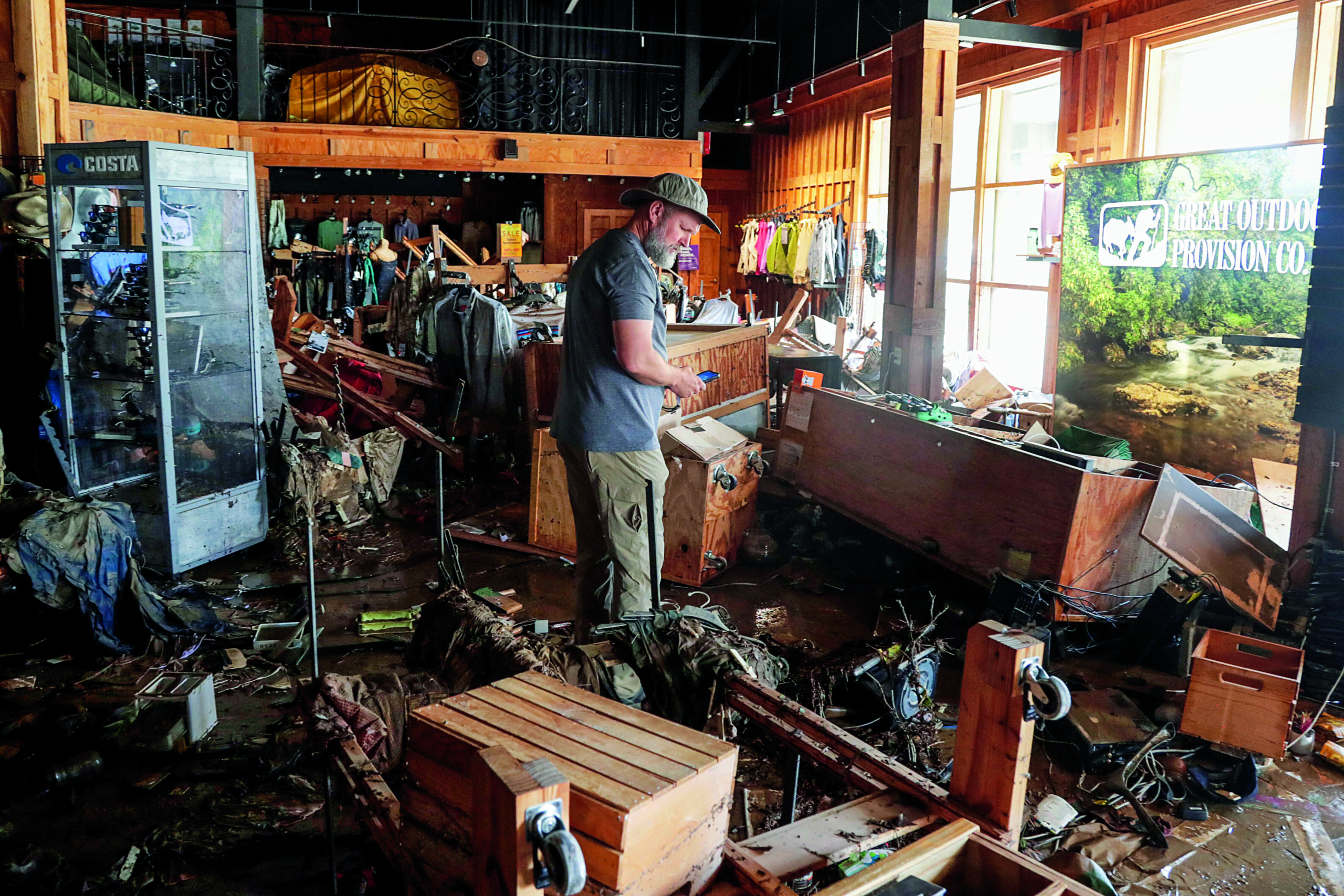
An employee surveys the damage at the Great Outdoor Provision Co. in Eastgate Shopping Center after it was flooded during tropical storm Chantal. (Photo: AP Images/Chris Seward)
Tropical Storm Chantal arrived at Eastgate Crossing on the night of Sunday, July 6, and wouldn’t leave. She deposited 6 to 10 inches of rain across central North Carolina in a few hours, according to the National Weather Service, and the water soon flooded every business, along with 120 cars, at the shopping center, which was built in 1958 on top of the Booker Creek flood plain.
The water surged so quickly, stores didn’t have a chance to put up their floodgates. Trader Joe’s, The Loop, ALDI and Kipos all were inundated by standing water at least 5 feet deep. Some businesses were still closed at the end of August.
Many Eastgate business owners and managers said they didn’t pull up metal barriers used to block flood waters because they didn’t expect the rain to be so intense. Scott Novak, the owner of The Loop, served his typical Sunday night crowd until he noticed water creeping from the parking lot toward his door shortly after 8 p.m. He immediately shooed out customers and employees mid-meal. Everyone got out safely, but the swiftly rising water trashed the restaurant interior.
Giorgios Bakatsias, owner of Kipos Greek Taverna, found tables and chairs from the dining room slammed into his kitchen, and soil from potted plants coated much of the interior. The water shoved a dumpster inside another building.
Bolin Creek runs along South Estes Drive between University Place and Camelot Village condominiums. It meets up with Booker Creek to form Little Creek just east of Fordham Boulevard. Many businesses in Eastgate and University Place had been through a flood in 2018, when a 100-year storm hit. In 2020, Eastgate owners invested in stormwater mitigation to accommodate a 25-year flood, the maximum level of reduction the space allowed. Chantal created the equivalent of a 500-year to 1,000-year storm, according to FEMA standards.
A study of the Lower Booker Creek Subwatershed in 2017 recommended remediation efforts costing $20 million for stormwater basins and culverts further upstream, but the work was not initiated. In 2014, the town of Chapel Hill put in place strict requirements for new construction to capture and filter runoff, but a state law passed in 2018 undercut Chapel Hill’s rules.
Sammy Bauer ’14 (’18 MPA), a stormwater education expert for Chapel Hill, said town staff are researching new stormwater mitigation options, including bioretention ponds, rain gardens and creek restoration projects, but haven’t found a permanent solution for potential flooding in the high-risk area. “When we’re seeing that volume of rain,” she told The News & Observer, “there’s only so much we can do.”
Apartment buildings and houses in the area also suffered flood damage from the storm, as did some businesses in University Place. Patrons at Silverspot Cinema were trapped until flood waters began to recede in the early-morning hours. Med First Primary & Urgent Care opened a few months ago in University Place. Justin McLean, Med First’s director of operations, expects the clinic to be closed for months and out-of-pocket repairs to cost $200,000 to $300,000.
The total to restore the Eastgate businesses is estimated at about $11 million. Insurance policies cover only a fraction of the rebuilds. The leases that businesses sign with their Eastgate landlord, Kite Realty, require them to have flood insurance, but some insurance companies now don’t want to renew the policies.
Small businesses with long-term leases are in a particularly difficult quandary. They can’t afford litigation to exit early. Though the U.S. Small Business Administration has offered low-interest disaster loans for North Carolina businesses hurt by Chantal, businesses still have to pay the money back.
Shutting down their businesses comes at a particularly bad time for retail businesses, which make a good portion of their annual revenue in fourth-quarter sales. At this time of year, they’re investing in merchandise for the holiday season. Instead, they’ll be diverting funds to repair and rebuild. The longer a store remains closed, the more time customers have to seek out a competitor as a go-to vendor.
Eastgate has a diverse mix of businesses — restaurants, grocery stores, a bakery, coffee and frozen yogurt shops, personal care salons, clothing and outdoor provisions stores, a pet supply vendor. The big businesses and national chain stores seem intent on returning. Trader Joe’s gathered work crews to start the cleanup-and-rebuild process the day after the storm. Elie Abou-Rjeileh, owner of Olmaz Jewelers, has a long-term lease and must rebuild his existing space. He hopes to see all of the Eastgate tenants return.
“I want to hear clients complaining about not finding parking spots,” he told Chapelboro news website. “That was our biggest issue at Eastgate — not finding parking.”
— Nancy E. Oates
Thanks for reading the Carolina Alumni Review
Carolina Alumni members, sign in to continue reading.
Not yet a member? Become one today.