University to Expand Campus Northward
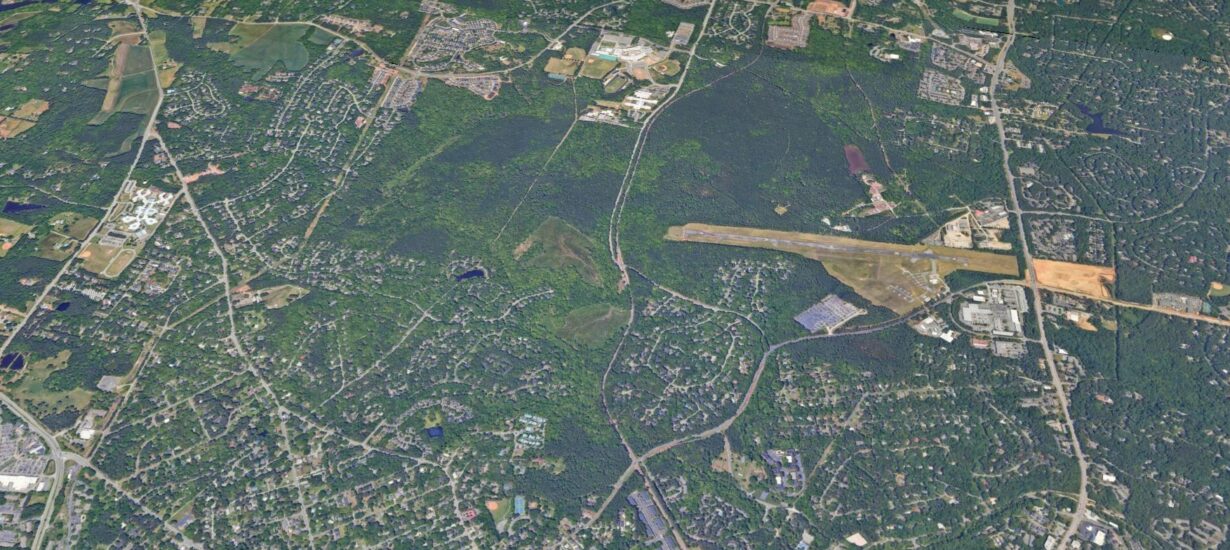
The southern part of heaven is looking north.
Chancellor Lee Roberts told the University’s Board of Trustees Wednesday the University plans to develop a roughly 230-acre “live-work-play-learn” campus at Carolina North, on the site of the former Horace Williams Airport. Early estimates suggest construction could begin as soon as 2027.
The airport site, which was named for the professor who donated the land to the University in 1940, sits 1.6 miles north of Franklin Street and is connected to downtown Chapel Hill by Martin Luther King Jr. Boulevard.
“This will be the largest expansion of the University since the cornerstone of the Old East building was laid in 1793,” the University said in a press release.
The new campus will be home to academic buildings, housing for students, employees and families, as well as research facilities supporting applied sciences and experiential learning. Roberts said approximately 2,200 undergraduate beds would be built in the area during the first phase of the project.
Carolina North has also been proposed as a site for a new basketball arena. However, conversations regarding the fate of the Smith Center are ongoing, and no final decisions have been made. Roberts told the Board the University would soon announce two stakeholder committees to inform any decisions made about the arena: one comprised of students and another comprised of “basketball folks.”
Vice Chancellor for Research Penny Gordon-Larsen said establishing a campus at Carolina North is not just about extra space, “it’s about redefining the modern American research university.” She said the new campus would be intentionally designed to break the silos between disciplines. For instance, she told the Board about a recent occurrence in which three faculty members from three different departments ran into each other at a coffee shop and had a conversation that sparked mutual interest in a project, which went on to earn a $64 million grant. “We want to set Carolina up for more of those happenstance-type interactions,” she said.
She also said modern facilities built on the property will allow for more industry partnerships, citing for example an existing collaboration between the biomedical engineering department and medical device company SonoVascular to create an ultrasound technology to break up blood clots without invasive surgery.
Carolina North will also include a mixed-use entertainment district that could include retail stores, restaurants, hotels, public plazas, civic gathering spaces and performing arts venues. The University anticipates most mixed-use, multi-story buildings will be developed through public-private partnerships.
Roberts said the new campus will ease Chapel Hill’s “housing crunch,” which he said has also affected the University’s ability to attract and retain top talent. He told the Board that Mayor Jess Anderson, who began her second term in December, said, “There is no comprehensive solution to the affordable housing challenge in the Town of Chapel Hill without Carolina North.”
Recommendations to develop the old airport property have circulated since the late 1950s, and Chief Financial Officer Nate Knuffman told the Board Wednesday the University has “really been kicking the can on this opportunity” until now. The last time any significant progress was publicly announced was in 2008, when the University received town approval to build a satellite campus in the area over several decades, the first phase of which stalled unfunded.
Roberts’ announcement marks the first official green light for new construction. Roberts said he has been asked why the University is pursuing expansion now, to which he answered, “What has taken us so long?”
The development will occupy about one quarter of the 947 acres of the Carolina North Forest. The University said 20 miles of existing public trails within the forest will be protected and improved.
The University sought $8 million in spending authority from the Board of Trustees to kickstart advance planning, such as hiring consultants for site planning, infrastructure design, identification and assessment of individual projects, site remediation and relocation of impacted units, including facilities services. University officials said it was too early to estimate how much the development will cost, but individual projects will be funded through state support, University funds, revenue-backed debt, private donors and third-party investors.
“Pedestrian-first streetscapes will ensure the campus is fully integrated with surrounding neighborhoods,” the press release said. A dedicated rapid transit bus line developed in partnership with the Town of Chapel Hill will connect Carolina North to the main campus, alongside wide paths for “walking, biking and rolling.” The bus project is anticipated to be operational by 2030.
The University will likely choose a master developer for the project in late spring, after which more details about the design will become available. The University said it will also form an umbrella advisory group made up of faculty, staff, students, alumni, trustees, former student-athletes and community members to inform decision-making about the property’s development.
Roberts said the advisory group will be co-chaired by Trustee Brian Allen, Professor of Public Law and Government Anita-Brown Graham ’91 (JD) and The Chamber for a Greater Chapel Hill-Carrboro President Aaron Nelson ’97, who is also a former student body president. The project will be spearheaded by Tiffany Lacey, a developer with decades of experience hired to lead the project; Ivy Taylor ’98 (MRP), the University’s local relations director and former mayor of San Antonio; and Marcus Ginyard ’09, a former Tar Heel basketball player hired in October as the University’s director of special projects.
The University is in the process of cutting $70 million from its operating budget, but campus leaders said the northward expansion is necessary to increase the number of students at Carolina, which University officials consider necessary due to population growth across the state.
Forty percent more in-state students have applied to UNC since 2019, and the University plans to add 5,000 undergraduate students in the next decade, an expansion that requires thousands more beds and hundreds of thousands of square feet in instructional, research and social spaces.
Trustee Jim Blaine ’00 said, as the number of applications to the University have increased, “this University has become too selective.” He said regardless of what ends up on the campus, it is imperative to grow the school’s capacity.
The press release announcing the plans said, “Even with continued renovation and modernization, the historic campus faces limits.”
Roberts said, “Most universities would give anything to have this amount of developable land available to them this close to the main campus.”
Multiple trustees and vice chancellors said they were excited about the project. Malcom Turner ’93, chair of the Board of Trustees, said in a statement, “This kind of forward-looking development benefits our students, fuels job creation, attracts new partners and reinforces Carolina’s competitiveness for decades to come.”