Now Chancellor, Roberts Discusses DEI, Politics, Vision
Posted on Sept. 25, 2024
“There are a lot of things working really well. … You don’t want to mess up anything that’s already working, that doesn’t need to be tinkered with. ” — Lee Roberts (PHOTO: Carolina Alumni/Cory Dinkel)
In August, the UNC System Board of Governors elected Lee Roberts Carolina’s 13th chancellor, succeeding Kevin Guskiewicz, who resigned in January to accept the presidency at Michigan State University. Roberts had been interim chancellor for about eight months. Those who oversaw the search for a new chancellor said he demonstrated a devotion to the University’s core mission to serve North Carolina and support ground-breaking research.
While serving as interim chancellor, Roberts faced concerns from some faculty and alumni about his inexperience in academia. Roberts, who received his undergraduate degree from Duke University and a law degree from Georgetown University, founded an investment firm and served as the state budget director for Gov. Pat McCrory from 2014 to 2016. He also served on the UNC System Board of Governors and taught a course on public budgeting to Duke graduate students. Research at UNC, however, has shown a move among universities nationwide to appoint more leaders that do not come out of academe. UNC System President Peter Hans ’91 defended the appointment in an opinion piece in The Chronicle of Higher Education, saying the chancellorship doesn’t require someone with academic credentials or teaching experience because the position “won’t involve teaching or researching.” Rather, the job requires someone who will focus on infrastructure, business operations and growing enrollment. “What Chapel Hill needs right now is operational excellence to match its academic prowess, so that was a priority in searching for a new leader,” he wrote.
Roberts also faced criticism, as well as support, for calling in police in April to remove pro-Palestinian protestors on Polk Place, an action that some thought was counter to a University tradition of allowing free speech and protests on campus. When protestors removed the American flag from Polk Place to raise a Palestinian flag, Roberts helped replace the American flag, a move that drew calls from the Republican leadership in the state Legislature to have him appointed chancellor. He also was tasked to respond to how the University would adhere to the new UNC System policy on diversity, equity and inclusion, which has drawn sharp criticism from some students, faculty and alumni, who fear UNC will no longer have programs and spaces for students of color and LGBTQ individuals.
The Review sat down with Roberts shortly after he was elected as chancellor to discuss these and other issues, and his thoughts on leadership and vision for the University. The following has been edited for clarity and brevity.
While interim chancellor, you were frequently asked whether you were interested in the full-time job. You were noncommittal. When did it hit you that you wanted to be chancellor?
I don’t think there was one moment, but it’s such an extraordinary place. And I’ve talked about the love that people have for this campus and for this institution. It really does grow on you. It’s palpable. You can feel it in the air. And there’s so many incredible things happening all over campus, everywhere, everywhere you look. It’s easy to fall in love.
Many people believed that the search for a new chancellor was wired for you. Some had hoped for a more transparent process. Do you think the selection was preordained?
Nobody promised me anything. It certainly felt like a rigorous process. As a participant, [I recognized] there were obviously a lot of highly credible, highly reputable people on that search committee.
Soon after being named interim chancellor, you said your primary goal was to do no harm. Can you explain a little bit more what you meant by that, what would harm look like, and will it be part of your approach as chancellor?
I’d say two things. One is, and this is more of what I meant at the time, that there are a lot of things working really well, and so there’s a reason that that’s the Hippocratic Oath. You don’t want to mess up anything that’s already working, that doesn’t need to be tinkered with. You [don’t] need to spend energy and resources on things that are more or less on the right track.
There’s another dimension too, which is downside risk. So, I come from an investment background. I’m trained to think about risk, and we have 44,000 students, faculty and staff. At any given time, somebody’s probably doing something we wish they wouldn’t do, and we have a lot of inherent risk, latent risk, in a large, complex, decentralized organization like this. I think being aware of that downside risk, trying to mitigate it, should be an important consideration for anybody in a world like mine.
“There are a lot of things working really well. … You don’t want to mess up anything that’s already working, that doesn’t need to be tinkered with. ”
— Lee Roberts
What are some things that UNC is doing right?
How long do you have?
OK, give me your top three.
Well, we just went over $1.2 billion in research funding. That’s an extraordinary achievement. I’ve seen different numbers about where that puts us in in terms of ranking, and I think the reason it’s hard to get exact numbers — everyone else is reporting their numbers right now — but it puts us in the same category as Stanford, Duke and Ohio State in terms of research funding, clearly the absolute top tier of global research institutions.
We have extraordinary students. We’ve got 4,700 new students arriving from all over North Carolina, all over the country and the world. We had 68,000 applications this year, and these are the 4,700 students who came out of those 68,000, and so that’s a wonderful thing that there’s that much interest, that much demand for what we offer in terms of undergraduate education.
And we have remarkable faculty. One of the most rewarding parts of this job has been meeting faculty, interacting with them. I was walking around a little bit this morning, just trying to go in buildings that I hadn’t been into before, and I ran into a music professor practicing the cello. He’s been here for 42 years. There aren’t a lot of places where on a morning walk you can run into somebody like that and have a fascinating conversation with them.
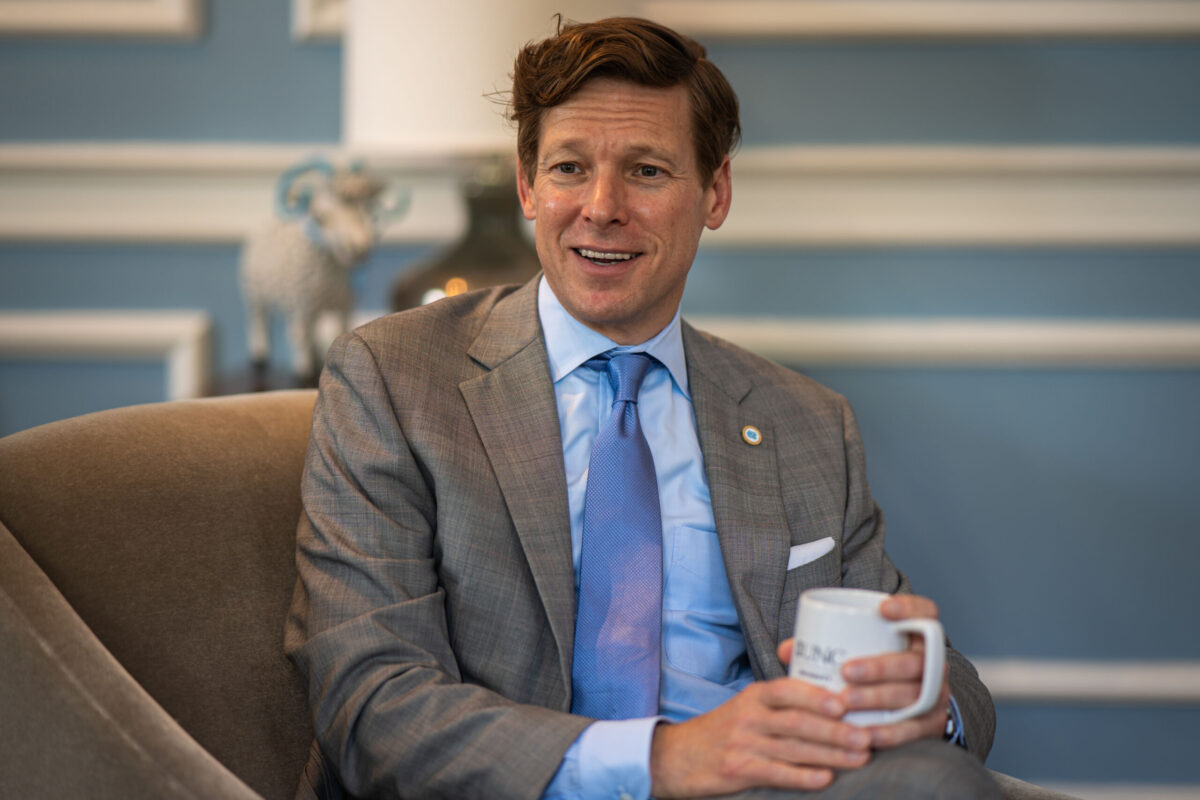
Chancellor Lee Roberts: Carolina is “such an extraordinary place. And I’ve talked about the love that people have for this campus and for this institution. It really does grow on you. It’s palpable. You can feel it in the air. And there’s so many incredible things happening all over campus, everywhere, everywhere you look. It’s easy to fall in love.” (PHOTO: Carolina Alumni/Cory Dinkel)
In his statement announcing your appointment, UNC System President Peter Hans [’91] said, “We have found the right leader for this moment in Carolina’s history, because the questions facing public higher education are wide-ranging, enormously complex and likely to become magnified in the years ahead. I am convinced those questions are best addressed right now by a set of fresh eyes, by someone with experiences and expertise that offer a wide perspective on the challenges and opportunities ahead.” What are the fresh eyes you are bringing and the experience and expertise that offer a wide perspective?
Well, first of all, it’s obviously flattering, and I appreciate those comments from President Hans. I’ve been described as a nontraditional candidate, and obviously I don’t have the usual academic experience. I do think I have some relevant experience, and I’m hopeful that the work ahead allows me to combine my background in business and finance and management and budgeting with the very strong academic expertise and talent that’s already here.
Your lack of an academic background has some faculty concerned they may be left out of participating in governance. The School of Civic Life and Leadership, which was formed before you were interim chancellor, is one example in which some faculty believed they weren’t appropriately consulted. How do you feel the relationship is with the faculty right now?
I really look forward to working closely with the faculty. I’ve been trying to meet as many members of the faculty as possible. I’ve really enjoyed our partnership with Beth Moracco [’92 (MPH, ’99 PhD)], the chair of the faculty. I’ve tried to make clear that I have the utmost respect for what the faculty do. I know I’m not an academic. My role is to make sure that the faculty have the resources that they need. And when it comes to shared governance, the AAU [Association of American Universities] definition of shared governance says that effective shared governance depends on cooperation and communication, and I think that sums it up pretty well. There are some areas in the shared governance structure that are clearly the products of the governing board, and there are some areas that clearly belong to the administration and some that clearly belong to the faculty, and then there’s some gray areas. And the gray areas are where all the challenges are, and the way you work through those gray areas are through cooperation and communication and good faith. And hopefully we’ve done that so far, and I look forward to continuing that approach.
“People aren’t always going to agree on direction. … Respect isn’t something that comes with a job title or with an office; it has to be earned over time. I’ve been working since I got here eight months ago to earn the trust and respect of the community, and I’m going to continue to do that.”
— Lee Roberts
Your report on how you plan to approach the new diversity, equity and inclusion policy at Carolina is due to be submitted to the UNC System office in September. Can you give us some insight on the approach to what diversity on campus may look like and your general thoughts on the issue and the future of DEI programs?
I said before that I believe the University exists in a moral compact with the people of the state. We have an obligation to reflect the state. And everyone who lives here knows how quickly the state is growing and changing across multiple dimensions, and we have to reflect that. That’s who we are. We don’t have any choice, and we can’t only reflect it on paper. We need to make sure that when students come here, they feel welcome, so they belong, as though this is a place where they can flourish and they can thrive. And fortunately, we have some powerful tools to do that. But I think we need to redouble our efforts, especially given how quickly the state has changed. So, part of the answer is affordability. And we have a terrific story to tell on affordability. Our tuition has been flat for eight years. It’s clearly the best value of higher education in America; we give away $200 million a year in financial aid. We have the Tar Heel Guarantee, the Blue Sky Scholars program, the Carolina Covenant program. Carolina Covenants are now 10 percent of our student body, and 70 percent of those are first-generation college students. So, those are very powerful tools when it comes to access and affordability, but we need to do a better job telling that story.
We have a lot of rural counties in this state where we need to do a better job of attracting students. And how do we do a better job? It’s telling the story about Carolina, making sure that students think of this as an option for them. And then what happens when they get here? It’s a big public school. It’s a place where you need to figure out how you’re going to plug in. Everybody needs to find their place on campus, find their place in the student body. And we’re fortunate to have really robust centers that do some of that work. We’ve got over 800 student groups on campus. So hopefully, no matter what you’re interested in, no matter what you like to do, there’s a student group for you.
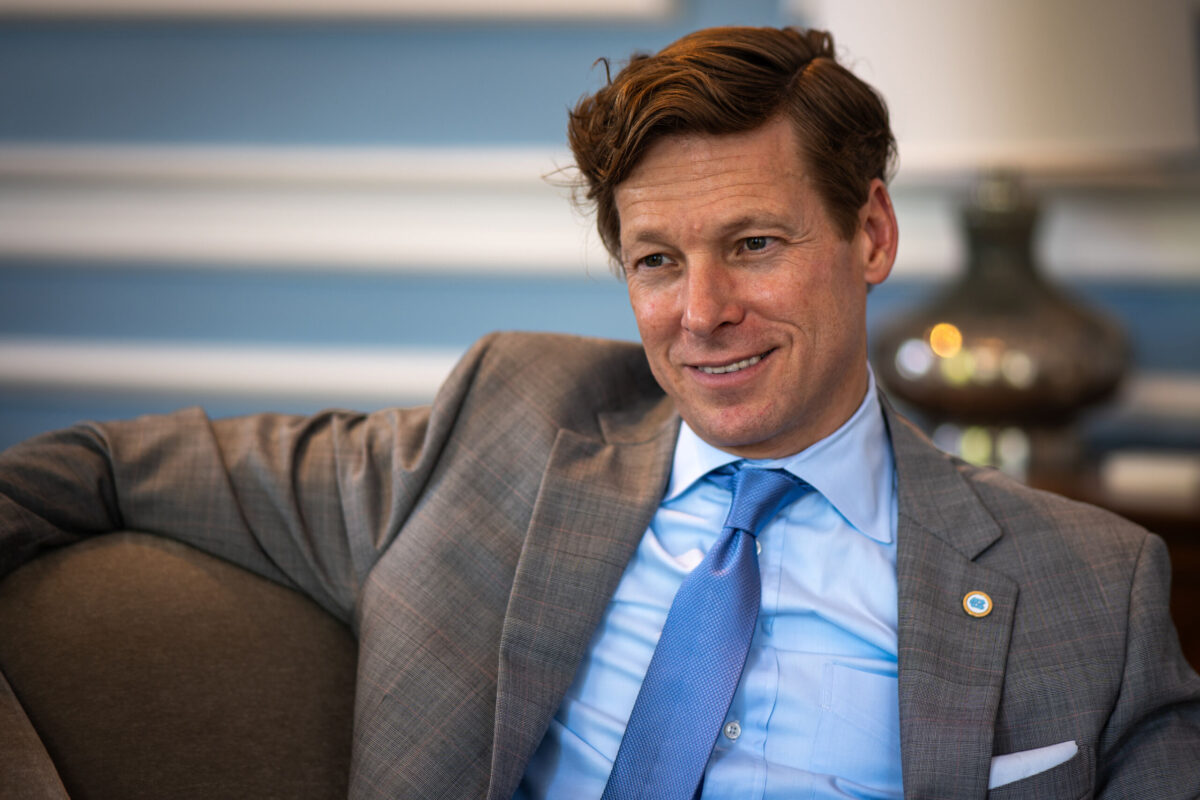
“I said before that I believe the University exists in a moral compact with the people of the state. We have an obligation to reflect the state. And everyone who lives here knows how quickly the state is growing and changing across multiple dimensions, and we have to reflect that. That’s who we are.” (PHOTO: Carolina Alumni/Cory Dinkel)
You’re seen as having a background in or connections to Republican politics, having served as state budget director under Gov. Pat McCrory, and Republican leadership in the General Assembly endorsed you after the flag incident in Polk place. This led some alumni, as well as some faculty, to be concerned that politics may play a role in your decisions and policies coming out of South Building. How would you address people’s concerns?
Well, first of all, I’ve never thought of myself as having a background in politics, Republican or otherwise. I’m an unaffiliated voter. I’ve never been anything other than an unaffiliated voter. I’ve never run for anything, never. I did work for a Republican governor when I was budget director under Gov. McCrory.
More broadly, our elected officials are going to have a view about what happens here at the flagship state University, and I’m confident that’s been true since William Richardson Davie sat under that poplar tree out there. And the role of the chancellor is to take all views and try to do what we think is best for the University.
It’s been said that chancellors should have the freedom to lead with moral authority, speak with moral authority, which in turn allows others to feel safe to do the same. Do you think you will be able to have the moral authority as chancellor?
People aren’t always going to agree on direction. I don’t think there’s anything new about that, but the chancellor has to make the final call. Respect isn’t something that comes with a job title or with an office; it has to be earned over time. I’ve been working since I got here eight months ago to earn the trust and respect of the community, and I’m going to continue to do that. Most people don’t know me. I’ve been trying to change that one handshake at a time. But it’s a big place, and I’m going to continue to spend a lot of time trying to talk to as many people as possible and meet as many folks as possible. … I can’t promise anyone, no matter who they are, that I’m always going to agree with them, but I certainly can promise that I’m always going to listen and be open-minded and do my best to be reasonable and fair.