Born Biltmore
Posted on July 29, 2025After Helene, Chase Pickering ’11 is more determined than ever to preserve the place he calls home.
by Eric Johnson ’08
Listen to this story as read by ElevenLabs AI.

Chase Pickering in the library of the Biltmore House. (Photo: Jesse Barber)
When Chase Pickering ’11 was 9 years old, a family friend handed him a signed copy of Jane Goodall’s The Chimpanzee Family Book. Inside was a note from the British conservationist herself: “For Chase, Follow your dreams.”
He did, and he didn’t need to search long.
In the forests and fields of the Biltmore Estate outside Asheville, along its creeks and hillsides, a young Pickering had already fallen hard for the same mountain landscape that captivated his great-great-grandfather, George Washington Vanderbilt, more than a century earlier.
“This is the valley I grew up in,” said Pickering, Biltmore’s vice president of guest experience and operations who was raised in a cottage not far from the grand home that defines his family’s legacy. Pointing to the sweeping views from the back of Biltmore House, he added, “My love for conservation is really rooted in this land right here.”
Vanderbilt, after just one visit to Asheville in 1888, spent six years and most of his fortune constructing the 250-room French Renaissance chateau — the largest private residence in America, then and now — on a hilltop with vast views of the Blue Ridge Mountains. It was the centerpiece of an estate that once spanned 125,000 acres.
Now, Biltmore House is a museum, and the broader estate is an economic driver for western North Carolina, employing well over 1,000 workers and attracting more than a million tourists every year for horseback riding, wine sipping and garden strolling. Pickering is one of the key family stewards of the land, a place trying to hold on to an old and idyllic vision of conservation on a grand scale — a place that was directly in the path of Hurricane Helene last fall.
“The impact on this whole region is challenging. All the businesses reliant on guests are really having a hard time. We need people to come back.”
— Chase Pickering ’11
The physical and psychological impact of Helene in western North Carolina is difficult to comprehend. The storm killed more than 100 people, according to the N.C. Department of Health and Human Services, making it the deadliest hurricane in recent North Carolina history. It damaged more than 100,000 houses and completely destroyed about 1,000 homes, uprooting lives on a scale the region had never experienced before. The impacts on vulnerable people — older adults, people living with disabilities, families in mobile homes — were especially pronounced, given the high concentrations of those populations in the areas hardest hit. (See “Law Students Aid Helene Survivors,” and “After Helene, Healing and Listening,” May/June 2025 Review.) Thousands of Carolina alumni live in the counties declared natural disaster zones after Helene struck. Some of the worst destruction was in Buncombe County, home to both Asheville — where some neighborhoods were completely destroyed by flood waters — and the Biltmore Estate. Biltmore House sustained only minor damage, but the estate’s grounds took a major blow. Helene turned Biltmore’s bucolic grounds into a tangle of downed trees and eroded riverbanks. The grand house is situated high on a hill and avoided the flood waters. But the 8,000-acre estate borders both the Swannanoa and French Broad rivers, putting it right at the crossroads of some of the worst flooding during and after the hurricane. Tens of thousands of trees — some of them dating back to Frederick Law Olmsted’s original 1895 landscape design for the estate — were toppled. “We have never seen anything like this in our family’s history,” Pickering said.
The estate had survived the Great Depression, oil embargoes that curbed tourism and an attempt to annex land for a municipal airport. It withstood pandemics and numerous floods. But Helene set a new high-water mark for damaging Biltmore’s core business. “This was worse than the 1916 flood, which was the worst we had on record,” Pickering said. “And in many ways, we’re still in the middle of it.”
After Helene hit, the estate was closed to visitors for more than a month, only the third time in its history the gates were shuttered. (World War II and the coronavirus are the others.) “We had five weeks of true emergency mode,” Pickering said. “And then we entered a new phase of recovery, which is about getting this economy back on its feet.”
Recovery is urgent for the business of Biltmore, which relies on tourism to keep the estate running. It’s also important for the Asheville region, where 14 percent of jobs depend on tourists. Over the winter holiday season, when Biltmore usually sees some of its heaviest traffic, visitor numbers were down by as much as 70 percent. By the end of February, monthly totals compared with previous years were still down by half. “The impact on this whole region is challenging,” Pickering said. “All the businesses reliant on guests are really having a hard time. We need people to come back.”
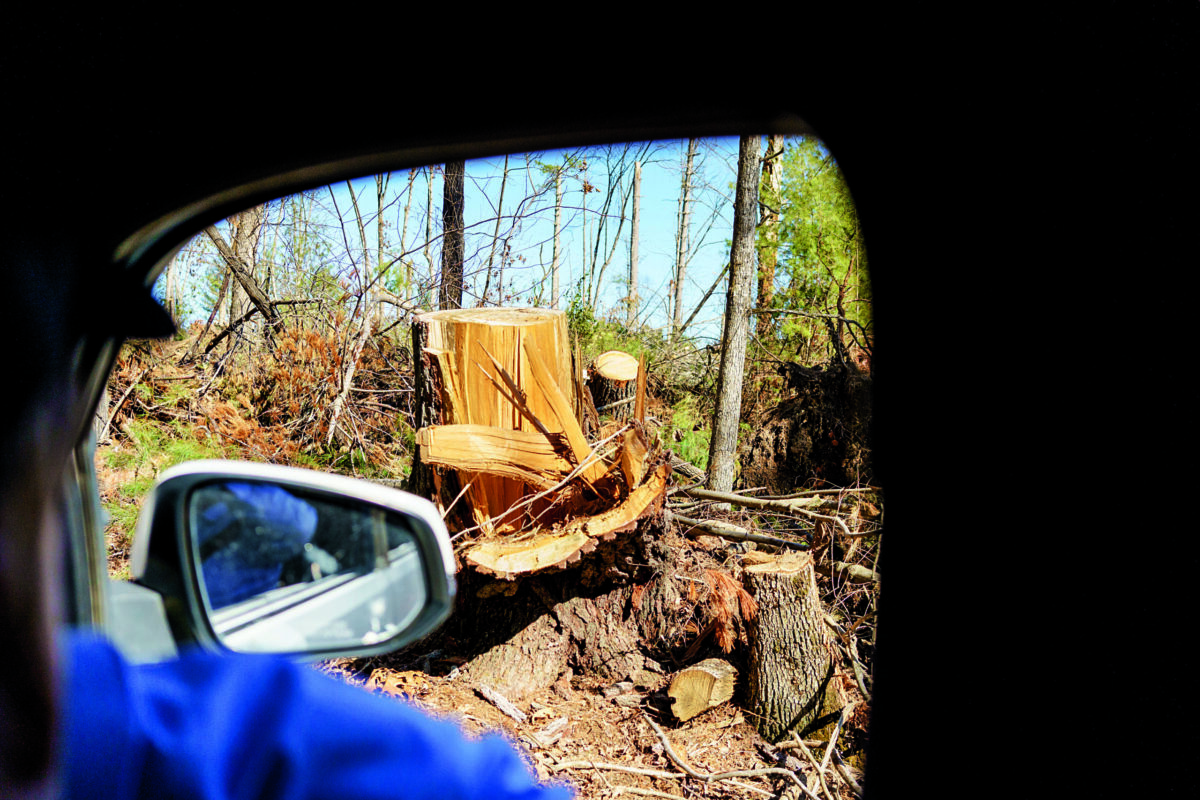
Helene turned Biltmore’s bucolic grounds into a tangle of downed trees and eroded riverbanks. Tens of thousands of trees — some of them dating back to Frederick Law Olmsted’s original 1895 design for the estate — were toppled. (Photo: Jesse Barber)
The burden sits heavily with Pickering, whose job is to hone the guest experience and convince people to spend more time and money at the estate, which is not publicly owned or run by a nonprofit, though that assumption persists because similar properties are. The Breakers, an opulent Vanderbilt property on the shores of Rhode Island, is run as a museum by the Newport Preservation Society. The Vanderbilt Mansion in Hyde Park, New York, is run by the National Park Service.
The Biltmore Co., however, owns and operates the estate. Its CEO is Bill Cecil Jr., George Vanderbilt’s great-grandson and Pickering’s uncle. The estate pays taxes and spends enormous sums of money to preserve the house and maintain the land. “It’s a really unique model; there’s nothing else quite like it in the United States,” Pickering said. “Since I was young, I’ve known that our family mission is to preserve this place for the next generation. And that means every generation needs to add some new innovation, some new contribution to the Biltmore legacy.”
Pickering’s contribution is to help jump-start Asheville’s tourism industry. It was partly his decision to reopen the estate as soon as possible, even as large parts of Asheville had no potable water and city officials pleaded for tourists to be patient after Helene’s floodwaters destroyed the region’s water infrastructure. Tourists to Asheville were welcome by the end of October. Ten months after Helene struck, parts of Asheville are still in recovery mode.
Pickering was scheduled to meet in mid-July with Chancellor Lee Roberts, who was on a planned summer tour in western North Carolina to discuss disaster recovery efforts at Biltmore and other areas, and UNC’s support of health care and economic development in the region.
All natural
Pickering is in it for the long haul. When he was 12 years old, he earned a wildlife rehabilitation license so he could rescue injured animals and nurse them back to health. Three years later — and seven years after receiving Goodall’s inscribed book — Pickering met the famous naturalist when she visited Warren Wilson College in Swannanoa, a 15-minute drive east of Asheville. The encounter inspired the teenaged Pickering to start a branch of the student conservation group Roots & Shoots USA at the Carolina Day School. The Goodall-promoted initiative brings together kids as young as preschoolers and as old as college students to become involved in environmental and humanitarian causes.
After high school, Pickering joined the Jane Goodall Institute, headquartered in Washington, D.C., for a year-long fellowship, during which he accompanied Goodall to Tanzania, where she began her storied research with chimpanzees and where Pickering served as photographer for the institute’s 50th anniversary. One of his photos made the cover of Goodall’s 2013 book, Seeds of Hope, a New York Times bestseller. When Pickering was 19, the institute invited him to join its board of directors, and he remains friends with Goodall, now 91. Last year, Pickering and his wife, Clary Powell Pickering, attended Goodall’s 90th birthday party in New York.
Pickering came to Carolina to study communications, environmental studies and entrepreneurship. He didn’t have an immediate family connection to UNC, but Pickering said he was drawn to Carolina like any other ambitious young person who saw high school friends head off to Chapel Hill.
Following Helene, despite the more pressing and immediate needs of the distressed region, the Biltmore team understood how devastating it would be for Asheville and Biltmore to lose a full tourist season. “The more people we host, the more people we can employ, and that matters for this community,” Pickering said. Before Helene, Biltmore employed about 2,400 people. This spring about 1,500 were working. “It’s weighed heavily on all of us,” he said.
Buck Goldstein Jr. ’70 (’76 JD), who co-founded UNC’s entrepreneurship program, remembered Pickering as a serious-minded student who was already thinking about business innovation as a way to make an impact in the world. “We really pitched [the program] toward social entrepreneurship in those early days, and that was clearly something he was already focused on,” recalled Goldstein, who has stayed in touch with Pickering. “Until you really got to know him, you wouldn’t know he had any connection to Biltmore or the family that he’s from. He was doing a series of intentional things while he was in school and after to prepare himself for the responsibility he was going to have.”
At Carolina, Pickering read Richard Louv’s Last Child in the Woods: Saving Our Children from Nature-Deficit Disorder and recognized a deeper purpose behind the drive for conservation. Louv argued that exposure to nature is essential for a healthy childhood, and that too many young people don’t have the generous access to the outdoors that Pickering enjoyed.
“I knew I had this passion for how we talk about the environment, how we invite people into nature,” Pickering said. “I started to think a lot about how to give back to other kids who may not have had the kind of access to nature that I grew up with.”

The physical and psychological toll Helene wrought in western North Carolina is difficult to comprehend. The storm killed more than 100 people, making it the deadliest hurricane in recent North Carolina history. It damaged more than 100,000 houses and completely destroyed about 1,000 homes, uprooting lives on a scale the region had never experienced before. PHOTOS: Istock/FS
After graduating, Pickering spent three years with the Disney Conservation Fund, which gives grants to environmental nonprofits. Then he decided it was time to return to the family business, starting on the marketing team and “getting performance reviews like anyone else,” said Mark Hemphill ’13 (MBA), Biltmore’s chief marketing officer and a 26-year veteran of the estate. “[Chase] has a humility and a curiosity in the way he approaches the work here. He knows he’s a steward of this incredible place, and he knows he has to work with a large team to realize that vision.”
Pickering said he would like to see Biltmore become more of an outdoor destination, a base for exploring the estate’s natural beauty and the wider region. His weekends are often spent taking his two young kids camping or exploring favorite trails around Asheville. He and his wife spent their 10th wedding anniversary snorkeling for hellbenders, giant salamanders native to mountain rivers. “As a dad, I think a lot about spending meaningful time outside together as a family,” he said. His children are growing up on the estate much as he did, roaming the fields and forests.
After the flood
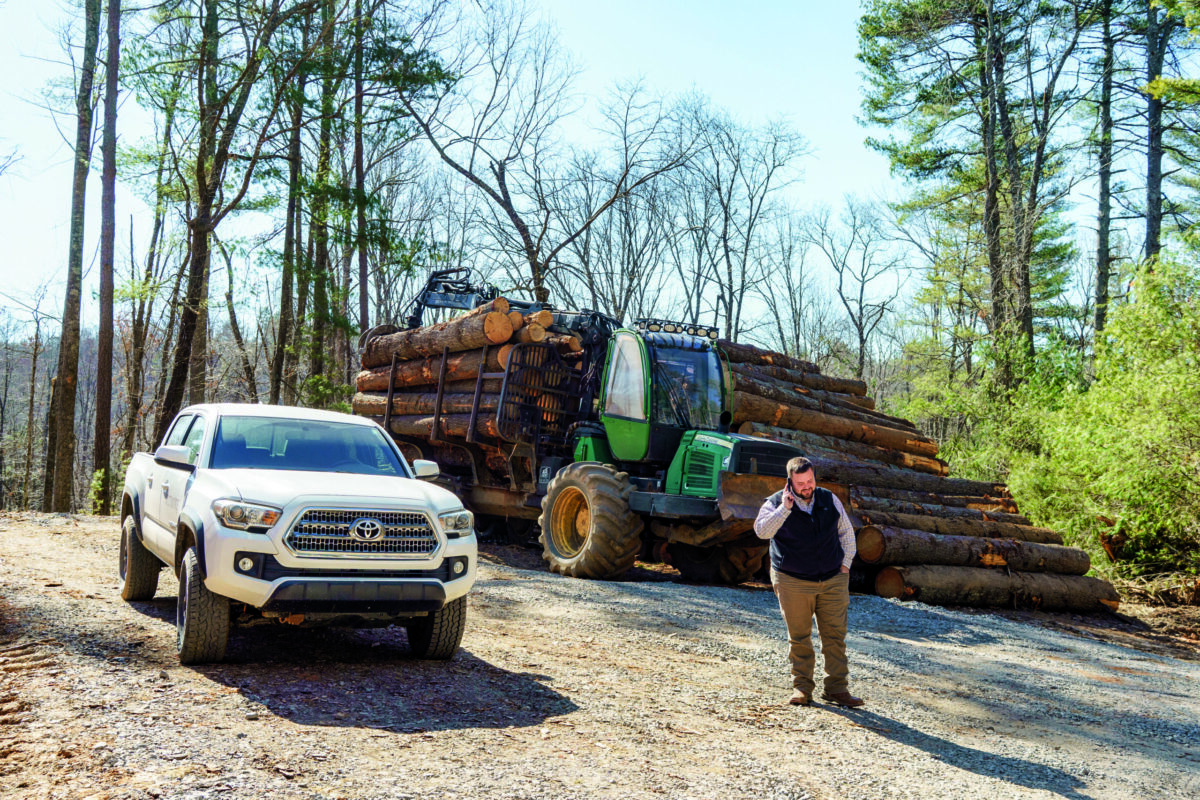
Kyle Mayberry, Biltmore’s director of agriculture, supervised the operation to remove as many of the fallen trees as possible before they dried out and became a fire hazard. (This year, wildfires have burned thousands of acres throughout the North Carolina mountains, fueled in part by downed trees.) “This is going to be a long process, but it’ll be a good story out of a bad situation.” The loss of pine trees will offer the chance to plant more hardwoods, Mayberry said, and he’s sending some of the fallen trees to manufacturers of wine barrels. (Photo: Jesse Barber)
On a Friday in February, Pickering began his work with a pep talk to the house staff just before a tour group of rambunctious elementary school students filed through the front door. From there, he piloted the company’s electric Ford pickup truck down to the Lodge Gate, where Swannanoa River floodwaters had reached nearly to the top of the 28-foot arched entryway during Helene. The gate withstood the onslaught, but two adjacent buildings were severely damaged, and the 120-year-old tulip poplars that lined the driveway were uprooted and lost.
Bill Quade, Biltmore’s director of horticulture, walked Pickering through a new design for the estate’s entrance road and a plan to replace the poplars in a manner faithful to Olmsted’s original vision. “We’re all about preservation, so we approach any changes with a lot of caution,” Quade said. He maintains a database of more than 17,000 trees considered part of the landscaping plan, distinct from the estate’s forests. Helene wiped out about 1,800 of them.
Quade said immediately after Helene passed through, he and his team needed nearly two days to cut through fallen trees to reach Biltmore House. “You really start wrapping your head around the extent of [the damage],” he said, “and what it’s going to take to get this place back in shape for visitors.”
Following Helene, despite the more pressing and immediate needs of the distressed region, the Biltmore team understood how devastating it would be for Asheville and Biltmore to lose a full tourist season. “The more people we host, the more people we can employ, and that matters for this community,” Pickering said. Before Helene, Biltmore employed about 2,400 people. This spring about 1,500 were working. “It’s weighed heavily on all of us,” he said.
That’s apparent from watching Pickering greet by name every employee he passes, often pausing to ask questions about their work or their home life. There’s a caution in the way he speaks — a careful choosing of words that reflects a lifetime of preparation for public scrutiny. In a 2009 interview for the Carolina Photojournalism Workshop — a week-long program that immerses UNC students in various communities to create a documentary website — a college-age Pickering talked about the experience of growing up on the estate and carrying the responsibility of being a Vanderbilt heir. “We kind of are always under the microscope,” he said. “It’s a challenge to be normal, and I love that challenge.”
While most visitors to Biltmore focus on the famous house and its grandeur, Pickering is eager to share his love of the surrounding land. Standing on the enormous terrace just outside the 10,000-book library, looking southwest toward the French Broad River and the expanse of Pisgah National Forest, Pickering interrupted himself to point out a bird of prey swooping between the trees. “That’s a Cooper’s hawk right there,” he said, stepping to the edge of the stone balustrade. “Those are magnificent.” A few minutes later, he identified a pileated woodpecker by its distinctive call.
To him, keeping this land intact is the family business, and the iconic chateau is a means of supporting the broader estate. From its earliest days, George Vanderbilt’s Asheville oasis has faced pressure to sell or develop prime chunks of land, forcing every generation to find creative ways to preserve the core holdings that make up Olmsted’s design.
At the time Vanderbilt acquired the land in the late 1800s, much of the property was eroded and worn out from farming and timber harvesting. Vanderbilt became one of the first major landowners in the country to embrace “scientific forestry,” hiring some of the country’s earliest trained foresters to develop a long-term plan to restore the landscape.
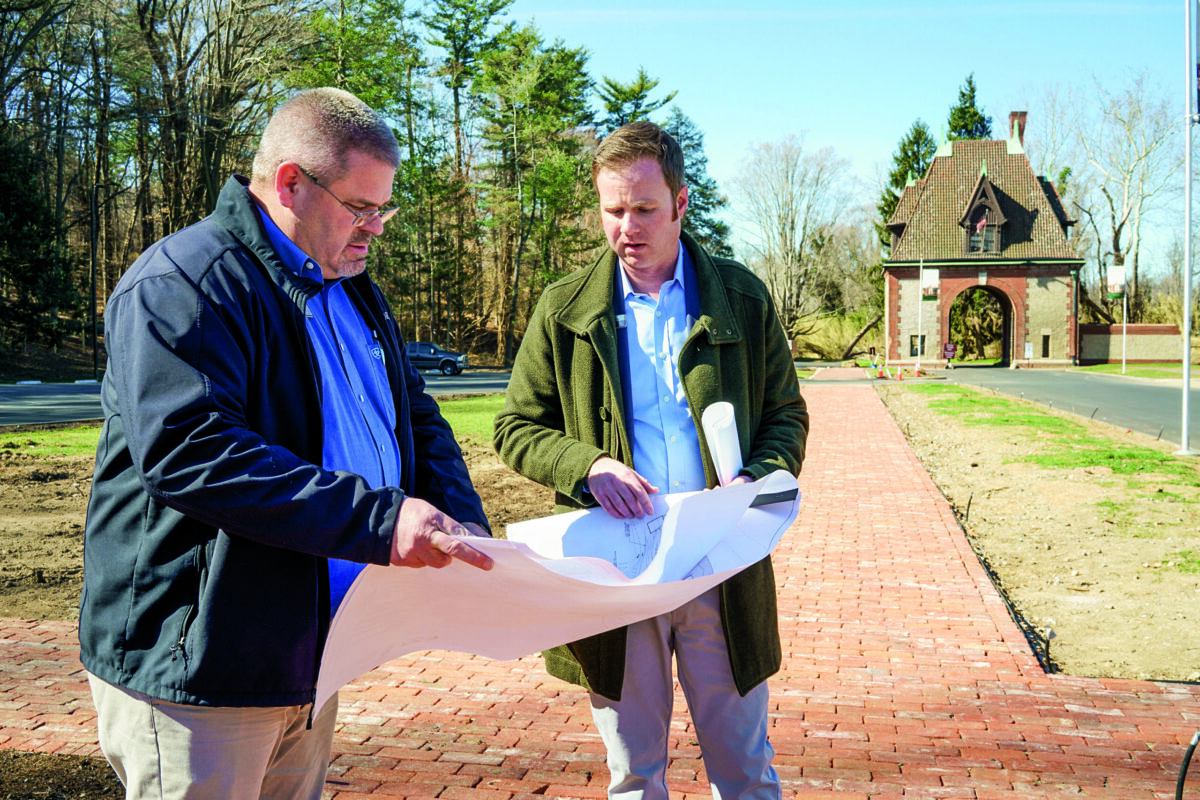
Bill Quade, left, Biltmore’s director of horticulture, walked Pickering through a new design for the estate’s entrance road and a plan to replace the poplars in a manner faithful to Frederick Law Olmsted’s original vision. “We’re all about preservation, so we approach any changes with a lot of caution,” Quade said. (Photo: Jesse Barber)
After Vanderbilt’s death, his wife, Edith, sold 86,700 acres at cut-rate prices to the federal government, which then established Pisgah National Forest and set the foundation for western North Carolina’s outdoor tourism economy. The U.S. Forest Service still runs the Cradle of Forestry in America museum high in the mountains about 18 miles southwest of Biltmore House, commemorating the spot where Carl Schenck, the estate’s second chief forester, established the Biltmore Forest School in 1898. “That’s the really cool part of our story,” Pickering said. “The commitment to conserving this land and protecting the original vision for this place,” which includes 75 acres of formal gardens, hundreds of acres of working farmland and huge tracts of carefully managed forest.
Past, present, future
A few hours after discussing the replanting of the poplars at the main gate, Pickering slogged through a much less delicate tree problem with Kyle Mayberry, Biltmore’s director of agriculture. Helene blew down tens of thousands of trees across the estate, including whole swaths of forest. Mayberry was supervising the operation to remove as many of the fallen trees as possible before they dried out and became a fire hazard. (This year, wildfires have burned thousands of acres throughout the North Carolina mountains, fueled in part by downed trees.) As Mayberry’s company pickup bounced up a muddy track, Pickering sat in the passenger seat, surveying the damage.
“Startling, isn’t it?” Mayberry said, bringing the truck to a stop in the middle of a vast tangle of timber. “This is going to be a long process, but it’ll be a good story out of a bad situation.” The loss of pine trees will offer the chance to plant more hardwoods, Mayberry said, and he’s sending some of the fallen trees to manufacturers of wine barrels. “We don’t want all of this to go to waste,” he said. “We’re a large nature preserve and a working estate, and we want that timber to have value.”
“It’s a really unique model; there’s nothing else quite like it in the United States,” Pickering said. “Since I was young, I’ve known that our family mission is to preserve this place for the next generation. And that means every generation needs to add some new innovation, some new contribution to the Biltmore legacy.”
Aside from wildlife, Biltmore is home to 1,500 animals, including pigs, goats, sheep, draft horses and cows. After the storm, Mayberry’s team spent days bringing the animals food and water, while also starting to clean up the worst of the damage. For the first few days, with power and communications down across the region, Mayberry came back to his house on the Biltmore property every evening to find a mass of sticky notes stuck on his screen door, each one carrying an update from his colleagues. “We made it work,” he said, “because that’s what we always do.”
Pickering’s family has been finding ways to make Biltmore work for more than a century. A thriving dairy operation once supported the estate, which later focused on historic house tourism and now has added a well-regarded winery and hotel operation to the mix. The Biltmore Co. balances preservation and innovation, past and future. “That entrepreneurial spirit is part of who we are,” Pickering said. “Always trying something new, adding something new.”
The experiences of COVID and then Helene have left Pickering determined to broaden income sources so that Biltmore’s financial health doesn’t depend exclusively on visitors driving through the entry gate. Asheville is a mecca for beer and spirit enthusiasts, and Pickering hinted strongly that Biltmore might be venturing into that line of business soon. “We have to continue diversifying revenue streams to support this place,” he said.
Nearly all of his ancestors resisted the temptation to sell parcels of land for commercial development, despite the millions of dollars such a land sale would bring the Biltmore Co. To Pickering, turning the family estate into more Asheville subdivisions is a nonstarter. He wants to preserve it, to keep the view from the grand house the same as his great-great-grandfather might’ve seen it. Holding onto the landscape where he was raised will be the work of a lifetime, and he welcomes it.
“This land is the mission,” he said. “There’s still so much beauty here in Asheville and at the Biltmore. The magic of the mountains is still here.”
Eric Johnson ’08 is a writer in Chapel Hill. He works for the UNC System and the College Board. His previous article in the Review profiled taxidermist Erica Heller ’13.
Thanks for reading the Carolina Alumni Review
Carolina Alumni members, sign in to continue reading.
Not yet a member? Become one today.