Rapture of the Deep
Posted on Oct. 13, 2025In a bizarre world far below the surface of the ocean, Sönke Johnsen ’96 (PhD) found himself.
by George Spencer
Listen to this story as read by ElevenLabs AI.

Sönke Johnsen ’96 (PhD) Johnsen has discovered such a wide range of fantastical animal behavior that a colleague said he has transformed the field of marine biology. (Photo: Carolina Alumni/Ira Wilder ’24)Biologist Sönke Johnsen ’96 (PhD) loves to dive into the unknown — literally. Whether this oceanographer is swimming with sharks, daring crushing depths in submersibles or building a basement rainforest, he revels in unwrapping the mysteries of the planet’s strangest creatures.
Biologist Sönke Johnsen loves to dive into the unknown — literally. Whether this oceanographer is swimming with sharks, daring crushing depths in submersibles or building a basement rainforest, he revels in unwrapping the mysteries of the planet’s strangest creatures.
“Nature is my religion in a visceral way,” Johnsen said. “There have been times in my life where I, all of a sudden, imagine this entire living world all doing its thing around me and how remarkable that is. Something needs to be bigger than yourself. For me, it’s this natural world and this incredible unfolding family history that is evolution.”
While some biologists devote their careers to studying only one species, Johnsen, a professor at Duke University, has advanced our understanding of more than two dozen species. Because of his research, we now know more about scallops, seals, sharks, shrimp and squid, as well as land animals such as spiders and the tiny transparent northern glassfrog of Central and South America. He has discovered such a wide range of fantastical animal behavior that a colleague said Johnsen has transformed the field of marine biology.
Johnsen studies how animals use light, mirrored surfaces, iridescence, fluorescence, bioluminescence or ultrablack color to find their next meal, attract a mate, camouflage themselves and, in the case of the glassfrog, become invisible. For the past three years, Johnsen has studied sea turtles with Carolina marine biologist Ken Lohmann to learn how they harness the Earth’s magnetic field and travel thousands of miles to the same nesting grounds each year.
“Sönke is the world’s foremost expert on vision in aquatic animals, and his work is a synthesis of biology, physics and math, all of them beautifully interwoven,” Lohmann said.
Too madcap to be true
There is something charming and endearingly goofy about Johnsen, who shares his office with a 10-foot-long red squid plushie a student gave him. His restless imagination sparks seemingly way-out, yet unexpectedly plausible, insights. For example, he believes that fireflies on the screen window of his bedroom are trying to communicate with the glow of his bedside clock. “They’re sending a signal they would like to mate,” Johnsen said. “I totally believe that.”
To Johnsen, science may be less about expertise and accomplishments and more about observing nature’s awe-inspiring wonder. “Biology is hysterical,” he said. “I’ve always loved the humor in what animals will do — what evolves and what doesn’t. It’s all so random, crazy and very funny, and that’s what has kept me in it — the endless story of nature.”
Johnsen’s life — particularly his path from earning a doctorate and landing a professorship, both at world-class universities — unspools like a movie peppered with random moments that seem too madcap to be true.

“I’m really bad at thinking about myself in terms of achievements,” Johnsen said. “I just do what I like, and I do what I can to see the world in my own way.” (Photo: Carolina Alumni/Ira Wilder ’24)
Johnsen is the son of German immigrants who struggled financially in their adopted home of Pittsburgh. He crossed the Atlantic as an infant in 1966 on the German liner MS Europa. Because the ship had no crib, he made the voyage sleeping on a pillow in an orange crate nailed to the deck of his parents’ stateroom. Once in the United States, his physicist father struggled to find a teaching position. His mother, a physician, stayed at home to raise their two children until they were old enough to allow her time to practice medicine. “My parents were poor but inventive — growing, building, sewing and scavenging just about everything we needed,” he said.
Johnsen grew up a self-described “lonely child” and a “mathlete.” He and his mother routinely walked a mile to the library to check out books. Often bedridden with chronic tonsillitis, Johnsen said he had to remain intellectually occupied to please her. When fevers weren’t making him hallucinate cartoon dinosaurs on his bedroom walls, his mother had him read literature far above his grade level, such as To Kill a Mockingbird.
The soot-blackened buildings of steel-town Pittsburgh in the 1970s darkened his childhood spirits, Johnsen said. The bits of nature he experienced were neighborhood trees, squirrels and guppies. He said he was more thrilled by the wilder nature of the Outer Banks, specifically Kill Devil Hills and Avon, where the family vacationed. “I would feel like I had stepped into God’s open cathedral,” he said. “I’d throw myself into the ocean with this love of the fact that it was there, and I was in it.” He remembers feeling heartbroken when he had to leave the Outer Banks.
Back then, he thought the beach was the ocean. “I was mistaking the peel for the apple, the bark for the tree, the skin for the person inside,” he wrote in his 2024 book Into the Great Wide Ocean: Life in the Least Known Habitat on Earth, which Smithsonian Magazine listed as one of its Best Books of 2024.
Yet, after graduating from high school, he didn’t pursue an education or a career focused on the sea. Instead, when he enrolled at Swarthmore College outside Philadelphia, he chose math as a major and art as a minor. He sculpted, painted and designed sets for the campus theater group while living in a clothing-optional group house with his girlfriend. “The art itself, the doing of it, got me fascinated with light, color and vision,” he said.
“It was stormy, the ship smelled, and I was seasick,” Johnsen said. “It was the best time of my life.”
Johnsen took only one biology course. Feeling adrift, he dropped out in 1988 after three years. “I had no idea of what I was doing and how to interact,” he said. “I couldn’t crack the social code of it at all. And intellectually, I had no idea what I wanted to do with myself.” Luckily, he took so many classes his last two semesters that Swarthmore awarded him his degree a year later.
Disenchanted with academia, Johnsen taught dance to toddlers and kindergarteners at a Quaker school. He made so little money — occasionally he had to pilfer food from the cafeteria — that he took odd jobs as a carpenter.
During a glum car ride with a friend after they botched a carpentry job, Johnsen chose to pursue biology in grad school in a most unscientific way. Because he didn’t know what major to pick, he let the alphabet decide. He had studied art, which had led him to poverty, so he ruled that out. Biology began with the next letter, and that set his future life into motion. (Oddly, the friend adopted Johnsen’s strategy. He picked ‘E’ for education and is now a professor of education.)
And why Carolina? He said he applied to UNC because Chapel Hill was relatively close to Kill Devil Hills. To his amazement, the biology department’s graduate program admitted him.
Once on campus, things went badly. Most of the biology department’s faculty had opposed his admission because he had no science background. But his soon-to-be faculty adviser, Professor William Kier, argued that his math skills would enable him to figure out biology. That prediction proved false — at first. “I had no idea what I was doing,” Johnsen said. “I would sit out on the lawn between Wilson and Coker, watch bugs come by and try to draw them. I nearly flunked out a number of times because I couldn’t learn the material fast enough. I was fascinated by it; I loved it. But I was woefully ignorant.”

Hippopodius hippopus. Johnsen: “Hippopodius is famous for being able to go opaque rapidly when it’s touched. Normally it’s very clear but will go opaque in 5 to 10 seconds when disturbed. It does this by precipitating proteins inside its body, which then scatter light. Nobody is sure why they do this, but we assume it has a defensive function. Its name means ‘horse foot’ because the pieces that make it up — known as bracts — look like transparent hooves.” (Photo: Sönke Johnsen ’96 (PHD))
Johnsen muddled through. Another abysmal academic moment came during his oral exams when a professor asked him what he saw himself doing with his degree. “I said that I’d like to design playgrounds that looked like animals,” Johnsen recalled. “That professor had an artistic bent and thought that was cool, but my adviser was horrified.”
Johnsen successfully defended his dissertation on how certain echinoderms see. These eyeless marine animals, better known as serpent stars, resemble starfish and see using photoreceptors in the skin of their bodies. He applied for postdocs with the Harbor Branch Oceanographic Institute and the Woods Hole Oceanographic Institution. Both rejected him. So he bided his time for a year cleaning fish tanks at UNC. When he reapplied, both schools gave him the nod, and he chose Harbor Branch, where he studied under Edith Widder, a renowned oceanographer and marine biologist who co-founded the Ocean Research & Conservation Association. He soon went on his first research cruise. “It was stormy, the ship smelled, and I was seasick,” he said. “It was the best time of my life.”
Finding his stride
Johnsen was on Widder’s team when he made one of the first of his many startling discoveries. He hauled up from the deep waters of the North Atlantic Ocean a hand-sized, blood-red octopus. The crimson cephalopod (Stauroteuthis syrtensis) had been netted before, but Johnsen noticed something no one else had — its suckers glowed, twinkling blue-green. “It was like we caught evolution in midstep, which you don’t often see,” he said.
Widder and Johnsen concluded that the suckers did something unheard of: They glimmered primarily to lure prey, not to grab it. Their photograph of the neon creature caused a sensation and landed on the cover of the science journal Nature.
During his 18 months in Widder’s lab, Johnsen produced nine scientific articles on three subjects. “He was the most productive [postdoc] I’ve ever worked with,” Widder said. “He was just unbelievable. Sönke is always producing something new and exciting. His outside-the-box thinking has transformed the field.”
One of his recent discoveries involved the inch-long northern glassfrog of Central and South America, which makes itself almost invisible by removing red blood cells from its circulation and tightly packing them into its liver. The packed cells should form life-threatening clots, Johnsen said, but for some reason, they don’t.
No one knows how glassfrogs pull off such a feat, but understanding why may have significant implications for blood research. New drugs often have unlikely origins. For instance, scientists studying Gila monster venom in the 1990s discovered a hormone that controls blood sugar, a finding that led to the creation of the widely prescribed diabetes drug semaglutide, which is the active ingredient in the popular weight-loss medication Wegovy. The market for such drugs is estimated to reach $150 billion in the early 2030s.

“Nature is my religion in a visceral way,” said Johnsen, shown here reflected in rainwater that collected in his canoe. “There have been times in my life where I, all of a sudden, imagine this entire living world all doing its thing around me and how remarkable that is. In the end, a lot of what religion gives us is this sense of awe. It’s very hard to go through life happily without a sense of awe. Something needs to be bigger than yourself. For me, it’s this natural world and this incredible unfolding family history that is evolution.” (Photo: Carolina Alumni/Ira Wilder ’24)
To learn how the leaf-hanging, leaping frog pulls off its vanishing act, Johnsen (and postdoctoral researcher Carlos Taboada) created a small tropical rainforest in the basement of Duke’s Biological Sciences Building. It turned out the glassfrog, while resting, sucks 90 percent of its hemoglobin into a “mirrored pouch” full of reflective crystals surrounding its liver. Since its translucent skin reflects little light and its hemoglobin-free blood cannot absorb light, the frog disappears, a special effect that protects it from predators.
“A pretty good little trick,” Johnsen said of the discovery that earned his lab a lot of media attention. The same has been true of his collaboration with Lohmann, who has spent his career at Carolina untangling the mystery behind how leatherback turtles somehow migrate 3,000 miles from Canada’s Newfoundland shore to Trinidad off the eastern coast of Venezuela and then return to the same beaches, year after year. (See “Turtle Umwelt,” January/February 2025 Review.)
Led by Lohmann, the research team came up with a number of good hypotheses about how the turtles use the Earth’s magnetic field to navigate. The details will be spelled out in a forthcoming scientific publication.
For Johnsen, the attraction of the research may partly be the unusual size of the turtles. “They are truly enormous animals — half the size of a VW Beetle,” he said. “We’ve had a great time puzzling out how on earth they [migrate].”
Risk and reward
Johnsen said what he doesn’t know humbles him. “Almost daily I realize I have no idea what’s truly going on,” he wrote in Into the Great Wide Ocean. “Now and then an animal does something that seems so impossible that all I’m left with is the nagging concern that we must be overlooking something really big and really important.”
Still, what he and others have discovered is remarkable, and much of it can be seen in his new coffee-table book The Radiant Sea: Color and Light in the Underwater World. Written with Steven Haddock, a senior scientist at the Monterey Bay Aquarium Research Institute, its striking images and relatable text reveal how alien-looking, deep-sea creatures thrive by relying on transparency, pigmentation, iridescence, bioluminescence and fluorescence.
“Sönke is drawn to anything out of the ordinary and is willing to try just about anything once — and again, if he survives,” said Carolina marine biologist Kenneth Lohmann.
Creating such a book would be impossible without Johnsen’s participation in the daring scientific ventures he finds thrilling. In May, Johnsen shipped out on the Woods Hole Oceanographic Institution research ship Neil Armstrong. While hovering above the Lucky Strike Rift in the Mid-Atlantic Ridge in the middle of the Atlantic Ocean, he and other scientists sent a remote-controlled, deep-diving vehicle named Jason a mile below the surface to study visual systems of deep-sea animals that live on hydrothermal vents that reach temperatures around 925 degrees Fahrenheit.
The voyage was one of dozens Johnsen has made to sites around the world, including the Great Barrier Reef, the Gulf of Mexico and the East Pacific Ocean. He said he is most at home at sea, where he revels in the “self-contained community of often odd people made even odder by extended isolation. And where else do professors get to play with hydraulic winches and 30-meter fishing nets?”
The way Lohmann sees it, “Sönke is drawn to anything out of the ordinary and is willing to try just about anything once — and again, if he survives.” One danger Johnsen has experienced is swimming with sharks, which, he learned, can be unpleasantly unpredictable. “They swim towards you relatively quickly, and then at the last moment, they turn away,” he said. “When you’re swimming on the coral reef, you’re in their refrigerator.”
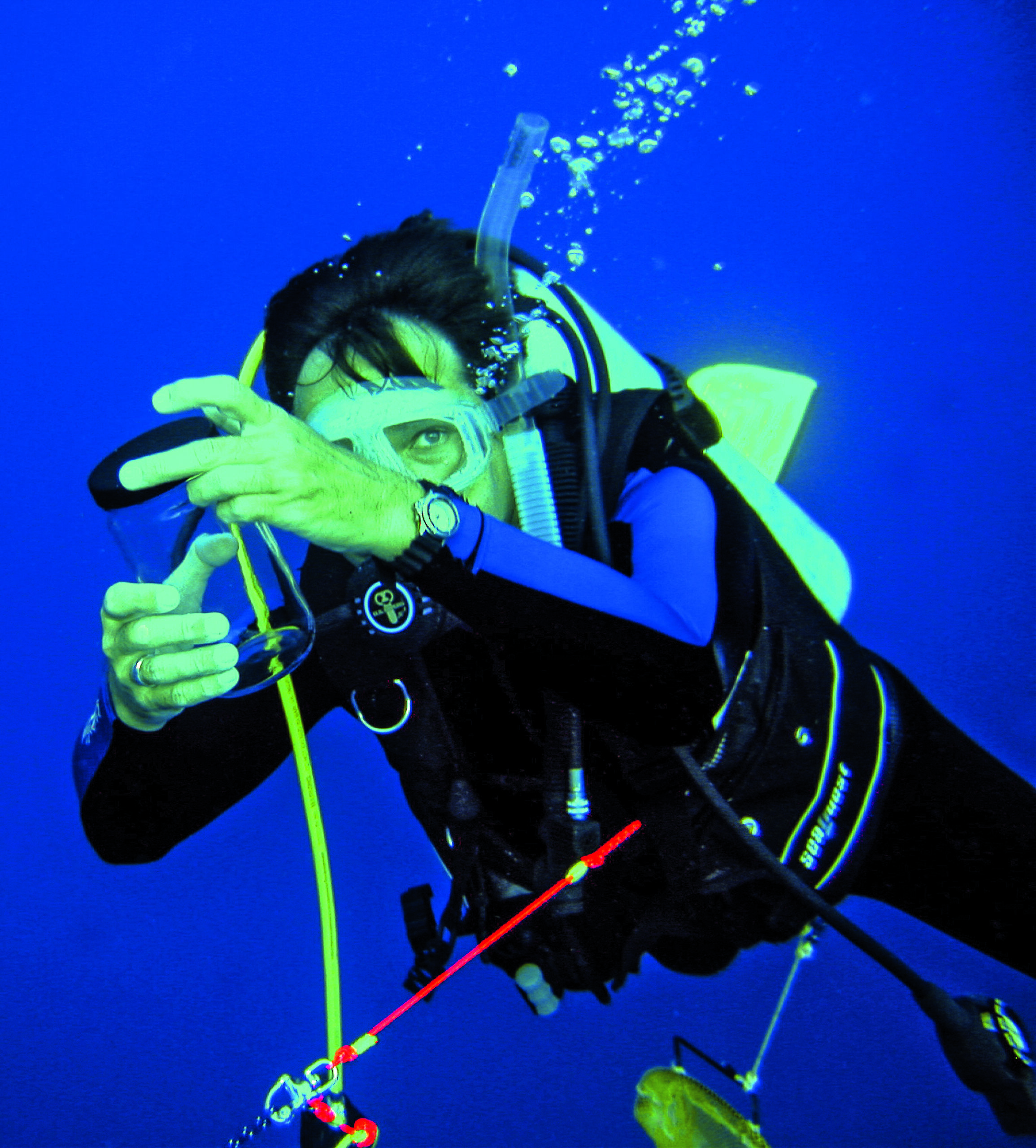
Sharks, Johnsen said, “swim towards you relatively quickly, and then at the last moment, they turn away. When you’re swimming on the coral reef, you’re in their refrigerator.”(Photo: Sönke Johnsen ’96 (PHD))
Once, while diving off Wistari Reef in Australia’s Great Barrier Reef, Johnsen and five other researchers surfaced to find their dive boat had left. It returned a hair-raising hour later before the current could sweep them off toward Antarctica.
His imagination also carries him away. “I personally would be both thrilled and nervous to be surrounded by a pack of human-sized tentacled predators [Humboldt squid] sending colored signals to one another in a twilit sea,” he writes in Into the Great Wide Ocean. Johnsen said they are like “a whole bunch of Hulk Hogans with tentacles in the water. I have friends who have gotten chomped by them. I have no real desire to have a giant beak take a piece out of my thigh.”
A few times while diving, Johnsen suffered nitrogen narcosis, which is commonly known as “rapture of the deep.” It is caused by breathing too high concentrations of nitrogen, leading to feelings of intoxication. In Into the Great Wide Ocean, he wrote that in his drowsy stupor he had the feeling he was “a magic fish, invulnerable to harm.”
“I had enough discipline to rise to shallower depths,” he said.
Johnsen said he had “a number of odd and oddly specific goals in life,” one of which included “the urge to swim as far from shore as possible,” a compulsion that nearly killed him more than once. And he has plumbed the depths of the ocean in submersibles such as the Johnson-Sea-Link, which he called a “true lead zeppelin: large, heavy and cumbersome on deck and in the air, but as peaceful as a hot-air balloon under the water.”
Johnsen explains his attraction to taking risks this way: “I’m cautious, but there are things that pull me stronger than the risk. The pull to go to the bottom of the sea completely overwhelms any thought of the risk of it.”
The love of diving into an unknown world is why Johnsen has, on occasion, tempted fate. “The great thing about marine biology is it’s a field where there’s still a lot of exploration left,” he said. “It’s almost like getting in a spaceship and going to another planet. But it’s all here.”
George Spencer is a freelance writer living in Hillsborough. His article in the March/April 2025 Review reported on UNC research into tardigrades, which may lead to improving drugs and vaccines.
Thanks for reading the Carolina Alumni Review
Carolina Alumni members, sign in to continue reading.
Not yet a member? Become one today.