Lifting the Sweatshirt Curtain
Posted on Dec. 5, 2025In the 1950s, Carolina football’s fiercest opponent was the newspaper created to tout it.
by Kenneth Joel Zogry ’97 (MA, ’08 PhD)
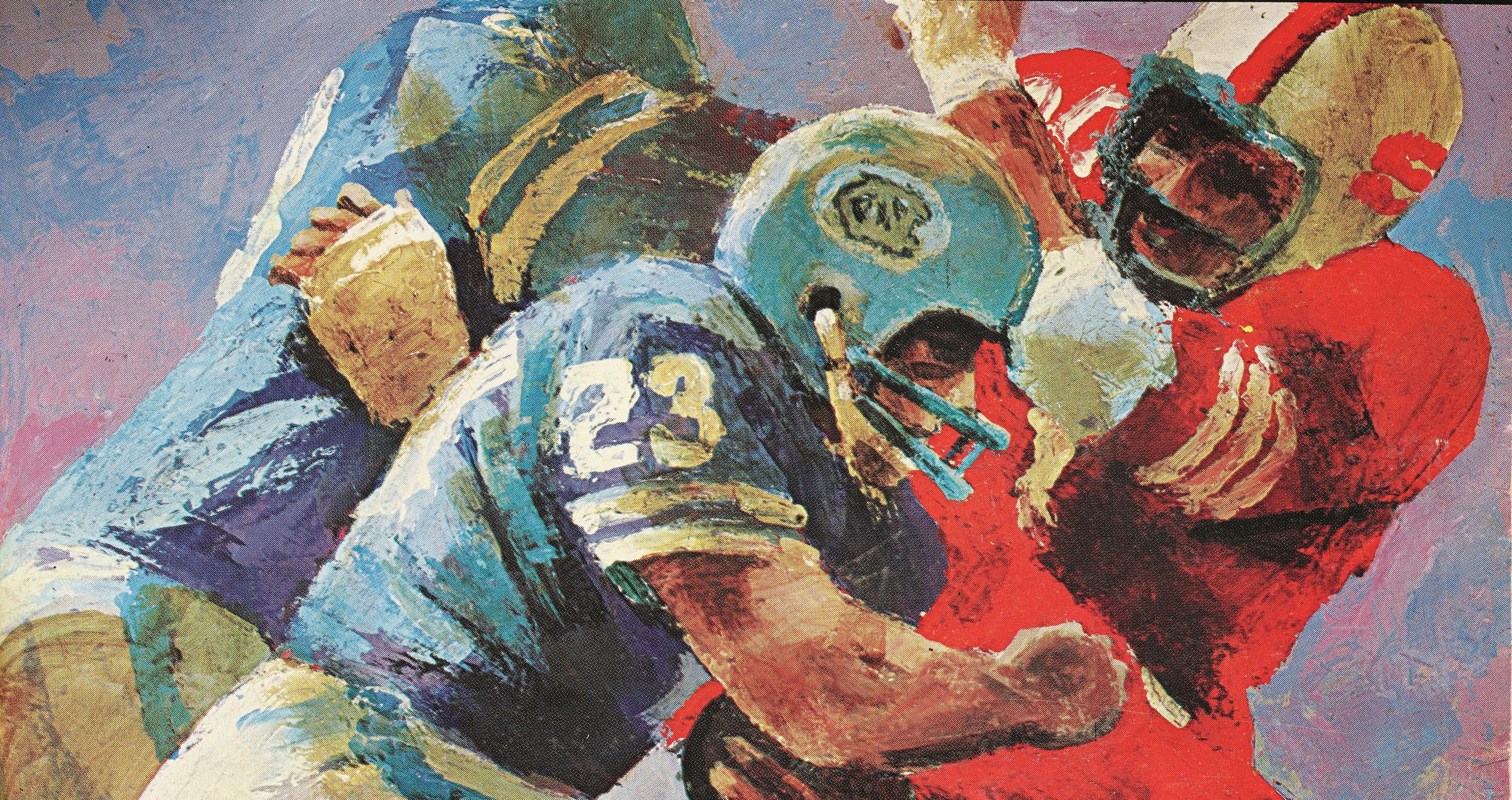
(Photo: 1968 UNC vs. NCSU Football Program)
The name-image-and-likeness era of Tar Heel football under famed head coach Bill Belichick is now underway, and the Review is taking the opportunity to look at the little-known history of the program before the modern era began in the 1960s. Part 1 focused on the origin of UNC football. (See “A Bit of Hair or Blood,” July/August 2025 Review.) Part 2 told the story of the growth and the evolving professionalism of the amateur game (See “Carolina Football Comes of Age,” September/October 2025 Review). Part 3, the last in the series, tells the story of the struggles of Carolina football and backlash against the program, as in-house rival basketball took center stage.
In fall 1950, Carolina football head coach Carl Snavely had a problem. His star running back, Charlie “Choo Choo” Justice ’50, was now in the National Football League. In his four-year UNC career, Justice rushed for 3,774 yards and passed for 2,352 yards, a total-offense record that would stand for the next 45 years. He was twice runner-up for the Heisman Trophy and led Carolina to two Sugar Bowl appearances. The Tar Heels went 32–9 in the 1946–49 seasons and were ranked No. 1 by the Associated Press in October 1948, the only time UNC has ever attained the top spot. But without Justice those achievements were unsustainable, and over the next three seasons Carolina compiled a 7–19–2 record. In 1953, Snavely pulled up stakes and left to coach Washington University in St. Louis.
Tar Heel Nation was not accustomed to losing seasons, and pressure was intense to find a winning coach. The next three coaches were tapped from within the Carolina family, two of whom had played for Snavely during his brief first tenure at UNC in 1934 and 1935. There was hope some of the magic would return.
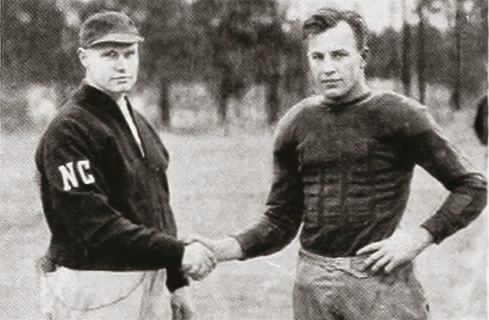
Coach Carl Snavely (left) and George Barclay ’34 (right), UNC’s first All-American (Photo: 1935 Yakety Yak)
First up was Tar Heel gridiron legend George Barclay ’34, who had been a two-time first team All-Southern Conference guard and linebacker and Carolina’s first All-American. He served as team captain his senior year, and his number 99 jersey was retired at the end of his playing career. Barclay Road just north of Franklin Street was later named for him. (The neighborhood’s streets honor several players of that era, among them: Justice, Paul Severin ’41 and Don Hartig ’49 (’53 MEd).) Barclay had a successful three-year run as head coach at Washington and Lee University, and Snavely brought him back to Carolina in 1952 as an assistant prior to his promotion to head coach in 1953. On Barclay’s coaching staff was a young assistant hired from Vanderbilt named Steve Belichick, whose son, Bill, was known to toddle around practices and home games during the three years his dad served as running-backs coach.
Although Snavely favored the single-wing offense, Barclay believed the split-T formation was a winning strategy. Despite high hopes, the team’s performance floundered and fans grew restless.
Little recognized at the time, Barclay faced strong winds from two directions swirling around Carolina sports during the mid-1950s: growing opposition to big-time sports among some students and University community members paying increasing amounts of money to, and providing special treatment for, varsity players, and the rise of an on-campus rival — basketball.
“The Educational Cancer”

UNC System President Gordon Gray ’30 (seated) and Vice President William D. “Billy” Carmichael Jr. (class of 1921), ca. 1954
Ironically, it was The Daily Tar Heel — a newspaper founded in 1893 as The Tar Heel to cover Carolina athletics — that gave voice to the most strident criticism of the football program in the mid-1950s.
The first sign of trouble appeared in fall 1953, when ambitious young DTH editor Rolfe Neill ’54, who would become the legendary Pulitzer Prize-winning publisher of The Charlotte Observer from 1975 to 1997, accompanied the team to a much-hyped game against the University of Georgia Bulldogs in Athens. In a blistering column published Nov. 6, 1953, and headlined “Big-Time College Sports — The Educational Cancer,” Neill wrote the trip “opened my eyes” to an athletics program that had “grown too big and was torturing the basic academic purpose of the institution.”
At issue, according to Neill, was special treatment given football players, the unseemly role of certain alumni and the revelation that one-quarter of the profits from the student stores was being turned over to the newly established Educational Foundation for what amounted to improper football scholarships. Student store profits were supposed to be used for academic purposes.
“Big-Time college sports are a cancer at the heart of education,” Neill wrote, adding that “long suspected as a serious disease, the ravages of intercollegiate athletics becomes a certainty when state funds are tabbed for specific uses as grants-in-aid to athletes.”
He continued: “What really hurts is that this happened to us. … The University officially has joined the alumni and ‘friends’ who provide the cash to buy better teams. We’ll miss the student with the curious mind and puny frame who otherwise [would] have received the benefit of these state funds. … We would rather have fewer students come here because of our reputation for learning, rather than the many who come to cavort in a playboy’s paradise.”
The editorial concluded with a bombshell: “We believe Carolina should withdraw from the big-dollar arena.”
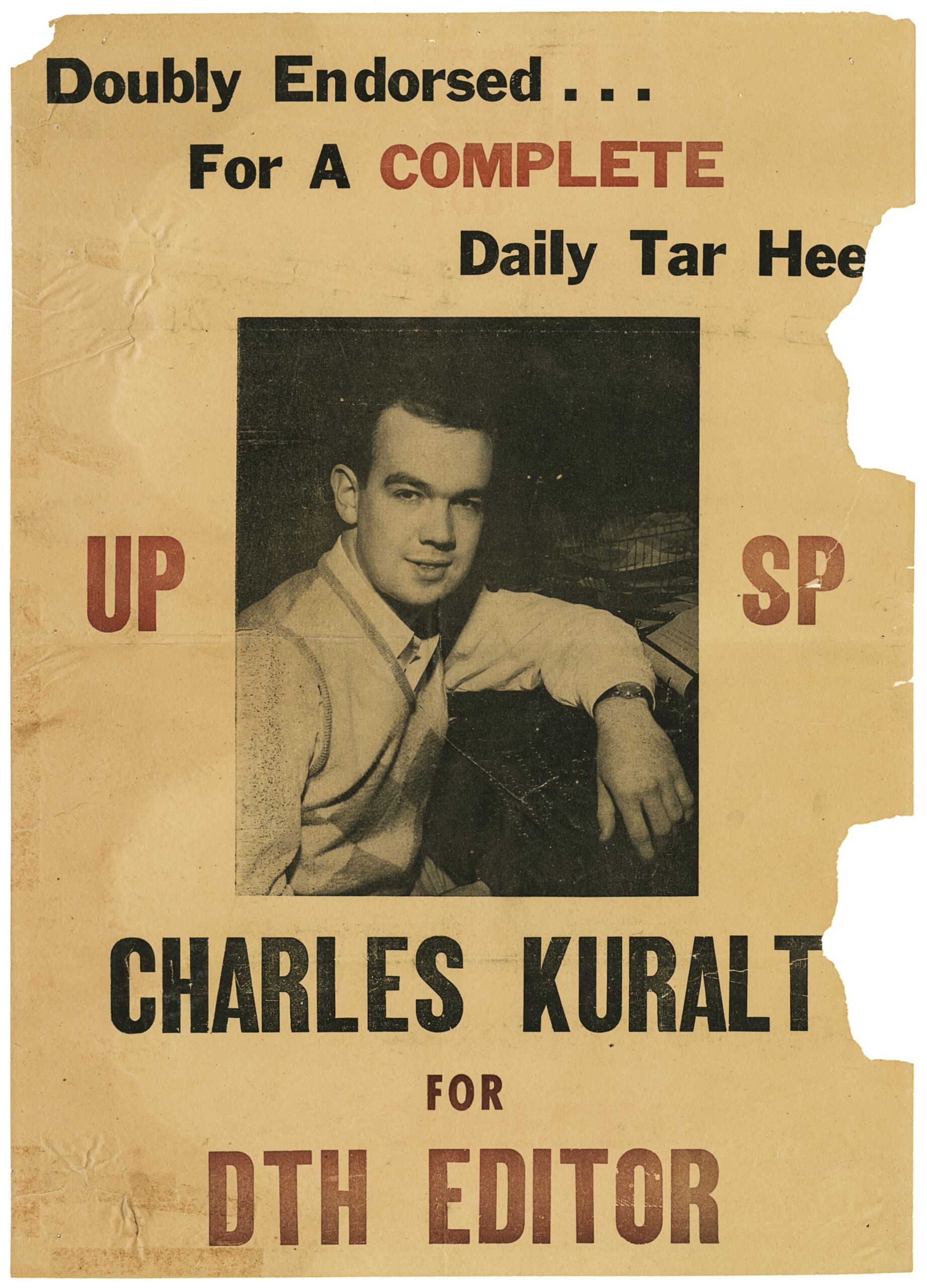
Poster of Charles Kuralt ’55, who ran for editor of The Daily Tar Heel, 1954. Kuralt won the election by promising not to attack “big-time” Carolina sports in print.
UNC System President Gordon Gray ’30, a man who usually kept a low profile and avoided conflict, felt compelled to issue a statement revealing that the UNC Board of Trustees had approved using a portion of student store profits for athletic grants as a one-time allocation in response to a similar action taken at State College (later, N.C. State University). The concern was that the State team would have an advantage over Carolina, and the board wanted a “level playing field.” Neill fired back on Nov. 10 with an editorial headlined “An Unwanted ‘Fairness,’ ” declaring the board’s action equated “one bad with [another] bad,” and did nothing but “smudge Carolina’s hands.”
Neill’s editorials reignited a debate about the role of big-time athletics at UNC that had lain largely dormant since controversy over the Graham Plan in the mid-1930s. (See “Carolina Football Comes of Age,” October/November 2025 Review.) The fallout was so intense that when Neill’s successor ran in spring 1954 to become The DTH editor (chosen each year from 1923 to 1993 by campuswide election), he promised not to continue attacks on Carolina sports. That new editor was Charles Kuralt ’55, legendary CBS commentator and best-selling author. (See “Kuralt in Full,” July/August 2022 Review.)
“Winning isn’t everything…”
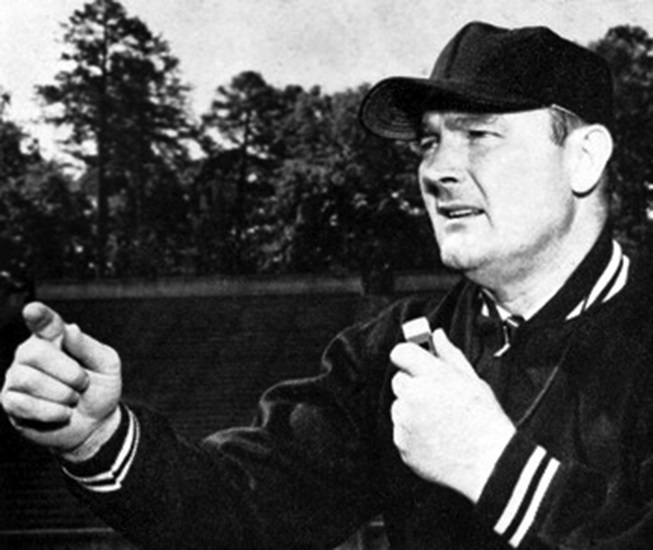
“Big Jim” Tatum ’35, in his first season as head coach at Carolina, 1956 (1957 Yackety Yack)
In 1955, after three lackluster seasons, Barclay was pressured to resign. He made the unusual move of stepping down as head coach but remained as an assistant coach until retiring in 1966.
The search for Barclay’s replacement brought out the razor-sharp pen of DTH co-editor Ed Yoder ’56, resulting in one of the biggest public battles over the hiring of a head football coach in UNC history. Yoder, a Rhodes Scholar and later Pulitzer Prize-winning columnist for The Washington Post as well as a noted author, was part of a remarkable era of DTH student editors that included Neill, Kuralt and Jonathan Yardley ’61 (also later a Pulitzer Prize-winning columnist for The Washington Post). They were intelligent, capable young men whose words were read far beyond Franklin Street. Hugh Stevens ’65, a lawyer who served as editor of the school newspaper, described Yoder, in a 75th DTH anniversary edition, as “a genuine intellectual, … a character trait which marks him still as one of the rarest birds ever to inhabit the Tar Heel office.”
During fall 1955, several lead editorials by Yoder and his co-editor, Louis Kraar ’56, sharply criticized aspects of the football program. When a dust-up arose over the price of nonstudent tickets, the pair suggested students should be given control over the football program. Jim Weaver, then commissioner of the newly formed Atlantic Coast Conference, stated that “you have to have a good conference to compete for the entertainment dollar in this day and time.” The DTH editors responded that college athletics ought to be exclusively “for training students and giving them recreation and providing the campus with a pillar for school spirit.” By 1955, however, the editors’ sentiment was an unrealistic expectation of what had become big business.
Acknowledging that alumni would be involved in hiring Barclay’s successor, Yoder and Kraar opined in print that they’d “rather see alumni put their heads together over the amount of foundation money, of the quality of teaching, or the state of dorms at the university.” Pulling no punches, the editorial concluded: “But some men can’t grow up and always must play the game of college boys, paining bitterly when they lose a football game. Perhaps some of this talk to college students about growing up, about maturity, should be administered in stiff doses to footballing elders.”
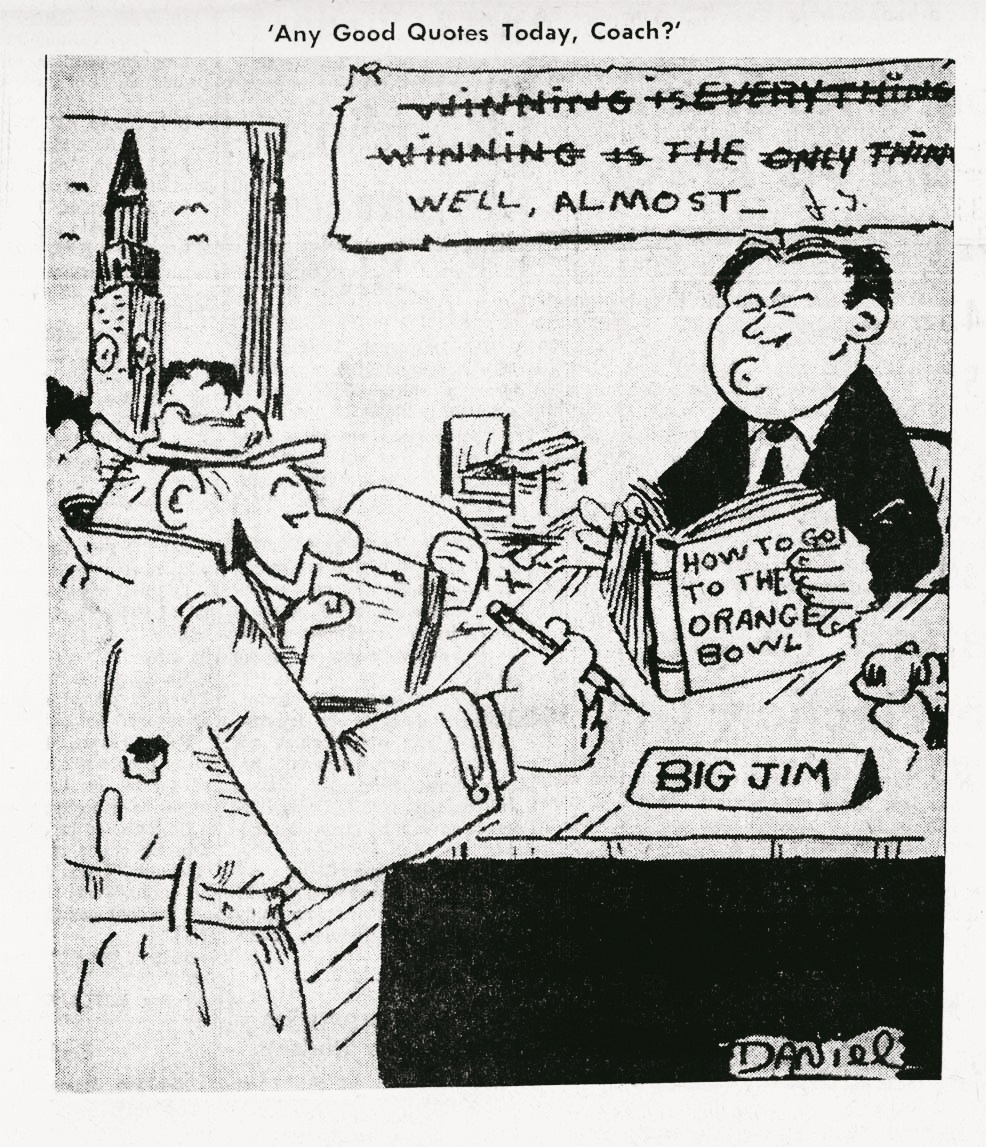
DTH cartoon by Charlie Daniel ’57, lampooning Jim Tatum’s famous quote about winning, February 1956
Tensions reached a boiling point when Jim Tatum ’34 was announced as the new head football coach in 1956. Known simultaneously as “Big Jim” and “Sunny Jim,” Tatum had been a tackle alongside Barclay in the 1930s and returned to Carolina to assist Snavely in 1939. He was UNC head coach for the 1942 season before leaving for the University of Oklahoma and then the University of Maryland, where he led the Terrapins to a 1953 national championship.
But Tatum was also strongly criticized in some quarters at Maryland, including on the pages of the student newspaper, The Diamondback, for bringing big-time sports to the school in the form of vast sums spent on a massive new stadium and large athletic scholarships for his players. He was well known as a coach who would do anything to win, and he adhered to the motto: “Winning isn’t everything — it’s the only thing.”
What was not well known at the time was that Tatum and UNC System Vice President William “Billy” Carmichael (class of 1921) were cousins. In a 2010 interview, former UNC System President William Friday ’48 (LLB), an assistant to System President Gordon Gray in 1955, recounted that behind closed doors Carmichael and Gray argued strenuously over hiring Tatum in the 1950s. Carmichael, who had played on the UNC basketball team that won the Southern Intercollegiate Athletic Association Championship in 1921, was a tireless supporter of Carolina athletics. After successful careers on both Wall Street and Madison Avenue, he was brought back to UNC in 1940 by UNC System President Frank Porter Graham (class of 1909) to run the business side of the University, assist in development of alumni relations and calm fears that the faculty, curriculum and student body had become too politically left-leaning.
Upon the announcement of Tatum’s departure for Chapel Hill, an editorial in The Diamondback expressed relief and hope that Maryland might then return to “more of the academic fundamentals for which the University exists.” DTH editor Yoder, stunned by the announcement of Tatum’s hire, wrote one of the most infamous editorials in the history of the student newspaper. Headlined “From University to Cuckoo-Land,” the piece blasted the University for hiring Tatum:
“Amateur football has suffered acute asthma at this school for two decades. With the arrival of Jim Tatum as head football coach, it will draw its last painful gasps and suffocate. Now that we have this parasitic monster of open professionalism in our midst, let’s not hold on to any delusions about it. Let’s not think, naively … that it will fail to take its toll on the academic health of the school. The Daily Tar Heel believes as strongly in winning sports as anyone else. But we do not believe in subsidies for athletic prowess alone. We do not believe that a football coach should receive more money than the President of the University. And we would sooner see intercollegiate sports stopped than the University made over into an athletic Cuckoo-Land.”
Outcry to the editorial was swift and thunderous. Particular offense was taken to the phrase “parasitic monster,” which many believed was a slur directed against Tatum. Years later, in his 2005 book, Telling Others What to Think, Yoder cringed at the brash “purple prose” of his DTH editorials. And in a 2011 interview, Yoder stated that the “parasitic monster” phrase was not aimed at Tatum but was a condemnation of the entire process of professionalizing the Carolina football program. Responding to The DTH coverage lamenting his hire, Tatum shrugged his shoulders and quipped that the whole controversy was a “tempest in an inkpot.”
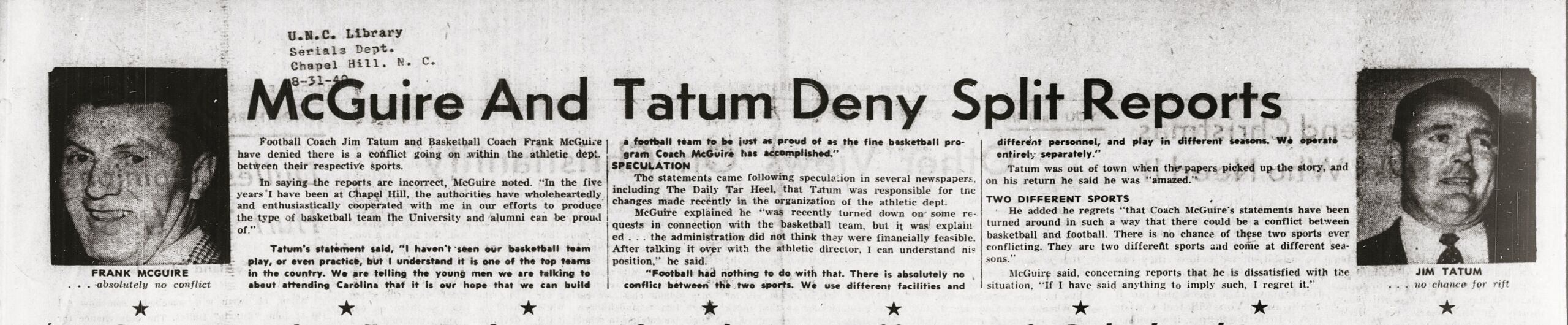
In the Dec. 18, 1956 edition of The DTH, the two coaches denied there was any rift.
Outrage in some quarters was so intense that for only the second time in the newspaper’s history, students gathered enough signatures on a campuswide petition to demand a midyear recall election for the co-editors. School of Journalism Dean Norval Luxon took the unusual step of going on record stating that removal of any editor for expressing an opinion, no matter how unpopular, would be “a crime.” Despite a vigorous campaign by the opposing candidates for editor, Yoder and Kraar won the recall election handily. Hugh Stevens ’65 later wrote that the episode “came closer to destroying The Daily Tar Heel as a free, unfettered newspaper than any issue before or since.” (See “Spouting Off on Every Imaginable Subject,” January/February 2005 Review, and “In Memoriam,” March/April 2024 Review.)
Tatum’s arrival on campus in spring 1956 brought enthusiasm and excitement from Tar Heel Nation, and he quickly set about recruiting and reshaping the team for the fall season. But a 2-7-1 record that first year was compounded by a series of embarrassments and scandals. The DTH reported that since Tatum’s arrival, new preferential treatment was given to players, including access to free tutors and a separate cordoned-off dining section in Lenoir Hall. In December it was discovered that fullback Don Coker ’60 accepted a country club membership paid for by UNC “alumni and friends.” Another revelation was that Tatum recruited a former player from Temple University, Vince Olenick ’58, to suit up under the assumed name of “Olen” apparently to extend his eligibility. The NCAA forced UNC to forfeit nine games from the 1956 season as a result of the violation.
“Clash in Woollen Gym”
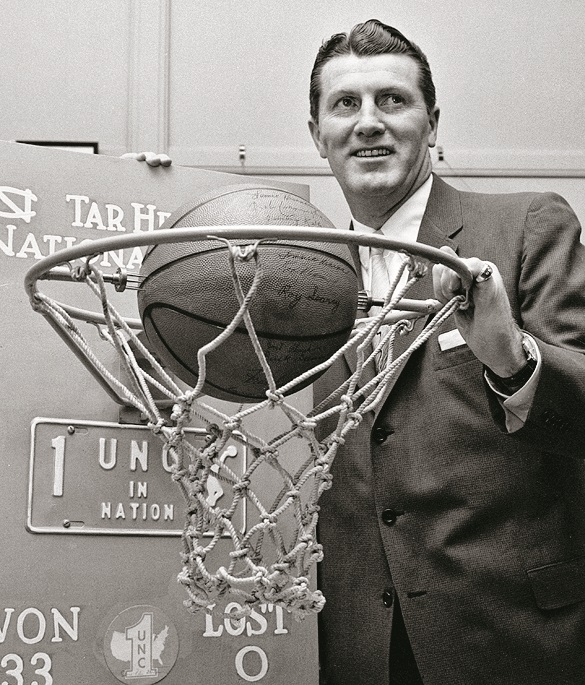
UNC Men’s Head Basketball Coach Frank McGuire, 1957
As the turmoil played out in public, a power struggle was brewing behind the closed doors of Woollen Gymnasium between the new football coach and head basketball coach Frank McGuire.
Hired in 1952 to build a consistent conference and national basketball contender, McGuire would do just that with a spectacular 1956–57 national championship season. (See “60 Years and None Better,” January/February 2017 Review.) But McGuire’s success before the championship had Tatum seething, especially in the face of his own first-season failures. Football had reigned supreme in Chapel Hill, and Tatum saw himself as king and would do everything he could to keep it that way, according to those who were familiar with the situation.
On Dec. 14, 1956, DTH sportswriter Neil Bass ’58 shocked campus with an article published on the editorial page headlined “Lifting the Sweatshirt Curtain.” Citing a refusal of UNC Athletics Director Chuck Erickson to allocate needed funds requested by McGuire for the basketball program — and refusing to allow weekly press conferences during the basketball season, as was standard for football — Bass revealed the source driving the decisions.
“Tatumian tactics are overwhelming the entire athletic set-up, and students actually know nothing about it,” Bass wrote. “Will athletics ever be the same as they were in the B.T. Era (Before Tatum)?” the sportswriter queried, noting presciently that McGuire “may be in for his greatest season here, and possibly one of the greatest seasons we have ever had.”
Although elements of the story had appeared a week earlier in The Durham Sun, Bass felt compelled to defend his reporting by adding that “it might be argued by sources from which this reporter got information that revelation of the turbulent athletic situation is not proper or appropriate at this time.” Four days later, Dec. 18 — the same day the story about Olenick’s ineligibility and Carolina forfeiting its football season broke nationally — a rare above-the-banner headline appeared on the front page of The DTH proclaiming, “McGuire and Tatum Deny Split Rumors.” Inside, sports editor Larry Cheek ’57 led with an editorial headlined “Clash in Woollen Gym,” outlining the power struggle between the football and basketball coaches and attempts by Ericson and UNC athletics publicity director Jack Wade (class of 1923) to rectify the situation.
“Reportedly both of these two kings of the athletic world are now somewhat mollified,” Cheek concluded. “Apparently the skillful diplomatic maneuvering of Ericson and Wade paid off. … We hope these waters remain calm.”
Tatum’s coaching record improved to 6–4 in both the 1957 and 1958 seasons. During that time he earned the respect of his players, and the future looked promising, according to The News & Observer. Dick Herbert, former sports editor of The N&O, later wrote of Tatum that there were “few like him” and noted his strengths included “devising defensive tactics … work[ing] with alumni … [and was] one of the top recruiters in football.” Tatum’s tenure, though, was cut short when, after a trip to Canada during summer 1959, he and his wife contracted a serious viral infection and were hospitalized upon returning to Chapel Hill. Edna Tatum survived, but “Sunny Jim” Tatum died July 23, 1959.
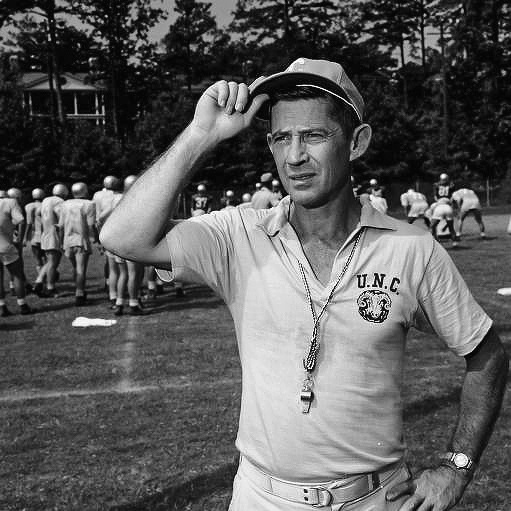
Coach Jim Hickey (Hugh Morton Photographs and Films Collection #P0081, Wilson Library)
Four days after Tatum’s death, with football season fast approaching, assistant coach Jim Hickey was given the top job. He’d only been with the team one year, brought by Tatum from Hampden-Sydney College in Virginia where he had been head coach for five winning seasons. In his first year, Hickey was 4–5 heading into the Duke game in Durham on Thanksgiving Day in front of a national television audience. NBC paid $208,000 (about $2.5 million in today’s dollars) for broadcasting rights, at a time when 85 percent of American homes had only one small black-and-white set, and it was four years before the instant replay was introduced.
Since 1892, UNC had played Virginia in the last game of the regular season, a contest billed as “the oldest rivalry in the South.” But by the 1950s, the rivalry with Duke had eclipsed that of UVA. In 1959, UNC and Duke looked evenly matched. In his pregame locker room speech, Hickey echoed actor Ronald Reagan’s famous dying words from the movie Knute Rockne, All American when Hickey told his squad, “Boys, if there was ever a game Coach Tatum wanted you to win, this is it.”
In a spectacular show, Carolina annihilated Duke, running up the score to 48–0 midway through the 4th quarter after a 32-yard touchdown. The outnumbered UNC fans in Duke’s stadium reportedly chanted, “Hickey, go for 50!” The coach obliged, and the Tar Heels scored a two-point conversion, after which Carolina took its foot off the gas pedal, winning 50–0. Duke’s worst defeat in program history.
The players hoisted Hickey on their shoulders and carried him off the field, a joyous end to the football program’s most troubled and least successful decade.
Even The DTH was impressed: “Pick the adjectives you want to use, name the outcome a rout, a slaughter, a licking, a pasting, a shellacking or anything else, … it all means the same thing, Carolina’s 1959 football season officially goes down in the book as a success.”
Kenneth Joel Zogry ’97 (MA, ’08 PhD) is a historian and preservation consultant in Raleigh who has researched and written extensively about UNC history. His books include Print News and Raise Hell: The Daily Tar Heel and the Evolution of a Modern University and The University’s Living Room: A History of the Carolina Inn.
What it Was
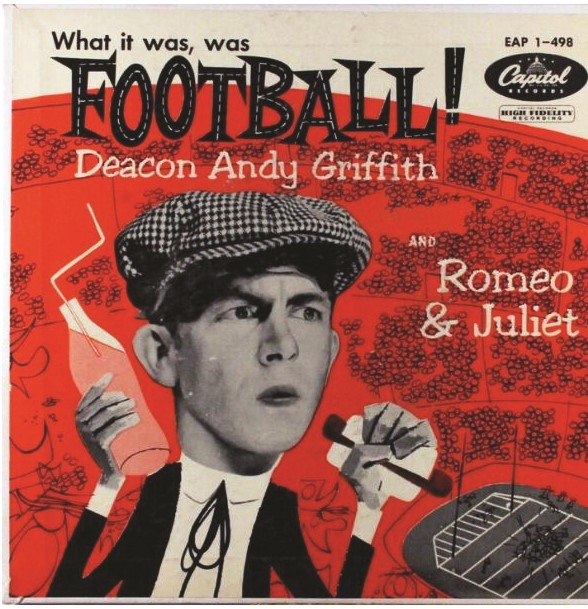
Griffith’s performance was released as a recording in 1953.
In the early 1950s, Andy Griffith ’49 was trying to break into show business. He developed a comedy monologue in which, using an exaggerated Southern accent, he described a country boy accidentally stumbling on a football game at Carolina. Not understanding the game, the boy describes in detail two groups of men fighting over a “pumpkin” on a cow pasture. Griffith performed the monologue at events across North Carolina, until one day in 1953, Orville Campbell ’42 heard his performance in front of a Rotary group at The Carolina Inn. Campbell, who owned the Chapel Hill Weekly and Colonial Records, had connections in the music industry, and “What It Was, Was Football” was subsequently professionally recorded and released, eventually selling 800,000 copies and climbing to No. 9 on the record charts in February 1954. The success of the skit led to an appearance on The Ed Sullivan Show and launched Griffith’s highly successful Broadway, movie and television career.
The Den Father
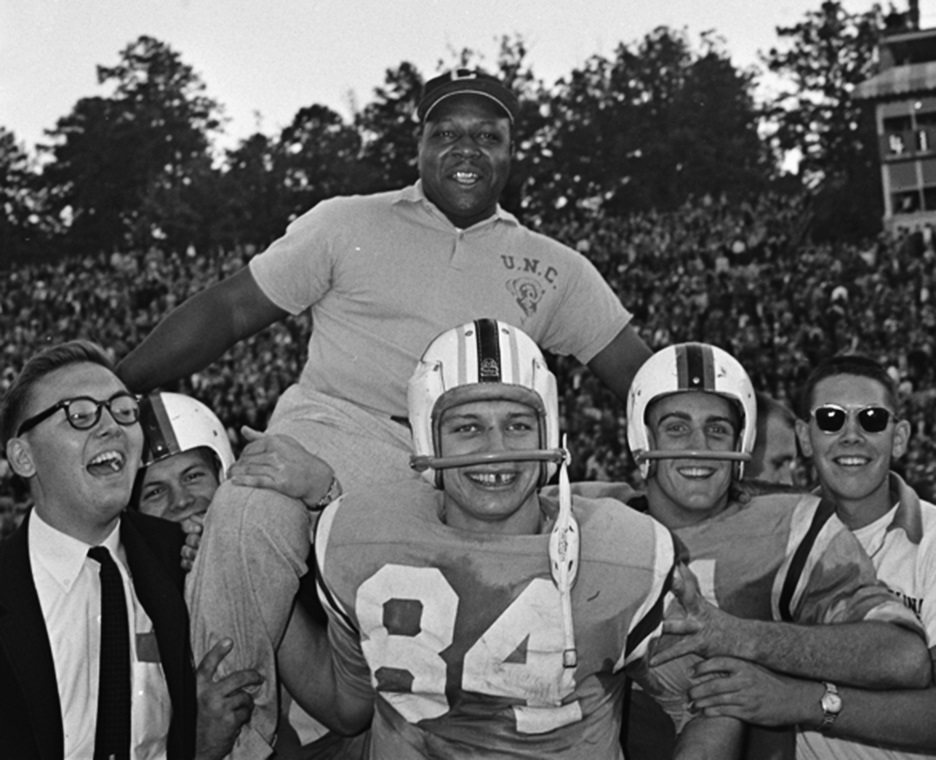
Morris Mason, 1958
Morris Mason, a Black man, was hired as custodian of Kenan Field House when it opened in 1927 and was widely respected by staff and students despite institutional and codified racial segregation during most of his employment. He later became equipment manager and something of a “den father” to generations of football players, who publicly showed affection for Mason on several occasions, including the honor of being hoisted on players’ shoulders and paraded around the field after UNC beat Wake Forest in 1958 — an honor normally reserved for coaches and star athletes. At halftime in a 1968 game, alumni boosters presented Mason with a new car in appreciation of his long service. He also was awarded a varsity football letter, the first nonstudent to ever receive such an honor. He retired in 1974, having never missed a Carolina home game. He died in 1992.
The Heartbeat of Modern Times
Carolina football’s historical record reads like an EKG — a spike of exciting success followed by restful years of respectability with some scary fibrillation of consecutive losing campaigns.
In the 1960s, the Tar Heels had only one winning season, a 9–2 campaign ending in a 35–0 Gator Bowl victory over the Air Force Academy. When 29-year-old Bill Dooley became head coach in 1967, it took him three years to get the squad to a .500 record before an 8–4 season in 1970, Carolina’s first winning season in seven years. Dooley was known for the ground game, pounding out a 69–53 record over 11 seasons. His tenure peaked in his sixth season in 1972 with an 11–1 record, including a lone bowl victory in six tries.
When Dooley left for Virginia Tech, UNC hired Miami University of Ohio head coach Dick Crum, who would lead the Tar Heels to a 4–2 record in six bowl appearances and an overall record of 72–41–3 over 10 years. The heartbeat of five consecutive winning seasons from 1979 to 1983 was the strongest since the 1930s and featured defensive end Donnell Thompson ’81 and linebackers Darrell Nicholson ’82 and Lawrence Taylor ’81, one of the best defenders to ever play the game. In 1980, Taylor’s senior year, the Tar Heels were led on offense by running backs Kelvin Bryant ’83 and Amos Lawrence ’80 behind a strong offensive line. They went 11–1, finished 10th in the final AP poll and defeated Texas 16–7 in the Bluebonnet Bowl. It was the last time UNC won the ACC championship.
In 1981, the 10–2 Tar Heels finished the season ranked ninth, and the only other Carolina team to be ranked higher at season’s end would be the 1997 squad under Mack Brown, which finished ranked sixth after an 11–1 season. Brown led Carolina to eight consecutive winning seasons, the longest stretch of consistent winners in Carolina football’s long history. His tenure featured talented players, including linebacker Brian Simmons ’97; defensive ends Greg Ellis ’97, Marcus Jones ’96 and Vonnie Holliday ’98; safety Omar Brown ’98; cornerback Dre Bly ’99; center Jeff Saturday ’97; and running back Natrone Means ’94. Brown parlayed that 1997 season into a head coaching job at the University of Texas, where his team won a national championship in 2005.
For the past 27 years, including Brown’s return in 2019 through 2024, Carolina football’s heartbeat has fluttered to a barely above .500 record of 164–147, which includes victories from two 8–5 campaigns in 2008 and 2009 under head coach Butch Davis. The NCAA, however, officially adjusted those seasons to 0–5 records due to an academic scandal that marred the program. (See “A Flag is Down,” Nov/Dec 2010 Review.)
This century, Carolina has finished ranked in the top 25 just twice, and its 45-year ACC championship drought will continue for at least another season. UNC has now turned to Bill Belichick, a six-time Super Bowl champion as head coach, hoping he will be the defibrillator that shocks Carolina football back to success.
—Mark Derewicz
Touchdowns, Tackles and Tradition: a Tar Heel Timeline
1888
The first game was played against Wake Forest. John Motley Morehead III (class of 1891), who would endow the Morehead Scholarship 57 years later, is a member of the first Carolina team.
1892
UNC teams are referred to as just “Carolina” for the first time, dropping “University” and “Chapel Hill.”
1893
UNC plays Virginia on Thanksgiving Day, beginning a Thanksgiving tradition that will last for 46 years.
1895
Halfback Edwin Gregory (class of 1896) throws the first forward pass, illegal at the time. Gregory’s pass is credited for changing the rules to allow the play years later.
1898
Edward “Vernon” Howell (class of 1897), dean of the just-established School of Pharmacy and a graduate student, playing with a broken finger and nose, runs 40 yards to beat Virginia 6-2. Spectators hoist Howell on their shoulders, shouting and dancing. UNC records the only unbeaten season in school history.
1899
UNC’s Athletic Association votes to sever ties with Virginia, partly because crowds often rush the field to impede UNC players. The rivalry is reinstated in 1900.
1900
William Reynolds finishes his UNC coaching career with a 0.763 win percentage, still the highest of any Tar Heel coach who served more than one season.
1901
UNC beats all in-state opponents to win seventh state championship since 1892.
1902
Greeneville Berkeley (class of 1903) runs 80 yards for a touchdown in a 27-0 win over Davidson.
1904
The value of a field goal drops from 5 points to 4.
1905
L.F. Abernethy, a fullback who was described by a teammate as “probably the best line plunger that ever has been,” runs a record-setting 87 yards for a touchdown.
1906
UNC wins only one game, against Richmond, and has its first losing season in nine years.
1908
In coach Edward Greene’s last game, Virginia beats UNC 31-0 on Thanksgiving Day. Henceforth, most coaches’ stints last more than just one year.
1909
The game against Virginia, the last of the season, is canceled due to the death of a Virginia halfback in a game against Georgetown two weeks before.
1911
Branch Bocock, considered the best coach in the South, leaves VPI to coach Carolina and immediately records a winning season. He returns to VPI, which defeats UNC 26-0 the next year.
1912
Carolina suffers its most lopsided defeat, a 66-0 trouncing from Virginia on a snowy field in Richmond.
1913
Lonnie Abernathy (class of 1914), a tackle nicknamed “Big Ab,” is named captain.
1914
UNC, 10-0 entering its last game against Virginia, loses 20-3, missing the chance to record its second undefeated season. The Tar Heels won’t have another 10-win season for 58 years.
1916
Captain Bill Folger (class of 1918) runs for a 52-yard touchdown to defeat Virginia 7-0 in the Thanksgiving Day game. Isaac Emerson (class of 1879), who made a fortune when he invented the new headache remedy Bromo-Seltzer, donates $30,000 for a new stadium. Emerson Field opens with a capacity of 3,200.
1917
Football season canceled due to World War I. “The time necessary for military training has made it impossible for intercollegiate football to be carried on,” reported The Tar Heel Sept. 15, 1917, “and so our team will not have a chance to repeat last year’s most successful season.”
1919
Five players from the 1916 team return to play, but Carolina loses the opening game to Rutgers 19-0. The Tar Heel reports Carolina players were outweighed by 20 pounds per man in the aggregate.
1921
UNC joins the new 14-member Southern Conference and has a 2-1-0 conference record.
1922
UNC wins the Southern Conference title under head coach Bill Fetzer with a 9-1-0 record.
1924
About 15,000 people attend the Carolina-State Fair week game, the largest ever to watch a football game in North Carolina, The Tar Heel reports. UNC beats N.C. State 10-0.
1925
George Robinson (class of 1925) “ranks in the minds of Dixie football fans with the greatest tackles the game has produced in the South,” The Alumni Review wrote in its December 1925 issue. Rameses, named after fullback Jack “The Battering Ram” Merritt (class of 1925), makes his debut in the Nov. 8 game against VMI.
1929
Jim Magner ’31 (LLB) is thought to be one of the best passers in the nation and described as a Philadelphia boy whom head coach Collins sends in when he needs touchdowns. “When Magner trots on the field the fireworks get underway,” The Tar Heel reports.
1931
Diminutive quarterback Johnny Branch ’32 (5 feet 6 inches, 152 pounds) and a teammate are suspended from the team for attending a “liquor party” after a game at Florida. Branch is reinstated for the last game against Virginia and returns a punt for a touchdown. That season Branch returns four punts for touchdowns, a record at the time. He goes on to play professionally for the Charlotte Bantams.
1932
UNC and Duke create the Duke-Carolina friendship trophy to encourage a “friendlier sentiment between the two universities,” The Daily Tar Heel reports. It is awarded to the winning team “as a token of goodwill from the losers.” UNC awards the trophy to Duke, which won 7-0.
1934
New head coach Carl Snavely, called the Grey Fox because of the color of his suits, arrives from Bucknell University and is described by a former player as “one of the most pleasing personalities of any coach … a clean liver, morally upright, and a good builder and organizer.” Snavely records the best record since 1929. George Barclay ’34 is the first Tar Heel named first-team All-American. His No. 99 jersey is retired.
1935
In the final game of the season, UNC beats Virginia 61-0, the largest margin of victory in UNC history, a record that still stands today. Halfback Don Jackson ‘35 runs for 84 yards, passes for another 272 yards and scores a touchdown.
1936
A banner headline in The Daily Tar Heel announces Raymond “Bear” Wolf as new head coach, reporting Wolf “is highly popular with the boys on the squads … and he has a great deal of enthusiasm.”
1937
Defensive end Andy Bershak ’38 is named to six All-American squads, and the AP names him to its third team, the UPI to its second team. “Handy Andy,” as he was known, was diagnosed with a kidney disease shortly after graduating, but went on to help coach UNC until 1942. He died the following year.
1941
The Board of Trustees renews coach Raymond Wolf’s contract for five more years, but he steps down as coach to serve in the Navy during World War II. His 38-17-3 career record is the second-best winning percentage in Tar Heel history among those who have coached more than one year.
1942
Jim Tatum ’36 coaches just one year. He leaves for Oklahoma and later ends up at Maryland, where he wins the national championship in 1953.
1943
Late in the fourth quarter in a game against No. 10 Penn in Philadelphia, Hosea Rodgers ’50 runs 34 yards for a game-winning touchdown, giving Carolina a thrilling 9-6 victory. Tom Young ’28, an All-Southern halfback at Carolina, is named coach, but the following year he joins the Navy.
1944
Former Davidson head coach and All-American from Tennessee Gene McEver is signed to a one-year contract. UNC posts its worst record since 1891.
1945
Carl Snavely returns to coach on a salary reported to be $12,000 a year (roughly $219,000 in 2025 dollars).
1946
Charlie “Choo Choo” Justice ’50 arrives at UNC after serving four years in the Navy and having been recruited by Tennessee, Duke and South Carolina. In his first game against Virginia Polytechnic Institute, Justice runs for a 68-yard touchdown in a game that ends in a 14-14 tie. UNC recovers during the season to win the Southern Conference title, its first since 1922, but loses to Georgia in the Sugar Bowl 20-10, its first bowl game.
1948
UNC is ranked No. 1 in the nation in October — the first and only time Carolina has reached the top spot. The Tar Heels, ranked third in the nation at the end of the season, play Oklahoma in the Sugar Bowl in front of a record crowd of 80,383. The favored Heels lose 14-6. Justice, who was sick with a virus days before the game, blames himself. “I lost it,” he says.
1949
Charlie “Choo Choo” Justice finishes his career with 6,126 total offensive yards, a record that will stand for the next 45 years. But his career ends on a sour note with a loss to Rice in the Cotton Bowl, 27-13.
1953
Former Tar Heel star George Barclay ’34 is hired as head coach. He hires as one of his assistant coaches Steve Belichick, who brings to Chapel Hill his infant, and eventually famous, son, Bill.
1956
Jim Tatum ’34 returns to UNC to coach. He was well known for repeating, “Winning isn’t everything — it’s the only thing.” The DTH laments that University leaders are okay with the “parasitic monster of open professionalism” threatening academics. Carolina posts its worst record since 1951.
1958
UNC beats Wake Forest 26-7, and players carry equipment manager Morris Mason, a Black man who was widely respected despite institutional and codified racial segregation, off the field on their shoulders.
1959
Jim Hickey, a former scout and backfield coach at UNC, is named head coach three days after 45-year-old Coach Jim Tatum ’34 is buried July 25 in the Old Chapel Hill Cemetery after succumbing to a viral infection. Hickey’s three-year contract is worth $12,000.
1963
Ten school records are broken, including total and passing yards, most passes caught in a single game (10 by Bob Lacey ’64) and most passes completed in a career (193 by Junior Edge ’64). UNC shares the ACC championship with NCSU, its first conference title since 1949. Carolina pummels Air Force 35-0 in the Gator Bowl.
1966
Wide receiver Charlie Carr ’68 (’71 MAT) has 16 receptions against Air Force at Kenan Stadium, a single-game record that stands today.
1967
Ricardo “Ricky” Lanier ’73, a highly recruited high school quarterback out of Williamston near the coast, becomes the first Black scholarship player to join the football program. He and other Black athletes at Carolina will later meet with head coach Bill Dooley and men’s basketball head coach Dean Smith to convince the band to stop playing Dixie during the games. The song “was just uncomfortable for us,” Lanier would later say.
1968
UNC beats Duke in the final season game, avoiding a winless ACC record, but it’s the fourth consecutive losing season.
1969
Ricky Lanier ’73, a second-string quarterback, starts the second quarter and goes on to set a school record for most rushing yards by a quarterback (174) in a 61-11 Homecoming win against VMI.
1970
Running back Don McCauley ’71 rushes for 279 yards against Duke in the final regular-season game, amassing 1,720 rushing yards and 19 touchdowns for the season — two records that still stand today.
1971
Carolina wins its first outright ACC championship.
1972
UNC posts its best season in history, an 11-1 record; claims the ACC championship; finishes No. 12 in the nation; and beats Texas Tech 32-28 in the Sun Bowl.
1976
Running back Mike Voight ’77, who called himself a track athlete who played football, rushes for 261 yards and scores a two-point conversion in the last seconds to beat Duke 39-38, sending UNC to the Peach Bowl. He has 42 touchdowns for the season, which tied the ACC record at the time, and set UNC’s career rushing record (3,971 yards).
1977
Coach Bill Dooley ends his Carolina coaching career by winning the ACC championship, his third, and becomes the winningest coach in UNC football history at the time. He is credited for taking UNC into the higher echelons of college football.
1978
In January, UNC announces the new coach: Dick Crum from Miami in Ohio, surprising Tar Heel fans.
1980
Carolina posts an 11-1 record and claims the ACC championship, two milestones UNC has yet to accomplish again.
Thanks for reading the Carolina Alumni Review
Carolina Alumni members, sign in to continue reading.
Not yet a member? Become one today.