Amina’s Gift
Posted on Dec. 4, 2025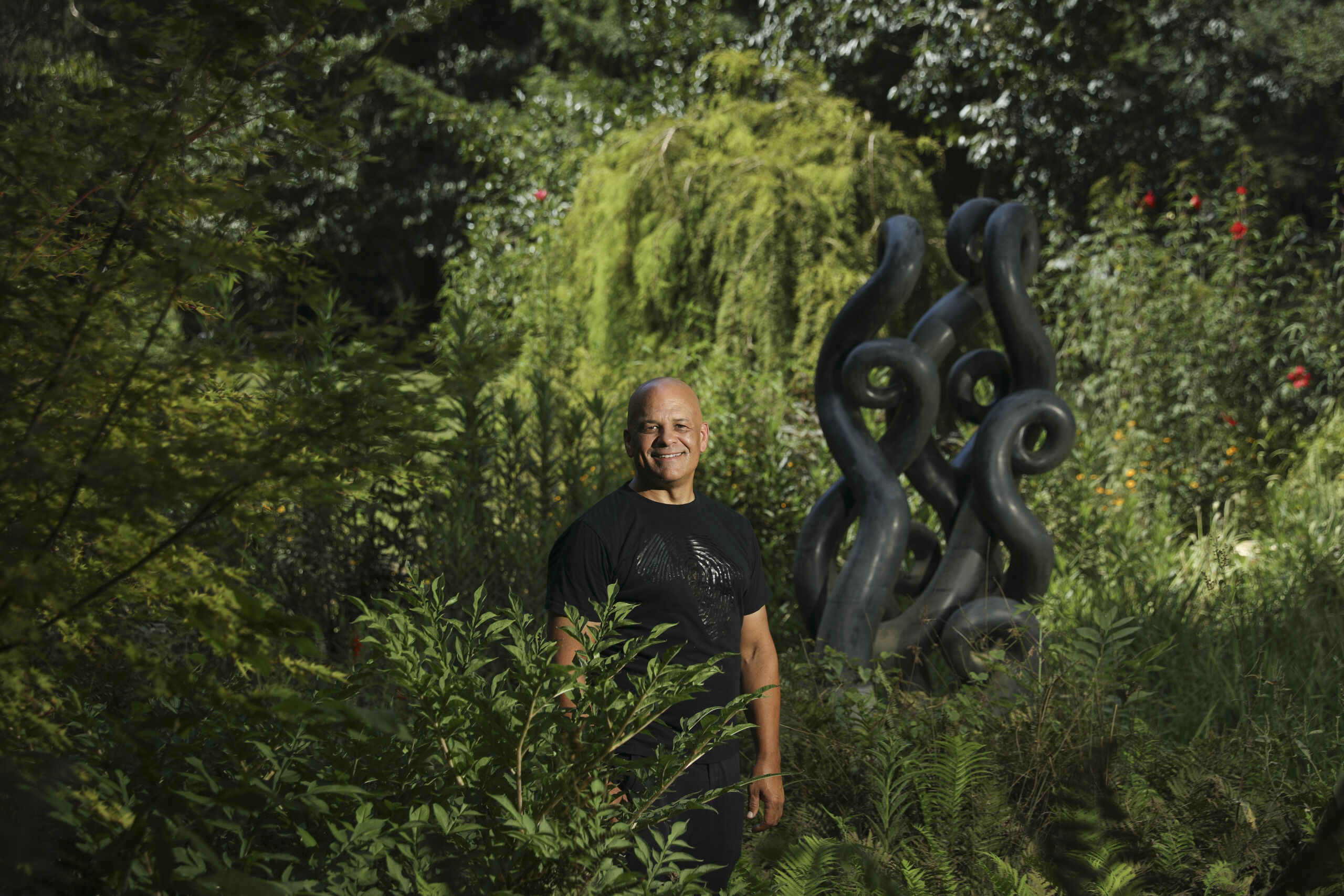
Emergency medicine doctor Terrence Brayboy ’86 (’94 MD) created a foundation to raise money to support African schoolchildren through the sale of sculpture created by African artists. The sculpture behind Brayboy is by Zimbabwean artist Percy Kuta. (Photo: Carolina Alumni/Ira Wilder ’24)
Flood waters from tropical storm Chantal in July weren’t enough to uproot the sculptures that had crossed an ocean to find a living display case in a Hillsborough garden, thanks to the efforts of Terrence Brayboy ’86 (’94 MD).
Dotted along a lush green garden walkway, the stone, wire and bead creations shine in the dying light, even as mud left by high flood waters cakes surrounding purple coneflowers. At the entrance to a private forest, a stone fertility goddess stands proudly next to a gurgling pond, which overran its banks when Chantal dumped a torrent of rain.
This particular crop of sculptures is part of a life-giving ecology that stretches from the Eno River in Orange County to Victoria Falls in southern Africa. They’re at the centerpiece of Amina’s Gift, a nonprofit Brayboy, an emergency medicine doctor, founded in 2016 after he met 17-year-old Amina, while visiting Tengenenge village in Zimbabwe’s Guruve District. She was malnourished and HIV positive, with no way to access a local clinic that offered free medicine. Recognizing Amina’s deteriorating health, Brayboy gave her shoes and helped transport her to a clinic, where she later died. He said the “grace and gratitude” with which she accepted the shoes struck him so much that he decided to start a nonprofit to pay for children to attend school in South Africa, Zimbabwe and, most recently, Ghana.
During his international travels as a sculpture connoisseur, Brayboy had met school-age children whose parents could not afford school tuition. In Zimbabwe, every citizen has a constitutional guarantee to free primary education, but many children in rural areas, where there is endemic poverty, must forego classes so they can work to support their families.
Amina’s Gift pays for school fees — along with food, clothing, medical transportation and menstrual care — primarily from reselling Zimbabwean sculptures. The art arrives in 40-foot containers at the port of Norfolk, Virginia, where trucks transport them to the Amina’s Gift warehouse in Gibsonville. The nonprofit then sells the sculptures at prices ranging from $10 to $8,000.
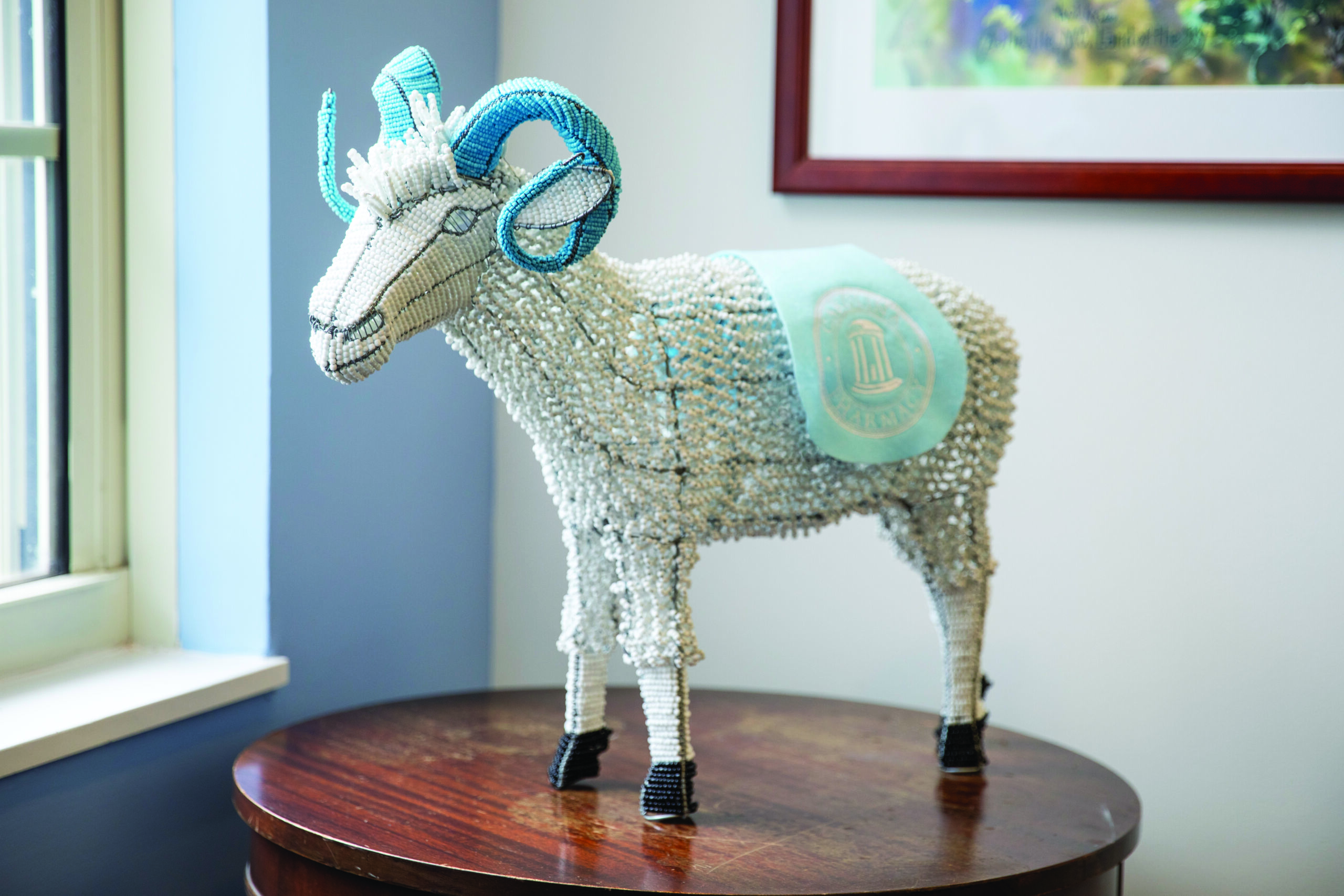
Pharmeses, who is now the Eshelman School of Pharmacy’s mascot, is one in a series of similar scupltures by Zimbabwean bead-and-wire artist David Chirisa, who works with Amina’s Gift. (Photo: Carolina Alumni/Ira Wilder ’24)
Brayboy, who has collected Zimbabwean sculptures since 2011, conceived of what he calls a “circular and community-oriented model” as a way to empower sculptors and schoolchildren at the same time. For every sculpture sold, usually at exhibits like the one in Hillsborough, Amina’s Gift pays for one child’s four-month school-term fees. The nonprofit uses any remaining money to purchase more inventory and funds programs such as menstrual health education and medical tours of southern Africa. Two North Carolina-based staff members — Jane Stein, a language educator and public health professional, and Elizabeth Branch, a financial adviser — instruct health care professionals from the United States on cultural competence and patient-provider trust in 14-day tours.
“As I spent more time in Africa, I realized that there was a great need, but also, I could accomplish a lot with a small amount of money,” Brayboy said. “I can spend $20 and help a kid.”
Brayboy grew up in Lumberton, home to a large Lumbee Indian population. In March, he was among six Lumbees to receive the prestigious Order of the Long Leaf Pine, which the governor awards to North Carolinians who have made a significant contribution to the state.
Brayboy cites his father’s adventurous spirit for his own lifelong wanderlust. As a boy, he took cross-country road trips, and his father’s military career moved the family to numerous states. These days, Brayboy splits his time between southern Africa and Raleigh, where he is an emergency physician at WakeMed.
Brayboy credits many service-minded peers during his undergraduate years at Carolina for planting the seeds for his nonprofit work and said his medical background led him to understand the need for access to education equity. “Healthy kids are smarter kids, and smarter kids are healthier kids,” he said.
But the cost to attend school in Zimbabwe is on the rise. Since 2016, primary school fees have increased 275 percent. Unemployment is high, and even a university education is no guarantee for success. Still, Amina’s Gift remains unwavering in its mission. In nine years, it has made school possible for about 250 children, most recently sponsoring the construction of a weaving school in a Ghanian village. The school purchases artisan cloth and handwoven baskets, a West African specialty.
Amina’s Gift has built a network of about 250 African artists, and Brayboy continues to find new stages for their creations. In October 2024, the Chapel Hill retirement community Carolina Meadows hosted an Amina’s Gift art show. The sculptures have also migrated to coastal Massachusetts and Harvard University. Brayboy hopes to convert his 73-acre farm in Guilford County into a sculpture park that would double as a benefit space for Amina’s Gift.
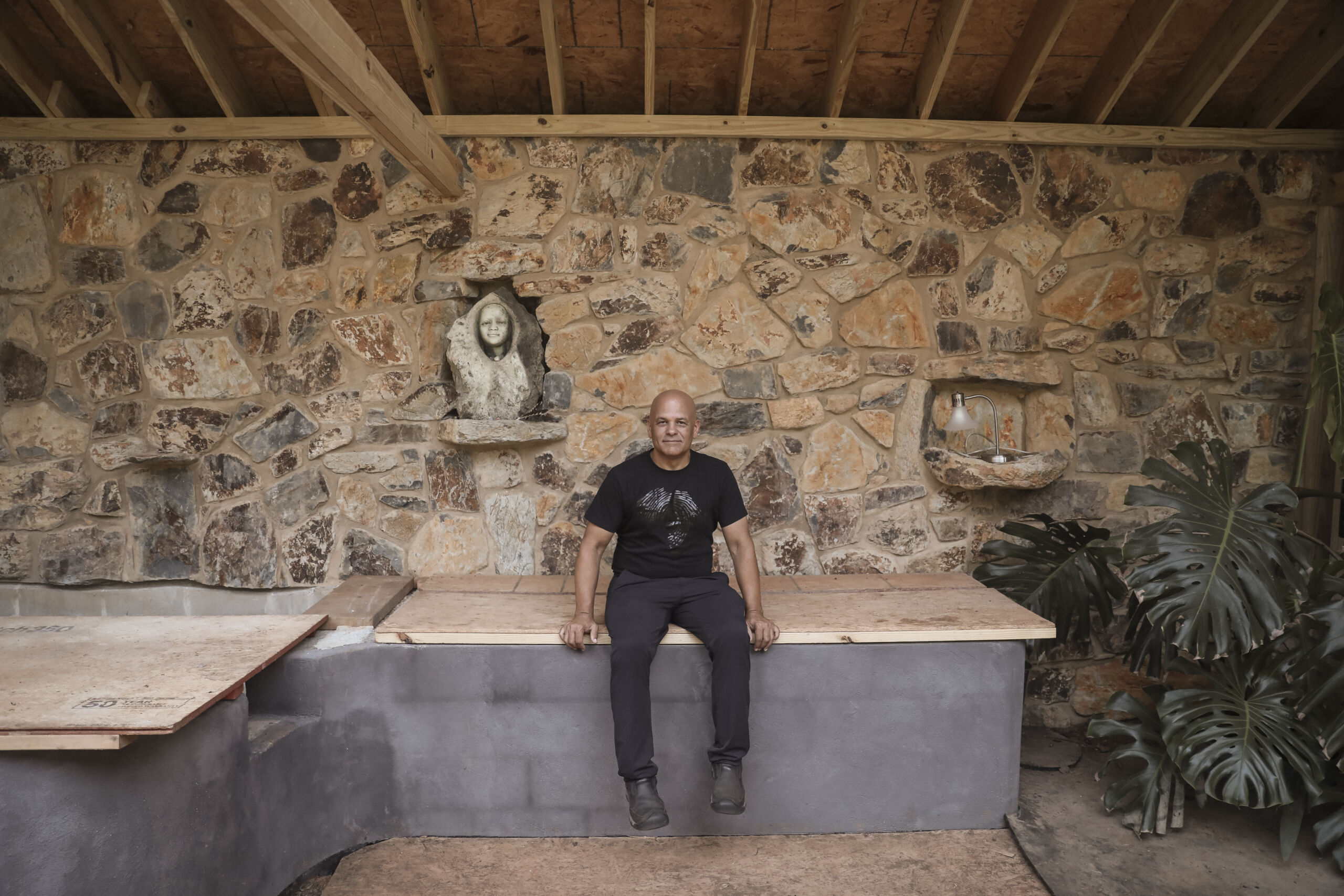
“As I spent more time in Africa, I realized that there was a great need, but also, I could accomplish a lot with a small amount of money,” Brayboy said. “I can spend $20 and help a kid.” The sculpture behind Brayboy is by Zimbabwean artist John Gwaravaza. (Photo: Carolina Alumni/Ira Wilder ’24)
In Zimbabwe, the country’s abundant supply of smooth, blackish-green serpentine stone has allowed the Shona sculpture movement to flourish since the post-colonial era began in 1980. The Shona are a Bantu ethnic group native to Zimbabwe. Although the artists who live and work at the open-air sculptor community at Tengenenge are not all ethnically Shona, their intricate carvings are rooted in the tribe’s mystic traditions.
One Tengenenge-born artist who works with Amina’s Gift is Kelvin Ferenando, whose abstract serpentine series called Mushroom Ladies celebrates the life-giving roles of fungi and female caregivers. Another is bead-and-wire artist David Chirisa, creator of Pharmeses, a small beaded ram that stands in the Pharmacy Foundation Office at the UNC Eshelman School of Pharmacy.
To illustrate the impact of these artists and Amina’s Gift, Brayboy mentions Nicole Phiri, a former student he sponsored who has become a teacher. Phiri went to school thanks to Amina’s Gift and, in turn, helped a young boy receive a quality education and, with the help of the organization, arranged for the boy to receive corrective surgeries for facial burns.
“When [former students] return and start giving back,” Brayboy said, “those are the times when you know you’ve done a good job.”
— Phoebe Martel is a senior intern at the Review.