Let There Be Light
Posted on Feb. 10, 2026The Carolina Public Humanities program is a throwback to a simpler time. Can its wisdom be a beacon in our digital age?
By John Bare ’87 (’92 MA, ’95 PhD)
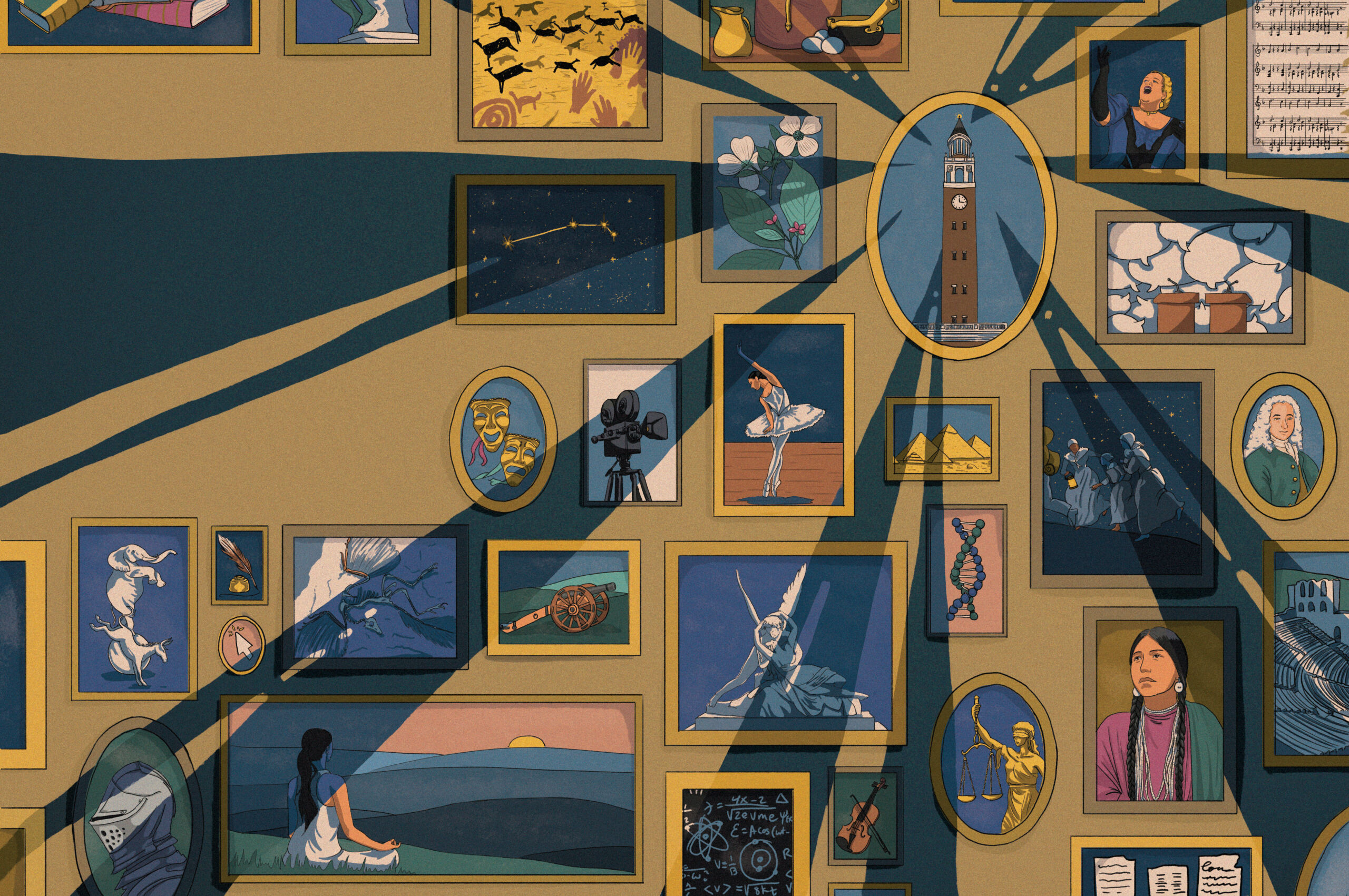
A unit within UNC’s College of Arts and Sciences, Carolina Public Humanities produces original programs, trains teachers and provides support to state and local agencies. All of its work is designed to bring Carolina’s scholarship directly to community members in Chapel Hill and across the state. (Illustration: Haley Hodges ’19)
At a moment when social media platforms make it their business to escalate conflict, Carolina Public Humanities (CPH) is drawing on the humanities’ ancient powers to invite people across the state to meet up, face-to-face, to talk about songs, stories, faith, history and all the things that bind us together. Driven by an unwavering belief that the humanities can save society from dissolution, CPH operates with the openness of a New England town meeting and the enthusiasm of Johnny Appleseed, bound and determined to spread the University’s bounty to all 100 counties in the state.
“It sounds idealistic, I think, and it is, and that is the essence of what we do, to make the University part of the lives of people across the state and to make Carolina accessible,” said Victoria Rovine, CPH director and professor of African art history. “Carolina Public Humanities is really unusual, unique and extraordinary.”
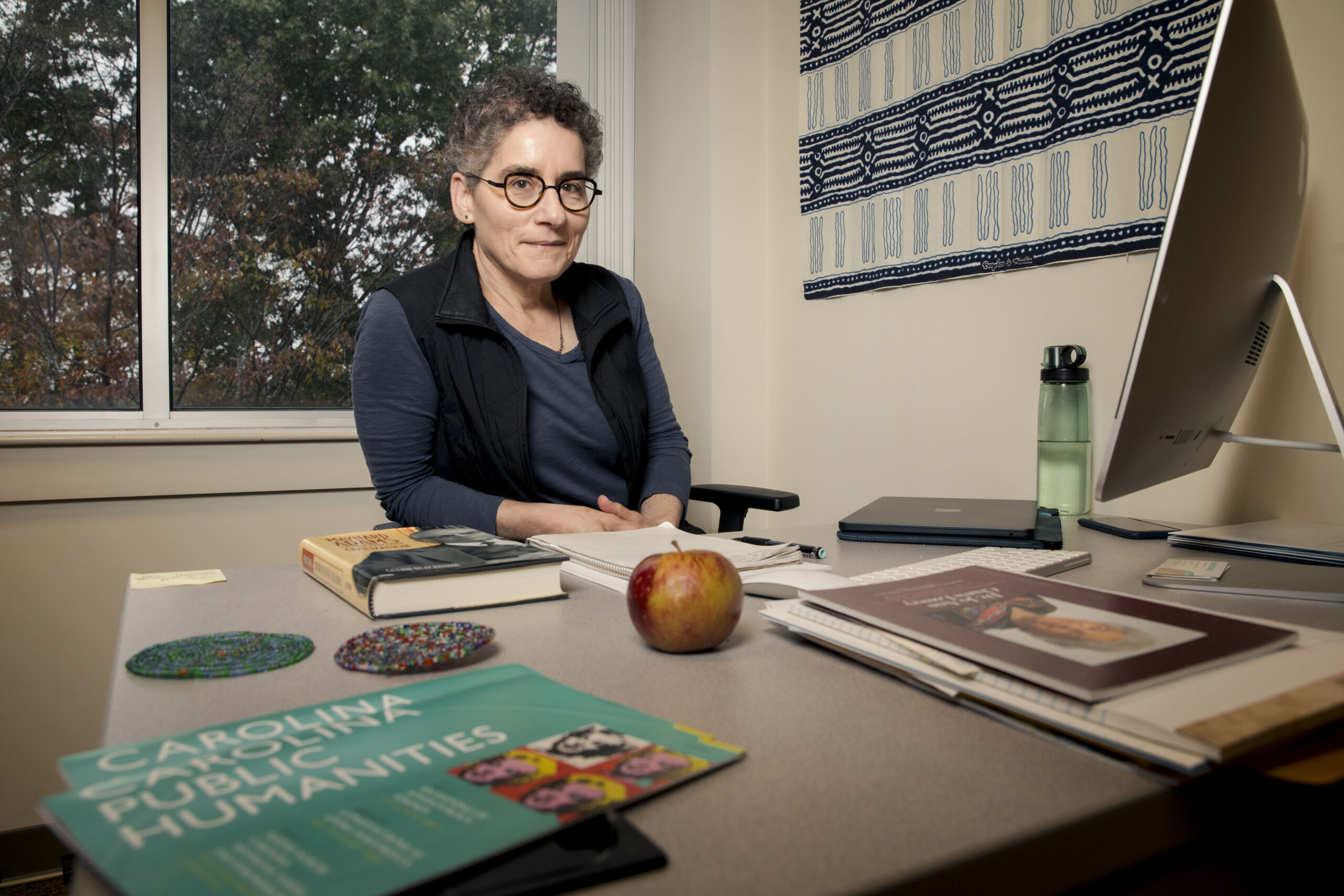
“I don’t know of another university that has an entity focused on bringing arts and humanities research to the people.” — Victoria Rovine, Carolina Public Humanities director (Photo: Carolina Alumni/Ira Wilder ’24)
The unifying thread for CPH is the belief that gathering people together for humanistic exploration builds a stronger democracy and a more humane world.
“Today’s students need to engage with history and the humanities because these subjects help make sense of the world,” said Valencia Abbott, the 2025 National History Teacher of the Year, who teaches social studies at Rockingham Early College High School in Wentworth. Abbott has created curricula for Carolina K-12, a CPH program that brings humanities to life in schools across the state. She also has used other CPH curricula. She said students develop essential skills through reading, writing, discussion and analysis “that transfer across all areas of learning and life,” she said. “By encountering experiences beyond familiar boundaries, a deeper understanding emerges of what it means to be human and how different struggles, triumphs and cultures shape shared humanity.”
A unit within UNC’s College of Arts and Sciences, CPH produces original programs, trains teachers and provides support to state and local agencies. All of its work is designed to bring Carolina’s scholarship directly to community members in Chapel Hill and across the state. The variety of CPH topics reflects the richness of the University’s assets. Recent CPH programs have examined Native Americans in North Carolina, AI and censorship, the 14th-century tale of Sir Gawain and the Green Knight, and the music of Mahalia Jackson. For its Carolina Biodiversity Collaborative, CPH pairs humanities scholars with scientists for outdoor excursions — including garden parties — designed to heighten human connections to natural environments. CPH works with state officials on cultural history projects, including enhancing visitor experiences at Bentonville Battlefield, Tryon Palace, Fort Macon and other sites.
Rovine, who’s been an art professor at Carolina since 2014, recruits opera singers, medical doctors, social work historians, anthropologists and other scholars to lead programs. She encourages people to shake themselves loose from defining what the humanities are or where they belong. The humanities, to her, are bigger than any one subject. “It’s about thinking about how human beings experience the world and how they express themselves in the world,” she said, “and then we can analyze that expression.”
That’s why for a spring 2025 seminar, Rovine invited a philosopher, a physicist and an English professor to lead discussions celebrating the 100th anniversary of the discovery of quantum physics, which has had profound implications in our daily lives. The event was sold out, a testament to the power of curiosity and the role of humanities, even our understanding of science and its role in popular culture.
“I don’t know of another university that has an entity focused on bringing arts and humanities research to the people,” Rovine said.
Modern-day enlightenment
CPH grew out of the Program in the Humanities and Human Values, founded in 1979 to create a culture of engagement with the humanities and to share the University’s intellectual resources with all North Carolinians. Today, CPH is central to the University’s public-facing commitment to enlightenment. It has hosted more than 900 conferences, seminars and workshops for more than 57,000 community members.
To carry out its mission, CPH draws on a number of philosophical ideals, including the right of people to assemble peaceably for the free exchange of ideas. There are flavors of French philosopher Voltaire’s cosmopolitanism, an 18th-century notion that historian Robert Darnton described in a 2002 essay as a rejection of nativist, narrow-minded thinking of individuals “whose mental horizon did not extend beyond the territory that could be viewed from the tower of their church.” CPH’s curiosity carries scents of German philosopher Immanuel Kant’s challenge: Sapere aude, or “dare to know.” Promoting freedom in the arts and sciences, Kant argued, requires encouraging individuals to use their own reason to formulate “candid criticism of existing basic laws.” The convenors of CPH seminars and workshops encourage listeners to assign the most rational, virtuous intent to remarks from others. As fictional TV soccer coach Ted Lasso misattributed to poet Walt Whitman, “Be curious, not judgmental.”
Maybe most of all, CPH’s pursuit of public engagement in all 100 North Carolina counties evokes images of the 200-year-old American Lyceum movement, a loosely affiliated group of curious Americans dedicated to lifelong inquiry and learning that Yale alumnus Josiah Holbrook founded in 1826 in Middlebury, Connecticut. After celebrity lawyer Daniel Webster started the Boston Lyceum in 1830, Americans rushed to form more than 3,000 local lyceums. In 1832, members of the newly formed New Bern Lyceum in North Carolina elected John Robert Donnell (class of 1807) as president, and similar groups emerged in Asheville, Fayetteville, Oxford, Rutherford and other towns statewide.
In 1845, editors of Raleigh’s Weekly Standard called on leaders in that capital city to launch a lyceum, proclaiming that “labor of the intellect” would defeat “the heaviest of evils.” National advocates promoted the gatherings for “readings of essays, books, poems, discussions of town problems, national politics, in fact, almost everything was grist for their intellectual mills,” education scholar Louis Alber wrote in his 1931 essay Josiah Holbrook — Father of the Lyceum. Scholars of political communication would later recognize the importance of this relatively informal, routine “everyday political talk” in the functioning of deliberative democracy, as political scientists Pamela Jonston Conover and Patrick Miller ’07 (MA, ’10 PhD) wrote in The Oxford Handbook of Deliberative Democracy in 2018.
Carolina K-12’s impact stretches beyond the classroom because the humanities unlock “the ability to ask thoughtful questions, evaluate evidence and recognize connections across time and place,” said Valencia Abbott, the 2025 National History Teacher of the Year, who teaches social studies at Rockingham Early College High School in Wentworth.
CPH’s capacity for public engagement is critical to Miriam Zietlow ’83 and her husband, Tom Zietlow (’01 MBA), two chemists whose $1 million donation is the largest single gift to CPH. “The emphasis of the project is to engage young people from across the state to use the incredible resources of UNC to offer trustworthy ways for their peers — particularly members of their home communities — to find answers, raise questions and empower change, especially in those areas of North Carolina which often feel that the ‘expert opinion’ does not apply to their circumstances,” Miriam Zietlow said. “Charles Kuralt’s [’55] famous quote, UNC ‘is, as it was meant to be, the University of the people,’ animates this project. Access to the research and ideas of the University should be a right of all North Carolina citizens, not just those who go to UNC.”
In the 18th century, it was print newspapers, an emerging technology of the day, that shaped public life. As Darnton wrote, “Print, talk, and coffee combined to create a powerful new force everywhere in Europe: public opinion, and public opinion took a radical turn in all the great cities.” Today, digital platforms have replaced newspapers, and the implications for public opinion and civil society are still unfolding. So far, results appear fraught.
“Trust in expertise, media and politicians has severely eroded, and the pace of that erosion is increasing quickly,” Miriam Zietlow said. “Whom do people trust at this point? They trust their neighbors, their peers, people they perceive to have shared experiences.”
Pointing to social media as a primary way young people communicate and bond, Rovine believes social media can extend CPH’s reach and deepen authentic engagement. She foresees CPH using digital platforms to bring North Carolinians together, especially young people, to participate in humanities programs.
“I would like to see us use social media as a vessel for our message, rather than just promotional,” Rovine said. This requires finding or creating shared spaces that draw individuals out of their information silos. It’s a challenge that requires more than a grasp of technology. It requires a deep understanding of what it means to be human and what attracts people to communal, lyceum-style gatherings, a CPH strength, she said.
Making sense of the world
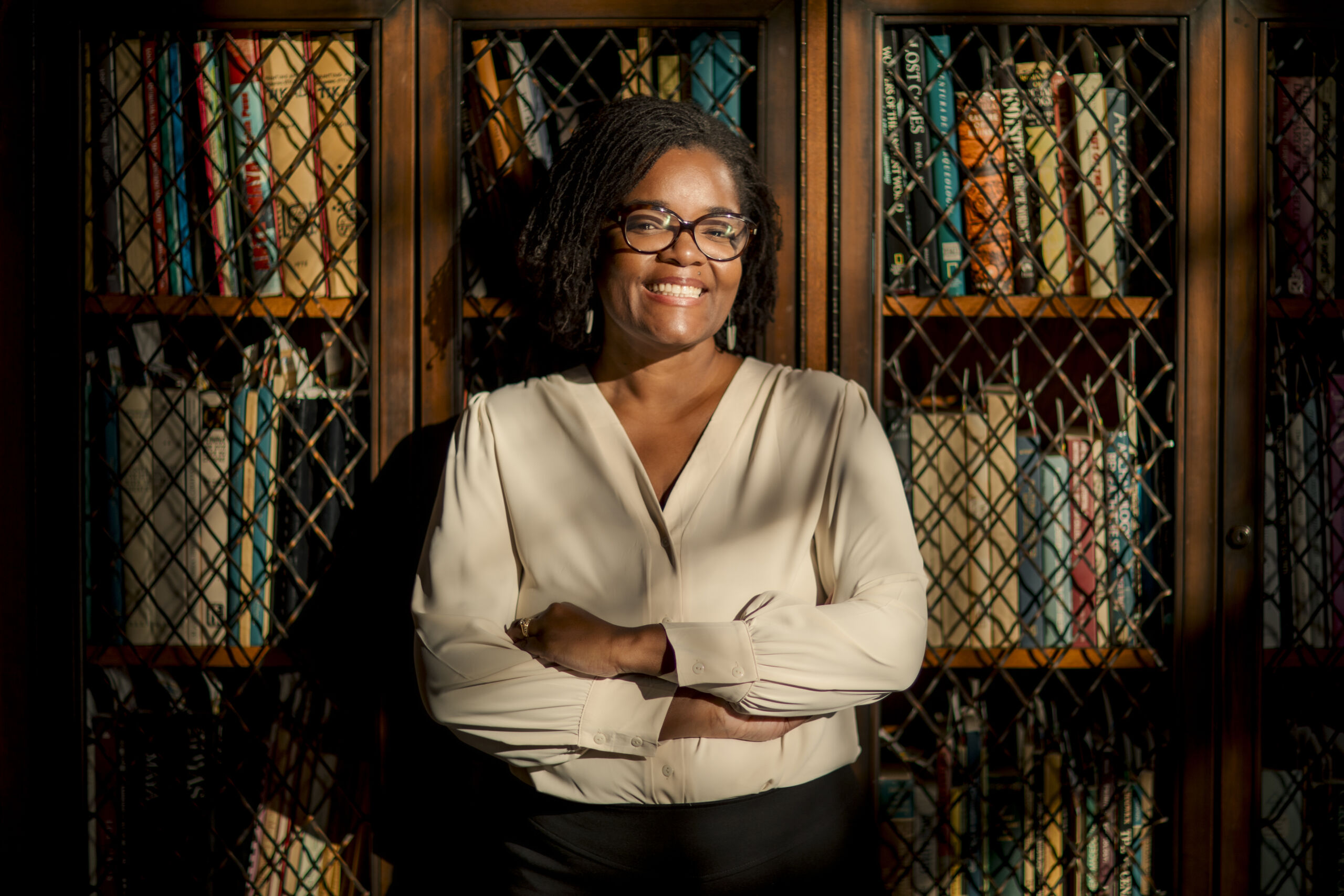
“My history degree and the way I earned it helped shape my philosophy on how children should learn, which is through immersive, experiential project-based learning,” said Cori Greer-Banks, director of CPH’s Carolina K–12 Program. She wants to bring the humanities to life for thousands of North Carolina teachers and students. (Photo: Carolina Alumni/Ira Wilder ’24)
Cori Greer-Banks, director of CPH’s Carolina K-12 program, first experienced the power of the humanities while an undergraduate in the early 2000s, reading World War I poetry in a battlefield trench in Péronne, France, and studying the Battle of the Somme, where more than 400,000 British, French and German soldiers died during the summer and fall of 1916.
Among the poets Greer-Banks read was Wilfred Owen, who wrote in Anthem for Doomed Youth: No mockeries now for them; no prayers nor bells / Nor any voice of mourning save the choirs / The shrill, demented choirs of wailing shells.
“I remember reading World War I poetry in one of the preserved trenches,” she said. “I still have that book from that class. My history degree and the way I earned it helped shape my philosophy on how children should learn, which is through immersive, experiential project-based learning.”
Through Carolina K-12, Greer-Banks wants to bring the humanities to life for thousands of North Carolina teachers and students.
For a Carolina K-12 lesson on Abolitionism, Quakers and the Underground Railroad, a video transports students to the edge of the Deep River in Guilford County, where Quakers provided safe haven. Standing by the water, historian James Shields explains that “enslaved Africans south of this place understood that if they could get here, to the Deep River, that freedom was within their reach.” Shields, who manages the African American Cultural Arts and History Center in Burlington, sings Deep River, a slave song Marian Anderson recorded in 1923. Its lyrics express a longing to reach Jordan, which Shields explains represented the Ohio River, the boundary to freedom in the North.
CPH supplies classroom lessons about barter and money, an unsolved crime from the Salem Witch Trials, the Lewis and Clark expedition, the First Amendment, Saman dance in Indonesia, religion in the South and dozens of other topics. For a training program in Asheville, Greer-Banks organized a Paideia seminar, where an instructor guided teachers through a discussion of a short story by Thomas Wolfe (class of 1920). The Paideia method fosters critical thinking, listening and civil discourse about the author’s text. Feedback from participating teachers confirmed their commitment to bring the Paideia method into their classrooms. “I plan to incorporate Paideia-style discussion skills into my first-grade classroom,” a Polk County Schools teacher said after the training. “My students are working on listening and speaking standards, and I believe these strategies will help them grow in both areas.” The teacher said that even young students can learn the value of respectful dialogue and shared ideas.
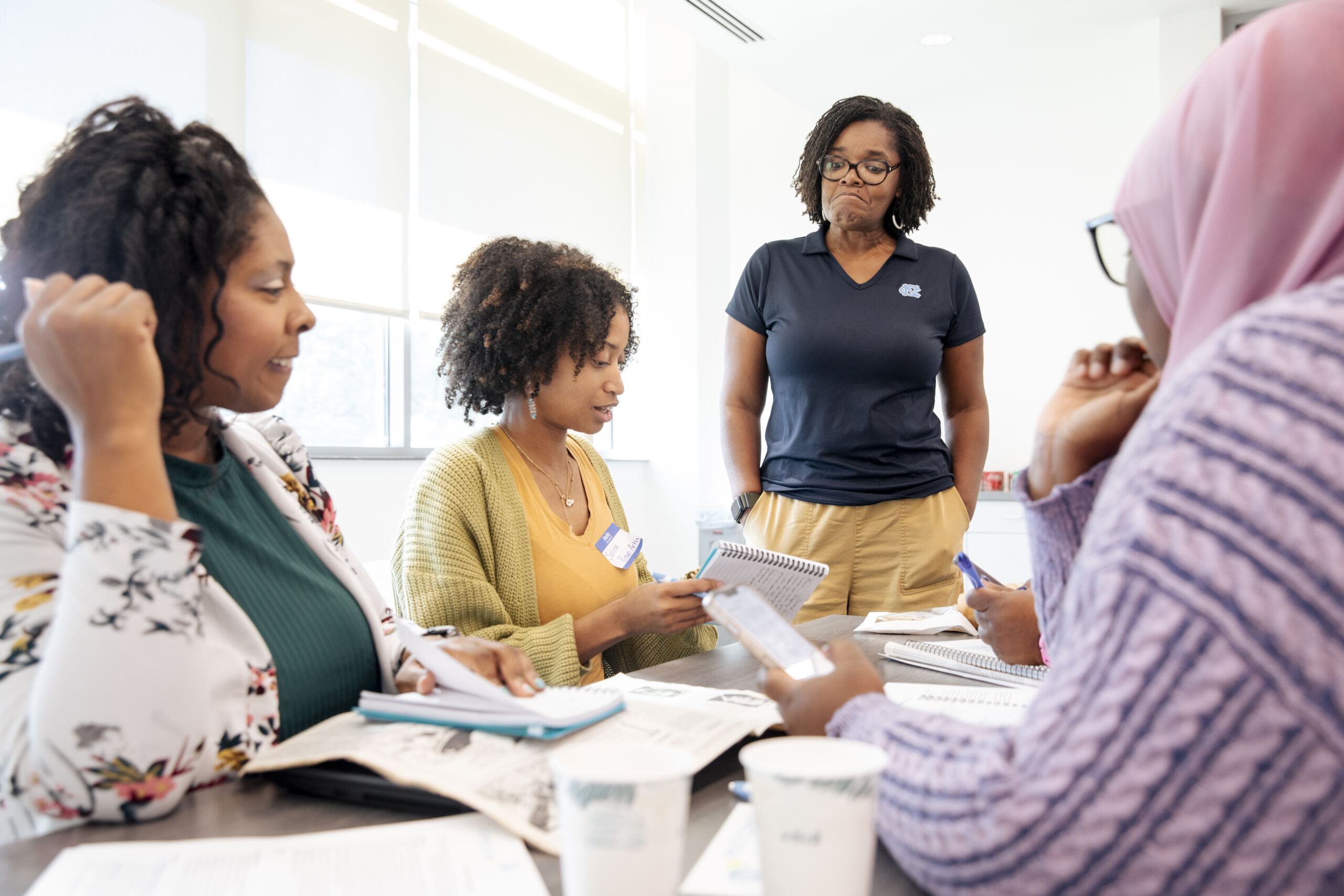
Cori Greer-Banks leads a teacher workshop in Durham Saturday, Oct. 18. She focused on how to teach sensitive topics to kids of all ages courageously and with an emphasis on truth-telling. (Photo: Carolina Alumni/Ira Wilder ’24)
Over years of teaching, Abbott, the History Teacher of the Year from Rockingham, has seen reading habits change and recognizes the need to package and present stories in ways that grab the attention of students. In examining the 1971 Supreme Court case Griggs v. Duke Power Co., Abbott’s students learn that 14 Black employees at Duke Power’s facility in Rockingham County demonstrated how the company’s rules confined Black employees to low-paying jobs — and that the rules were unrelated to individuals’ capacities to do the work. Abbott’s citing of historical cases enables students to understand the connection between neighboring Rockingham County residents and legal theory. The students learn how actions “ripple outward from the local level to national and global stages,” she said. “Engagement is strong when the humanities feel relevant, personal and tied to larger human questions.”
Carolina K-12’s impact stretches beyond the classroom because the humanities unlock “the ability to ask thoughtful questions, evaluate evidence and recognize connections across time and place,” Abbott said. “Such courses cultivate informed, reflective and responsible citizens who communicate effectively, empathize with others and contribute meaningfully to the shared work of living together in community.”
It changed everything
CPH is part of a humanities renaissance, including here at Carolina, that is preparing individuals for careers and to take part in democratic self-governance. Stephen Israel ’66 has gifted $10 million to Carolina to create humanities professorships and scholarships. His donation honors the late O.B. Hardison ’50 (’50 MA), an English professor whose course on John Milton stirred Israel to switch his major from business to English. “It’s inspiring to have the humanities, not because you can go on Jeopardy! but because it rounds you out as a human being,” Israel said. “Literacy, breadth of intellect, communication skills, creativity, judgment, good character are a few of the important things that are derived from the humanities.” If people want to become good citizens, he said, they should study humanities.
To that end, CPH staff design programs that integrate student learning, teaching training and community engagement. In September, CPH hosted an event at the N.C. School of Science and Mathematics titled Constitutions as Living Documents: Promises, Procedures, and Possibilities. Multiple audiences examined the N.C. Constitution and the U.S. Constitution, and students conducted research and prepared game show-style quizzes for members of the audience and for two expert speakers: Irving Joyner, professor and chair at N.C. Central University’s School of Law, and Ann McColl, interim president and executive director of the Public School Forum of North Carolina. The event program included small-group discussions among community members, teachers and students in attendance. Following remarks from Joyner and McColl, five students led interactive discussions on constitutional issues they’ve studied. For NCSSM senior Elise Carson of Asheville, a member of the student panel, the critical takeaway was something more than constitutional history. She said this kind of gathering could overcome partisan conflict, threatening behaviors and othering — treating a group or individual as different and usually inferior, a process that can lead to marginalization and dehumanization.
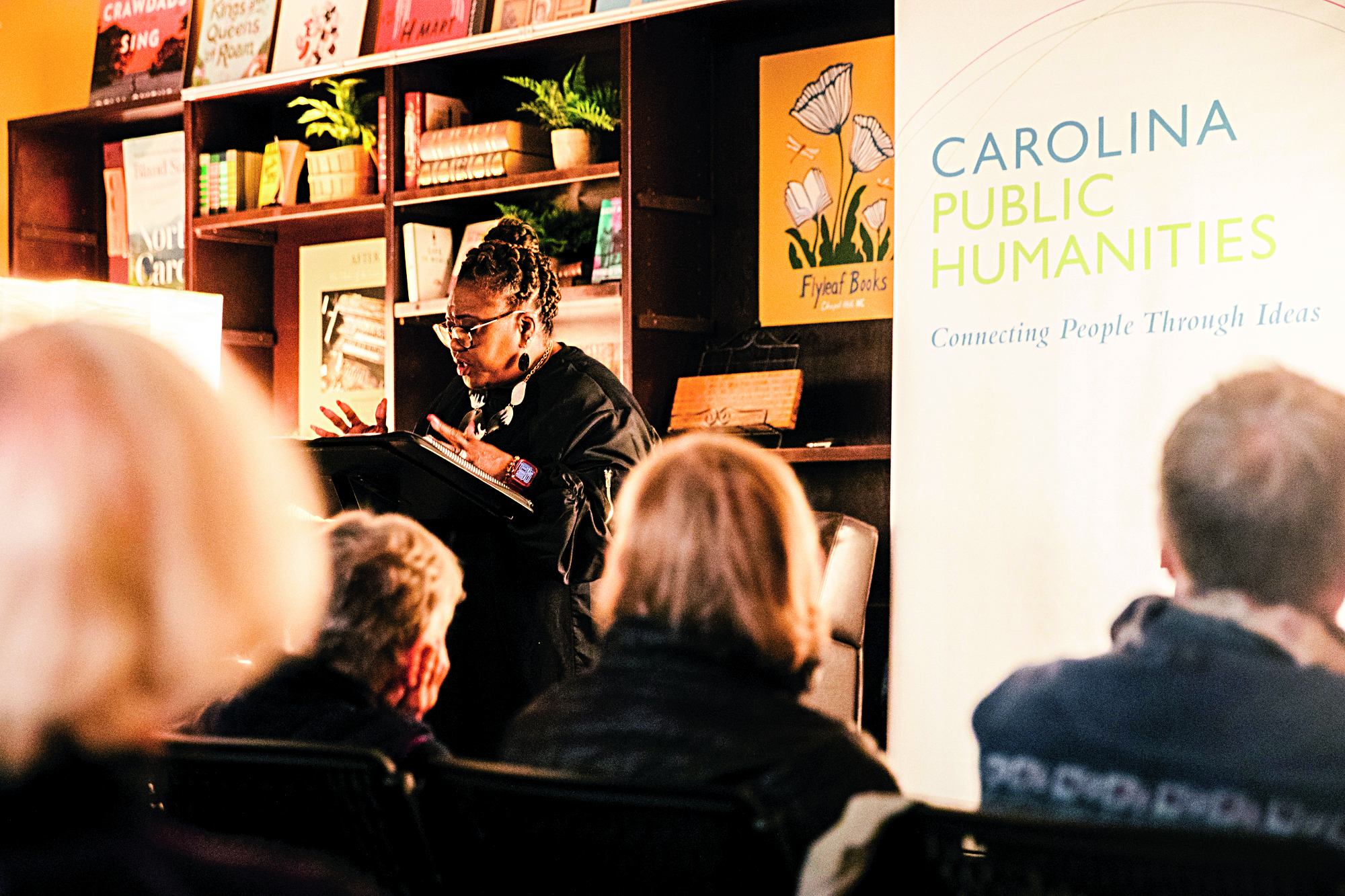
Mary D. Williams, an adjunct professor at Duke University, performs a tribute to gospel legend Mahalia Jackson, telling Jackson’s life story through song and excerpts from Williams’ upcoming book Mahalia Jackson, Moving On Up a Little Higher: The Story of an American Civil Rights Pioneer. The event, hosted at Flyleaf Books in Chapel Hill Wednesday, Oct. 29, was organized by Carolina Public Humanities. (Photo: Carolina Alumni/Ira Wilder ’24)
“Convenings like these are so important in the current climate,” Carson said. “You really have to create space for the conversation. I have had some of the most eye-opening conversations about how other people view the world by discussing politics with people who see things a bit differently from me. Talking with my friends about topics like these showed me that we can learn from each other without trying to ‘win’ the conversation.” She added that such events allow for questions, listening and new ideas, “because there’s no pressure to convince the other person. The goal is just to understand where they’re coming from.”
Sandy Smith, a retired school psychologist from Carrboro who regularly attends CPH programs, said of CPH staff: “They always create an atmosphere for all people to feel welcome to ask questions and space for people to talk about what they’ve learned. They really build community.”
For Carson, who plans to enroll at Carolina next year to study business, CPH programs are essential because public discourse feels more brittle than ever. “People my age are so afraid to touch on topics like this,” she said. By watching tapes of past presidential debates, Carson has noted changes in the nature and tone of public discourse in political conversations, which she calls “radicalized.” People are reluctant to take part because it’s hard to find low-stakes conversations where they can learn more about one another, she said, and every encounter feels like combat, as if every utterance represents a vote for one solution over another. As a result, there’s less of the everyday political talk central to deliberative democracy. And it is this ongoing conversation, Carson believes, that builds the civic muscle required to make sound political and policy decisions.
The CPH programs “have really shown me that trying to find solutions to a problem will never be successful if your goal in the conversation is to convince the other person that your solution is right,” Carson said. “As a past high school debater, it took me a while to understand this, but once I did, it changed everything.”
For Rovine, the humanities are critically important because they encompasses the vast array of human expression — hymns, recipes, paintings, poems, novels and more — that attracts people to one another. She witnessed this when she was a graduate student studying art and culture in Mali, and now she sees it in North Carolina when teachers, students and community members opt in to CPH events. Every CPH program and training session represents another magnet pulling more people into face-to-face conversations. It’s the way we make sense of the world.
“I feel very strongly we have got to listen to each other,” she said. “Our job is to show people across the state why the arts and humanities matter.”
John Bare ’87 (’92 MA, ’95 PhD), a writer based in Concord, is the author of My Biscuit Baby, a novel set in Chapel Hill. His last Review article featured the conflict-resolution approach pioneered by Hamilton College President Steven Tepper ’89.
Thanks for reading the Carolina Alumni Review
Carolina Alumni members, sign in to continue reading.
Not yet a member? Become one today.