The Star Behind the Scenes
Posted on Feb. 10, 2026For 26 years, Johnny Griffin ’85 has kept Wilmington a production destination Hollywood can’t refuse.
Story and photos by Ira Wilder ’24

As director of the Wilmington Regional Film Commission, Griffin is the go-to problem solver for television and movie productions in southeastern North Carolina. He also works with Hollywood producers, enticing them to bring their productions to Wilmington.
Johnny Griffin ’85 once phoned officials in Rose Hill, a small town in eastern North Carolina best known for the world’s largest frying pan, to tell them he wanted to blow up something. Griffin knows how that came across — he’s made similar calls many times before.
“Their first thought is usually that you’re literally just going to light a stick of dynamite and run,” he said. “But this is a controlled event. It’s meant to look spectacular, not cause destruction.”
As director of the Wilmington Regional Film Commission, Griffin is the go-to problem solver for television and movie productions in southeastern North Carolina — the guy who helps production teams navigate permits, road closures and, sometimes, small-town pyrotechnics. He also works with Hollywood producers, enticing them to bring their productions to Wilmington, which for years has been a popular destination for filmmakers and TV showrunners, providing the backdrop for more than 200 movies, including Iron Man 3 and The Conjuring, and more than a dozen television series, including Dawson’s Creek, The Summer I Turned Pretty, Matlock and Eastbound & Down.
“He’s really the bait,” said Barbara D’Alessandro, a line producer who has known Griffin for nearly 40 years. “He hooks the fish when it first comes in, so his delivery shows them the depth of opportunities that would be presented [in Wilmington]. That’s really important in terms of getting productions here.”
In Rose Hill, 45 miles north of Wilmington, he was coordinating behind-the-scenes logistics for a sequence in Iron Man 3, the highest-budget film ever shot in the state. But before he was managing explosions and stewarding the local film industry, he was a student at Carolina, learning what it took to make TV shows and movies come to life.
It’s in North Carolina now
Griffin came to UNC in 1981, following in the footsteps of his older brothers, Steve ’82 and Vick ’82, and his father, Ben ’50. Beyond the legacy appeal, he was drawn by the radio, television and motion pictures program, not because he wanted to be a star but because the technical aspects of sound recording and lighting fascinated him. As he stepped foot on campus, Griffin assumed he’d end up working at a television news station. “I had no interest in going to California and doing anything in film,” he said. “I had not been exposed to that in any way, and it really didn’t cross my mind.”
But coursework at Carolina piqued his interest, and the summer after his sophomore year, he heard the CBS miniseries Chiefs was filming in South Carolina. He drove down with a friend and landed a job working on set as Charlton Heston’s motorhome driver. When he came back to Carolina with a tan, he chalked up his film set work to nothing more than a fun summer job. He thought he’d focus on becoming a serious broadcaster when classes started again. But Griffin couldn’t shake the feeling that film was where his heart lay.
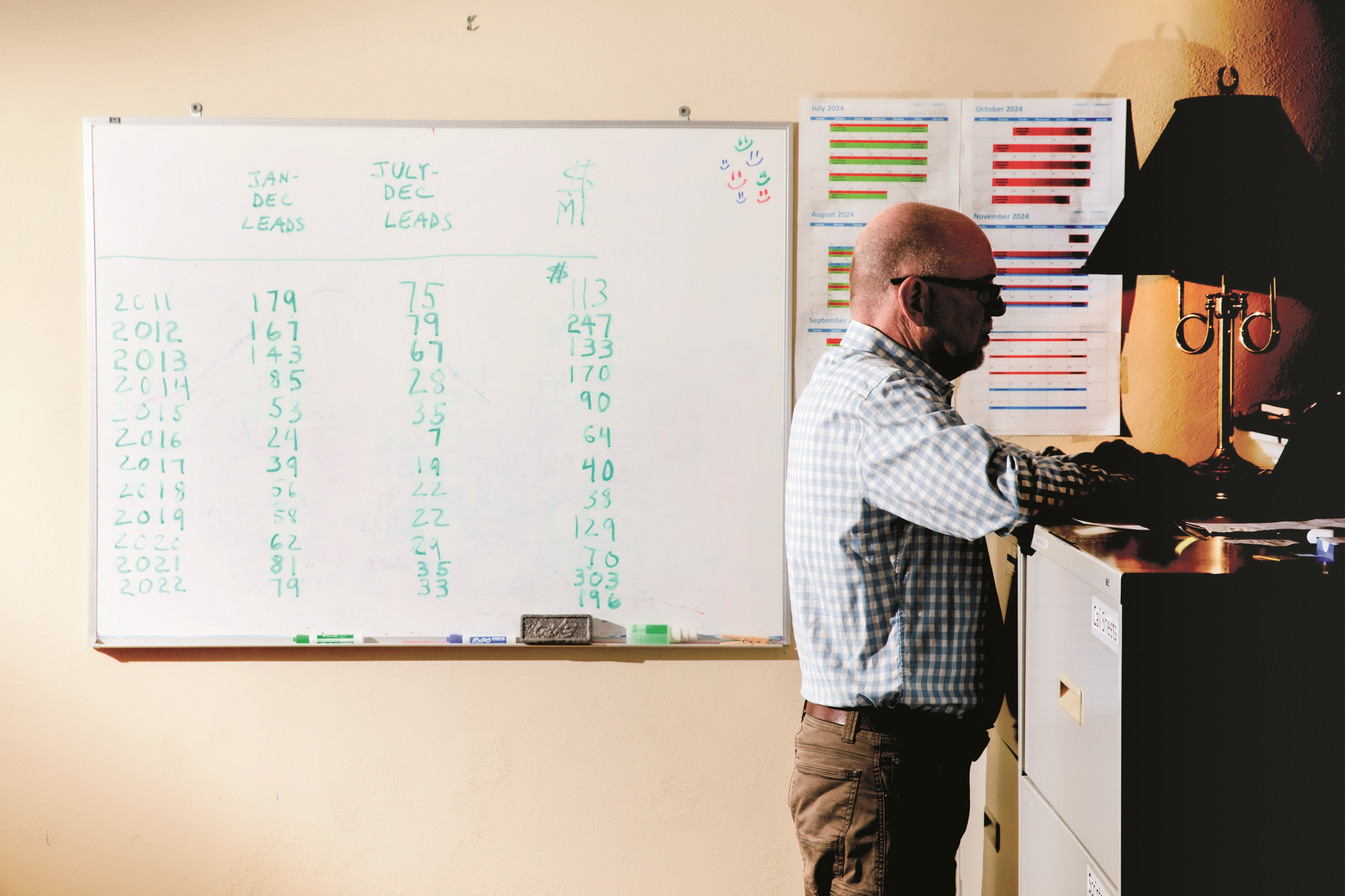
Griffin is often in Los Angeles, making the rounds to studios and production companies and following up on leads. Most projects can film anywhere, but Griffin excels at selling Wilmington to Hollywood.
In 1983, during Griffin’s junior year, legendary Italian producer Dino De Laurentiis built Wilmington’s first large-scale studio to make the movie Firestarter, based on the Stephen King novel and starring a then 9-year-old Drew Barrymore. The next year, De Laurentiis was making Cat’s Eye, another film based on a Stephen King novel and starring Barrymore and James Woods. Because the film industry in Wilmington was so new, the production company hired people with little or no experience. Griffin was one of them, and so during the summer before his senior year, he came to Wilmington, crashed with a distant cousin three blocks away from the studio for a few days until he could get an apartment and found himself carting around actors and running errands for Cat’s Eye.
“All of a sudden I realized this is actually something that’s in North Carolina now,” he said, “and I can actually work in film and not have to go to California.”
That fall, he returned to Carolina, and when he graduated in May the following spring, he went back to Wilmington, where he planned to stay for half a year to see whether he could make a career out of his new passion.
Griffin worked as the errand boy and driver on one project, and then another and then another. Wilmington was home to seven film productions in 1985, including director David Lynch’s Blue Velvet. “My parents were still a little bit unclear on what my path was,” Griffin said. “They were like, ’You go to Carolina and get a four-year college degree, and now you’re a truck driver?’ ” But he used his connections to climb the ladder.
Griffin talked to everyone he chauffeured, asking about their craft and how they got into the business. In fall 1985, a location scout offered him a job as an assistant. His foot firmly wedged in the film industry door, Griffin worked his way up to location manager. Before the internet, the job often involved going to a local bookstore and flipping through photo books to find great spots for filmmakers to shoot scenes. (Now, the commission has an online Rolodex of about 4,000 local places photographed and indexed.) He worked as a location manager for the next 15 years.
Though he was based in Wilmington, he traveled all over the Southeast. “I got to work with a lot of film commissions, and all of a sudden I begin to realize that that was an interesting job I might want to pursue.”
Scouting locations for Winter People in 1988 brought him to the mountains of North Carolina, and director Ted Kotcheff, who directed the first Rambo movie, asked him to find a cabin that was simultaneously at the top of a mountain and next to a stream. “Streams don’t run on the top of a mountain,” he told Kotcheff. “They’re down in the valley.”
Kotcheff wouldn’t hear it. “Have you checked the top of that mountain?” he asked.
“No sir,” Griffin said.
“Then you can’t tell me it doesn’t exist,” Kotcheff said.
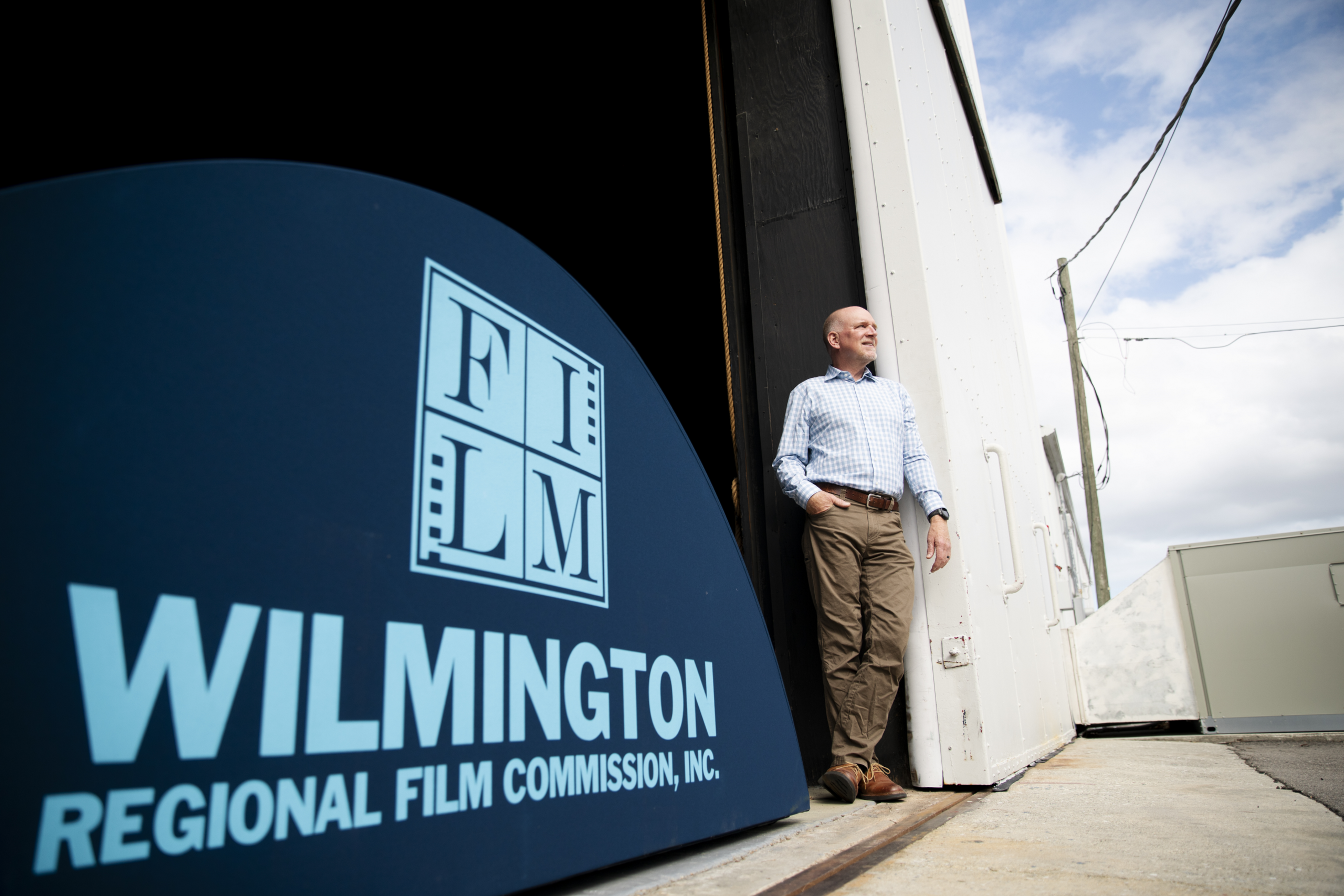
Griffin’s one-man office is on a Wilmington studio lot. He said it’s a lot like a hotel. Productions come and go, and when no cameras are rolling, the soundstages are empty and quiet. “But when it gets busy, there’s all sorts of activity and hundreds of people running around.”
Griffin discussed the predicament with a producer, who told him, “Go get a helicopter and scout, and we’ll spend a little money to prove to him that we’re willing to try and help him.”
Griffin boarded a helicopter and flew over the mountains for two days to an impossible aim, photographing cabins peeking through fall foliage. “I laid out all the pictures, showed him everything,” Griffin said, “and then he looked at me and said ‘Now I believe you because you actually went out and did it.’ ”
That taught him that in show business, effort counts as much as the results. Credibility is earned by the miles you’re willing to go.
He said scouting locations was exciting work, especially when he was a single guy who could head to a meeting in Los Angeles at a moment’s notice. One day, in 1993, he got a call on a Tuesday from a producer, and by Saturday he was in Africa, finding locations to shoot director Bruce Beresford’s A Good Man in Africa.
After he married in 1996, the hustle seemed less doable. He and his wife, Renee, wanted to have a child, so Griffin knew he needed a job that would let him stay in one place. He worked with film commissioners often, so he knew a job as a commission director would be a good fit. “I could just jump over to the other side of the fence and help location managers who are looking for places to shoot,” he said. “So, it was an easy progression.”
The Wilmington sale
In 1999, Mark Stricklin, who had directed Wilmington’s Regional Film Commission since its inception in 1993, decided to pursue a job in another state. Griffin said he applied “and was lucky to get it.” His job involves marketing Wilmington to filmmakers and helping productions obtain local permits, lodging, crews and tax incentives. He spends hours in his office, reading scripts and call sheets on his laptop that sits atop a file cabinet crammed with paper versions studios used to send before they went digital. D’Alessandro said the reason Griffin is such a well-rounded commissioner is because he has a background in production as a location manager: “He knows what producers are looking for.”
FILMINGTON:
A partial list of movies and television shows filmed in and around Wilmington
- The Confession (2023)
- The Summer I Turned Pretty (seasons 1–3, 2021–24)
- Boys Of Summer (2021–22)
- Scream (2020)
- Iron Man 3 (2012)
- Eastbound & Down (pilot through season 4, 2007–13)
- The Secret Life of Bees (2006)
- One Tree Hill (pilot through season 9, 2003–11)
- Divine Secrets of the Ya-Ya Sisterhood (2001)
- Dawson’s Creek (pilot through season 6, 1997–2003)
- I Know What You Did Last Summer (1997)
- Ruby Bridges (1997)
- Matlock (seasons 7–9, 1993–94)
- The Crow (1993)
- The Hudsucker Proxy (1993)
- Billy Bathgate (1991)
- Sleeping With The Enemy (1990)
- Teenage Mutant Ninja Turtles (1989)
- Weekend at Bernie’s (1988)
- Blue Velvet (1985)
- Maximum Overdrive (1985)
- Firestarter (1983)
D’Alessandro added that Griffin’s deep Rolodex makes him a valuable partner to production teams, whether that means getting the mayor on the phone or leasing a bus from the city at the last minute.
Wilmington has grown into a film epicenter of the South, competing with production hotspots such as Atlanta and Austin. Wilmington’s Cinespace Studios boasts a 258,000-square-foot campus with 10 soundstages. Dark Horse Stages, which hosts 82,500 square feet of soundstage space, opened in 2020. Griffin’s one-man office is a four-room square building on the Cinespace lot. He said it’s a lot like a hotel. Productions come and go, and when no cameras are rolling, the soundstages are empty and quiet. “But when it gets busy, there’s all sorts of activity and hundreds of people running around.”
The film industry in America has struggled in recent years due to competing international filming incentives, the onset of the streaming model, the subsequent box office declines and the pandemic. But film production remains one of Wilmington’s biggest industries. Thousands of fans visit every year to see where hit shows Dawson’s Creek and One Tree Hill were filmed. Griffin said local residents make up about 90 percent of the people who work on the city’s productions, which include recent movies such as the fifth Scream horror flick and the romantic comedy Zoey 102, as well as popular shows like Netflix’s The Waterfront and Amazon’s The Summer I Turned Pretty, based on the series of novels by Jenny Han ’02. (See “Alumna Author’s Amazon Prime Show Filmed on Campus,” September/October 2025 Review.)
Filmmakers are often drawn to Wilmington’s humble charm and the easy access to the beach. D’Alessandro said Griffin is often in Los Angeles, making the rounds to studios and production companies and following up on leads. Most projects can film anywhere, but D’Alessandro said Griffin excels at selling Wilmington to Hollywood.
Griffin said, “It can sound a bit cheesy sometimes, but folks coming from California, they’re used to working in big cities, busy places, lots of traffic and a lot going on. And they come to Wilmington, and they’ve got great weather, and they’ve got the beaches.” There’s no crowded freeway. There’s no paparazzi.
Griffin tries to make the place welcoming for out-of-town film folks, whether that means shutting down a road or, of course, exploding something. For Iron Man 3 filmed in Rose Hill, he dispatched a Wilmington firefighter to Los Angeles to learn how to safely coordinate the fiery blasts the production crew needed. And sometimes Griffin needs to do less exciting, but ultimately more important, logistical work, such as securing nearby daycare arrangements for a producer’s children. Griffin’s daughter was often in tow with him on set.
When Virginia Griffin ’24 was a kid, she knew her father worked in the film industry, but she didn’t fully understand what he did. She’d tag along with him to the studio, fascinated by the movie props that decorated his office — dinosaur eggs from Journey 2: The Mysterious Island and a spaceship from Muppets From Space. In her eyes, her dad was a magician.
She’d meet production assistants and grips, most of whom were her father’s friends, while watching productions film around the town she grew up in. Though they retaped the same scenes over and over again, which she said was “like watching grass grow,” she knew it was special. “My town is on display for the world to see,” said Virginia, who was a DJ at WXYC in Chapel Hill while she was a student. “That makes me really proud.”
“It can sound a bit cheesy sometimes,” Griffin said, “but folks coming from California, they’re used to working in big cities, busy places, lots of traffic and a lot going on. And they come to Wilmington, and they’ve got great weather, and they’ve got the beaches.”
“He loves the people in this town and the businesses, and he wants to show them off,” she said. “His way of doing that is through what he loves, which is film.”
When Griffin is not guiding Virginia through replacing her brake fluid or helping a production navigate permits or lodging, he’s working with North Carolina legislators, advocating on behalf of the state’s film industry. Guy Gaster, the director of the N.C. Film Office, said state representatives and senators from the Wilmington region look to Griffin for guidance on how to best illustrate the film industry’s economic importance to other state lawmakers.
“Not a week goes by that [Griffin is] not looking at the economic impact that these productions are having in the area and helping tell that story to someone who’s either in the Legislature or who’s working with the Legislature,” Gaster said.
The modern film business
The N.C. Department of Commerce announced the state’s film industry generated more than $302 million in direct in‑state spending in 2024.
Over nearly three decades in his post, Griffin has seen the big movie set lights change from smoke-billowing carbon lamps “as hot as fire” to efficient LEDs, but he’s also helped usher the local studios through an industrywide shift away from blockbuster films and toward streaming projects. “As the industry has changed, we’ve had to adapt to those different business models as to how they’re produced, how they spend money and how they schedule their projects,” he said. “And of course, film incentives.”
North Carolina introduced its first film incentive program in 2000, offering grants of up to $200,000 per project. By 2005, the program evolved into a 15 percent tax credit, which increased to 25 percent in 2010, a change that sparked tremendous growth in the state’s film spending. In the following years, film commissions statewide secured projects such as Iron Man 3, Safe Haven and The Conjuring in Wilmington and The Hunger Games in the Asheville and Charlotte regions.
In 2014, the tax incentives expired and were replaced by a grant-based rebate system, which limited funding to $10 million annually. The change led to a dramatic decline in film industry projects in North Carolina: In‑state spending dropped from a peak of $377 million in 2012 to $48 million in 2018, according to the N.C. Department of Commerce.
Griffin added that House Bill 2, which passed in 2016 and required transgender people to use bathrooms matching the gender on their birth certificate, deterred a lot of filmmakers from working in the state. The so-called “bathroom bill” was repealed in part in 2017 and then completely by a sunset provision in 2020. Even after the bill was partially repealed, Netflix chose to film the first season of the hit show Outer Banks in South Carolina rather than North Carolina, where the show is set, citing the “remnants” of the bathroom bill.
Since then, production spending has rebounded, in part due to an increase in funding for grants. In 2024, the industry roared back from a lull prompted by both the pandemic and the 2023 actors’ and writers’ strikes, posting record numbers in production spending and volume, with Wilmington leading the state. The N.C. Department of Commerce announced the state’s film industry generated more than $302 million in direct in‑state spending in 2024.
That’s not because blockbusters are once again filming in North Carolina. It’s because industry leaders, including Griffin, are attracting smaller productions to the state. “The Wilmington region has done well finding the projects that make the most sense for our incentive,” which is grant-based rather than percentage-based, Gaster said. Smaller productions stand to benefit more from grants because the grants make up a fatter portion of a project’s budget. For example, a $5 million grant means a lot more to a $30 million television production than it would to a $300 million feature film.
“We’ve gotten a lot more involved in the political landscape and working with the government and the Legislature, whereas before it was just working with filmmakers,” Griffin said. “I would say probably half our time now is just spent working with government entities, trying to maintain those incentive programs so we can grow the industry.”
Box office numbers are still below pre-pandemic highs, and executives are trying to increase streaming revenue, but Griffin is hopeful his city can remain resilient in its slow but steady path. “The good thing,” he said, “is we still have all of the things that have made Wilmington great.”
Thanks for reading the Carolina Alumni Review
Carolina Alumni members, sign in to continue reading.
Not yet a member? Become one today.