Olympic Born and Bred
Posted on Feb. 23, 2026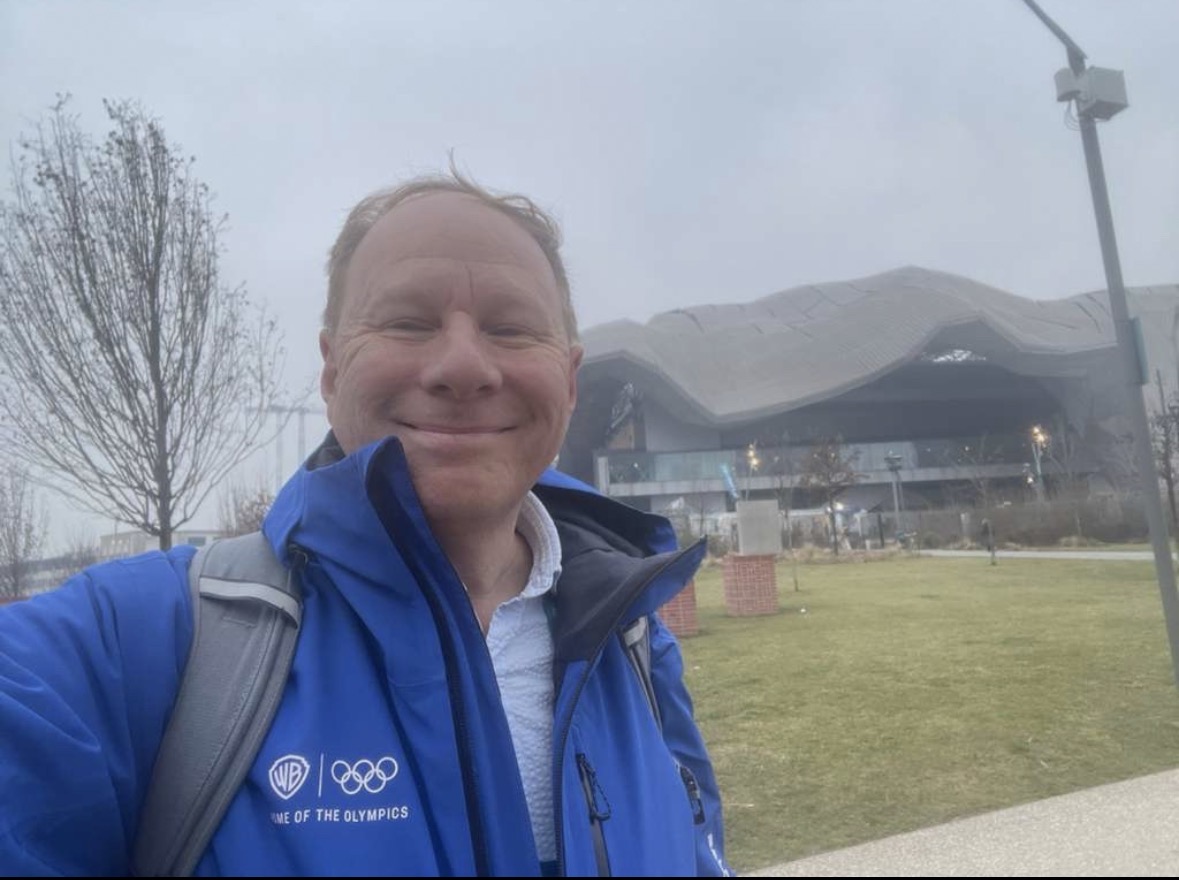
This February, Deaton Bell ’90 worked his sixth Olympic Games as hub producer for Warner Brothers Discovery and Eurosport, which televises and streams sports coverage across Europe.
Deaton Bell ’90 has been watching the Olympics his entire life.
“The story is that right after I was born, my mom would sit up feeding me and watch the ’68 Mexico City Games,” Bell said. “I like that legend.”
This February, the Wilson native worked his sixth Olympic Games as hub producer for Warner Brothers Discovery and Eurosport, which televises and streams sports coverage across Europe. In his role, he oversaw onsite producers and reporter groups covering figure skating, speed skating and hockey, and he connected market producers from different countries to ensure televised coverage was organized and efficient.
It’s been a long journey for Bell to get to this point in his career. As a child, he was an avid sports fan — his mother’s love for the Olympics transferred to him — and some of his earliest memories are watching the games with his family.
“[The Olympics] really impacted the way I look at sports television,” Bell said, “and kind of the way I look at the world.”
When he was a teenager, his family moved from Wilson to Atlanta, where he went to a large high school before returning to North Carolina to attend UNC, where he double majored in broadcast journalism and history.
In Chapel Hill Bell started to understand what he wanted to do in his career. He honed his writing and broadcast skills and got the chance to study abroad in Bristol, England, which stretched his worldview and made him consider the impact sports have globally.
“I felt like I was constantly expanding my horizons and being challenged by different perspectives,” Bell said.
After graduating from Carolina, Bell worked as a low-level research assistant for CBS at the 1992 Olympic Games in France, paying his own travel costs and spending most of his day doing menial tasks unrelated to his career aspirations. After a week of diligent work, he got a field promotion to an actual production role.
“I have a vivid memory of sitting in this ski chalet in Courchevel, France, after getting these additional responsibilities,” Bell said. “I was 23 years old, not that far removed from Carolina, kind of figuring out what I was gonna do. And I just remember thinking, okay, this is hard but I can do it.”
Bell has carried that attitude with him throughout his career. He’s worked at the World Cup and NFL, NBA, NHL and MLB games for several organizations, including ESPN, and for the past 18 years at Warner Bros. Discovery, also known as Turner Sports. To him, the most rewarding event has always been the Olympics. The days are long and there’s no reprieve for the duration of the Games. It can be exhausting at times, and Bell said nothing ever feels like it’s done perfectly. In fact, he said most days it seems like there are 900 things he wanted to do better. But despite all the pressure, the end result is worth it.
“Sometime in the summer, I’ll probably be sitting somewhere — maybe a little bit bored — and I’ll kind of miss the running around,” Bell said. “So, trying to look at pressure as a privilege, and that responsibility as a gift to be able to share stories — that’s sort of what keeps me going.”
At the end of the day, the storytelling is most important to Bell. That’s what drew him to this career and why he’s always been so interested in the Olympics.
The Games offer the chance for stories of incredible athletic achievement, but also of personal fortitude, heartbreak and joy, to resonate with people around the world.
After each long, grueling day of work, Bell looked at the viewership numbers of the broadcasts he oversaw, and they blew him away. Millions of people watched each day. Knowing that so many people get to see and hear the stories that move them keeps him going.
“We love telling the athletic stories, but the Olympics are also really about personal stories,” Bell said. “And I think all sports journalism is about personal stories. There’s something about the Olympics that really amplifies that. And so getting to be just a small part of that — and to share that with a wider world — feels like a real privilege.”
—Gwen Peace