Well and Truly Symbolic
Posted on May 29, 2026Over its nearly 130-year history, the Old Well became a visual icon for the state’s flagship and helped the University navigate murky political waters.
by Kenneth Joel Zogry ’97 (MA, ’08 PhD)
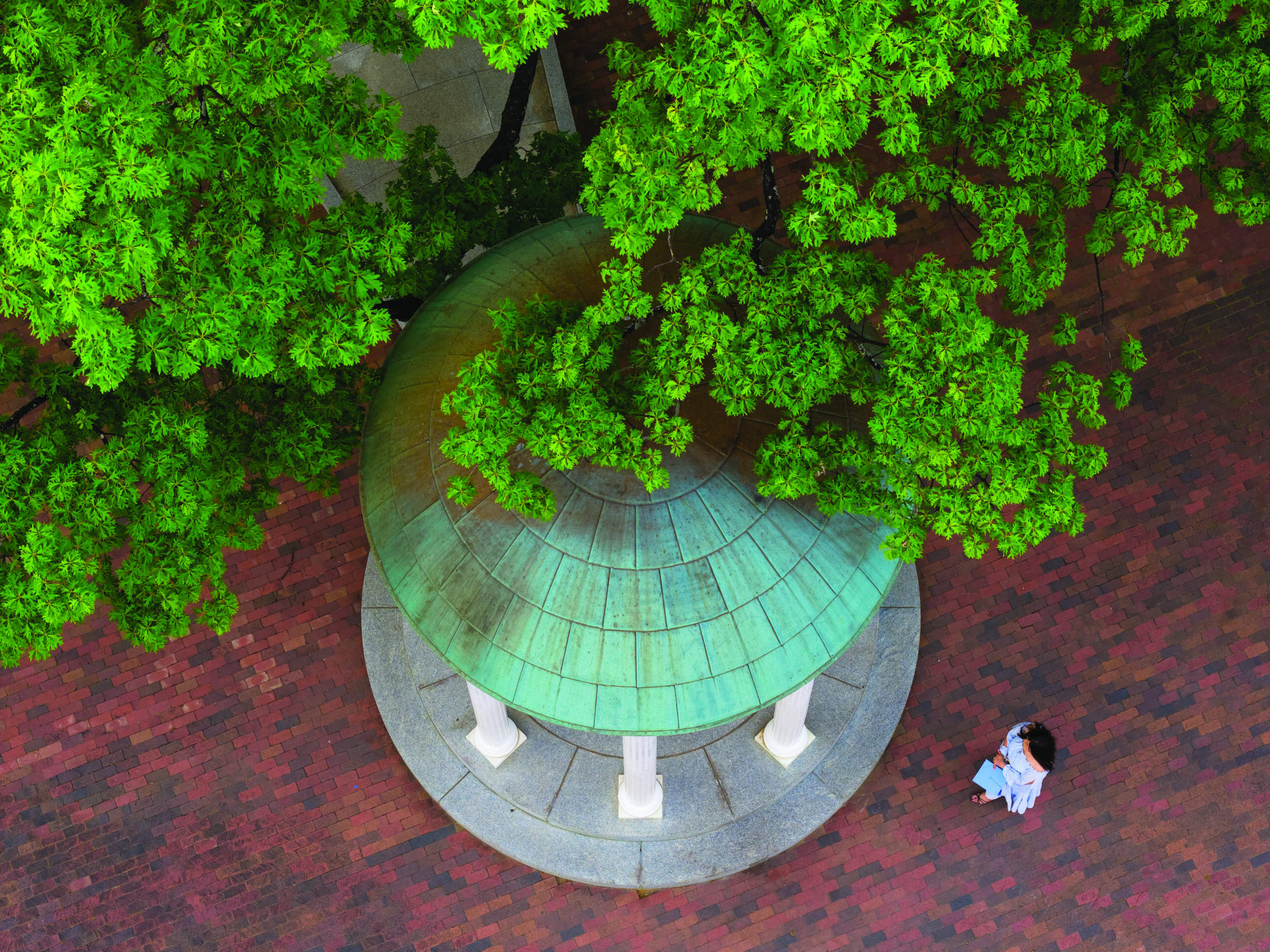
Alderman wanted a small neoclassical temple, based on those he had seen in English and European gardens, derived from ancient Grecian and Roman models. (PHOTO: Mark Terry ’95)
The Old Well is, well, neither very old nor a functioning well.
The fountain itself, from which countless first-year students drink every autumn as a token of good luck, was installed in 2001. It provides city water, like every other water fountain on campus. At about the same time, a stylized digital image became the literal icon for the University, cementing the romantic status the structure has held for more than a century.
The Old Well as we know it today does not date to the founding of the University in the 1790s. Despite its neoclassical appearance and location in the heart of main campus surrounded by late 18th- and early 19th-century buildings, the hallowed domed structure didn’t appear until 1897. It was substantially renovated in 1925, and then essentially rebuilt in 1954. The current revered structure is, for all intents and purposes, a mid-20th-century monument. But a monument to what? And a symbol of what?
The story of the well’s symbolism is intertwined with key moments in North Carolina and American history, when the University faced external political crises that threatened its tradition of academic freedom, public support and legislative funding. At each critical juncture — 1897, 1925 and 1954 — the Old Well was used to help address tense situations, rally alumni support and symbolize continuity between the past and present.
The early well

The University’s original well, dug in 1795, is situated east of the Old Well’s center point. It’s 30 inches wide and 42 feet deep and was uncovered in 2023 when workers added an accessibility ramp to the Old Well. The iron hook shown above was originally used to retrieve the well’s bucket when it slipped off its rope. (UNC/Johnny Andrews ’97)
The original well was a hole in the ground — today about a foot-and-a-half east of the current Old Well’s center point — that does date to the earliest days of the University. In January 1795, a month before the arrival of the first student, Hinton James, the trustees authorized digging a well to provide water for drinking, cooking and bathing. Thirty inches wide, 42 feet deep and lined with small stones, the original well was capped with a very simple wooden-framed box and flat cover that was likely no more than 2 feet tall and built for the purpose of preventing small animals and absent-minded students from falling in. All that remains today of the early well apparatus is a three-pronged 19th-century wrought iron hook used to retrieve lost buckets that slipped the rope. Found in the well decades later, the iron hook now resides in the University Archives.
The 1795 well was purely utilitarian and barely noticeable on the campus landscape. Early prints show a taller and more decorative wooden structure nearby, which is sometimes confused with the Old Well, but it housed the University bell and was burned down by prankster students in 1859. When the bell was replaced and fixed atop South Building, the center of the quad was left barren. Sometime following the reopening of the University in 1875 after the Civil War and Reconstruction, campus leaders built a crude, wooden shed over the well.
Joshua Gore, professor of science and engineering at UNC in the 1880s and the man responsible for modernizing the University’s infrastructure in the late 19th century, oversaw installation of the first central water system in 1892. At that point, the “old well” became functionally obsolete. But within a few years, UNC’s new young president, Edwin Alderman (class of 1882), tasked Gore with the creation of an architectural focal point for the center of campus to replace what had become an eyesore.

A crude wooden shed was built over the original well some time after 1875. (This photo is noteworthy for being one of the first to show the interlocking NC logo.) (PHOTO: UnC Image Collection P0004, N.c. Collection Photo Archives)
Regarding what he called the “squalid and ramshackled” shed, Alderman wrote in later years that he was “determined to tear it down and put something there of beauty,” to improve the “grim and austere dignity of the Old Campus … and thereby elevate and strengthen the spirit of the oncoming generations of students.” Aesthetically, he wanted a small neoclassical temple, based on those he had seen in English and European gardens, derived from ancient Grecian and Roman models. “Our little well,” Alderman stated, “is a sort of sixth cousin of a Greek shrine, or third cousin of the Temple of Vesta, or second cousin of the Temple at Versailles.”
Gore enlisted Eugene Lewis Harris (class of 1881), the University’s registrar and an accomplished artist, to create the design. The result was a simplified structure, pleasing to the eye but not particularly faithful to early models. Soon after completion, the edifice was described as painted in “national colors,” suggesting red, white and blue. Though that may seem odd, an early colored postcard shows the dome painted a dark red. Assuming the dome ceiling was painted sky blue, as was common for porch ceilings of that era, and the remainder of the structure white, then all three national colors would have been present.
Well-meaning

In the 1890s, UNC President Edwin Alderman (class of 1882) decided the University should create an architectural focal point to replace the derelict well, which was by then obsolete.
On one level, the domed edifice was intended simply as what the Victorians called an ornamental landscape “folly,” adding beauty but serving no practical purpose. On another level, Alderman’s Old Well was a metaphoric “fountain of knowledge” at the center of the state, representing the modern pedagogical approach at the core of the University following the Civil War. In an 1897 address to the student body, Alderman spoke of the University being “the greatest spiritual achievement in North Carolina … sending out its points of light in the shape of broad-minded public-spirited citizens,” who were “a breath of freedom” and stood “for sanity of thought, for toleration, for citizenship.”
Of equal significance, but virtually forgotten today, is that in 1897 Alderman simultaneously conceived and installed the ornate entrance to South Building, just yards from the Old Well. He funded both with $500 from a $5,000 state appropriation for campus improvements. Notably, the Old Well cost $200 to construct, while the elaborate new South Building entrance cost $300. Together they were an architectural set-piece, vastly different stylistically and in historical reference, yet part of a unified theme. The new Old Well, as a miniature neoclassical temple, represented the University’s link to the educational enlightenment of the Classical World and the Renaissance. The Georgian-style door surround replicated the “fine detail over the doorway to Westover, a noble Colonial home on the James,” Alderman wrote. The reference to Westover, one of the grandest of the James River Virginia plantation houses, was meant to represent the University’s fealty to the Old South, literally on the building known as Old South at the time.

In the late 1890s, Eugene Lewis Harris (class of 1881), at Alderman’s request, worked from this photo of the Temple of Love at Versailles to design a new architectural focal point for the campus. Harris was the University’s registrar and an accomplished artist. (PHOTO: Pubilc Domain)
Alderman’s design choices were not capricious nor purely aesthetic. In the late 1890s, the state was in the midst of one of the greatest political struggles in its history. Nearly a decade of biracial Fusion Party victories was coming to an end, and the fragile post-Reconstruction coalition of white Populists and African American Republicans was about to be destroyed.
In 1897, a bitter statewide fight was underway to fund modern graded public schools, an endeavor led and championed by UNC President Alderman, who viewed it as an extension of the University’s own mission. Opposed by the biracial Fusionist coalition, which preferred local control to state bureaucracy, the measure was defeated. Alderman and other proponents of improving public education were stunned. Determined to modernize the state’s public schools, they cast their lot with the state’s Democrats on a platform of educational reform, but this meant they had to align politically with white supremacy to destroy the Fusion coalition.
The Democrats employed vicious and deadly tactics, including the infamous Wilmington coup d’etat in November 1898, and swept into office statewide. Charles Brantley Aycock (class of 1880) was elected governor in 1900 and set about to modernize public education, but only to the benefit of white children and within the broader statewide framework of racial disfranchisement and codified segregation.
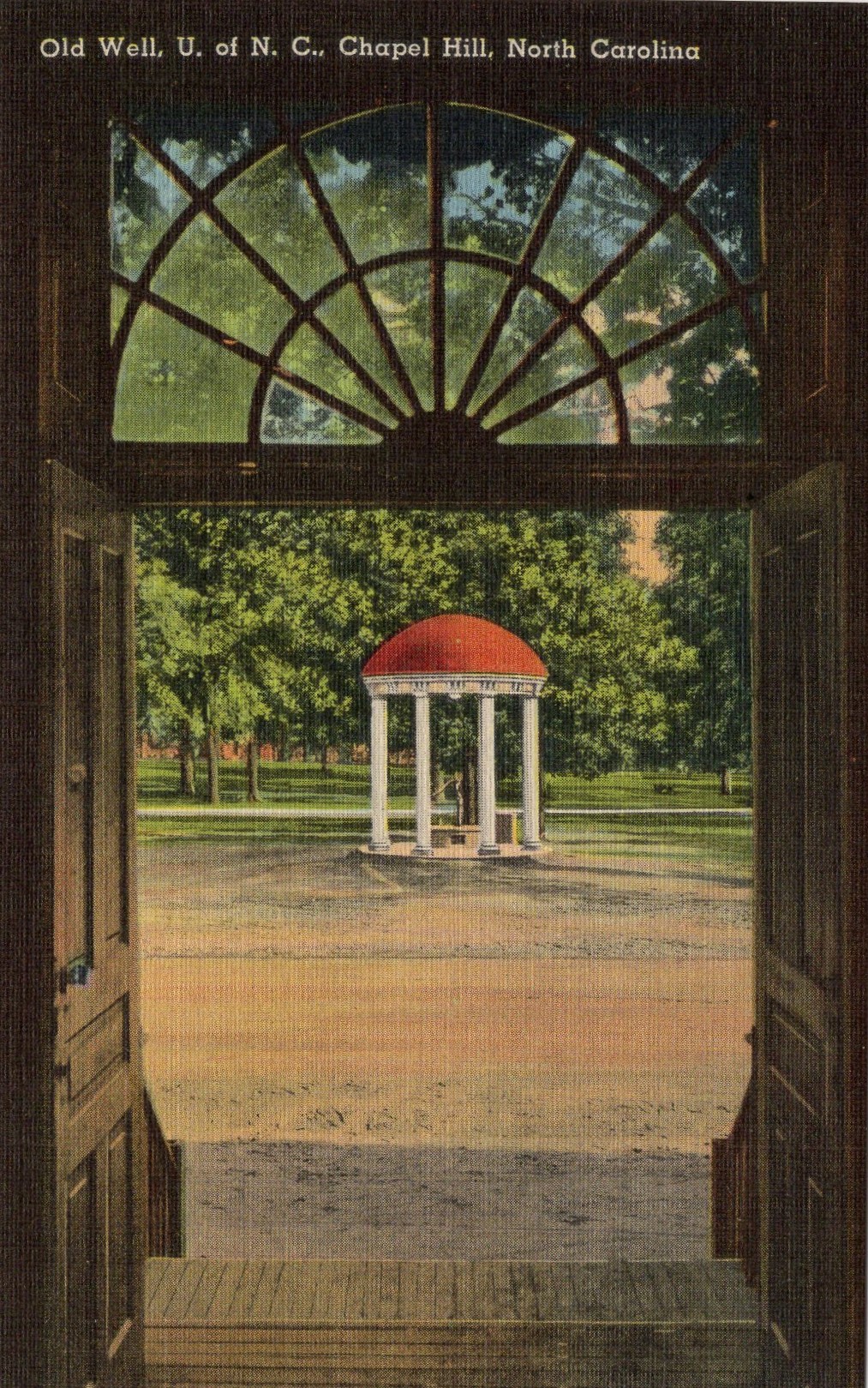
This postcard of about 1920 shows the Old Well from inside South Building’s ornate doorway, also installed by Alderman in 1897. He wanted both the well and doorway to be viewed as one unified symbol. (PHOTO: Pubilc Domain)
Alderman’s choice of the pure white columns and neoclassical form of the Old Well represented a perceived high point of early democratic and republican forms of government, along with the flowering of Western arts and culture in the Greco-Roman world. However, the use of a direct reference to Virginia plantation houses built by enslaved people on the front door of the University’s central building — also built by enslaved people — was seen as a sign of affinity for state leaders then attempting to reestablish the racial and social order of the vanquished Antebellum South.
In the end, Alderman compromised racial equality for what he saw as the greater good: the establishment of modern centralized public education in North Carolina to replace the haphazard system of woefully inadequate and outdated locally run one-room schoolhouses.
There is evidence Alderman had regrets about the bargain. In the last paragraph of a 1923 letter about the Old Well, he referenced both its greater purpose and the ugliness of white supremacy, represented by the Wilmington coup d’etat and the activities of the Red Shirts, an extremist group that opposed biracial political fusion:
The whole well incident, the building of the little Temple, was a pitiful, yet beautiful, illustration of the way Democracy cries out for beauty to give it backbone — spiritual backbone — that will make it so strong that it can and will defy self-gratification, mobs and red terrors.
A well to light the way
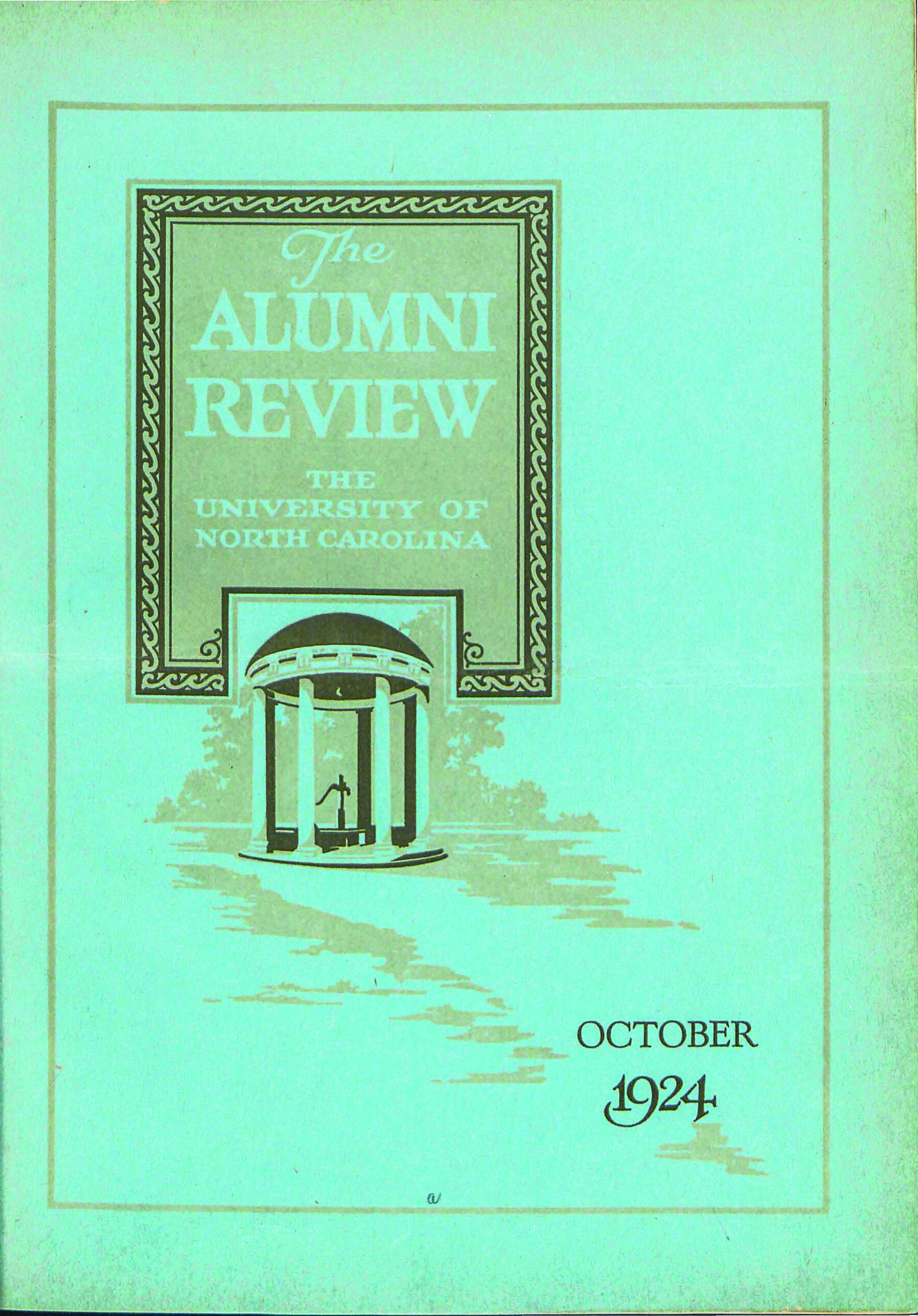
One of the first uses of the Old Well as the campus icon was the cover of the October 1924 issue of The Alumni Review. This cover design was used for the next 20 issues, with a different color scheme each time.
For most of the first quarter of the 20th century, the Old Well was seen as a quaint campus landmark, but it was not the revered icon it would become. Sometime after 1902 the open well was closed, and a more sanitary hand pump was installed. A 1917 photograph taken by a student from the window of his room in Old East showed the grounds around the structure as little more than a dirt parking lot for Model T’s. By the mid-1920s, though, campus expansion and the first attempt by the State Legislature to dictate what was taught at UNC resulted in renewed attention to the Old Well as a symbol.
During the 1920s, the University was undergoing the most significant physical transformation in its history. Along with neatly ordered groups of redbrick classroom buildings and dormitories, the University’s master plan called for the creation of a new quadrangle, Polk Place, intended to shift the focus of main campus from the north to the south side of South Building, which received a grand new portico to emphasize the point.
Almost as an afterthought, the Old Well, now on the proverbial wrong side of the tracks, was spruced up. By 1925, three decades of weather and student vandalism had taken their toll. The hand pump was replaced by a drinking fountain, and water from the well itself ceased to flow. In addition, a second concrete step encircling the base was added, and repairs to the structure were made. On University Day, October 12, 1925, The Tar Heel reported that returning alumni would note many changes on campus, including the fact that “one can no longer drink water from the Old Well, [as a] deftly concealed pipe carries water to the fountain from the University’s water main.”
Despite emphasis on the newer portions of campus, the Old Well was again enlisted in 1925 as a symbol for the University as it faced outside challenges to its bedrock academic freedom. In January of that year, state Sen. David Scott Poole introduced a bill to abolish the teaching of evolution at public schools and universities. Fights over Darwinism and public education were breaking out across the country, most famously the Scopes “monkey trial” in Tennessee. Because the state was largely footing the bill for the University’s expansion, some state politicians decided they should dictate what was taught in its classrooms.
UNC President Harry Woodburn Chase sprung into action to stop the measure. In a letter to a legislator, Chase wrote, “[T]he passage of the Poole Resolution would virtually set up a tribunal before which every teacher of science and related subjects would be badgered, worried and disgraced. Good men will simply not teach in an environment of that sort. … It is an abridgement of the freedom of discussion and thought which will go a long way toward ruining the University, because it deals with the vital education process itself, of which the appropriations [for new buildings] are simply the means to create.”
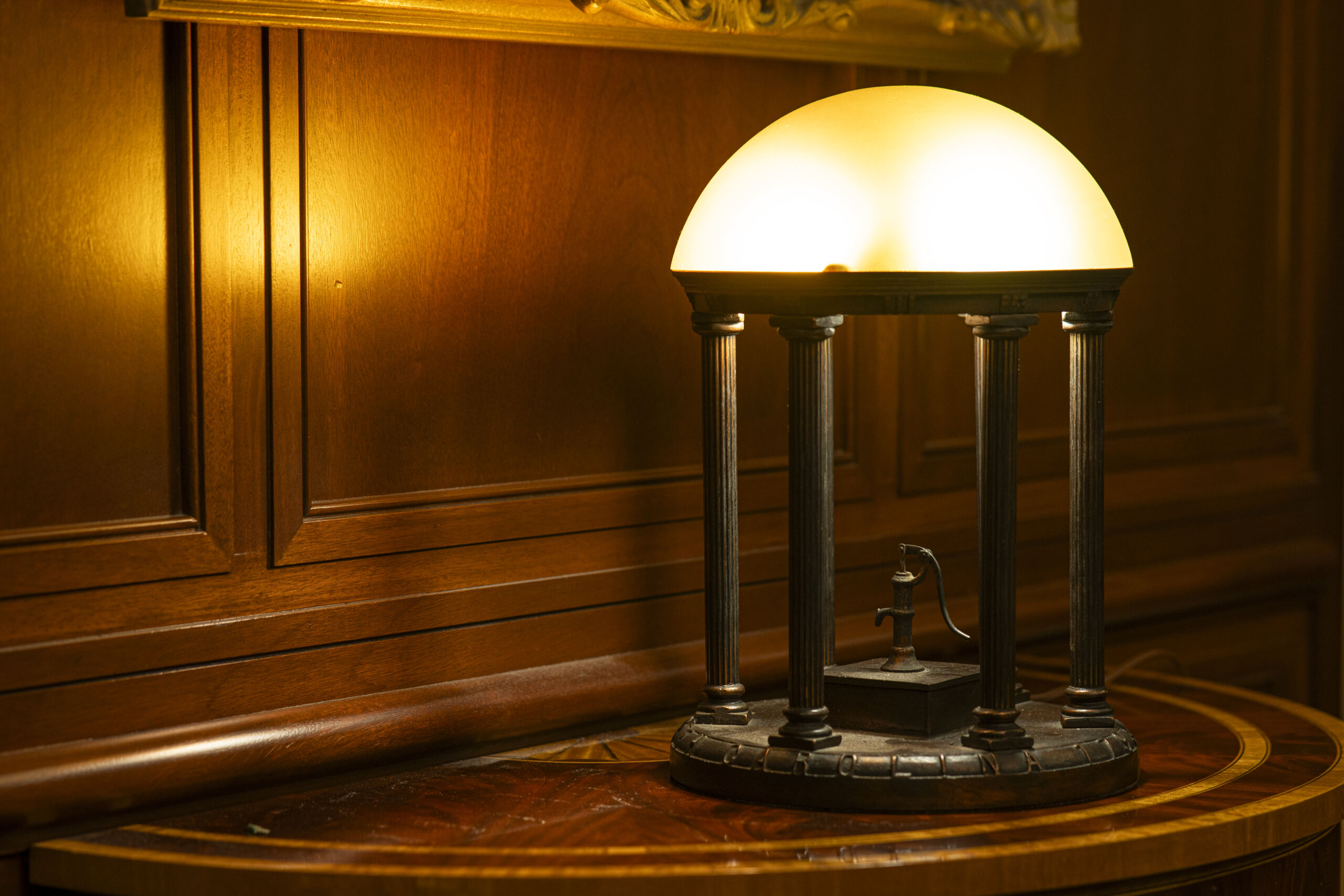
Old Well lamp, 1927. One of a handful known to exist. Made of cast bronze and brass with a heavy opaque amber glass dome. The small hand pump handle is functional and serves as the on/off switch. In the collection of the George Watts Hill Alumni Center.
Frank Porter Graham (class of 1909), an associate professor of history who would succeed Chase as UNC president in 1930, spoke out publicly against the Poole Bill. In the April 1925 edition of The Alumni Review, Graham declared that if the Poole Bill became law, “[t]he teachers and youth of North Carolina would revolt against this ancient tyranny in its latest form.” Graham went on to state, “The buildings at the University — symbol of all our schools and colleges — are forever treasured [by] the people because they tell their own story of poverty, struggles, failures and heroism.” Noting Carolina’s tradition of academic freedom, he wrote: “The ancient buildings, clustering under the great oaks about the Old Well, are dearer to University men because of their associations with a great tradition of freedom.”
The Poole Bill was defeated, and in its wake Graham’s words were taken to heart. The Old Well became fixed as an icon of the University’s purpose and illustrious history, even though the little temple was less than 30 years old.
Beginning in October 1924, the cover of The Alumni Review featured a rendering of the Well, and a new recurring magazine column was entitled “Heard Around the Well.” The cover design continued through 20 issues until July 1926, changing background color for each publication.
The May 1925 issue of the Review announced that, at Commencement, there would be “a new feature for reunions,” as “each class will have a tent as headquarters … extended around Old Well.” A cartoon showed alumni — ranging in ages and carrying flags with their graduation year — marching toward the little temple. The caption read: “Join the Annual Pilgrimage to the ‘Fountain of Youth.’ ”
At graduation that June, Charles E. Graham, head of the University’s electric and water division and the man responsible for the recent renovations, overheard one alumnus remark to another, “I would like to have that Old Well where I can see it every day.” On the spot Graham decided to create an elegant memento for alumni — an “Old Well electrolier,” appropriate for use as a “library lamp.” Graham enlisted a committee of five alumni to approve the lamp’s design, arrange terms for manufacturing it and set pricing. The Tar Heel reported in May 1926 that the lamp would be 18 inches high, constructed of “statuary brass and amber glass” and “would be available soon.”
About 18 months later, December 1927, an illustrated ad for the lamp appeared in The Tar Heel. Showing the lamp casting a halo of light, the ad called it an “exclusive gift” and asked, “What could be more appropriate and beautiful for Christmas than an Old Well Lamp for mother and sweetheart?” Graham’s design used a miniature working hand pump as the on/off switch — an ironic touch, as he had overseen removal of the well’s hand pump two years earlier.
The Alumni Review noted in January 1928 that at an alumni gathering in Lincolnton, Lester A. Crowell (class of 1926) “added touches of University life,” including, “[t]he Old Well lamp in the center of the table [which] attracted much attention.” In the late 19th and early 20th centuries, “lamps of knowledge” were common icons, often portrayed in forms from ancient Greece or Rome. Carolina’s Old Well lamp, which alumni could purchase and display at home, symbolized the light of education and democracy emanating from the University, just as Alderman had envisioned in 1897.
Rally ’round the well, boys
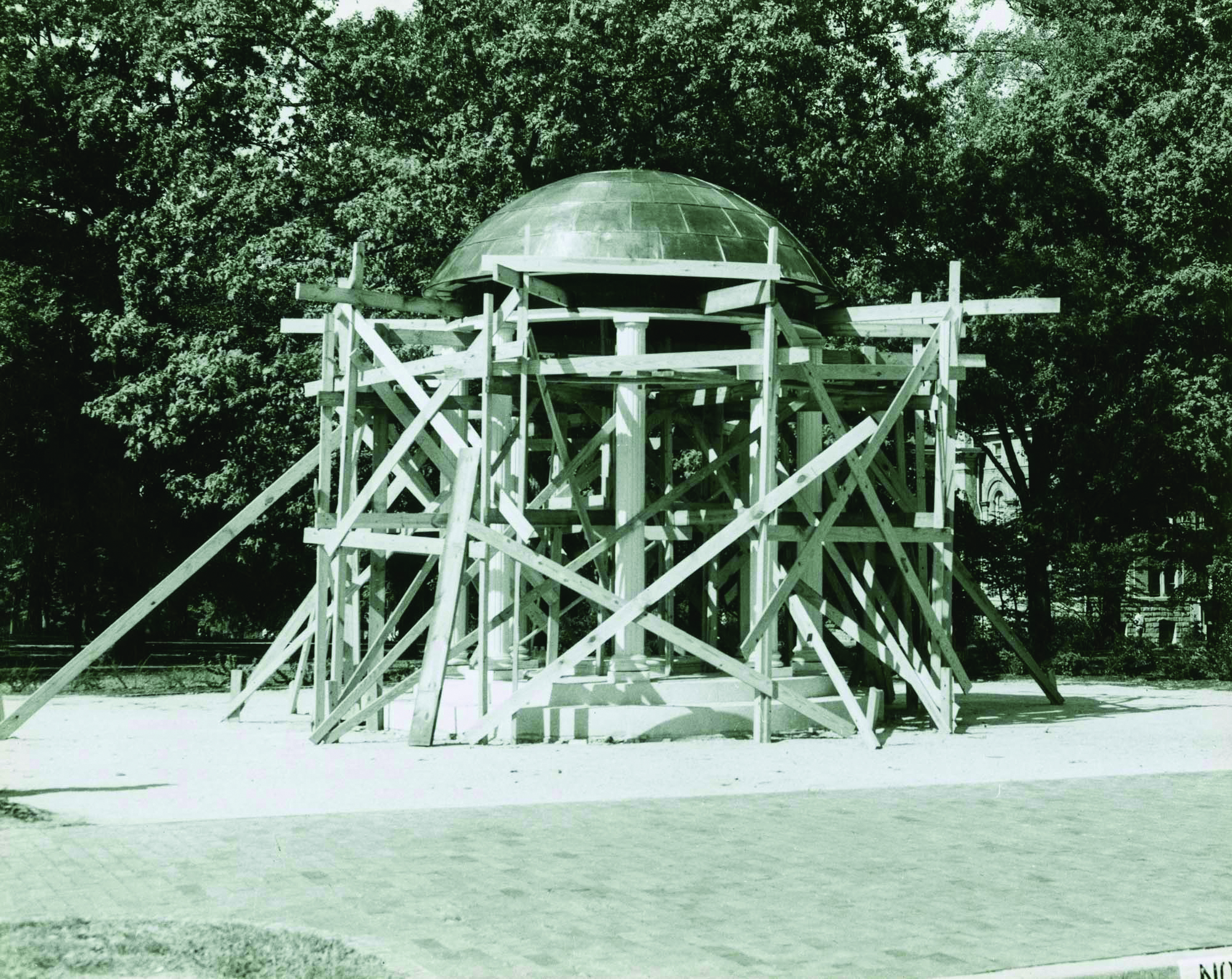
The Old Well’s current structure dates to 1954, when UNC System Vice President William “Billy” Carmichael Jr. (class of 1921) had it rebuilt and used as a symbol to counter negative national publicity about a small number of leftist students and faculty and ties to the Communist Party.
The Old Well’s status as the UNC symbol was challenged following construction of the Morehead Patterson Bell Tower in 1931. Soon that new edifice was appearing on covers of The Alumni Review, and The Daily Tar Heel even incorporated a graphic of the Bell Tower into its banner from 1947 to 1961. But another national crisis that engulfed the University — the fear of Communism during the Cold War — brought the Old Well back to prominence as the symbol of democracy, academic freedom, loyalty and patriotism of true Tar Heels.
In the decades following the battle over the teaching of evolution, efforts to practice academic freedom garnered the University a reputation as a “nest of red vipers.” It began in 1936, when a student organization invited exiled Communist leader Leon Trotsky to speak on campus. The invitation made national news, as U.S. Secretary of State Cordell Hull stepped in and barred Trotsky from entering the country. David Clark, editor of the Southern Textile Bulletin and oft critic of Carolina, asserted that the campus was full of “crack’d brained professors and baby radicals.”
In addition, UNC President Graham, who held the office from 1930 to 1949, was a close friend of President Franklin D. Roosevelt and his wife, Eleanor, both considered progressive enough to be cast as socialists. Graham was widely respected in the state, but he supported millworkers’ rights and civil rights for African Americans — both controversial at the time. And his attempt to limit big-time athletics angered some alumni and almost cost him his job. (See “Carolina Football Comes of Age,” October/November 2025 Review.)
Realizing UNC had a public relations problem, Graham enlisted William D. “Billy” Carmichael Jr. (class of 1921) to serve as vice president of the newly consolidated UNC System. Carmichael, who had played on Carolina’s basketball team and had successful careers on both Wall Street and Madison Avenue, spoke the language of the state’s business leaders, politicians and more conservative UNC alumni.
Carmichael went to work skillfully reshaping the University’s image and cultivating major donors. His relationship with John Motley Morehead III (class of 1891), for example, led to the donation of funds to build a state-of-the-art planetarium and the Bell Tower. Soon Carmichael’s sense of grandeur and imagery could be seen across campus, including an extensively remodeled Carolina Inn and its rebranding as “Tara” from Gone With the Wind to counter fears the University was too progressive on civil rights. Then he cast his eye on Alderman’s Old Well.
Carmichael’s 1954 reconstruction of the Old Well occurred at the height of the Red Scare, following a series of events that brought unwanted national attention to the University. In 1949, Hans Freistadt ’50 (PhD) became a national cause célèbre when the Atomic Energy Commission revoked his physics scholarship at UNC because he was a card-carrying Communist. His picture was flashed across the national wire services, showing him seated beside the Old Well. An incensed Carmichael told UNC trustees: “We frankly don’t want Communists on this campus. … If we can’t keep the Communists out, you had better get rid of us and get someone who can keep them out.”
In 1950, Frank Porter Graham, then a U.S. senator, was locked in a bitter election with an opponent whose operatives accused him of being “soft” on communism. One campaign flyer also asserted in bold type: “Frank Graham Favors Mingling of the Races.” Finally in 1954, Freistadt’s former UNC roommate Junius Scales ’47, also a member of the Communist Party, was arrested and convicted under the Smith Act for suspicion of sedition. His trial and subsequent imprisonment were national news.
Needing a public relations symbol to counter these negative narratives, Carmichael set about reconstructing the Old Well and placing it in a grander landscape setting. As a fundraising tool, he created an elaborate menu for the Carolina Inn dining room, which debuted on graduation weekend in 1954. The cover featured a detailed drawing by illustrator and art department lecturer William Meade Prince. At the center was the “new” Old Well, with a freshly minted white male UNC graduate following in the footsteps of illustrious alumni and ancestors of the Old South, including Confederate and Revolutionary War officers. The title reads “Faith of Our Fathers … Hope of Our Sons.” Inside the menu, along with food choices, were several pages of anti-Communist commentary: “Revolutionary heroes who founded the University were men of fighting faith; faith in Almighty God and faith in America,” Carmichael wrote, who “envisioned the University as the foundation stone of a people determined, under God and on their earth, to keep freedom forever as the firm basis for the fulfillment of all their powers.” The Old Well, by implication, symbolized this faith and vision.
Carmichael raised $3,000 of the $15,000 needed to renovate the Old Well, with the remainder coming from the University. The 1897 structure, renovated in 1925, was completely dismantled, the site graded, paved and extensively landscaped. A new granite base with marble plinths for the six columns was installed. The columns themselves were reworked, repaired and repainted. A new dome was built, framed in metal and sheathed in copper. Notably, the new Old Well was shifted a foot-and-a-half east to align exactly with the grand entrance to South Building as Alderman had envisioned.
Today, little is physically extant from Alderman’s original well, just as the Old Well’s use as a symbol of democracy, academic freedom, the Old South and anti-communism is largely forgotten. But a powerful symbol it remains for those who, as Thomas Wolfe (class of 1920) wrote, “drank from the old well and then went out in the state carrying the waters of life.”
Kenneth Joel Zogry ’97 (MA, ’08 PhD) is a historian and preservation consultant in Raleigh who has researched and written extensively about UNC history. His books include Print News and Raise Hell: The Daily Tar Heel and the Evolution of a Modern University (UNC Press: 2018) and The University’s Living Room: A History of the Carolina Inn (UNC: 1999).
Thanks for reading the Carolina Alumni Review
Carolina Alumni members, sign in to continue reading.
Not yet a member? Become one today.