On Purpose
Posted on May 29, 2026
Anthony Burrow ’98 helps people harness the power of intention to better their lives and the worlds of those around them.
by John Bare ’87 (’92 MA, ’95 PhD)
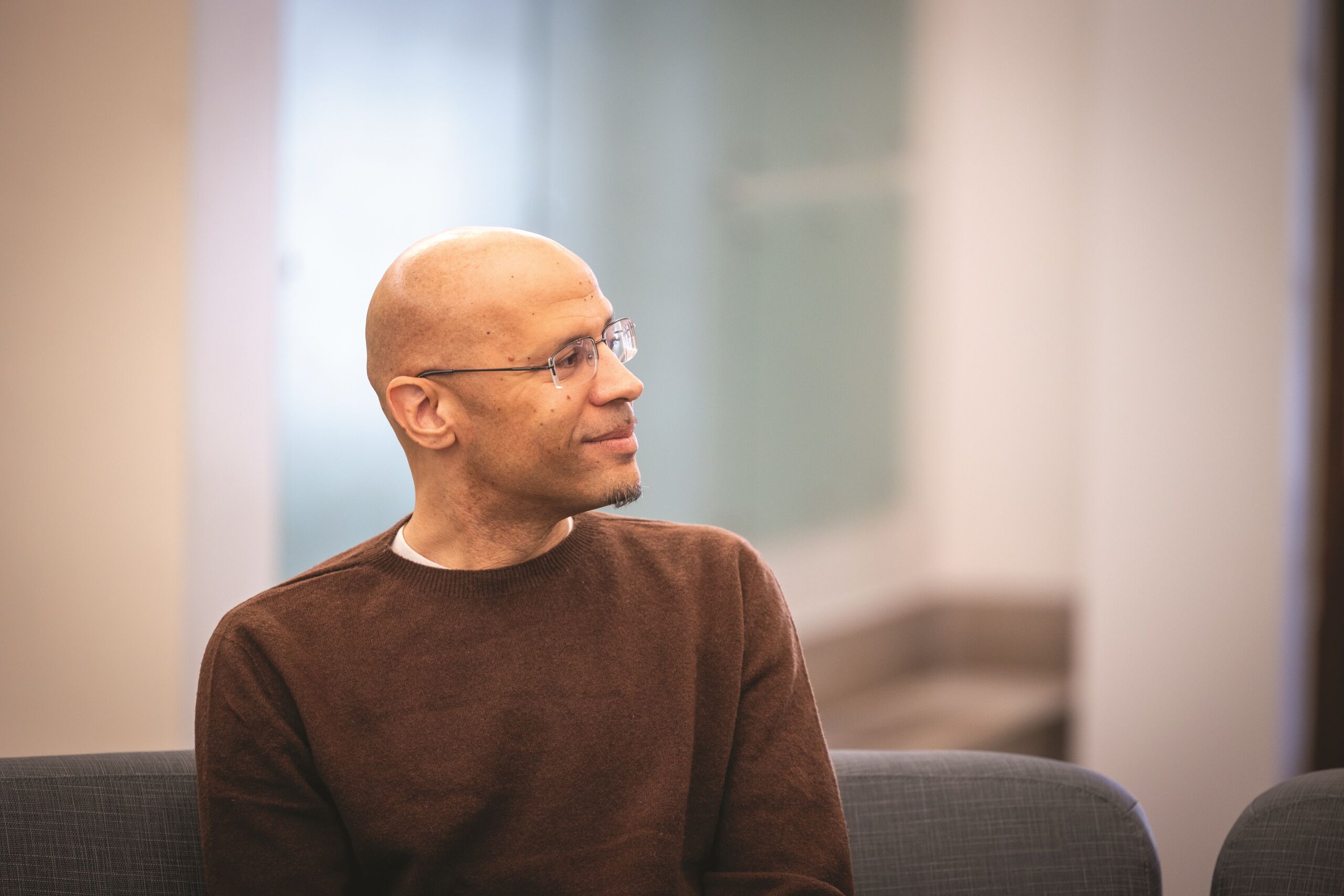
“Goals can become obstacles to the thing you most want to do,” Burrow said on the Hidden Brain podcast. “If you get me to think about my goal, then this hill is the effort, this is the obstacle between me and where I’m going to be in a few minutes when I get to the top. Whereas a sense of purpose seems to decouple those things in a way because I’m not thinking about what I’m going to do immediately at the top. I’m thinking about my general direction in life.” – Anthony Burrow ’98 (PHOTO: Cornell University)
Cornell University psychology Professor Anthony Burrow ’98 spent years figuring out one of the secrets to a healthy and happy life. Now he’s devoting his career to spreading the word.
The secret, it turns out, is purpose, a virtue that can be surprisingly difficult to apprehend and explain because it largely depends on the individual. In partnership with Hopelab, a nonprofit dedicated to improving youth mental health that philanthropist Pam Omidyar created 25 years ago, Burrow has co-founded a new national organization, Purpose Commons, to bridge the gap between what researchers know about purpose and how practitioners and policymakers serve young people.
“[Purpose Commons] has to be a place where people can come together to formulate ways to elevate purpose so that fewer young people sink into despair,” Burrow and Purpose Commons co-founder Jana Haritatos wrote in a short essay for the Purpose Commons launch.
On one side of the knowledge-practice gap, Burrow sees experts publishing findings in academic journals. On the other side are classroom teachers, counselors, parents, lawmakers, community volunteers and staff who run after-school programs. As a result of the disconnect, many of the 42 million or so adolescents in the country are missing out on experiences that could awaken them to the power of purpose. One study showed nearly six in 10 young people reported their lives lack purpose. Other estimates indicate 50 percent or more say their lives aren’t useful and that they don’t see any point in going to school. These are among the numerous, complex forces producing tragic conditions. From 2001 to 2021, the rate of suicide among people ages 10 to 24 rose by more than 50 percent, according to the CDC.
Many adolescents are missing out on experiences that could awaken them to the power of purpose. One study showed nearly six in 10 young people reported their lives lack purpose. Other estimates indicate 50 percent or more say their lives aren’t useful and that they don’t see any point in going to school.
“I think there is a dangerous and widening translation gap,” Burrow wrote to his Hopelab colleagues during the design phase of Purpose Commons. “If we don’t invest in creating more accessible and inclusive engagements with purpose, we risk contributing to a truly bifurcated population” with some individuals having substantial opportunities for purposeful development and others lacking such chances.
Burrow majored in psychology at Carolina and feels an obligation to bridge research and practice. He recalled experiences from his childhood that helped him acquire purpose — moments in 4-H programs in Bremer County, Iowa, clearing rocks on his grandfather’s Nebraska farm and volunteering in psychology labs at UNC. Today, in his academic post, teaching and research are enough to secure tenure but not enough to fulfill him.
“There’s no joy in producing an article that the people it’s written about can’t access,” he said. “I’d be humiliated to go back and talk to some communities … if I don’t actually create things they can access. I’d be ashamed to have gone through this entire experience and there’s no Purpose Commons. Actually, that’s malpractice.”
To Burrow, it just makes sense that that research and practical application go hand in hand, and he’s committed to closing the research-practice divide.
Acquiring purpose

This Hopelab graphic, created by Rio Holaday, illustrates the journey of young people discovering purpose, including collaborative moments and symbols of growth and connection.
The effects of purpose are stunning, according to mounting evidence from a number of studies. Despite the slippery nature of purpose as a concept — it’s not a clinical measure of well-being like blood pressure or cholesterol — a picture of the benefits is emerging. People who acquire purpose live longer and enjoy better psychological and physical health, many studies suggest. People experience fewer heart attacks and strokes and report fewer headaches and stomachaches. They recover faster from surgeries. People living with purpose hold onto their cognitive faculties longer. They also tend to have broader, deeper social networks and, it seems, greater interpersonal appeal. Others find them more attractive. They even enjoy greater financial success. “Purpose shows up in people’s lives in such intricate and interesting ways,” Burrow said.
An ancient virtue, purpose is a difference maker from adolescence to old age. Aristotle, Seneca and the Buddha called us to it. Viktor Frankl, a survivor of Nazi concentration camps, showed the world how purpose creates an awe-inspiring capacity to bear the most horrific circumstances. Burrow is interested in revealing ways to operationalize purpose to enhance youth development. He recognized, for example, that it can be counterproductive to ask teenagers to complete a questionnaire and declare their purpose in life. A Mad Libs-style, fill-in-the-blank exercise can build anxiety among young people unable to crank out a definitive answer on the spot. Instead, he said, it’s more helpful to ask young people to reflect on when they felt a sense of purpose. This enables them to consider what they were doing at the time and to understand that they can do more of the same going forward.
Through field experiments and applied research, Burrow devised ways to help young people cultivate purpose without suggesting they can flip a switch to make purpose magically appear. He believes young people can’t go searching for purpose the way they would search for a lost cell phone. “I just don’t see the evidence behind the idea that purpose can be found,” Burrow said. “I do understand why we might arrive at an understanding that I can go out into the world and find this thing if I just had the right flashlight or if you tell me where to look. But I don’t think that’s actually how it works.” It’s a topic Burrow takes up in his 2025 book, Purpose in Life as Ancient but Nascent.
Over time, through his research and his experience with a number of programs that promote youth service, Burrow began to grasp how purpose can blossom when young people make contributions to their communities. Purpose researchers saw young people as positive assets to their communities and found young people aching to make a difference.
For Haritatos, Hopelab’s chief science and innovation officer, reframing purpose is essential to unlocking its power. “It’s hard to talk about sense of purpose,” she said. “People always, even in their own communications teams, default back to: ‘Find your purpose. It’s your superpower.’ No, no, no. That feeling is not the feeling of purpose. When do you feel it? That is where reflection comes in, noticing our own internal rudder and when we feel a sense of purpose. It might be a constellation of things that make me feel like I’m playing a role here, it’s going somewhere, and I’m on a path that pulls me forward.”
Burrow believes that instead of finding purpose, we cultivate it. This can happen in three ways. First, it can emerge slowly, bit by bit, through our gradual and sustained exploration. When we recognize an internal curiosity about how children learn and play, the interest may stimulate us to explore nursing, teaching, coaching and other roles. Over a period of years, a sense of purpose can take hold as a person commits to caring for children. Second, events can pull us into purpose, as when a sudden, jarring event requires us to react. This can happen when a routine doctor’s visit turns into a life-changing diagnosis, when a new baby arrives, or when an encounter with law enforcement or actions of war threaten our freedom. Third, Burrow describes a “social learning” pathway where we observe another person living with purpose and model what we see. Young adults volunteering at a food pantry, as they observe staff working through complex distribution and supply chain details, might become intrigued by complex logistics puzzles. Over time, they may discover that they feel a sense of purpose when they design solutions that improve the efficiency of systems.
When goals get in the way
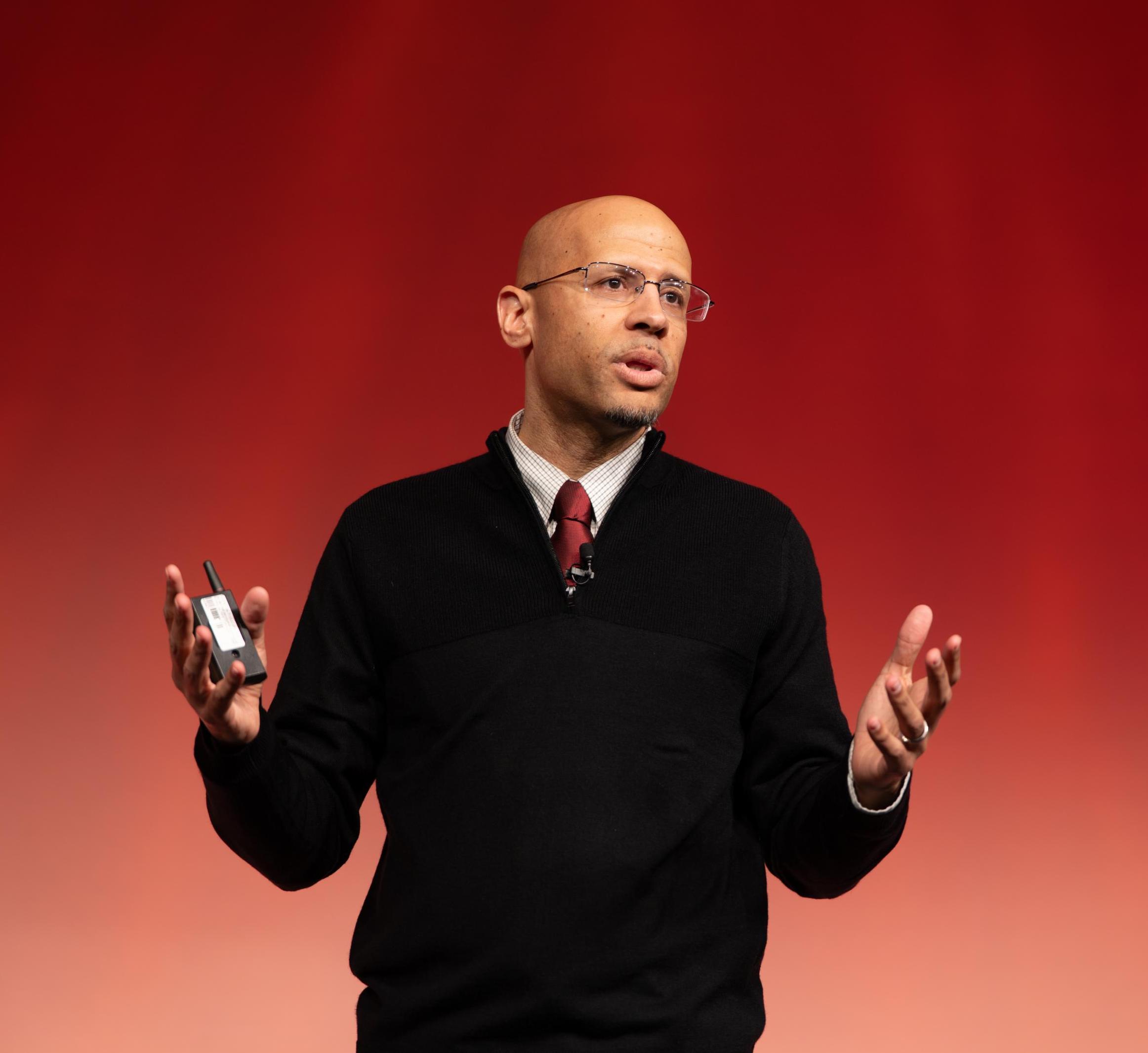
Burrow spoke at the Cornell Alumni Leadership Conference in Philadelphia: “Purpose has been shown to promote positive youth outcomes. Yet too rarely do we engage young people around their experience of purpose, or ask them what role we can play in helping them pursue it.”
Researchers tease out purpose as something distinct from goal-setting, identity, meaning and other concepts that popular culture commentators often conflate. The terminology matters, Burrow said, because the effort associated with each concept produces different effects. “Meaning is sort of like making sense of the world as it’s happened,” he said. If identity is the answer to a question — Who are you? — then purpose emerges from a related question: Where are you going? No surprise, identity and purpose are related. Looking to the future gets us to goal-setting, which involves an intent to accomplish something specific. Once the goal, such as becoming a teacher, is accomplished, the task is done. Completing high school, producing a documentary film and learning a foreign language are examples of goals we can complete and put behind us. In contrast, purpose is never over. “It is always in front of you,” Burrow said on a 2023 episode of Hidden Brain podcast, explaining that “purpose might be an organizer of our goals such that when I accomplish goals, it’s my purpose that tells me what are the goals that I should be pursuing next.”
The distinction between purpose and goal-setting is evident in Gold Medal Syndrome, where individuals who have reached a prized pinnacle are left feeling empty. This can happen when ambition is disconnected from something larger, namely, a reason for living. The condition is so familiar in American culture that it’s central to our storytelling. The classic film Citizen Kane revealed the disconnect between achievement’s fleeting gratification and the enduring fulfillment of purpose. Indeed, through purpose we find joy in growth, Burrow said, no matter the result of specific events. Whether we come out on top on any given day, “we are motivated to keep pursuing the purpose because we really believe in it,” wrote Michael Lamb, chair of leadership and character at Wake Forest University, in a 2024 John Templeton Foundation article. “Having a sense of purpose is crucial to a meaningful life.”
As more researchers began to suggest that contributing benefits the givers as well as the receivers, Burrow was moved to wonder: “What if it’s not just a nice thing to contribute? What if it’s actually something adolescents need, like an identity or autonomy or self-esteem?”
In Carolina basketball, Dean Smith famously emphasized a purposeful approach. What mattered most was how the team played — not the outcome — and whether the players pursued virtues such as unselfishness, hard work and togetherness. “In teaching our players,” Smith said, “I tried to concentrate on the process rather than the result. I think it’s the best way to teach. If a coach starts out on the first day of practice talking about winning, that approach can actually get in the way of winning.”
Burrow conducted an experiment to compare purpose and goal-setting, and the findings affirmed Smith’s method. In a series of tests, subjects had to complete a difficult hike up a steep hill. Before the climb, Burrow asked one group to write about goals they wanted to accomplish once they completed the hike. He had another group write about their sense of purpose. A third group wrote about a recent movie they had seen. When participants completed the hike and reflected on the burdens associated with it, members of the purpose group reported an easier journey.
“The insight to be drawn here is goals can become obstacles to the thing you most want to do,” Burrow said on Hidden Brain. “If you get me to think about my goal, then this hill is the effort, this is the obstacle between me and where I’m going to be in a few minutes when I get to the top. Whereas a sense of purpose seems to decouple those things in a way because I’m not thinking about what I’m going to do immediately at the top. I’m thinking about my general direction in life.”
The findings carry implications for the youth development field, where skills-based interventions often dominate. These programs identify children’s deficits, such as low grades in school, poor measures of physical or mental health or inability to form social relationships. Then these programs use goal-setting in attempts to shore up weaknesses. An after-school program, for example, might require children with low grades to complete a six-week tutoring program. When this work is disconnected from purpose, the programs can cause harm, or benefits may be small and short-lived. Arnold Chandler, co-founder of the nonprofit research organization Forward Change, has conducted systematic reviews of youth development interventions and found that traditional programs may negatively affect education outcomes and suppress student performance. In contrast, Chandler said, alternative approaches that emphasize purpose, identity and meaning can “show lasting effects that reflect a shift in life trajectory, not a temporary improvement.” These interventions work because “they seek to respond to the whole person. Not just their abilities, but what deeply motivates them.”
In the beginning was purpose
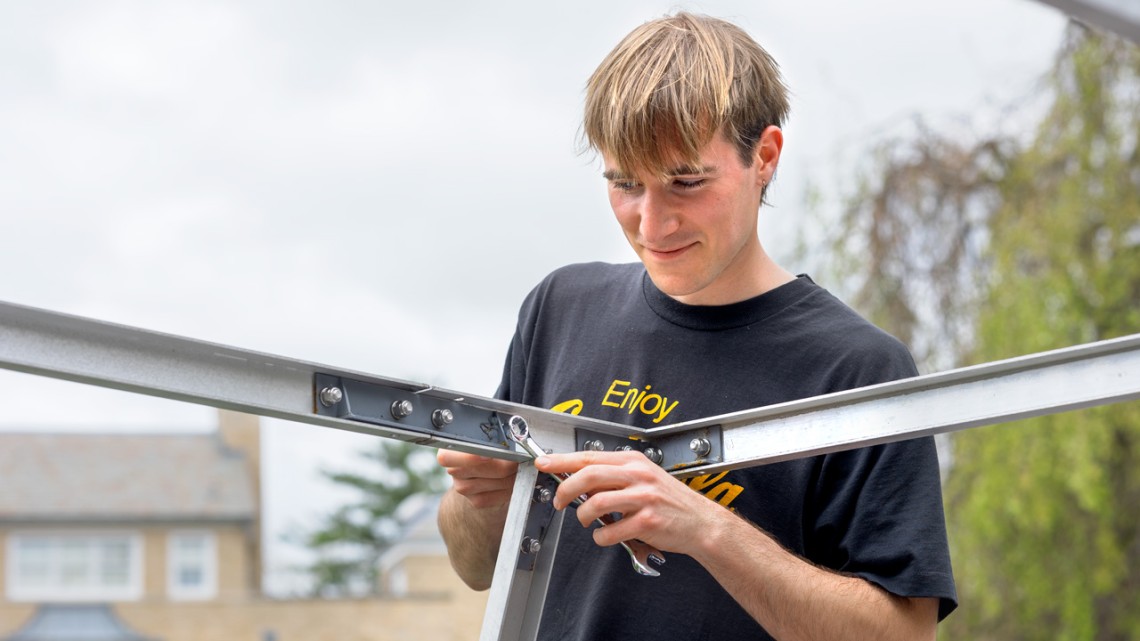
In 2025, the Contribution Project gave grants to 200 students across five universities in New York. Cornell University student Oscar Llodra used the grant to design a camper to serve as new way of approaching mobile, affordable housing. (PHOTO: Cornell University/Devin Flores)
During his grade-school years, Burrow realized a heightened sense of purpose through preparing and delivering presentations on his 4-H projects. There was a project raising hogs, another on tying knots, another on soil preparation. It was the sharing of information, not the project accomplishments, that he found enriching. For Burrow, teaching others about something he had studied and practiced “was a profound experience.” Even the setbacks were stimulating because they provided room for growth.
Then on visits to his grandfather’s Nebraska farm, the methodical, physically demanding process of clearing rocks elevated purpose. “It doesn’t sound glorious, and it’s not,” Burrow said. “This is field after field after field.” Yet Burrow found the work rewarding because it was purposeful. His grandfather needed to remove the rocks in order to plant crops. Trailing behind the tractor and loading rocks into the bin was critically important to the enterprise. “That combine is what everybody thinks is producing the crop,” he said. “Well, that combine is not going to do anything if you don’t prepare the field.”
In the summer between graduating from Enloe High School in Raleigh and starting at UNC, Burrow participated in Carolina’s Summer Bridge, a free, six-week transition program that immerses students in English and math courses before their freshman year. By providing academic support, community-building and peer mentors, Summer Bridge prepares students to succeed in much the same way clearing rocks from the field prepares farmers for success. Burrow’s father taught at the University of Northern Iowa, the University of Wisconsin and N.C. State University. So Burrow had a familiarity with campus life. Still, he found Summer Bridge indispensable.
“It was so deeply important that a university so highly touted had a program to make the transition easier,” Burrow said. “I remember being so grateful for Bridge, the introduction to a campus and then the depth of what learning could look like in a higher-ed setting. It just was beautiful and perfect, and I could not wait to come back.”
Once on campus, Burrow found a home in Lowell Gaertner’s social psychology course. Gaertner ’95 (MA, ’99 PhD) was teaching psychology courses and running a lab, and he invited Burrow into the mix. Burrow started hanging out with Gaertner, Tim Wildschut ’00 (PhD) and other young researchers, and he said spending time in their labs “gave me what I was looking for.” These were “graduate students who took me in. Basically, I was working in their labs, running experiments, but it wasn’t just that. It was more about the conversations we were having about the experiments. I got to ask questions. I got to make suggestions.”
Wildschut, a professor of social and personality psychology at University of Southampton in Great Britain, said of Burrow, “He stood out by his deep and authentic interest in social and personality psychology. But what endeared him most to me was his gentle, soft-spoken nature and his inherent grace and decency. It has been a real pleasure to see him emerge as a leading scholar on the science of purpose.”
Young people aching to contribute
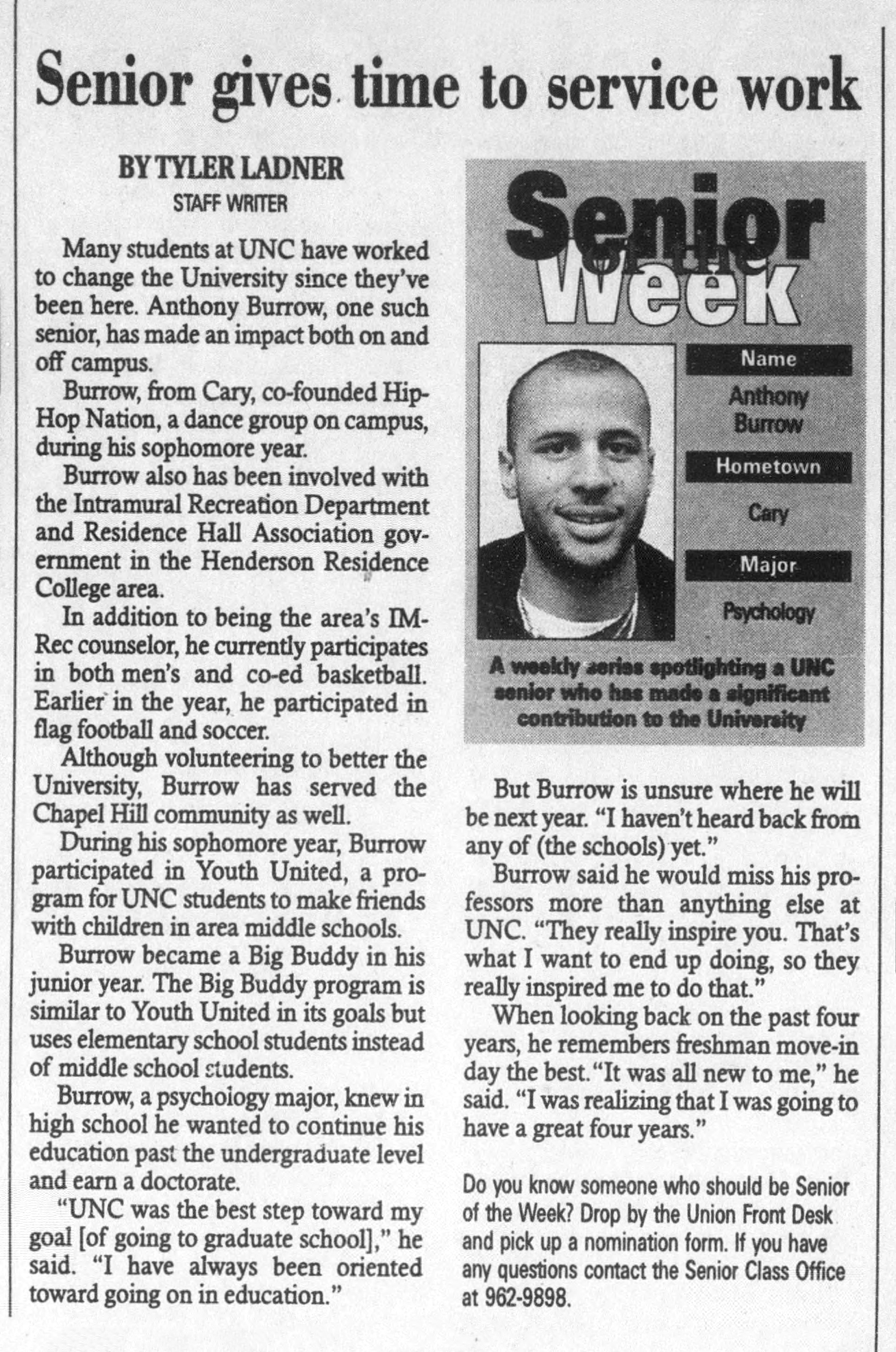
Burrow was The Daily Tar Heel’s senior of the week, Feb. 18, 1998.
Over time, through his research and his experience with a number of programs that promote youth service, Burrow began to grasp how purpose can blossom when young people make contributions to their communities. If research supported this position, the findings could rewire the youth development field. Recent generations of youth development programs often viewed young people as threats to communities, and successful programs were those that could diminish the threats. Purpose researchers were moving in another direction. They saw young people as positive assets to their communities and found young people aching to make a difference. These researchers positioned contribution as essential to adolescent well-being, not as an extracurricular enhancement.
Burrow found encouragement in a 2018 paper from UCLA psychologist Andrew Fuligni, who argued that contribution satisfies social and psychological needs among teens. Pointing to “accumulating evidence … that contribution benefits the givers as well as the receivers,” Fuligni called for new research on the impact of contribution on adolescent development. Burrow was moved to wonder: “What if it’s not just a nice thing to contribute? What if it’s actually something adolescents need, like an identity or autonomy or self-esteem?”
In January 2019, Burrow won Cornell University’s Engaged Scholar Prize, and the award included $30,000 he could use to deepen community engagement for students. Instead of designing an intervention that prescribed activities for students, Burrow decided to let students choose how to use the funds. In the first iteration of what would become The Contribution Project, he had students propose community projects, and then he randomly selected 50 students to receive $400 to implement their ideas. This fostered purpose by inviting students to contribute to their communities in ways that were meaningful to them. It gave them the agency and resources to act on their personal passions.
Six years later, The Contribution Project has awarded $400 to 1,200 teens and young adults from around the country. Individuals age 14 to 25 are eligible to apply for funds “to pursue what matters most” to them. From submissions that satisfy a short list of conditions, The Contribution Project still randomly selects winners. Burrow’s research shows that recipients post higher scores on measures of purpose, belonging, feeling needed and useful, and well-being than non-recipients. Reporting on The Contribution Project, CNN’s Michael Smerconish promoted purpose as a promising antidote to spiraling health issues among young people, describing how Burrow’s research — some of which is still moving through peer review — indicates that “the fastest route to well-being may be as simple as doing something that matters for someone else, … that even small acts of contribution can have a big impact on mental health.”
Among The Contribution Project highlights: One student built a therapeutic herbal tea garden for nursing home residents. Another constructed and installed birdhouses to give eastern bluebirds homes in an area where development has intruded on their habitat. Another rallied book donations to a local reading program. Another organized a day for incarcerated youth to spend time on a college campus. Another provided food and treats to guide dogs in training. And so on. The point is not for the projects to become a lifelong purpose. In fact, the student who produced birdhouses may never make another one. Yet through the projects, students explore pathways toward purposeful lives. This is possible because of the sweeping impact of inviting young people to make thoughtful choices and to reflect on those choices to help others. It appears the pursuit of contribution is a mechanism that can help young people cultivate purpose in their own lives.
The Contribution Project’s popularity affirms demand among young people. They want to try, Burrow has found, and they will expend disproportionate amounts of time and energy to help others. Given that students are excited to leap in, he said, there’s no prodding needed. Instead, scaling the approach requires changing the mindset of adults who control resources. “There’s a communication opportunity from a research standpoint,” Burrow said. The challenge is finding ways to communicate with adults so that they invite young people to generate and implement ideas for improving their communities, he said.
Momentum for purpose is growing. Tara Boyle, executive producer of Hidden Brain, said Burrow’s episode “had a huge impact on our audience. We received a flood of messages from listeners who were moved by the conversation, and it remains one of the most popular episodes in the history of our show.” The episode resonated because of Burrow’s gift for storytelling and “because of the deep hunger many people feel for a sense of purpose in their own lives,” she said. “We all want to feel that we matter. … Professor Burrow’s work taps into this hunger to contribute to something larger than ourselves.”
Now on the heels of the launch of Purpose Commons, a new $3 million grant from Templeton Foundation will enable Burrow to build more infrastructure to connect the science of purpose to the practice of youth development. Templeton describes the project as “infrastructure to create a world where purpose science is accessible, relevant and transformative — unlocking youth potential and reshaping systems for generations to come.” With the funding, Burrow will expand the reach of The Contribution Project and support research across a network of purpose science labs that are part of Purpose Science and innovation Exchange (PSiX), the sister organization to Purpose Commons. Further, the grant will allow Burrow to conduct the National Youth Purpose Survey, featuring interviews with at least 2,000 teens and young adults, and then to host gatherings that put the findings into the hands of young people so they can help decide how to deploy the knowledge.
“I like to make the invisible visible,” Burrow said. “I like when conditions are made for young people to have things that would be great for them to have. Everyone should benefit from this stuff. That’s what the Purpose Commons is about, and that’s what translational research should be about.”
John Bare ’87 (’92 MA, ’95 PhD), a writer based in Concord, is the author of My Biscuit Baby, a novel set in Chapel Hill.
Students Cultivating Purpose
This spring, John Bare ’87 (MA ’92, PhD ’95) partnered with Purpose Commons to teach a course for 17 Carolina students who led projects that bridged the research-practice gap on purpose science. In Communication Studies 690, student teams produced a glossary that translates academic concepts into user-friendly language, and they are reimagining how to explain findings from scholarly journal articles. Another team is taking on the challenge of explaining how young people acquire purpose, and other students are compiling and annotating compelling ways we engage with purpose in movies, books, music and art.
Carried out by young people for young people, such translational research is designed to awaken philanthropy to the role of purpose in youth development. The course is part of the department’s commitment to teaching students how to use communication to advance the public good. Tens of thousands of donors are investing billions of dollars in education and youth services, so even small swings in grant-making will matter.
Youth voice matters because students bring distinctive language to the work. Their observations are updating and freshening older notions, such as Viktor Frankl’s admonition: “Don’t aim at success. The more you aim at it and make it a target, the more you are going to miss it.”
As part of the course, students reflected on recent moments when they felt a strong sense of purpose in their lives.
“I found that above all else, helping people … is what makes me feel alive. Every time I volunteer with a new organization, complete work for my nonprofit or make progress on a campus initiative, I feel entirely solid in my purpose, and it makes me unbelievably happy.” — Grey Llewellyn, senior
“I feel a lot of professional purpose running my nonprofit organization. I enjoy the opportunity to make change by giving young people the opportunity to organize and advocate for policy they care about. … I cannot wait to grow this work with what I learn in this course.” — Makala Pitman, senior
“I was volunteering at PORCH Chapel Hill-Carrboro … and started my job as an after-school care counselor, spending time with children. These experiences gave me a feeling that I can only describe as fulfillment. … I left feeling more complete than before.” — Tiffany Evans Holness, junior
“In the past few weeks, I started talking to a sophomore in high school who is in a residential setting for mental health. Having had this same experience, I have shared my insight with her. Helping her has given me a sense of purpose. The experience made me feel like I have a reason to be here.” — Riley Greene, senior
“Over the holiday break, I was able to go home and spend time with my Aunt Jennie. While my sense of purpose can often feel tied to assignment deadlines or work commitments, the coffee walks, deep conversations and sharing of meals are what rejuvenate my soul. Spending time with my loved ones and deepening meaningful relationships is where I find my purpose in a sense of community.” — Ellen-Marie Strickland, senior
“After I graduated high school, I thought it would be my last time dancing, until I found Blank Canvas Dance Company on campus. I was able to feel a sense of purpose on stage, bringing people joy. I believe my purpose was to portray a powerful message to the audience, without the use of words. It felt amazing to be back on stage again and do what I love, feeling a sense of purpose.” — Emileigh Marion, senior