Poetry’s Connective Force
Posted on June 15, 2026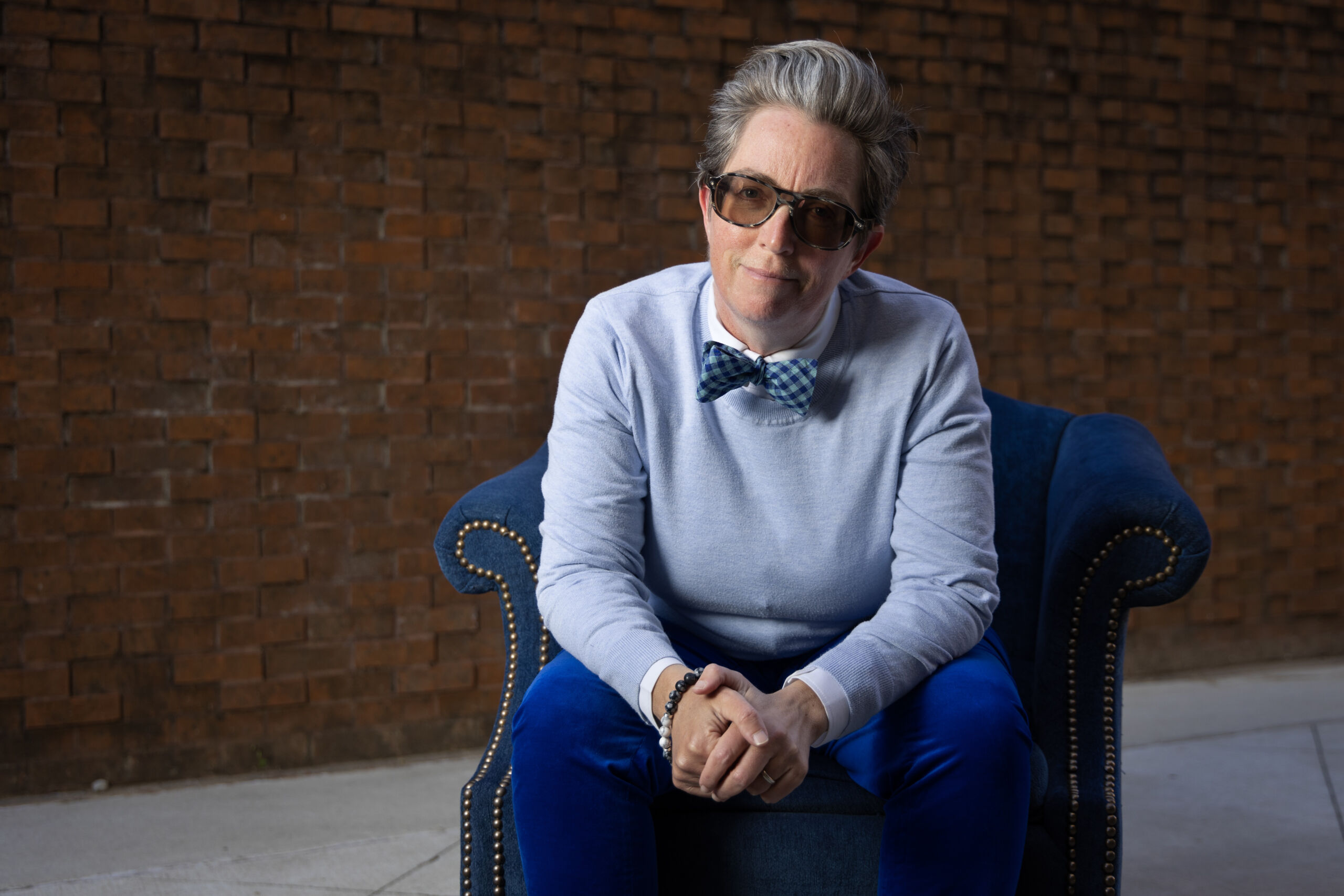
“Poetry helps students learn to be discerning, to trust their unique way of seeing the world, and it helps them make choices,” said Gabrielle Calvocoressi, a professor in the English department. (PHOTO: UNC/Alyssa Lafaro)
Gabrielle Calvocoressi’s latest book of poetry, The New Economy, explores themes as personal as grief and as big as global violence through an outsider’s sharpened perspective.
Before Calvocoressi was a UNC professor and finalist for the 2025 National Book Award in Poetry, they were a scared kid hiding from bullies in a school bathroom. They were a lonely teen, navigating the confusion and loss after their mother’s suicide. They were a person exploring issues of gender and sexuality in a world reliant on traditional labels that didn’t fit. Poetry provided a salve — a release, a freedom — even before Calvocoressi called their thoughts, jotted in a journal, poetry.
“Poetry has always been a place where I can imagine my capacity for friendship, kindness, curiosity and creative possibility,” Calvocoressi said. “It’s also helped me imagine the world I want to live in and build.”
Calvocoressi carried their passion for creative writing to Sarah Lawrence College as an undergrad, then to Columbia University for an MFA in poetry. Calvocoressi was a Stegner Fellow in Poetry at Stanford University and held teaching positions around the country before coming to UNC in 2013. Now, Calvocoressi shares their passion for poetry to a range of students, many of whom will never become professional writers but who often carry the lessons of poetry into their various fields.
“Poetry helps students learn to be discerning, to trust their unique way of seeing the world, and it helps them make choices,” Calvocoressi said. Poetry workshops help students learn how to listen, they said, and have real conversations and disagreements. “I love it when I hear from a student who’s now a dentist or a financial consultant or working in a lab,” Calvocoressi said, “and they say how the listening skills and creative experiments they used in class have helped them in their fields.”
On the courts near Cobb Hall, Calvocoressi hosts a weekly poetry workshop combined with a noncompetitive basketball game. They call it “Oh, Shoot!”
Professor Daniel Wallace ’08, director of UNC’s creative writing program and author of six novels, including the acclaimed Big Fish: A Novel of Mythic Proportions, praised Calvocoressi’s warmth as a colleague and inventiveness in the classroom, as well as the creativity and inclusion of Calvocoressi’s poetry. “It’s impossible not to find a place to live in Gaby’s work,” he said.
That inventiveness can also be found on the courts near Cobb Hall where Calvocoressi hosts a weekly poetry workshop combined with a noncompetitive basketball game. They call it “Oh, Shoot!” It creates an inclusive space for students and gives Calvocoressi an exercise outlet.
Former student Samuel Ellington ’25 appreciates Calvocoressi’s creative teaching style even more now that he’s teaching undergrads as an MFA student of poetry and teaching assistant at Colorado State University. “So much about getting people to write hinges on your ability to let them imagine the classroom in a way they never have before,” he said, “[as] a place that isn’t about getting things ‘right’ but rather getting yourself down on the page in a way that makes sense to you.”
Before The New Economy, Calvocoressi published three books of poetry: Rocket Fantastic, winner of the 2018 Audre Lorde Award for Lesbian Poetry; Apocalyptic Swing, a finalist for the 2009 Los Angeles Times Book Award for Poetry; and 2005’s The Last Time I Saw Amelia Earhart.
Themes like small-town America, faith and gender weave through all of Calvocoressi’s books, while much of The New Economy also explores the ideas of survival and loss as the author inhabits middle age. “The days I don’t want to kill myself are extraordinary,” opens the poem Hammond B3 Organ Cistern, before Calvocoressi illuminates little pleasures such as new blue sneakers and iced green teas that make life worth living. Poems like I Was Supposed to Cistern: Redbud Variation detail how relishing everyday beauty — like a blooming plant — creates small acts of resistance in a violence-filled world. A series of “Miss You” poems gives voice to the very common experience of loss. “Do not care if you arrive just in your skeleton,” begins the poem Miss You. Would like to take a walk with you.
The “Miss You” poems have been especially popular with people, Calvocoressi said, because of their universality.
Building connection is a superpower of poetry, and Calvocoressi works at it, both personally and professionally in their close-knit Durham neighborhood, where they live with their partner of 30 years, and in their poetry readings, which often function as community potlucks. Maybe it’s because Calvocoressi remembers being the scared kid eating lunch in the bathroom alone, or because they said current societal forces seem intent on tearing people apart. For Calvocoressi, poetry’s ability to help us understand each other’s stories has never been more important. “We are all,” they said, “the ambassadors of the imagination.”
—Beth Hatcher ’02
Thanks for reading the Carolina Alumni Review
Carolina Alumni members, sign in to continue reading.
Not yet a member? Become one today.