This Is Uncomfortable, and That’s the Point
Posted on June 15, 2026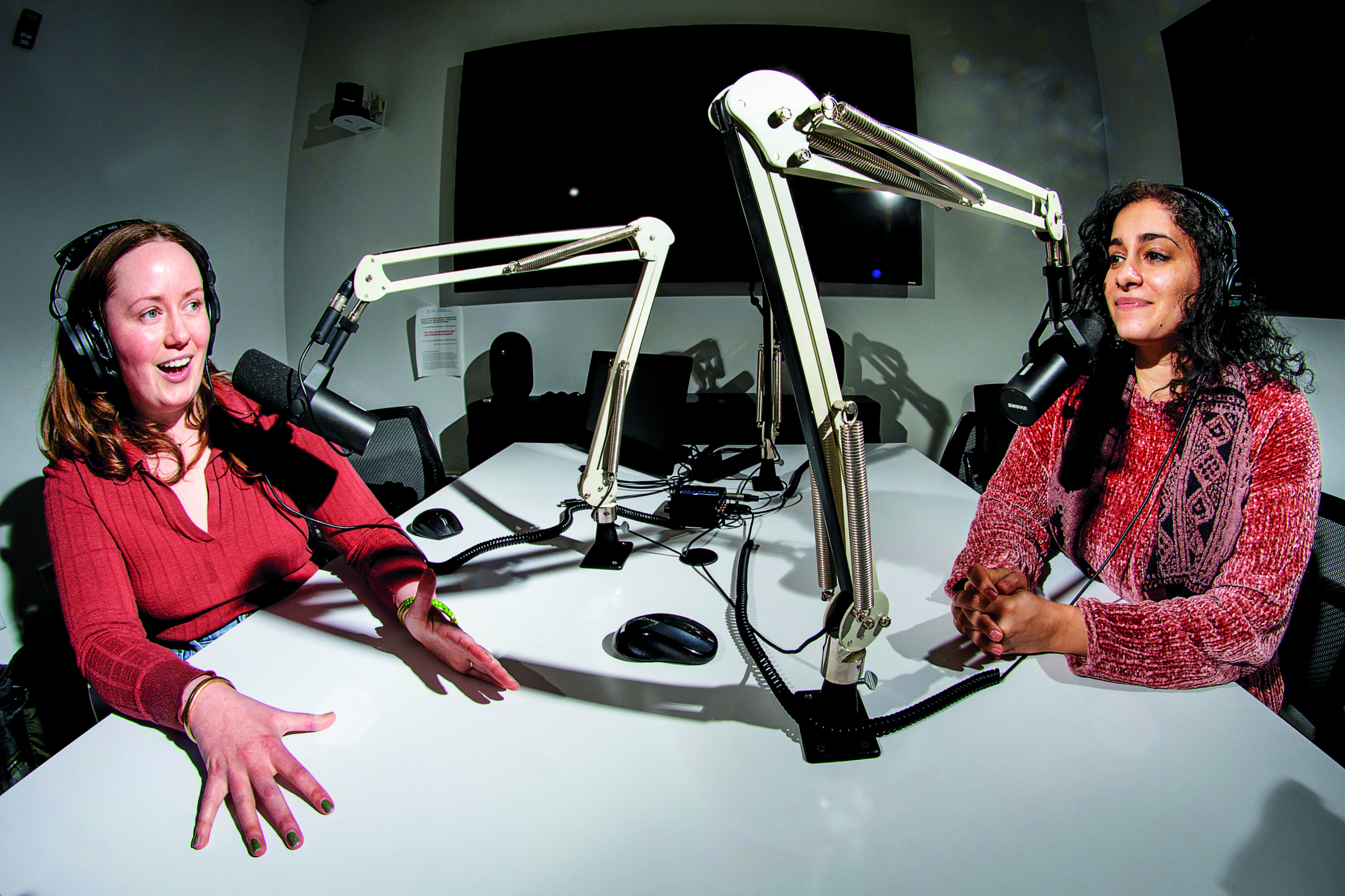
Alice Wilder ’17 (left) and Reema Khrais ’12 are producer and host of Marketplace’s weekly podcast This Is Uncomfortable, which focuses on personal finance topics some listeners might not know how best to discuss: prenuptial agreements, hidden debt, sharing finances and more. (Photo: Carolina Alumni/Ira Wilder ’24)
Reema Khrais ’12 remembers walking away from her student-radio broadcast in tears because she thought she didn’t do well enough. She wasn’t a defeatist, though. Her disappointment only inspired her to do better next time.
“I just took it very seriously,” Khrais said. “And so I feel like it really prepared us for the workforce and taught us how to be journalists.”
Now, being on air is Khrais’ full-time job. She’s the host of This Is Uncomfortable, a podcast she started in 2019 to shed light on taboo personal finance topics: hidden debt, income imbalances in a relationship, secret spending to name a few. The podcast is produced and distributed by Marketplace, the NPR program focused on business, economics and personal finance.
After stints as a fellow at NPR and an education reporter at N.C. Public Radio, Khrais landed at Marketplace as a general assignment reporter, covering issues such as immigration, Wall Street and the retail industry. This Is Uncomfortable was born from her submission to an internal pitch contest.
Fellow Tar Heel Alice Wilder ’17 has produced the podcast since 2022. The pair hopes the program empowers listeners to make sense of the unspoken ways money shapes their lives.
“I didn’t necessarily want to teach people how to invest or how to create a budget,” Khrais said. She was more interested in the emotional side of money, “because I think that’s something we don’t talk about enough, specifically how money impacts our choices, our relationships, our careers, how we see ourselves.”
Recent episodes have explored prenuptial agreements, parents who date scammers, sharing finances in marriage, sending children to private language school and how much money is enough to be satisfied. One episode that resonated with Khrais and Wilder was “The Things We Leave Behind,” which explored how money can complicate grief. Their interview followed Amanda, who discovered her recently deceased father had been secretly hoarding tens of thousands of dollars in rare coins, despite the family’s financial struggles. During another episode, titled “Breaking the Oath,” Khrais interviewed Tasha Adams, ex-wife of the founder of the Oath Keepers, Stewart Rhodes. The episode explored Adams’ claims that her ex-husband exhibited signs of financial abuse in their relationship while he was mismanaging funds for the far-right anti-government militia, whose members were involved with the protests and insurrection at the U.S. Capitol Jan. 6, 2021.
When Wilder graduated, the crime podcast Serial was just becoming a cultural phenomenon. Now, it seems like everyone with a microphone has a podcast. Wilder said, “The podcasts that are doing the best financially are hosted by major celebrities and are basically talk shows.” Hers is an outlier.
“So much of our relationship with money comes down to how we saw our families talk about money, how we grew up with money, how we heard our communities talk about money,” Khrais said. “I wanted us to unpack all of that and create a space where people could feel less alone talking about their finances.”
This Is Uncomfortable began as a highly produced, narrative-driven show, featuring guests who were interviewed multiple times over several months. It relaunched this January as a more chatty weekly show. “We’re trying to meet the demands of the audience and where they are today,” Khrais said, prioritizing current events and being responsive to what’s making headlines.
As the podcast industry has changed, the pair said they are grateful to work at a mission-driven program. Wilder said, “In public radio, the pay might not be as high as a place like Amazon, but you’re not at the whim of a billionaire who can just decide, ‘Actually, I don’t care about this anymore,’ and then you’re gone. We are a lot steadier and more in service of the public, versus ‘Can we have as many celebrities on as possible?’ ”
Two paths merge
At Carolina, Wilder majored in women’s and gender studies, which she said allowed her to understand the world from perspectives beyond her own, a crucial skill in podcast production. “When you’re looking at a story,” she said, “you say, ‘Who is not being discussed here?’ or ‘Who is really being impacted downstream from this thing?’ ”
Wilder wrote for The Daily Tar Heel’s opinion section, and in 2015, she founded the newspaper’s audio department. Her first podcast was a chat show called Having It All, hosted with her best friend Kelsey Weekman ’16 , now a senior culture reporter for Yahoo News. The show, which she said “no one should ever listen to,” became practice for editing audio files, pitching ideas and marketing content.
She landed at Marketplace after internships with ESPN and NPR and several years producing podcasts for WNYC Radio and ProPublica, such as the duPont-Columbia Award-winning podcast Trump Inc.
She applied to produce This Is Uncomfortable twice before getting the job, finding the program a departure from the typical business journalism ethos. It valued the stories she wanted to tell.
Khrais said, “It’s kind of a dream to work with Alice because I remember hearing about her when she was in college, which is very bizarre.” As a public radio intern, Khrais heard Wilder was a young Tar Heel with a talent and passion for podcasting. Now years into their collaboration, Wilder said Khrais is the best host she’s ever worked with, and Khrais said Wilder is the best producer she’s ever worked with.
Together, they brainstorm story ideas, research topics, write interview questions and more. Wilder said, “When she’s in the interview, I’m talking to her behind the scenes like, ‘Oh, they said this thing, can you follow up on that?’ or ‘OK, we’re going down a rabbit hole.’ ”
Khrais, who majored in journalism and political science, hosted Carolina Connection, the journalism school’s student-produced radio show. She called it a formative experience because it posed the same kind of challenges she’d face in a newsroom. “It wasn’t all sunshine and rainbows,” she said.
Khrais credited Adam Hochberg ’86 (MA), an NPR editorial project manager and adjunct instructor at the journalism school, for holding students to a high standard. She said in many ways, he made her hold herself to a higher standard, even if that meant crying after a less-than-perfect broadcast.
Khrais said it still surprises her how candid guests are willing to be about their personal finances, and many of her guests leave feeling like they just had a therapy session.
She said, “So much of our relationship with money comes down to how we saw our families talk about money, how we grew up with money, how we heard our communities talk about money,” Khrais said. “I wanted us to unpack all of that and create a space where people could feel less alone talking about their finances.”
Since embarking on that mission, Khrais and Wilder have recorded hundreds of candid conversations about money, inviting their listeners to join them in the wonderful discomfort of it all.
— Ira Wilder ’24
Thanks for reading the Carolina Alumni Review
Carolina Alumni members, sign in to continue reading.
Not yet a member? Become one today.