Once Upon a Time …
Posted on June 15, 2026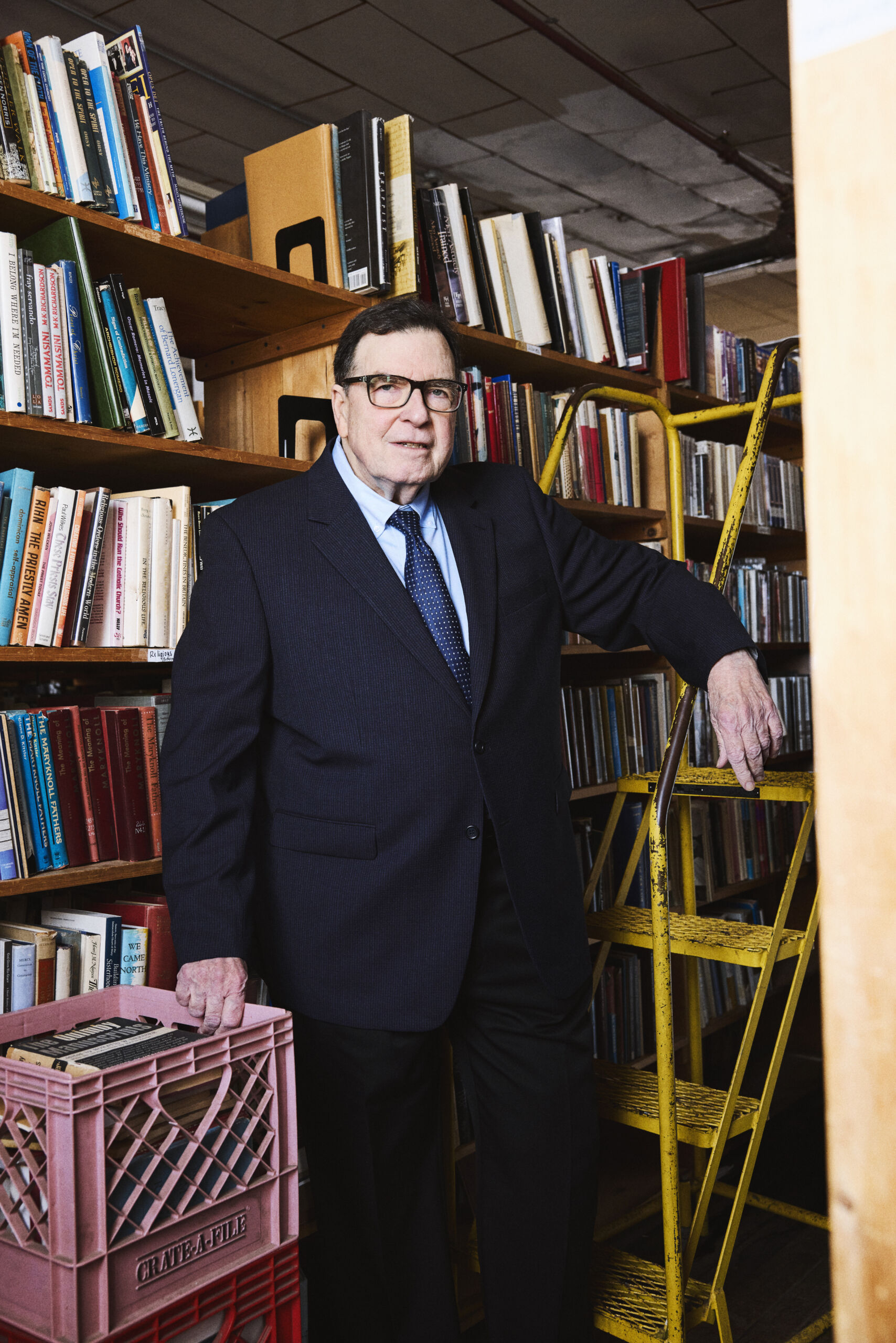
“A fairy tale,” said Donald Haase ’79 (PhD), “has core elements that include magic or wonder and a narrative that leads to transformation, metamorphosis or a change of status.” Photo by Jennifer Bondy
Donald Haase ’79 (PhD) has lived happily ever after, thanks to a life spent analyzing fairy tales. A professor emeritus of German at Wayne State University, he fell into his academic rabbit hole by accident and climbed a scholarly beanstalk to become one of the world’s leading experts in his field.
Until the early 1980s, folklorists dominated fairy tale studies, but thanks to emerging feminist and Marxist critics who interpreted the stories through the lenses of class struggle and patriarchal oppression, the young Haase realized he had stumbled upon a pot of academic gold. “What I encountered was a rich field of research that was teeming with questions and controversy,” he recalled. “It gave my work a connection beyond the university and esoteric research. I felt relevant.”
Haase edited the international journal Marvels & Tales for 16 years, oversaw a related book series published by Wayne State and co-edited the four-volume Folktales and Fairy Tales: Traditions and Texts From Around the World.
“Don is internationally recognized for his profound impact on the fields of fairy tales and folklore,” said University of Colorado professor of German Ann Schmiesing, the author of the 2024 biography The Brothers Grimm. Aside from Haase authoring scores of illuminating publications, Schmiesing added, “he’s been a tremendous mentor to scholars across the globe.”
It’s a real challenge determining what exactly is a fairy tale, according to Haase, because some people mistakenly include such things as fables in the genre. “A fairy tale,” he said, “has core elements that include magic or wonder and a narrative that leads to transformation, metamorphosis or a change of status,” as in Beauty and the Beast and The Frog King. Fables, such as The Boy Who Cried Wolf, lack these traits.
In response to broader cultural horizons, notably from Asia and Oceania scholars, fairy tale mavens now use the more inclusive term “wonder tales” to include stories that have “wondrous, magical or supernatural elements,” Haase said, “but don’t necessarily carry all the characteristics of a story like Sleeping Beauty.”
In 1944, poet W.H. Auden observed that Grimms’ fairy tales “rank next to the Bible in importance.” Haase said that’s no longer true due to so many different media and genres competing for children’s attention today. He said even his own grandchildren might not recognize Hansel and Gretel, though he suspects they and other children know of fairy tales from animated films.
Haase has a measured attitude toward Disney, whose 16 animated fairy tale-based films have rankled purists. Fans slammed Disney’s most recent Snow White remake after its Hispanic star Rachel Zegler said, before the movie’s release, her character didn’t need saving by a prince, whom she called a “stalker.”
“Disney is going to do what Disney is going to do, and there will be critics, and there will be fans,” Haase shrugged. “At least the movie provides fodder for interesting cultural discussions and keeps questions of values, morality and women’s issues, in particular, in the public eye.”
What is his favorite fairy tale? Based on the decor in Haase’s home office, it’s hard to tell. Front and center on his desk sits a little round tin box full of lemon drops — its lid features Snow White and her dwarves. Elves dangle from picture frames. A Hansel and Gretel gingerbread house perches on a bookshelf, as does a tin showing Cinderella and her Fairy Godmother.
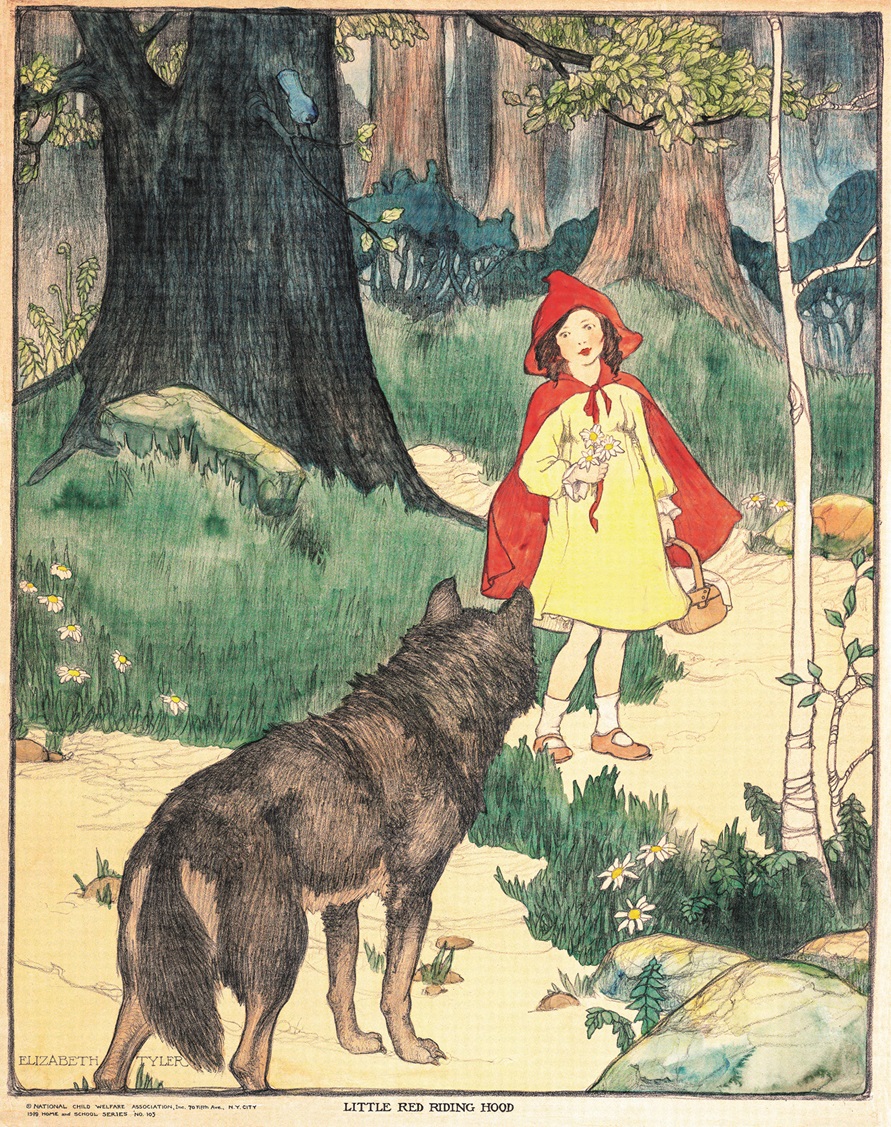
Little Red Riding Hood (1919), vintage illustration by Elizabeth Tyler. Original public domain image from Digital Commonwealth.
But the story that holds the most affection for Haase is Little Red Riding Hood. “It’s so rich, and there are so many interesting versions,” he said.
The French account by Charles Perrault in 1697 ends with no rescue of Little Red Riding Hood and a moral that indicates young women must be careful, not naive. “In a sense, the woman is blamed for her own sexual abuse or rape,” said Haase.
Meanwhile, Wilhelm and Jacob Grimm, who collected their tales in the 1810s from middle- and upper-class German women — not peasants, as scholars once thought — put an authoritarian spin on their versions. Their Red Riding Hood disobeys her mother by failing to go straight to grandmother’s cottage. “The Grimms turn it into a story about conflict between children and parental authority,” he said. “Little Red Riding Hood gives into the pleasure principle because she can’t stop picking flowers.”
Rescue comes in the form of a woodsman. Swinging his ax, he delivers grandmother good as new from the wolf’s stomach. “The Grimms’ tale reinforces the patriarchy,” Haase said. “It’s not a story in which she advances to a new level of independence and maturity. Instead she learns to accept the status quo and her parents’ authority.”
A cornerstone of Haase’s scholarly work has been his insistence that fairy tales must not be interpreted from a fixed historical or psychoanalytic perspective.
Every generation, according to Haase, should get to revise these stories according to changing times. He pointed to the female characters in Margaret Atwood’s dystopian novel The Handmaid’s Tale, whose Red Riding Hood-type robes signify their oppression. “A big part of the fairy tale industry today are revisions of traditional tales and newly invented ones,” he said.
The most frequent question Haase gets is whether fairy tales should be bowdlerized to spare children scenes such as the one in Cinderella where the stepmother is forced to don “red hot iron shoes” so that she dances to death.
“Parents and teachers need to use their own discretion,” said Haase. “There is a bit of hysteria about the gorier or darker side of fairy tales.” He admits stories such as Perrault’s Blue Beard, about a wife-murdering serial killer, are inappropriate for little ones. “I don’t think that’s going to be of a lot of interest to a child,” he deadpanned.
Fairy tales give hope, even in the most dire of circumstances. Many women who survived abusive and traumatic situations structured their memoirs around a fairy tale, according to Haase. He shared the account of a Czech artist who, upon arriving in Auschwitz in 1943, asked children what they wanted painted on their barrack walls. Scenes from Disney’s 1937 Snow White and the Seven Dwarves, they told her.
“The rub is fairy tales are not in and of themselves magical and won’t prevent death or more trauma,” Haase said. “The question is to what degree they can provide emotional survival and coping strategies.”
—George Spencer