Carolina South
Posted on Oct. 8, 2026As the University eyes development to the north, the natural beauty of a more sacred tract remains preserved.
story and photography by Keenan Baker ’26
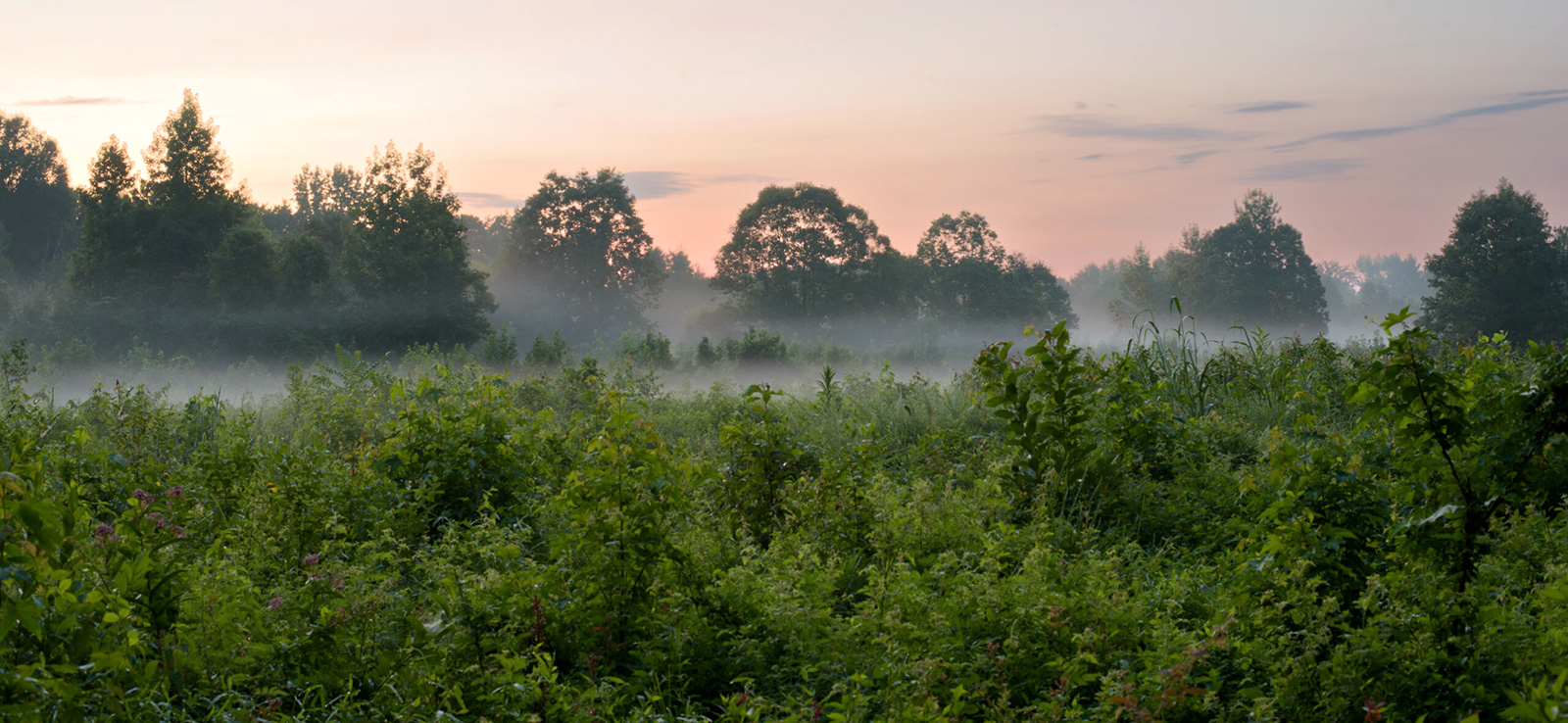
There are few parts of North Carolina where humans take a backseat to the animals, so it’s no wonder these areas attract a variety of nature lovers. (Photo: Carolina Alumni/ Keenan Baker ’26)
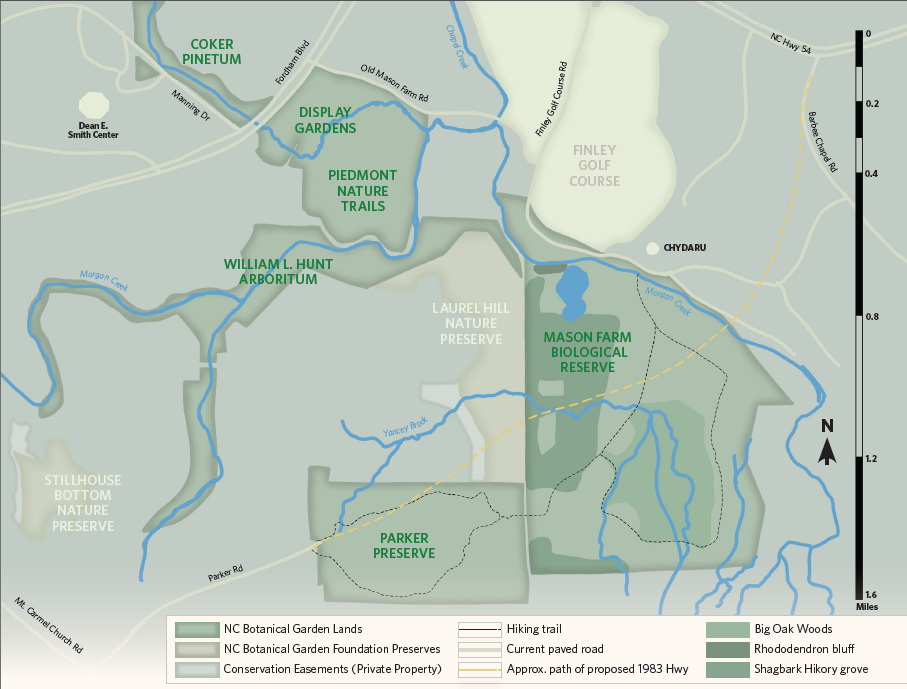
Mason Farm Biological Reserve and Parker Preserve seem to intentionally hide themselves, lying low inside the borders of Chapel Hill.
Map by Haley Hodges ’19
Entering the ecological gems from U.S. 15-501 requires slaloming along Old Mason Farm Road, past the Finley Outdoor Track and OWASA Wastewater Treatment Plant, zigzagging through the Finley Golf Course parking lot — around a practice range — and slowly rolling down a narrow, bumpy gravel path. The tree-lined Morgan Creek meanders eastward on the right before the golf range turns into wetlands on the left. At one time, not long ago, Mason Farm included the golf course and flat track fields and the OWASA area, even stretching to where the Friday Conference Center now sits along N.C. 54.
Owned by the University, Mason Farm and Parker Preserve are almost 500 acres of pristine wilderness. Swamplands, meadows and old-growth forests nestle together and, in their combination, yield an unmatched diversity of flora and fauna. Songbirds and warblers trill throughout the day as they dart in flashes of indigo and yellow between soft green grasses. In spring, the American woodcock’s mating ritual takes center stage, many a birder’s favorite courtship to witness.
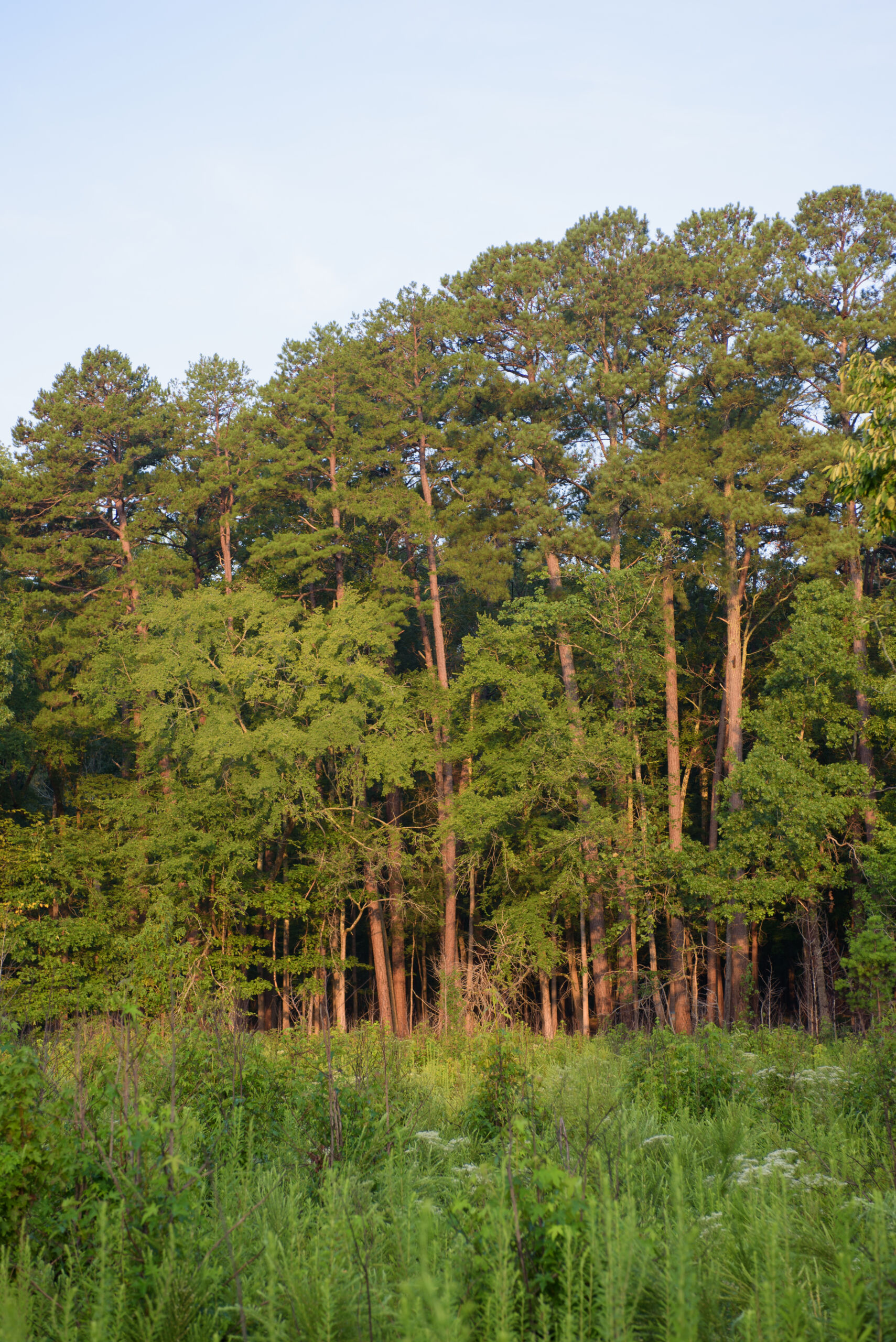
A fire-maintained meadow transitions into a mixed forest of loblolly pines, shortleaf pines and a wide variety of hardwoods. (Photo: Carolina Alumni/ Keenan Baker ’26)
Looming over the brush are centuries-old oaks and shagbark hickories, cloaking coyotes as they yip and howl throughout the night. Otters, foxes, even black bears and bobcats all sought refuge here in recent years. Hawks and ospreys have reappeared, with the former hunting a diverse menu of snakes and rodents. The often-flooded trails create nature’s tracking system, with paw prints and shoeprints mingling in one arena.
There are few parts of North Carolina where humans take a backseat to the animals, so it’s no wonder these areas attract a variety of nature lovers. Researchers, birders, professors, naturalists, volunteers, hikers and joggers have flocked to this land for decades.
Mason Farm and Parker Preserve seem untouched as human development has rolled on around them. But this place — at the bottom of a steady decline from campus — was not always preserved or protected.
The Morgan effect
Thousands of years ago, Native Americans made a similar downhill trek, following Indigenous footpaths that eventually became part of the Great Trading Path, which passed through modern-day Charlotte and Durham. Indigenous people have lived in the N.C. Piedmont for at least 10,000 years. According to the North Carolina Botanical Garden, Mason Farm was first cleared, cultivated and worked by Native Americans.
The appeal of the land was apparent. Conservationist Charlotte Jones-Roe, longtime director of development for the N.C. Botanical Garden, described it as an “area of frequent floods and fertile soil” in Mason Farm Biological Reserve: A Guide to The Old Farm Trail.
Enslaved People at Mason Farm
Danita Mason-Hogans, a historian, activist and self-described “memory worker,” is rooted in the Mason Farm area. Over seven generations of the Black Mason family lived in Chapel Hill, including Mason-Hogans’ father, a member of the Chapel Hill Nine — Black high school students who staged a 1960 sit-in at a Franklin Street drugstore.
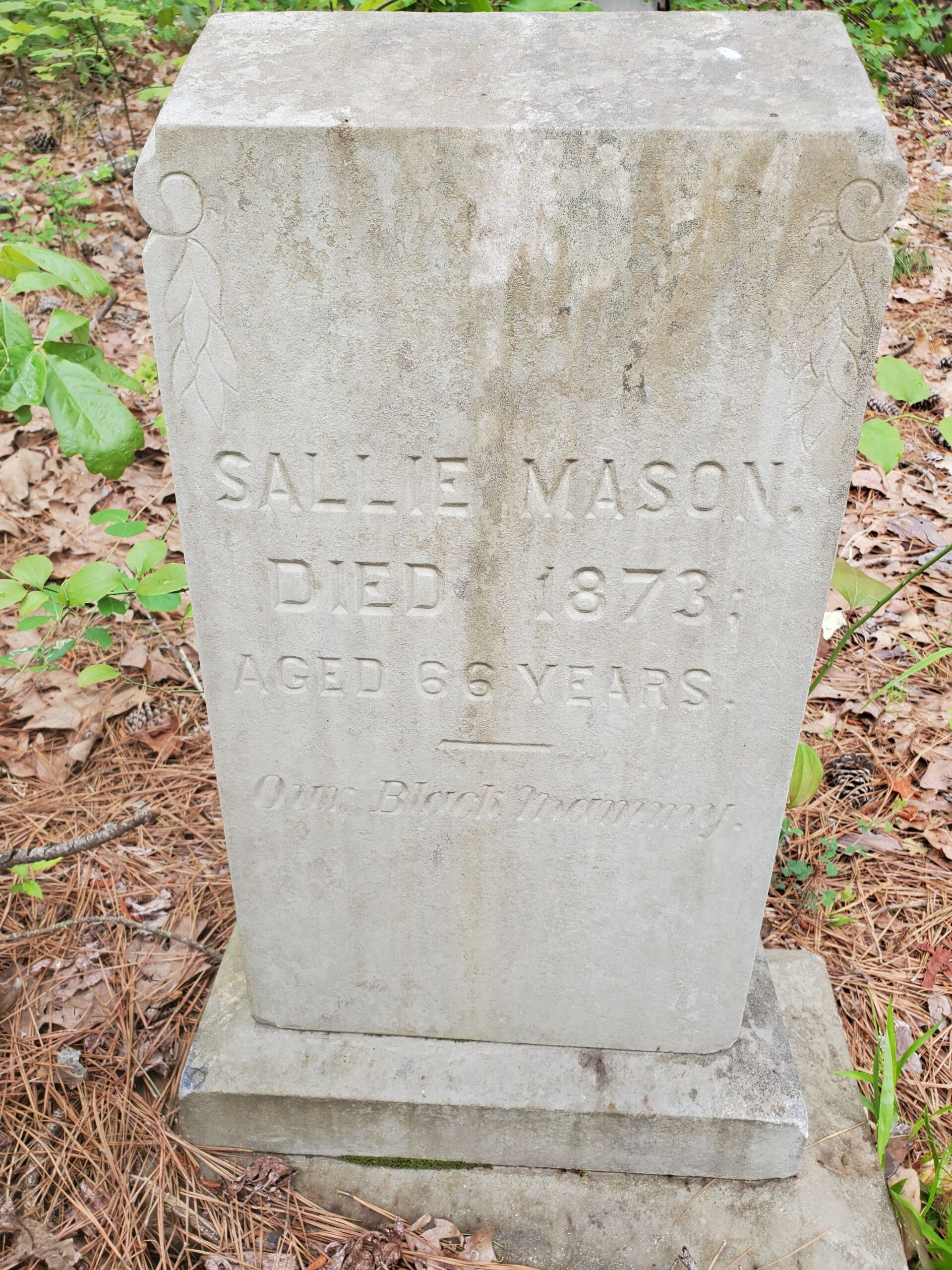
One of Mason-Hogans’ earliest known relatives was Sallie Mason, an enslaved woman buried with the white Mason family inside a wrought iron fence. Her tombstone was inscribed, “Our Black Mammy,” and it is surrounded by the unmarked graves of other enslaved workers. This, according to Mason-Hogans, was done “so that she could continue to serve them in heaven, and that’s a very common Southern tradition.”
“Obviously, as somebody who is connected to that legacy, it’s greatly frustrating that that happened, and it’s very commonplace,” said Mason-Hogans. “For me, it tells the story of our servitude to this University.”
Mason-Hogans founded the James Cates Scholars, a youth program that is currently looking at historical Native American usage and migratory patterns surrounding the Mason Farm land. Mason-Hogans noted that the support of the N.C. Botanical Garden has been key to diving deeper into the history. “When I look at what is going on at the biological reserve, they have been very welcoming and have really shown an interest in sharing this history with us, and I’m very greatly appreciative,” she said.
“[This] locality contains the largest known concentration of these [prehistoric] sites in Chapel Hill,” wrote UNC archaeology Professor Vincas Steponaitis in a 1992 memo to Finley Golf Course Management in advance of further golf course expansion. “All of these sites are historically significant, and all reasonable steps should be taken to prevent needless damage to them.”
By the time Mark Morgan purchased the land in 1747 from John Lord Carteret, earl of Granville, Indigenous communities in the area had been severely disrupted and displaced by European-introduced disease and warfare. Prior to this, the area had long been home to Siouan-speaking peoples, including the Occaneechi, Eno and Sissipahaw.
European settlement on the land remained sparse, however. According to John Terres’ book From Laurel Hill to Siler’s Bog, before “Morgan could build a cabin from the surrounding forest, he and his wife lived by his creek in the hollow trunk of a tall sycamore, ten or twelve feet across.” This creek, which forms the northern border of the current reserve, became known as Morgan’s Creek and eventually Morgan Creek. Back then, the creek cut through the middle of the property, which was about 1,600 acres.
Most of it was level ground — rare in a town named for a hill — and well suited to Morgan’s agricultural ambitions. He used enslaved labor to turn hundreds of acres into farmland and fields for growing cotton, corn and tobacco, all resting atop the evidence of earlier Indigenous inhabitants, including arrowheads and pottery shards. Hundreds of enslaved people also built the berms still visible today at the entrance of the reserve.
This land remained in the Morgan family for about 150 years until 1894, when Mary Elizabeth Mason, née Morgan, bequeathed over 800 acres to UNC. Both of Mason’s children died of typhoid in early adulthood, and she decided the best heir would be the University.
Mason stipulated the land was “never to be sold or divided” and that portraits of her husband and daughter were to be hung in the halls of the University. They are still displayed today at the botanical garden.
The donated land became a hub for tenant farming. Minutes from a 1900 Board of Trustees meeting included stipulations such as keeping the farm in good condition: “No grass that is difficult to be rid of [is] to be sown or planted.”
Some tenants, including philosophy Professor Horace Williams (class of 1883), subsequently imported and promoted Johnson grass, a noxious weed. The next tenants, the Soil Conservation Service, leased the land and sought to reverse this reckless management, with mixed results.
Unintended consequences
The federal Soil Conservation Service (SCS), which operated at Mason Farm from 1935 to 1953, decided in 1936 to “test plant performance and sources for soil erosion control, soil rehabilitation and wildlife species,” which included native vegetation and, unfortunately, nonnative plants.
These interventions shaped Mason Farm. The SCS created drainage systems and established graded dikes along Morgan Creek to prevent flooding. Quick-growing species such as Dahurian buckthorn, now considered invasive, remain on the property. Neville Handel ’07 (MA), natural areas manager for the botanical garden, and his crew still battle it today.
When the Soil Conservation Service packed up in 1953, it left a complicated legacy. The berms protected the farms — and the experimental plant species — from being overrun by flooding. The kudzu and other nonnative species introduced or tested by the SCS still help control erosion, even if conservationists loathe their abundance throughout the Southeast.
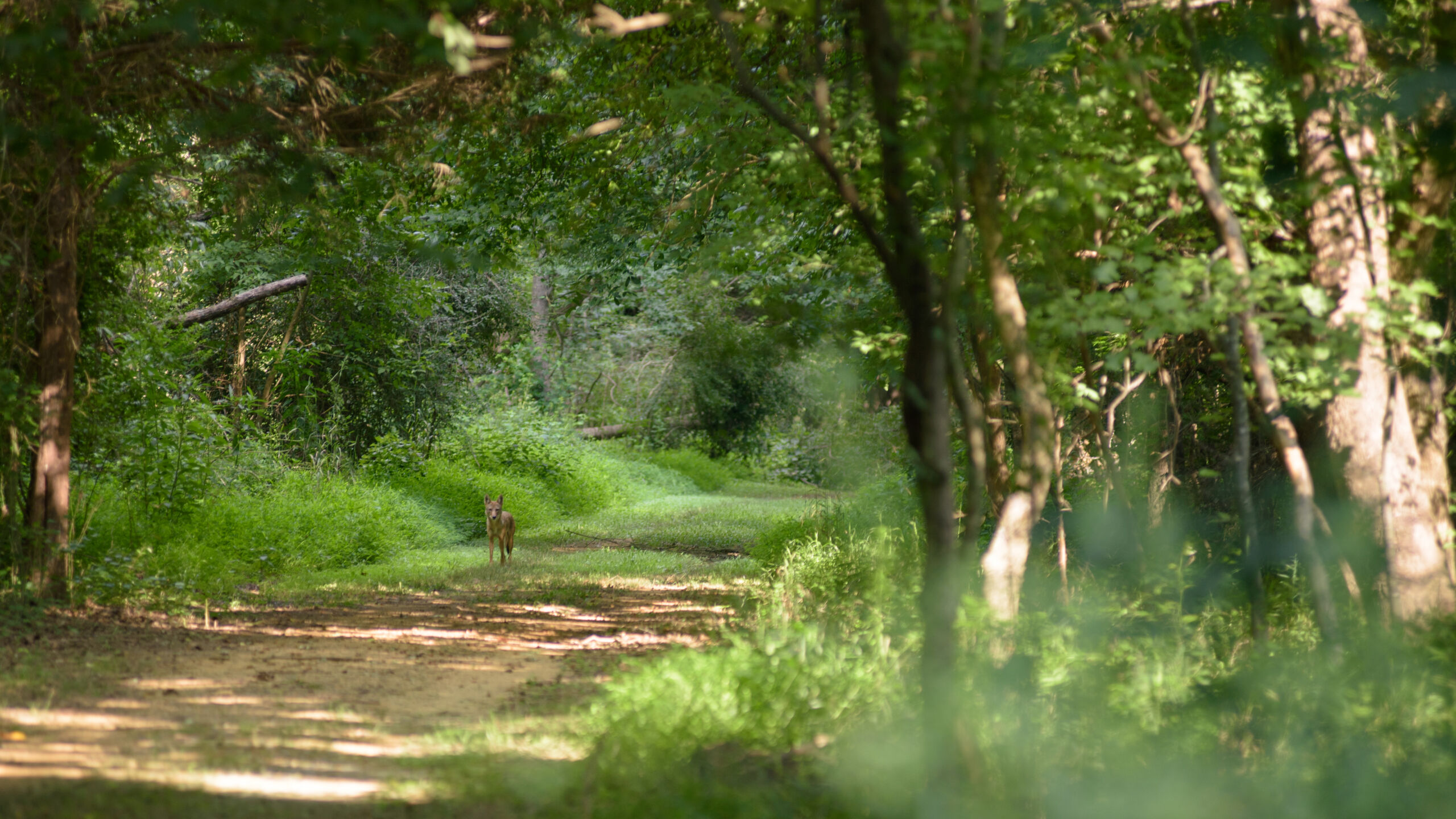
Coyotes are common at Mason Farm but rarely seen because they are more active at night. Bobcats, red foxes, river otters, American minks, beavers and many other mammals also call Mason Farm home. “It’s a real diamond in terms of biodiversity,” said Neville Handel ’07 (MA). (Photo: Carolina Alumni/ Keenan Baker ’26)
“I think that the Soil Conservation Service was probably doing what they thought was right at the time,” said Handel. “But sometimes you have unintended consequences, and we’re still dealing with some of the remnants of those.”
During and after the Soil Conservation Service era, the land north of Morgan Creek shifted even further away from its natural state. Finley Golf Course expanded, and the University began using small tracts for big ideas, including an experimental prison and out-of-the way places to dump hazardous waste (see “Radioactive Past,” page 65).
In the 1960s and 1970s, the land south of Morgan Creek became a popular spot for birders and naturalists seeking an accessible place to explore Chapel Hill’s remaining wilderness. There’s no better example of this than John Terres, who in 1961 left his job as editor of Audubon magazine in New York to live in Chapel Hill and write two books, including the Audubon Society Encyclopedia of North American Birds, published in 1980.
Finley Golf Course Expansion
In the late 1940s, the Mason Farm land north of Morgan Creek was developed into Finley Golf Course, a gift from local businessman Albert Finley.
A Raleigh businessman, he was a fan of Carolina football and wanted tickets for a highly anticipated matchup between the Tar Heels and Notre Dame at Yankee Stadium. With tickets sold out, Finley struck a deal with the athletic director and University golf coach Chuck Erickson to construct a nine-hole course on top of the rudimentary setup created by Navy Pre-Flight cadets.
The clash between the Tar Heels and Fighting Irish failed to live up to the billing, with Finley’s favorite player, Charlie “Choo Choo” Justice ’50, sidelined with an injury. The Heels lost 42–6. But the golf course opened in 1950, with the clubhouse replacing Mary Elizabeth Mason’s farmhouse.
He documented his first view of Mason Farm: “When I reached the top of the dike, I gasped. For two miles straightaway, and from east to west, windswept fields and woods lay under an enormous vault of blue,” said Terres. “A thousand acres of swamps and fields and forests, to as far as I could see, were suddenly opened before me — a vast freedom of land and sky.”
Terres would spend the next eight years walking 5,000 miles and logging 10,000 hours at Mason Farm, filling field journals with thousands of observations. His
all-encompassing ode to nature’s beauty in this oasis included interactions with raccoons, muskrats, golden mice, barred owls, cottontails and countless other species. The result was his 1969 book From Laurel Hill to Siler’s Bog: The Walking Adventures of a Naturalist. It earned many accolades, including the John Burroughs Medal, given for distinctive works in natural history.
Terres’ work had a tangible impact on the official conservation efforts that led to the creation of the Mason Farm Biological Reserve.
In February 1970, professors at UNC and N.C. State and other interested parties — led by C. Ritchie Bell ’43 (’49 MA), professor of botany and director of the N.C. Botanical Garden — wrote a letter to Vice Chancellor for Finance Joseph Eagles ’31 (’34 JD) urgently recommending “the cooperation of the University and Town of Chapel Hill in a united effort to help solve the mounting environmental problems now facing us.”
The letter painted a familiar picture: “As the population increases and development accelerates, the environment deteriorates unless counter-balancing measures are taken. Mason Farm maintained as a natural area would be an effective buffer zone against over-development.”
The letter referenced Terres’ book, which highlighted the “immeasurable aesthetic values of the area.”
In response to the letter, the University in 1971 designated about 195 acres at Mason Farm for teaching and research. In 1984, the protected area expanded to 367 acres — its current size — and was formally designated the Mason Farm Biological Reserve.
Road to nowhere
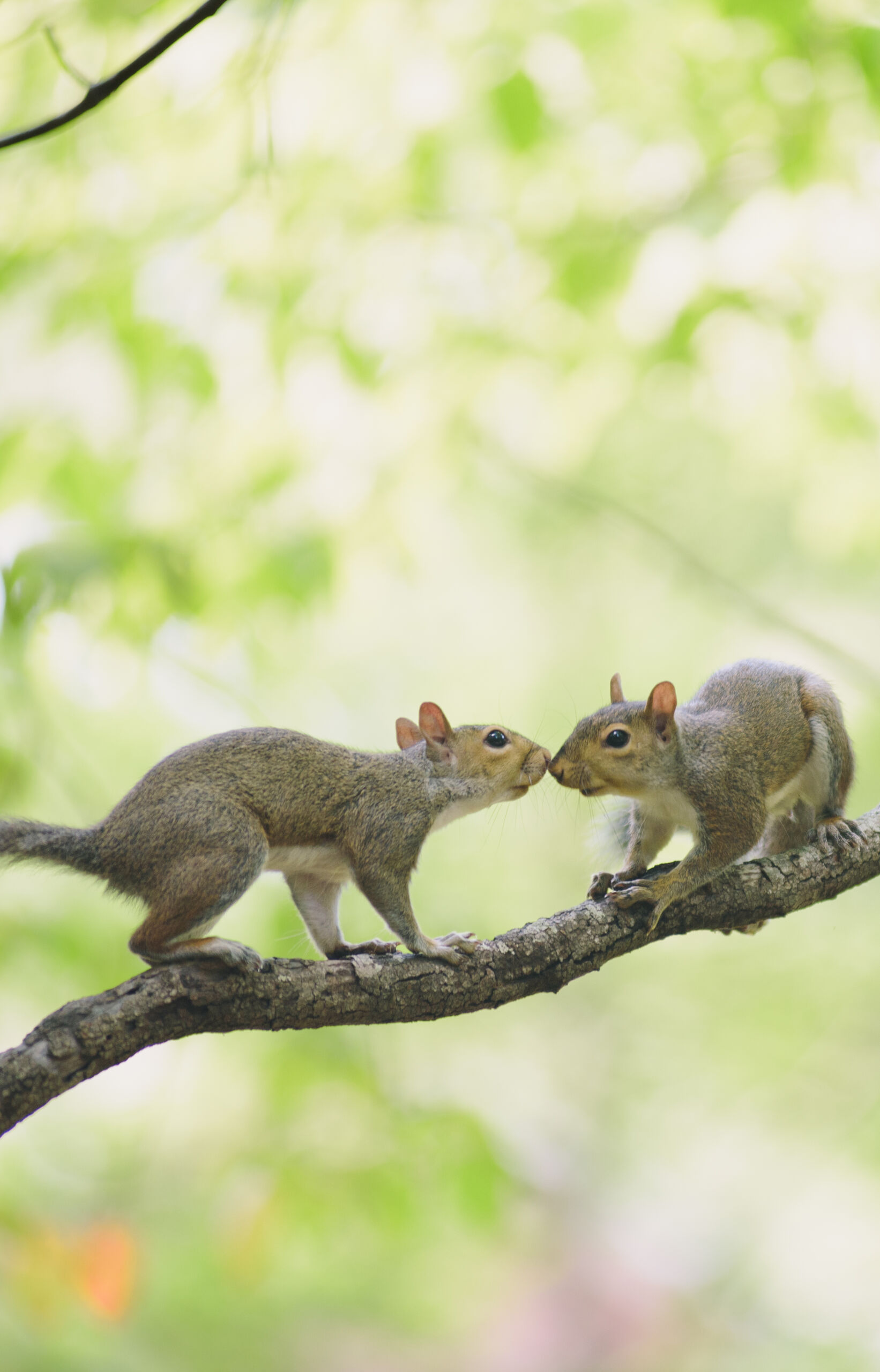
Eastern gray squirrels, which can live up to 10 years in the wild; a male blue grosbeak; a maintained path cuts through fields, giving birders another view into a bottomland habitat and naturalists a place to find more solitude.
But Mason Farm remained at the forefront of the most fervent fights for preservation the Piedmont had ever seen. Some battles were immediately tangible: Construction of the Friday Center in the late 1980s resulted in land near the reserve being used for fill dirt. Bulldozer operators practiced their craft until they were asked to stop. Without permission, the Finley grounds crew also expanded driving ranges and dump sites onto land designated for Mason Farm.
Beavers, previously thought to have been extirpated from North Carolina in 1897, made a triumphant return in the early 1980s, re-creating the flooding along Morgan Creek that had existed prior to the human-made berms and dikes. So formidable was this “invasion of beavers,” as it was described in the 1992 Mason Farm Biological Reserve Conservation Project, that all leased farmland and community gardens — which had peaked at more than 250 separate plots — ceased in 1990.
Laws of Preservation
While there is little preventing the University from further developing sensitive areas such as Mason Farm and Parker Preserve, there is little motivation to do so from economic, academic and ecological standpoints.
Under the 2019 Campus Master Plan, the University stated, “It is the intent of this plan to conserve and expand the ecological services provided by these valuable natural resources for future generations.”
Wilson Greene ’15 (’20 JD), assistant general counsel at the N.C. Department of Natural and Cultural Resources, works directly on purchasing property for conservation. Greene calls natural areas like Mason Farm and Parker Preserve “buffer zones,” meaning they exist as a balance to the rapid development in the surrounding areas. That can mean stormwater management, carbon sequestration or, in Greene’s words, “a thousand reasons why places like those two properties are important in the vicinity of large communities that are growing.”
“You can’t necessarily stop people from moving to places that are nice places to live and where there are jobs,” acknowledged Greene. “But with that said, you have to weigh [development] against properties like Parker Preserve and Mason Farm that are these buffer zones.”
The botanical garden may not have explicit power to prevent future development, but the N.C. Botanical Garden Foundation exists solely to preserve ecologically important parcels adjacent to the garden.
The foundation owns 163.8 acres of nature preserves and holds conservation easements on 149 acres, protecting them as permanent buffers to preserves currently held by the garden and the foundation. The largest easement is the 92-acre Morgan Creek Preserve, which includes Merritt’s Pasture, owned by the town of Chapel Hill. The 88-acre Laurel Hill Nature Preserve is the largest property owned by the foundation.
And then there was the Laurel Hill Parkway, a proposed thoroughfare to connect Parker Road to Barbee Chapel Road and alleviate Chapel Hill traffic along Fordham Boulevard and N.C. 54. It was the byproduct of a 1983 mandate from the N.C. Department of Transportation requiring all municipalities to submit traffic plans to the NCDOT. The joint town of Chapel Hill and town of Carrboro plan called for a highway to cut straight through the pristine natural areas of Mason Farm.
The towns hosted a joint public hearing on the proposed thoroughfare Jan. 31, 1983. Over a dozen constituents, from concerned locals to renowned professors, spoke out against the proposal. One resident played a recording of barred owls. Another, according to the meeting notes, “opposed destruction of the Mason Farm area as it was unique and could never be restored. The road could go other places.”
Despite the public outcry and the official designation of the Mason Farm Biological Reserve, Chapel Hill, Carrboro and NCDOT approved the thoroughfare plan in 1984. The next year, the U.S. Census created the Durham-Chapel Hill-Carrboro Urban Area, which required another traffic plan to be submitted to the federal government.
During this process, the Green Dragons, an advocacy group spawned by botanical garden volunteers and named after a plant growing in the proposed right-of-way, lobbied against the Laurel Hill Parkway. They were led by Charlotte Jones-Roe, then director of conservation of the botanical garden and author of thousands of pages on the history of these lands. The Green Dragons attended every University and public hearing for years, even after the federal thoroughfare plan was approved in 1991 without the inclusion of the Laurel Hill Parkway. NCDOT was more reluctant to quit on the plan but finally removed the proposed roadway from its maps in 1994, after the town of Chapel Hill sent a formal request to the state.
In the aftermath of various fights against roads and outside developments, Hurricane Fran roared through North Carolina in September 1996. Among other damage to the reserve, a shagbark hickory, deemed the largest of its kind in North
Carolina, was felled. To honor it, community members created a painting of the tree.
Extending preservation
Just west of Mason Farm, as the lowlands begin rising into hardwood forests, sits Parker Preserve, a 127-acre tract given to the University in 1976 by Bill Parker ’45
and Athena Parker ’44. The homesite included an 1830s cabin in Parker Meadow, which burned down in 1995. The Parkers, though, stayed put. They moved into a mobile home on the land they loved. They held a life estate on five acres, allowing them to live on the property until Bill’s death in 1997 and Athena’s in 2002. Ten years later, the botanical garden assumed responsibility for the land. In 2019, the N.C. Botanical Garden Foundation purchased an adjoining 13-acre parcel along Parker Road, creating a parking area near an abutting neighborhood and opening Parker Preserve to the public.
The beautiful hillsides of Parker Preserve are home to old-growth forest filled with shortleaf pines, some of which are hundreds of years old. These trees overlook the still-visible remains of the Parker homestead — rumored to have been a stop on the Underground Railroad and an inspiration for James Taylor’s seminal Carolina in My Mind. The trees are rooted in diabase soil, a distinct composition made from molten rock. Diabase has a high pH, in stark contrast to the typically acidic Piedmont soil. It supports plant communities rarely found elsewhere in North Carolina.
The roughly 500 acres that make up the Mason Farm Biological Reserve and Parker Preserve would, in many ways, have looked vastly different decades and centuries ago. Handel describes parts of the reserve today as being in their “early successional period,” a direct result of extensive human disturbance and farming.
As caretaker, Handel is doing the work of returning the land to a more natural state than what mid-20th-century intervention wrought. He can be found in the open meadows leading controlled burns integral to the maintenance and health of diverse habitats and species. These burns are both preventive and restorative, minimizing the impacts of invasive species and promoting the proliferation of native plants.
“The belief is that this area — pre-European arrival — would have burned on a fire interval every two to six years,” said Handel. “They know this from fire scars on old-growth trees and descriptions from early explorers talking about Indigenous peoples annually setting the woods on fire.”
The 494 combined acres of the Mason Farm Biological Reserve and Parker Preserve are home to thousands of species including:
- Over 800 species of plants
- 216 species of birds
- 67 species of butterflies
- 28 species of fish
- 23 species of amphibians
- 28 species of reptiles
- 29 species of mammals
Along the northern end of the reserve, bordering the entrance and along Morgan Creek, examples of unintentional restoration arise. The catastrophic floods caused by storms such as Hurricane Fran in 1996 and Tropical Storm Chantal in 2025 have rendered the human-made berms and controls functionally useless, Handel said. These floods, powerful enough to wash away the gauges that measure water levels around Morgan Creek, have restored parts of the reserve to a state much closer to what Native Americans likely experienced. In the face of centuries of human intervention, nature found its way through.
Now, in the Garden’s 60th year, restoration is its goal. And the reserve has become a study on how to maintain healthy, sustainable land and diverse natural populations in the age of ever-expanding human development.
“I hope Mason Farm continues to be the gem that it is,” Handel said. “I hope we continue to provide a haven for critters, wildlife, the native communities that don’t have their own voice. I also hope it continues to be a haven for people who want to just get away from the rat race and find a beautiful place to see some magical stuff.”
____________________________________________________________________________
Radioactive Past
“This place clearly had a history, and I was astounded I did not know it.”
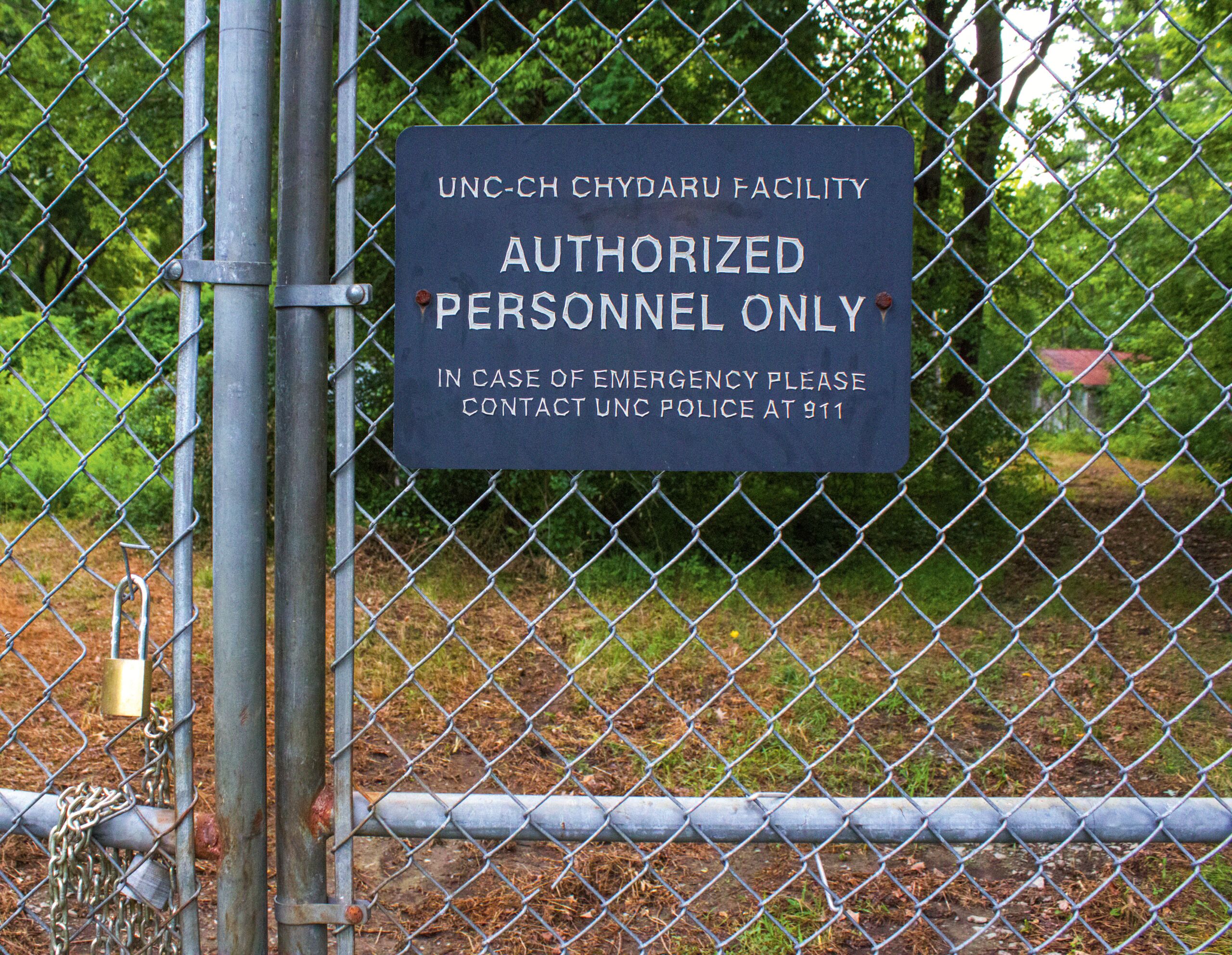
As I set my kids free to explore the forests and fields of Mason Farm, I spotted a tall, chain-link fence up a gravel road. I trudged through the light rain to read the sign on the gate: “UNC CHYDARU Authorized Personnel Only.”
I peered inside and saw several dilapidated structures among overgrown weeds and sweetgum trees. The remnants of these dirty white buildings looked like old barracks. Two open doors revealed old furniture and unidentifiable junk inside.
Though I felt like climbing the barbed-wired fence, consequences be damned, that seemed like a bad idea. I kept to the perimeter instead and eventually noticed a junky motorboat and two trailers inside the fenced area. An adjacent yellow sign with an unmistakable symbol caught my attention: “RADIOACTIVE MATERIALS.”
This place clearly had a history, and I was astounded I did not know it.
CHYDARU stands for Chapel Hill Youth Development and Research Unit. Having been opened as an experimental prison in 1964, it closed the next year. The Greensboro Record reported that “the pilot project is designed similar to a California experiment with small, self-governing convict units.” It could have housed about 20 boys younger than 18. Five “social therapists” trained the inmates “to live properly with other people, as well as learn new careers.” Some were selected to become apprentices in similar programs to “treat offenders” and prevent crime.
The state penal system sponsored the prison in cooperation with the UNC Institute of Government’s Training Center on Delinquency and Youth Crime. When the state declined in 1965 to appropriate funds for CHYDARU, federal grants could not make up the difference. The prison experiment was scuttled, though the University was not through with this chunk of land.
The UNC Bureau of School Services was housed there in 1973. Then, in 1975, the University began using the space “to hold radioactive wastes for off-site disposal,” later using it to store short-lived radioactive material for decay, according to a 1995 University memorandum. The state granted UNC permission in 1987 to operate the site as a hazardous waste treatment, storage and disposal (TSD) facility, “because one type of waste previously sent to Chydaru contained both hazardous and radioactive components.” UNC stopped storing hazardous materials there in 1991. “There is no radioactive or hazardous waste buried at this site,” the memo states.
But radioactive waste, including animal carcasses from research experiments, is buried farther east in Mason Farm. It, too, is cordoned off by fencing. That waste, dumped there between 1963 and 1970, required the University and the state to install groundwater wells and monitor them twice a year. According to the same 1995 memo, “to date … no detectable quantities of radioactive materials have been found outside the disposal site boundary.”
Still, the same 1995 memo states how UNC continued to store low-level radioactive materials at CHYDARU “for a duration of ten half-lives or longer (a period ranging from 30 days to 4.5 years), before being repackaged as medical wastes (no longer considered radioactive) and shipped to an off-site medical waste incinerator.”
The site was officially decommissioned in 2001, according to a 2021 article in The Daily Tar Heel.
Shortly after I stumbled across CHYDARU in 2017, I phoned the UNC Department of Environment, Health and Safety to ask whether radioactive waste was still being stored there. I was told that there no longer was any waste and that signs still in place should have been removed. There are no longer signs warning of radioactive contamination.
The old equipment was apparently dumped there after 2001, and the place was deemed safe enough for UNC bird biologist Keith Sockman to house an aviary on site for several years starting in 2006.
In the years since, CHYDARU has been on the University’s list for destruction. But more pressing projects have taken precedence. So there CHYDARU sits: a strange modern ruin among the swampy lowlands of Chapel Hill.
—Mark Derewicz
Thanks for reading the Carolina Alumni Review
Carolina Alumni members, sign in to continue reading.
Not yet a member? Become one today.