A Bit of Hair or Blood
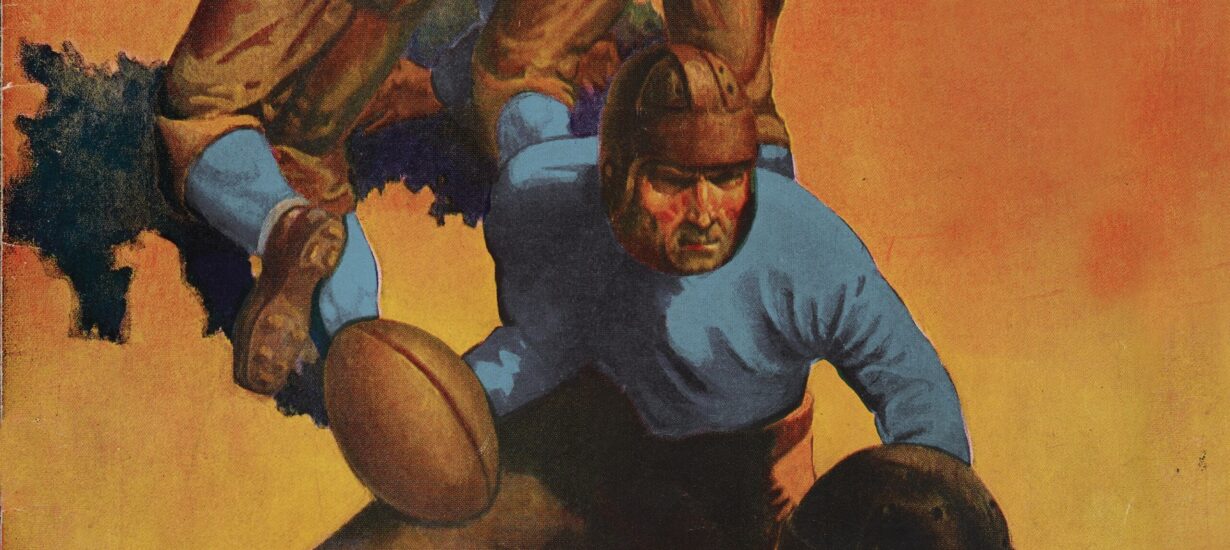
Tales, traditions and trivia from the first 65 years of Carolina football.
by Kenneth Joel Zogry ’97 (MA, ’08 PhD)
Carolina is a basketball school, so goes the refrain.
True as this has been for several decades, it might not remain true forever. And as history shows, it was not true prior to the Tar Heels’ 1957 national basketball championship. In fact, Carolina had been a football school long before a basketball was ever bounced in the old Memorial Hall, Carolina hoops’ first home. (See “The Forgettable Memorial,” January/February 2013 Review).
This is the story of Carolina football’s early history, from its humble beginnings as a means to show that late-19th-century college students could be tough guys, through the tumultuous 1920s when many questioned the professionalization of the game on college campuses, to the mid-20th-century peak of two-time Heisman Trophy contender Charlie “Choo Choo” Justice ’50, before a different sport won over hearts in the Tar Heel state.
Listen to this story as read by ElevenLabs AI.
Kickoff
Early football at Carolina would be almost unrecognizable to modern fans, just as the campus itself would be. UNC fielded its first team in fall 1888, nearly 20 years after the first collegiate game was played between Rutgers University and the College of New Jersey, later renamed Princeton. Carolina played Wake Forest Baptist College (later a university) at the State Fair in Raleigh Oct. 18, 1888, losing 6-4. At the time, student enrollment at UNC hovered around 300, and campus consisted of 10 buildings, all but two of which were built before the Civil War. There were no paved roads. Transportation was by foot, horse or wagon. The dirt paths through campus were often obstacle courses of mud and animal droppings. The buildings had no heat, electricity or telephones. Plumbing was rudimentary at best. There were no flushing toilets and no indoor bathing facilities until 1893 when the entire student body shared five “shower baths” in the basement of Smith Hall, where Playmakers Theatre now stands. The Old Well was not the elegant neoclassical structure of today but a rough wooden hut with a pulley and bucket.
As no administrative structure for college athletics existed in the 1880s, Carolina’s first team was organized and managed by the Athletic Association, an off-campus operation run entirely by students and supported financially with ticket sales and annual dues paid by students and alumni. The association hired the team’s first coach, Hector Cowan of Princeton, and paid his salary. UNC went 1–3 its inaugural season, after which the Athletic Association was put under the auspices of the campus YMCA, which itself was semi-autonomous.
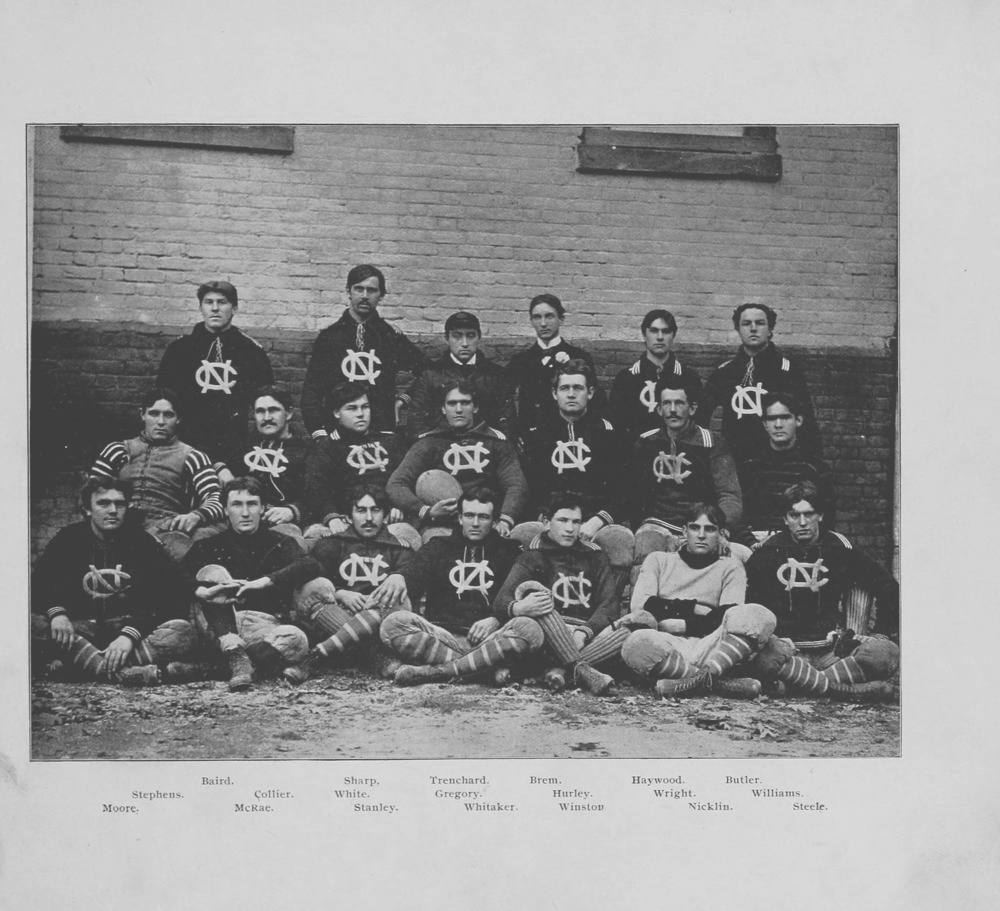
The 1895 varsity squad, famous for the game with Georgia when a then-illegal forward pass was used in the only scoring play. Note Coach “Doggie” Trenchard in top row center (in cap), and George Stephens at the far left of the center row who caught the pass and ran 70 yards for a touchdown. (Photo: 1896 Helenian)
The Carolina YMCA, founded in 1859, filled many daily needs for the students in the years when the University was small and offered few services. Y members greeted and oriented new students on their first day, published a small handbook with information about local accommodations and merchants, and ran the first campus bookstore. At its core, the Y was a Protestant evangelical organization with a mission to promote a moral life for young men. Early on, the Y promoted athletics to entice young men to join under the theme of “muscular Christianity.”
Of the team sports popular at the time, football gave public face to the notion that earning a college degree — seen as effete at the time — could be manly during an era when the majority of men earned a living through physical labor.
Organized athletics, and particularly football, also countered public notions of college students being dilettante pranksters. In 1894, UNC President George Tayloe Winston wrote in the Alumni Quarterly, “The energy that formerly spent itself in riotous living [and] nocturnal events of vociferous rowdyism, is now happily and enthusiastically and healthfully employed on the athletic grounds.” Student pranks such as “carrying off the city gates” and “lugging bullocks [young steers] into third-floor recitation rooms” were replaced with “glory on the ball grounds” and showing “prowess in manly conflict with his peers.”
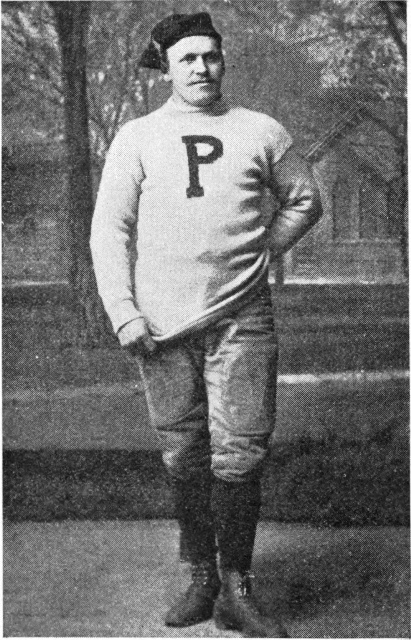
UNC’s first paid coach was Football Hall of Fame inductee Hector Cowan of Princeton. He arrived in the spring of 1889 and worked with the Carolina team for two weeks before returning to Princeton. (Photo: UNC Library)
The early game of football was considerably more rough-and-tumble and bruising than today. There were no formal rules or regional governing bodies, and there was a lack of standardization of everything from the length of the field to the size and shape of the ball. Protective body padding was rudimentary at best, and players didn’t wear helmets. The only face gear visible in early photographs were odd-looking thick leather nose guards.
Strictures on who could play and who could referee were also loose. In 1893, Charles Baskerville (class of 1892), who completed his PhD in 1894 — simultaneously the first editor of The Tar Heel and captain of the football team — published an open letter ahead of what had become the annual game against Wake Forest calling for a list “stating that every player is a bona fide student pursuing a regular course of study and receiving no remuneration for playing.” Further, “Neither Umpire nor Referee should be connected with either institution as either teacher, student, or alumnus.” Carolina team rosters for the first two decades or so included graduate students, young professors and on occasion nonmatriculated players known as ringers (though many universities prohibited the practice).
Despite the lofty YMCA intention of muscular Christian male students living a moral life and representing the virility of the school, drinking, gambling and the suggestion of womanizing among team members on campus and at away games caused concern among faculty and administrators. President Kemp Plummer Battle (class of 1849) called the sport “an incitement to drinking and rowdyism,” and in 1890 the UNC trustees banned intercollegiate play as the result of “controversies and disorders.”
However, as The Tar Heel reported in a later article, the ban was lifted following a “vigorous and manly” petition by several alumni and agreement that a Faculty Athletic Council would be established to provide oversight. Part of that agreement included limiting absence from classes and benching any student “reported by the professors as delinquent in his studies,” the student newspaper reported.
Scientific football
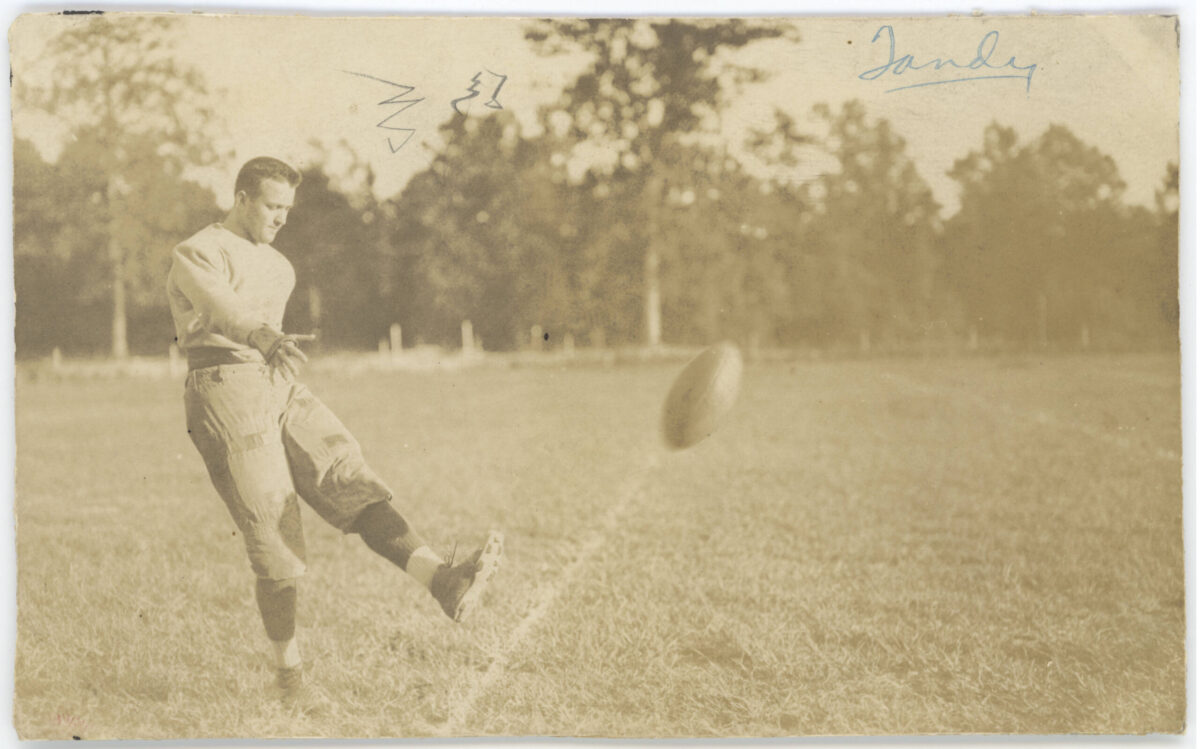
George “Yank” Tandy (class of 1917), shown punting, played center and was captain of the 1916 team. The Tar Heels went 5-4 that season. (Photo: UNC Library)
The establishment of a football team occurred in the aftermath of a hotly contested political debate in the State Legislature during the 1870s over the structure and future of a post-Civil War UNC, which had closed in 1871 during Reconstruction. The resulting 1875 reorganization transformed UNC’s curriculum. The antebellum University offered primarily a rote-memory-based classical education largely without written exams or a fully functional library, and it was taught by faculty without PhDs. The student body in large part consisted of sons from leading Southern families preparing for lives in antebellum society as lawyers, clergy, politicians and plantation owners. The new University was a research-driven, science-based institution with the mission of preparing a somewhat more inclusive student body (though still restricted by gender and race) to contribute to the social and economic structure of the New South.
Scientific football, as it was known then, was representative of the University’s new educational mission. In short, the term referred to the adoption of calculated plays and strategies developed off the field. Scientific football replaced the prevailing practice of using only brute force to move the ball toward a scoring position or stopping the opponent from doing so.
As UNC historian James Leloudis ’77 (’89 PhD) wrote in Schooling the New South: Pedagogy, Self, and Society in North Carolina, 1880-1920: “Sports became a source of shared identity on a campus where students no longer studied a common curriculum or participated in campus-wide debating unions. Young men might view themselves as historians, chemists, economists, or philosophers during most of the week, but on game day they were all united as ‘Tar Heels.’ Athletic competition also recapitulated the lessons of the classroom. On the gridiron, as in academic pursuits, success required the mastery of a specialized knowledge of plays and strategy, and the difference between winning and losing was measured by a cold numerical score. The victorious athlete, like the triumphant scholar, had to apply himself constantly to self-improvement, for at any moment he might confront a rival who had been more resolute in his preparation.”
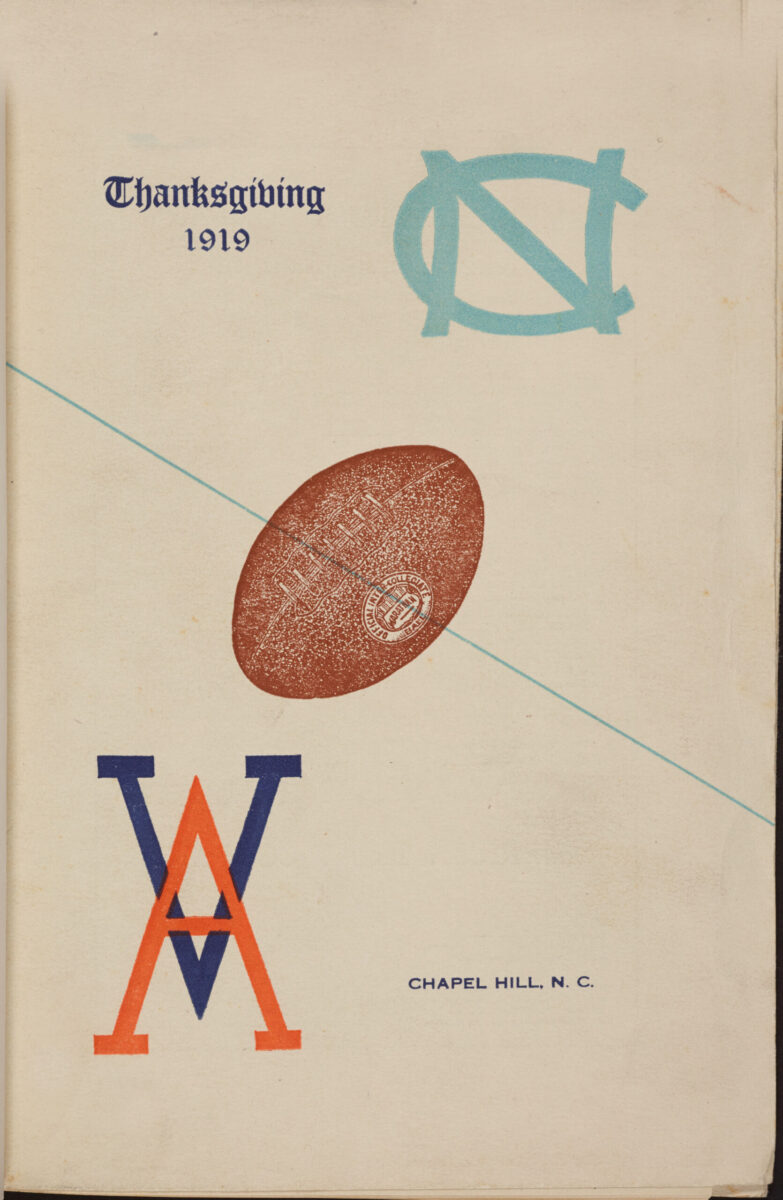
The first printed program for a UNC football game appeared at the annual Thanksgiving Day contest with UVA in 1919. The Tar Heels won 6-0.
Once the University exercised some control over the football team, traditions and structure of play developed rapidly in the 1890s. Carolina’s baseball and football were first played in a natural depression of land partially encompassing the area where the Pit was built in 1967, with wooden bleachers approximately where the UNC Student Stores, the Frank Porter Graham Student Union, the Robert House Undergraduate Library and the Walter Royal Davis Library are located today. It also offered seating on surrounding grassy slopes, but in 1916, permanent concrete stands replaced the rickety wooden bleachers. The site was named Emerson Field in honor of Isaac Emerson (class of 1879), who paid for the upgrades.
The football team adopted “Carolina” sky blue and white for uniforms because the two earliest student organizations —the Dialectic and Philanthropic societies — used the colors.
The Tar Heel newspaper was first published in February 1893 as an organ of the Athletic Association to promote football and other sports at Carolina, and the school song, “Hark the Sound,” was composed by student William Starr Myers (class of 1897) during his senior year and performed at athletic events from that time forward.
Following Cowan’s departure as coach in 1895, Thomas Gawthrop “Doggie” Trenchard (who had also played for Princeton) coached the Tar Heels for one season before leaving and returning almost 20 years later, when he enrolled in a master’s program as a part of the class of 1914. Trenchard was a somewhat controversial figure — an alleged drunkard and gambler who was accused of using ringers — but he won games. The most noteworthy event of his first tenure was a game played Oct. 26, 1895, in Atlanta against the University of Georgia, when Carolina purportedly threw the first — but at the time illegal — forward pass in college football.
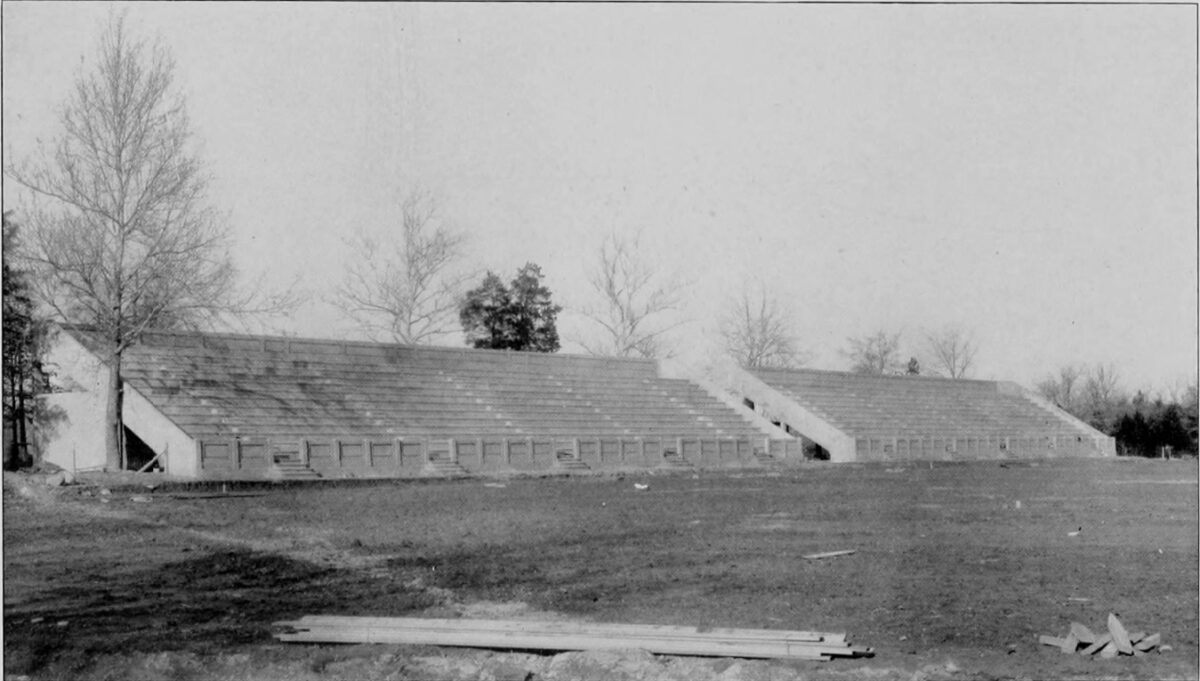
The original athletic field was extensively upgraded in 1916 with concrete viewing stands and other improvements and named Emerson Field in honor of the alumnus who footed the bill, Issac Emerson (class of 1879). (Photo: UNC Library)
A 1954 article in Delaware’s Wilmington Sunday Star stated that the “origin of football’s overhand pass is probably buried forever in musty legends of the sport,” but celebrated North Carolina sportswriter Bob Quincy ’44 provided clarity to when the forward pass may have originated in his account of the game in his 1973 book, They Made the Bell Tower Chime:
“John Heisman, a noted historian, wrote 30 years later that, indeed, the Tar Heels had given birth to the forward pass against the Bulldogs. … The Carolinians were in a punting situation and a Georgia rush seemed destined to block the ball. The punter with an impromptu dash to his right, tossed the ball and it was caught by George Stephens [class of 1896] who ran 70 yards for a touchdown.
“Heisman wrote that he was at the game standing near the action on the sidelines. He is emphatic that Pop Warner, who was coaching Georgia, protested to the referee to no avail.”
Contemporary accounts do not mention an illegal or unusual play. The Tar Heel gave a detailed account, headlined “An Exciting Game,” a few days later, noting that early in the game, “Stephens takes the ball on a double pass and makes a brilliant run from the center of the field for a touchdown, scattering the Georgia backs along the field as he goes.”
At the time, a double pass was a legal play that consisted of players moving the ball down the field via short underhanded passes. Curiously, the University’s copy of that news account in Wilson Library includes underlining in pencil of the words “double pass,” and handwritten in the margin is a note citing this was actually the first forward pass in collegiate football and referencing an article by Heisman in Collier’s Weekly, which was likely Quincy’s source.
Other teams are credited with using the forward pass before 1895, but apparently Heisman, then beginning his storied coaching career at Auburn University and on a scouting trip when he watched the game, saw it in action for the first time at this game and became a staunch advocate for making it legal. In that regard, Carolina’s spur-of-the moment use of the forward pass did help set the wheels in motion for it to become legal in 1906.
Rules, rivalries and Rameses
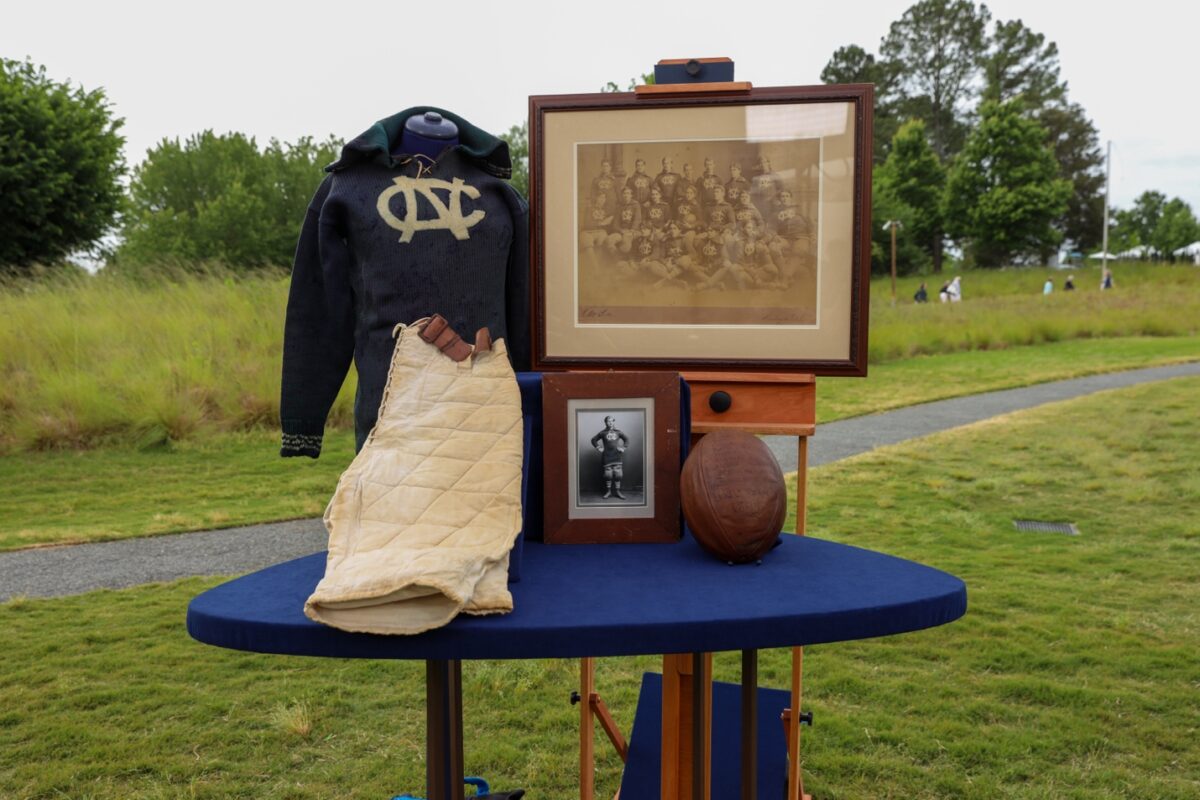
In 2023, at a filming of Antiques Roadshow in Raleigh, the family of William Daniel Merritt (class of 1895) brought a rare group of early Carolina football artifacts for appraisal. Included were Meritt’s blue wool varsity UNC warm-up sweater, a pair of quilted knicker-length uniform pants, a large team photo in its original frame and a football dated 1894. No other examples of the sweater, pants or football from the 19th century are known to exist. (Photo: PBS/Antiques Roadshow)
Despite increased University oversight and the adoption of scientific football, the game remained rough and dangerous. After the death of a Georgia fullback in November 1897, The Tar Heel editor Edward Kidder Graham (class of 1898) — later an English professor and UNC president before his death from Spanish flu in 1918 — wrote an editorial defending the sport and its masculine undertones. “We have no disposition to argue the question of the abolition of football by the colleges or the state. We grant that it is a rough game; perhaps at times, a brutal game. But its immense popularity is final evidence of the fact we haven’t yet gotten past the point where we demand rough amusement, and must have it. If it were not football it would be something else; we want men in hand to hand conflict. Very few people go to see a tennis match — the balls are too soft. At the present stage of civilization a bit of hair or blood is not objectionable.”
Controversies and attempts to regulate football continued at Carolina and on a national level from the 1890s until World War I. In response, Carolina team captain Baskerville co-founded the Southern Intercollegiate Athletic Association ahead of the 1893 season in an effort to standardize rules and provide oversight for regional member schools. UNC joined, resigned from and rejoined the shaky SIAA at least twice. In 1895 and again in 1898 other conference schools accused the Tar Heels of using nonstudent paid professional players.
The widespread debate about the controversies and roughness of intercollegiate football brought President Theodore Roosevelt into the fray in 1905, after 19 men died on the college gridiron the previous season. Roosevelt, whose four sons played football, established a committee to create safety and “fair play” standards. It was this committee to which Heisman, having first seen Carolina use the forward pass in 1895, brought his successful appeal to legalize the play as a means to reduce some of the violence and add interest to the game.
After stints with three other schools and some years playing on early professional football teams, “Doggie” Trenchard returned as head coach in 1913 for three seasons, compiling an overall record at UNC (including the 1895 season) of 26–9–2. His successor, Thomas Campbell, was head coach in 1916 and 1919. UNC did not officially field teams in 1917 and 1918 due to World War I, in which Campbell served in the military.
By the time play resumed in 1919, Carolina had three principal rivalries in the SIAA: Trinity College (Duke University after 1924), the University of Virginia, and N.C. Agricultural and Mechanical College (which became N.C. State University). Carolina played Trinity in 1888, the inaugural season for both teams, and the game was credited as the first example of scientific football in the state. Trinity did not field a team for 25 years following a bruising defeat in 1894 when the Tar Heels walloped them 28–0. However, Trinity assembled a team in 1920, and a fierce rivalry developed that eventually led to the first annual — and subsequently raucous — Beat Dook parade down Franklin Street in 1948. (See “Rivalry Royalty,” September/October 2024 Review.)
Games against Virginia, which date to 1892, are popularly referred to as the South’s Oldest Rivalry. The contest eventually became the final game of each team’s season, played on Thanksgiving Day. The showdown between the two schools in 1919 — which UNC won 6–0 — also marked the first appearance of an official printed program for Carolina fans.
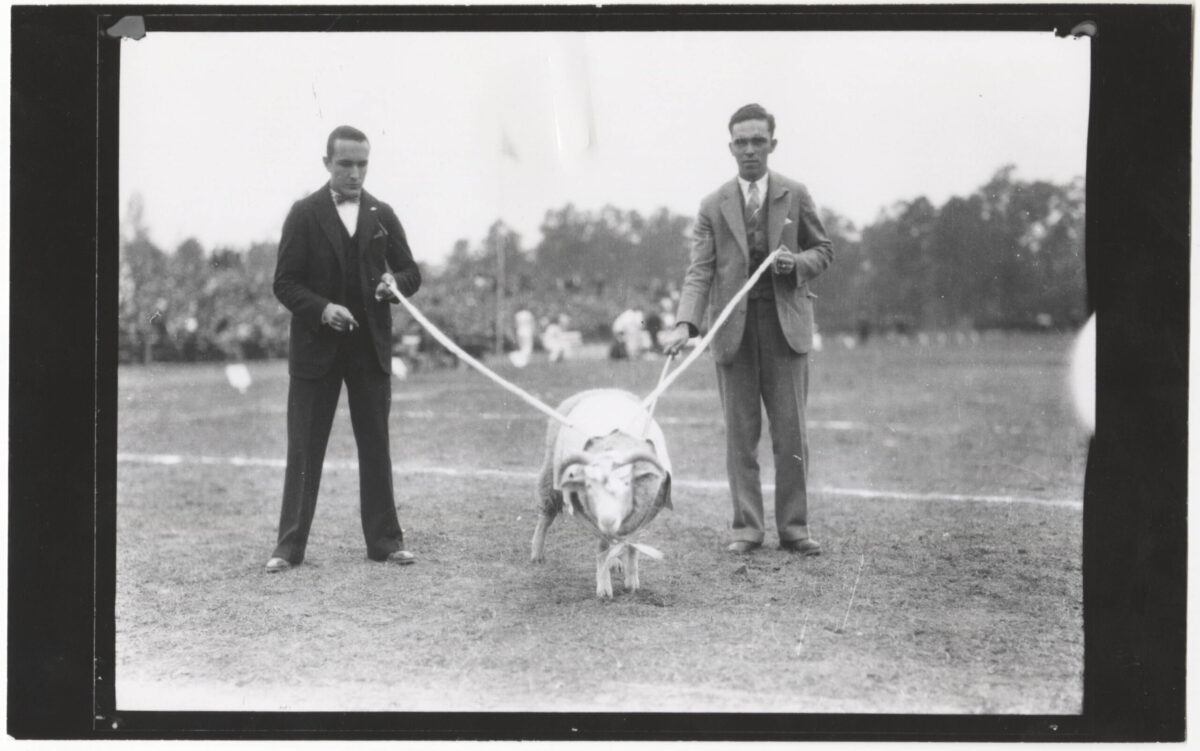
Rameses first appeared at Emerson Field in the fall of 1924. He was also trotted out for basketball games in early 1925. He didn’t live to see another season, as he died in the sweltering summer heat of his pen in the basement of Caldwell Hall. (Photo: UNC Library)
The Tar Heels first played the “Aggies” (a moniker for “agricultural”) in 1894, when NCSU was barely 2 years old. Contests were suspended for unknown reasons for a decade, returning in 1904.
As rivalries developed, so, too, did two UNC football traditions that continue today: an organized cheer squad and the adoption of a mascot. The cheer squad reportedly began spontaneously in 1914 when enthusiastic young professor Frank Porter Graham (class of 1909), — later UNC president and adviser to Presidents Franklin Roosevelt and Harry Truman — jumped up during a game and led the student section in coordinated vocal support for the players.
In fall 1924, UNC cheerleader Vic Huggins (class of 1925) approached Coach Charles Woollen (class of 1905) to ask about purchasing a mascot for the team. Woollen gave him $25 to buy a pedigree Dorset ram from a breeder in Texas, an animal chosen in honor of Carolina fullback Jack “Battering Ram” Merritt (class of 1925). The clever name of “Rameses” was a pharaonic reference to the craze for all things Egyptian, which entered popular culture following the discovery of King Tutankhamun’s tomb in 1922. Rameses appeared on the field that fall sporting a blue-and-white blanket emblazoned with the official “NC” school logo, and players rubbed the ram’s head for luck before games.
Sadly, the reign of the first Rameses was brief. After serving both the football and basketball teams in the fall and winter of 1924–25, Rameses was placed over the summer in the so-called “Carolina Zoo,” a collection of lab animals kept in the basement of Caldwell Hall. In the days before air conditioning, the unshorn ram was “entombed” in the sweltering basement and did not survive the summer. Fortunately, he left an off-spring who was christened for the 1925 football season, but also sadly died when several medical students extracted blood for a class experiment. (See “The Ram, the Myth, the Legend,” November/December 2024 Review.)
Both the University and the popularity of football grew exponentially in the 1920s. According to The Chapel Hill Weekly, “a crowd of more than 15,000 people” descended on campus for the annual Thanksgiving Day game against Virginia in November 1925, though Emerson Field only accommodated 3,000. “Chapel Hill has never before welcomed such a big throng as came to see the game,” the front-page Weekly article continued. “Wooden stands were built on one side and at both ends of the field to supplement the permanent concrete stands. Chairs and benches were placed in every available space. And still there were thousands who had to be content with standing room.”
University leaders needed a solution, and they would get one — a stadium, named to honor the Kenan family forever linked to Carolina athletics and academic excellence.
Kenneth Joel Zogry ’97 (MA, ’08 PhD) is a historian and preservation consultant in Raleigh and has researched and written extensively about UNC history.
His books include Print News and Raise Hell: The Daily Tar Heel, Evolution of a Modern University and The University’s Living Room: A History of the Carolina Inn.
Thanks for reading the Carolina Alumni Review
Carolina Alumni members, sign in to continue reading.
Not yet a member? Become one today.