Ackland Releases Color in New Exhibit
Posted on Sept. 22, 2025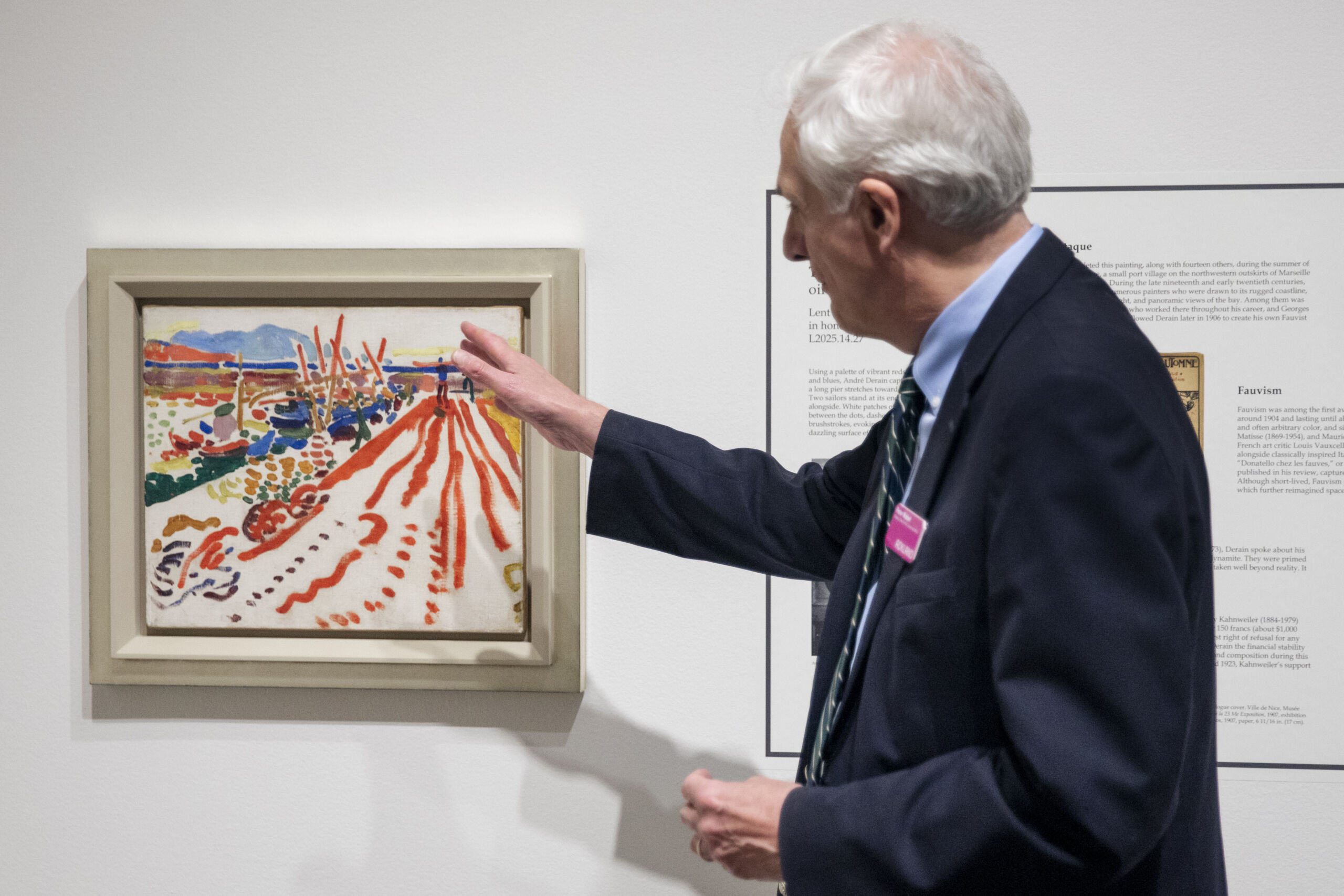
Peter Nisbet, the deputy director for curatorial affairs at the Ackland Art Museum, explains André Derain’s “The Jetty at L’Estaque” during a walkthrough of the new “Color Triumphant” exhibit . (Photo: Carolina Alumni/Ira Wilder ’24)
The Ackland Art Museum debuted Friday a colorful new exhibition, featuring works from the collection of the late Julian Robertson Jr. ’55 and his wife Josie.
Color Triumphant: Modern Art from the Collection of Julian and Josie Robertson brings to campus 54 works by 33 artists, including Claude Monet, Pablo Picasso, Camille Pissarro, Gerhard Richter, Frank Stella and Donald Sultan ’73. (See “New York Carolina Club Honors Artist,” July/August 2025 Review.)
The works are hung in sequence from impressionism to expressionism to abstraction. Peter Nisbet, deputy director for curatorial affairs, hopes visitors will trace the release of color over time. “That’s not to say that every painting is primarily about color or engages with color,” he said. “But it is a sort of thread through the show where you can see how color is sort of liberated and used in different ways at different times, whether it’s the atmospheric, fresh colors of nature in impressionism, the intensity of expressionism, where color becomes very subjective and unnatural.”
Color escapes throughout the display. One of the last pieces in the exhibition, “U.N. III” by American artist George Rickey, shows color physically leaping away from the two-dimensional and into a kinetic sculpture. Twenty-two colored metal strips within a framework spin slowly and randomly.
Nisbet said his favorite example of color’s liberation is the juxtaposition between two paintings on opposite ends of the display: tiny red flowers in Monet’s “The Seine at Argetuil,” a natural river scene, evolve into colossal explosions of red blooms in Donald Sultan’s “Four Red Flowers” and “Six Red Flowers.”
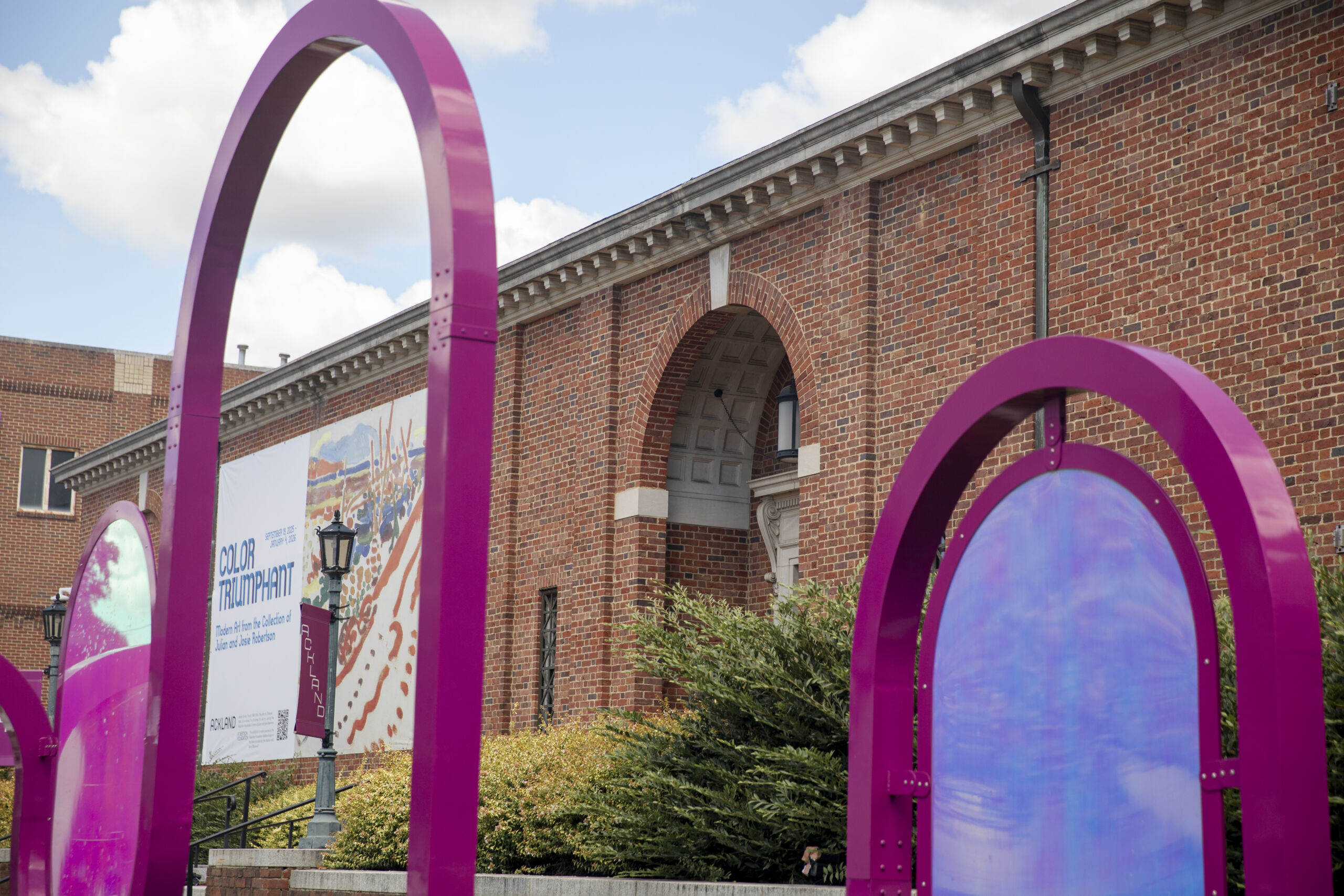
For several years, the Ackland has advertised its special exhibitions with a massive, singular artwork on the side of their building on Columbia Street. (Photo: Carolina Alumni/Ira Wilder ’24)
For several years, the Ackland has advertised its special exhibitions with a massive, singular artwork on the side of their building on Columbia Street. This time, the curators decided to highlight “The Jetty at L’Estaque,” a 1906 oil painting by French painter André Derain. Despite its huge presence mere feet from Franklin Street, the actual painting inside the museum measures only 18 inches across. “People may expect it to be a little bit bigger than it actually is,” Nisbet said. “But it has a monumentality and strength on its own.”
Nisbet said that the painting’s intensity and history made it a perfect representation of the exhibition. The painting is a classic example of Fauvism, which was a short-lived movement in French art between 1904 and 1908. The trend was a breakthrough in the use of color, as hues became non-naturalistic and several painters sought to represent a pattern on canvas rather than create a realistic scene. An entire wall of the Ackland’s exhibition is dedicated to the movement, which particularly appealed to the Robertsons.
After graduating from Carolina, Julian Robertson Jr. went on to a successful career in the hedge fund industry. He began collecting vibrant, expressive art in the late 1980s. Alongside his family, Robertson established the Robertson Foundation, which aims to grant $100 million annually to research related to education, the environment and medicine. The family also founded the Robertson Scholars Leadership Program in 2000, which offers students a fully-funded, dual-enrolled education at Carolina and Duke.
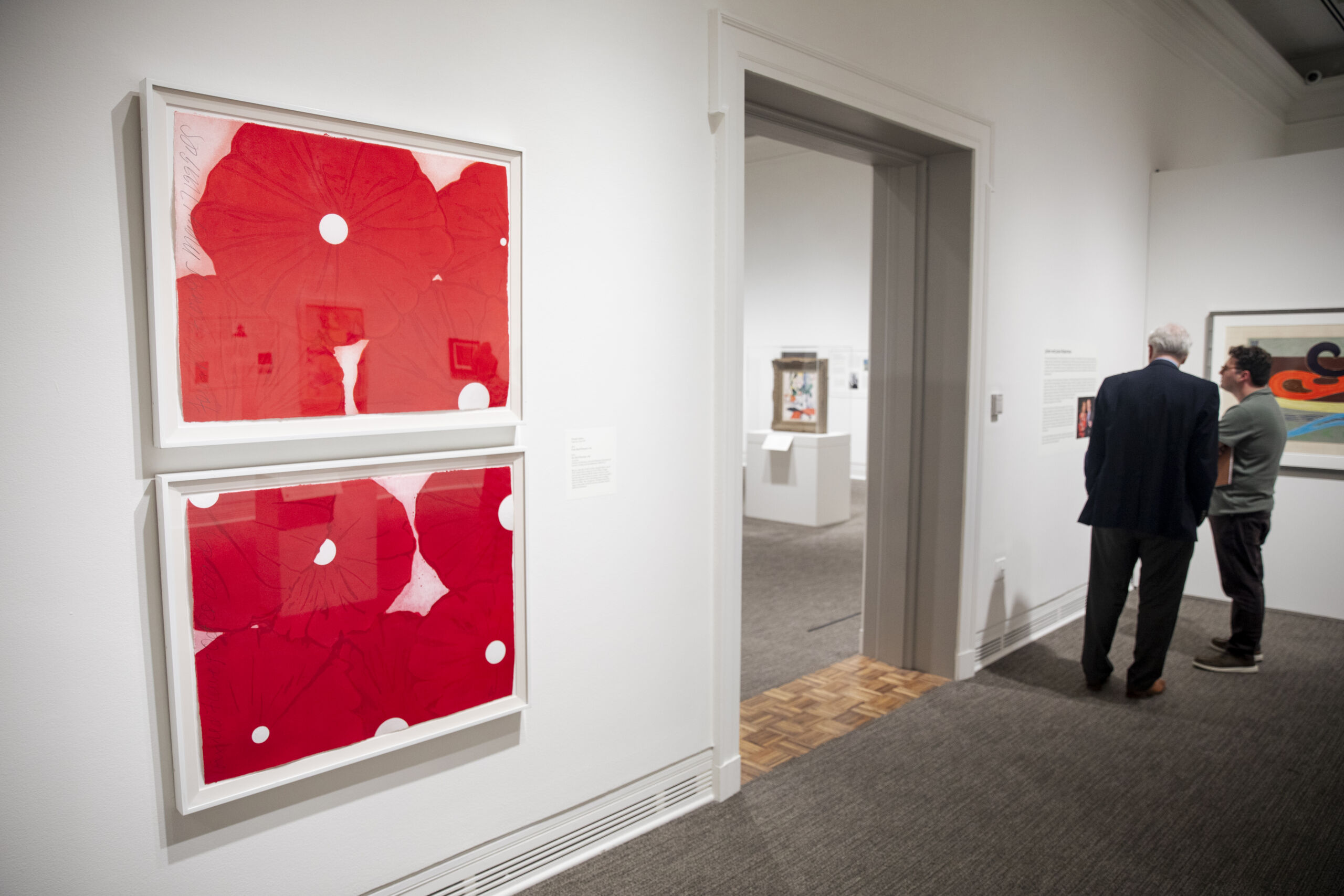
The exhibit also features two pieces, “Four Red Flowers” and “Six Red Flowers,” by Donald Sultan ’73, who was recently awarded the New York Carolina Club’s John L. Haber ’70 Award, or the Habey, earlier this year. (Photo: Carolina Alumni/Ira Wilder ’24)
Nisbet said the Ackland had a long-standing relationship with the Robertsons before Julian’s death in 2022, a relationship that continues through his estate today. (See “In Memoriam, Julian Robertson Jr.,” November/December 2022 Review.) Nisbet said he met with Julian and Josie in 2009, during which “she said she didn’t like a museum where there were more security guards than visitors, and I think that was a bit of the reputation of the Ackland a long time ago.”
Josie died in 2010, and during the following decade, Nisbet said he showed Julian that the Ackland was much livelier than his wife remembered — about 11,000 students and thousands of others visit the Ackland each year. The Robertsons lent works to the Ackland for four installations between 2011 and 2019. Seven pieces on display in Color Triumphant have been at the Ackland before.
Soon after Julian died, Robertson Foundation officials informed the Ackland that they believed it would be meaningful to the family for the collection to be shown on campus. “We, of course, said, ‘Absolutely,’ ” Nisbet recalled.
The exhibition will remain on display until Jan. 4, when it will be refitted for another section of the museum, where it will remain through the summer. That move will make way for the Ackland’s next exhibition, “Bill Bamberger [‘79]: Boys Will Be Men,” a series of portraits of male-identifying high school students, taken from 1984 to 2023 at schools nationwide. The images are accompanied by an audio program in which the students reflect on the pressures they experience in their daily lives. Selections of Bamberger’s photography will be on display from Jan. 30 until April 12.
The Ackland is open to the public, and admission to the museum is free.