An Invitation To Imagine
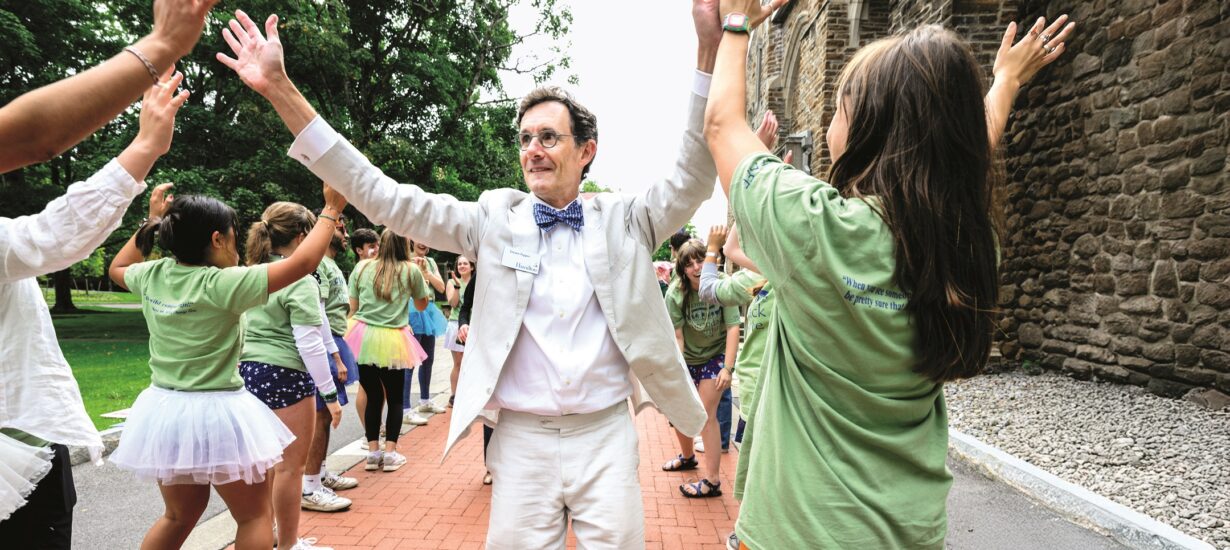
Steven Tepper ’89 has instituted a creative model for how universities approach solving tough issues.
Can it help resolve rising conflicts on campuses nationwide — and at UNC?
By John Bare ’87 (’92 MA, ’95 PhD)
Steven Tepper ’89 has bet his career on the human imagination.
Having just completed his first semester as the 21st president of Hamilton College in Clinton, New York, an institution whose first trustees included a Founding Father, Tepper is a bit of a founder himself. More than 20 years ago, Tepper and a handful of scholars imagined an alternative to the managerial-capitalism mindset that has served as the source code for generations of U.S. executives.
“Enlightenment and possibility. This is what fires me up,” Tepper said.
He describes his innovation — the creative campus leadership model — as a framework that promises new ways to make decisions and new ways to test and talk about ideas. The model’s distinctive feature is an invitation to students, faculty and staff to imagine and create new futures. In this way, the creative campus differs from management models in which those at the top of the organization chart judge success by how dutifully those below them implement their policies.
For example, at Arizona State University, where Tepper served as dean of the Herberger Institute for Design and the Arts from 2014 to 2024, he turned to the creative campus approach after an internal task force, as part of a national reckoning with sexual violence on campuses, recommended increased education and prevention measures. A typical administrative response might have ended there. Boxes checked, the elites in charge could close the case and move on.
But Tepper had a different approach. Using his creative campus model, the response looked more like an open research and development studio. In 2018, ASU asked students, faculty, artists and community members to imagine new ways to address sexual violence and to reshape the campus climate. Students produced a short play to engage incoming first-year students. Artists hosted conversations about sexual violence. On a quad where sexual assaults had occurred, artists and students set up 50 air mattresses and gathered for public discussions. Choreographers produced a mobile dance exhibition, organized alongside workshops in which students wrote poems and letters to survivors. Student feedback was positive, Tepper said, but a lack of funding cut short the programming and ended any chance to test for long-term effects.
Fast forward to today and Tepper’s model has taken on a new urgency. Surveys show that campuses nationwide need a new way to think through political changes, conflicts and curricula. Gallup reports that more than two-thirds of U.S. adults believe higher education is headed in the wrong direction. Culture and leadership are top sources of job dissatisfaction for faculty, according to a 2023 Harvard survey. Among post-secondary students, 1 in 4 report they have considered dropping out because they don’t feel like they belong, according to Gallup, and about the same share do not feel comfortable speaking freely on campus. A 2022 survey at UNC found a similar reluctance among some students to engage in discourse. (See “Some Students Across UNC System Avoid Speaking About Contentious Issues in Classroom,” November/December 2022 Review.)
HAMILTON COLLEGE
- Private liberal arts school, established 1793, chartered 1812
- President: Steven Tepper ’89
- Enrollment: 2,046
- Location: Clinton, NY
- 201 full-time faculty, 44 majors, 9:1 student-faculty ratio
- Namesake: Alexander Hamilton
- Acceptance rate: 13.5%
- Athletics: NCAA Division III, New England Small College Athletic Conference
- Mascot: Alex
Now with an increase in campus unrest that has turned violent at times, congressional investigations that have led to high-profile resignations of college presidents, conflicts over freedom of speech and charges of political influence in the classroom, the stakes for the future of the academy — and UNC — have risen. So, Tepper’s initiative matters, because what happens at Hamilton will not stay at Hamilton. For years, higher education has been on the lookout for better management practices, and Tepper believes his approach can steer campuses to productive dialogue, not by delivering simple answers but through unleashing expansive, imaginative thinking about the most complex questions facing campuses. Tepper believes creative disruption can bring both peace and prosperity.
“I think the creative campus could be critical to unsticking our current campus climate,” Tepper said. “How do we express our ideas without creating ideological division? How do we put inquiry over outrage? How do we help build empathy for subgroups who feel threatened by coarse and bigoted rhetoric?”
“We are stuck”

Tepper as UNC Student Body President with then-Chancellor Paul Hardin in 1989
For Tepper, the creative campus model has taken on greater significance. What began as a way to heighten student learning has now become a disruptive challenge to institutional bureaucracy. “When he started, it was more about the students and opening them up to new experiences. More recently the focus shifted to institutions, to shake up campuses,” said Bill Ivey, a past chairman of the National Endowment for the Arts and the founding director of Vanderbilt’s Curb Center for Art, Enterprise and Public Policy.
From 2004 to 2014, Tepper worked alongside Ivey as the center’s associate director. “With higher education now, lots of things are baked in — things like tenure, grading systems and how students declare majors. We are stuck,” Ivey said. “The future of higher education requires challenging that these are givens.”
For students to realize benefits from the creative campus model, university administrators have to be willing to reconsider their management practices.
Given that the administrators may benefit from the status quo, they can be slow to let go of power. This is where Tepper’s work begins. “My job is to get things unstuck,” he said. “So much of the idea of creativity is about getting unstuck.”
Having incubated the creative campus model, Tepper is now in a position to adopt it as the operating system for Hamilton College — and possibly show other universities an approach that could begin to find common ground among polarized students, faculty and administrators. Weeks into his tenure as president, Tepper launched the “What If” Initiative, flinging open a process for anyone and everyone to develop and submit experimental ideas to increase learning and improve teaching. The initiative’s goal is to enhance Hamilton’s “creative commitment to expression, fostering belonging and connection through the practice of the liberal arts” and to grow the college’s capacity “for collaboration, creative exchange, and non-routine approaches to fostering community, expression, and connection,” as Hamilton states on its website.
The “What If” ideas were due in December. This spring, Hamilton will announce R&D funding and monetary support to institute the most compelling suggestions.

At the core of Tepper’s creative campus model is speculative design, a methodology used to imagine multiple futures. The process assumes there are many potential “right” answers to knotty problems. (Photo: Hamilton College/Alexandria Leland)
In the meantime, Tepper offered an example of how a “What If” approach could work. “What if,” he asked, “rather than only putting up posters or holding teach-ins or preaching to the choir, we tried to learn and understand the lived experience of people who are different than we are, or tried to share our lived experience in artful ways. What if, as part of the recent election, our students and faculty wrote 2,000 love letters to someone on the other side of the political divide? Letters that shared something vulnerable; letters that acknowledge what we don’t know; letters that ask questions?”
At the core of Tepper’s creative campus model is speculative design, a methodology used to imagine multiple futures. The process assumes there are many potential “right” answers to knotty problems. The founders of speculative design describe it as “a catalyst for social dreaming.”
But the approach is tricky because it resists the human urge to identify a single best solution. In a culture where narratives tend to feature one clear loser and one clear winner, this can be a tough sell. To get there, Tepper cautions “against the purity of ideas.” Instead, he said, the creative campus “asks whether there are other ways — more humane and more open — to ask a question, to tell a story, to frame a debate, to see complexity instead of simplicity, to imagine alternatives.”
Like a sgraffito artist
The creative campus, in Tepper’s formulation, draws on imagination to find cultural solutions to what others may view as regulatory or technical problems. At ASU, Tepper deployed cultural solutions in an attempt to reshape the culture in ways that would ultimately reduce instances of sexual assault. For sure, technical improvements such as better campus lighting may help, and bigger budgets could provide safe-ride programs and improved clinical care for victims. But when campuses confront complex problems rooted in how humans treat one another — such as sexual assault — technical and regulatory measures can accomplish only so much.
What’s missing is the recognition that the problem may run deeper into our cultural DNA. Sometimes it’s not just lighting and clinical care that are broken. Community norms may be broken. The culture may be broken. Tepper designed the creative campus model on the belief that cultural problems require cultural solutions.
But asking administrators to focus on culture is a jolt. For generations, universities followed U.S. businesses and government agencies in adopting the manufacturing sector’s management and evaluation practices. In doing so, they placed a premium on maximizing the efficiencies of workflows and task completion to maximize measurable outputs. Promoted as “scientific management,” the approach required workers to follow directions precisely and suspend independent judgment. Managers were rewarded for producing the most with the least, and “an efficiency craze ensued,” historian David Hounshell wrote in a 1988 Harvard Business Review article.
Along the way, organizations fell to what Simon Head, a senior fellow at New York University’s Institute for Public Knowledge, calls “misindustrialization.” It was as if leaders of universities, governments and businesses all came to believe they could flourish using the same assembly-line processes that Ford Motor Co. used to manufacture automobiles. But by the late 20th century, Mike Judge’s movie Office Space gave voice to workers who had lost patience with the scientific management principles. A recurring joke in the film has as its punchline the paralysis of bureaucracies, such as bosses reprimanding staff for failing to arrange the cover pages of their monthly reports in a prescribed manner, despite the fact that management couldn’t explain why or how they used the information.
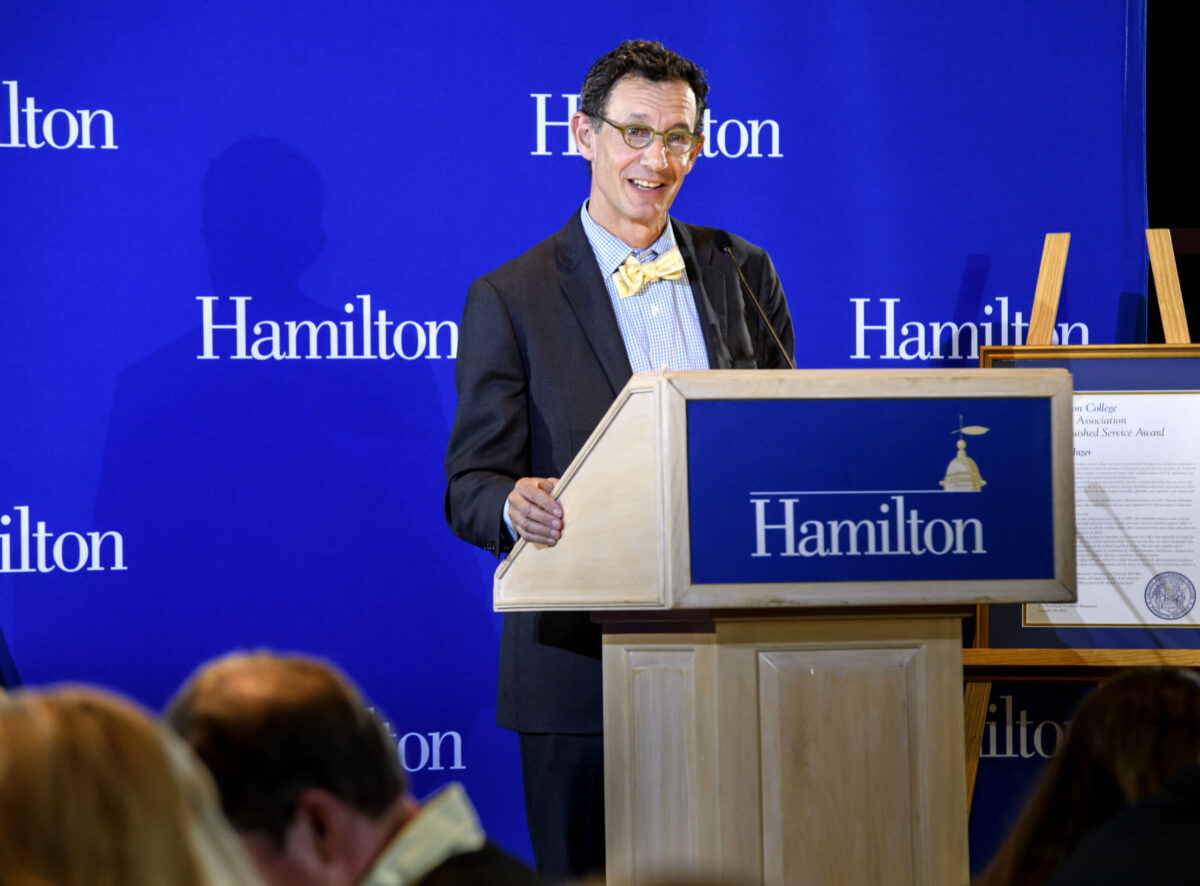
Tepper gives his inaugural address after being inducted as the 21st president at Hamilton College in September 2024. (Photo: Hamilton College/Nancy L. Ford)
By the time Office Space hit the screens, Tepper was pursuing a doctorate in sociology at Princeton University and working as deputy director of Princeton’s Center for Arts and Cultural Policy Studies, where he was searching for ways to “leverage public culture for public good.”
“First, I got frustrated with the narrow view of cultural policy as advocacy to get more public money to support the arts, and I became more interested in how the arts and creative expression can advance the public good and public policy,” Tepper said. “Second, I started thinking more broadly about creativity and public impact and the conditions for creativity to flourish. Third, I started studying cultural conflict in American cities and came to see fights over cultural expression as key to democracy.”
Tepper believed the capacity for creativity and imagination were somewhere underneath the arcane bureaucratic rules and processes. Like sgraffito artists — who create images by scratching off the paint on an object to reveal a color underneath, not by adding more of it — Tepper came to believe he didn’t need to pile on more directives to find solutions. Instead, he needed to scrape away the administrative layers that were suppressing what the philosopher Martha Nussbaum calls the “public imagination” — a force that can, she writes, “steer judges in their judging, legislators in their legislating, policymakers in measuring the quality of life of people both near and far.”
In a chapter titled “Webs of Meaning: Art and the Culture of Sexual Violence” which appeared in 2023 in the book Art, Advocacy, and Sexual Violence, Tepper examined how public imagination can fuel innovation. In describing what it takes to change culture, Tepper argues the creative campus model pulls leaders away from the typical administrative process and into new creative spaces.
“Cultural change demands the ability to imagine a different future,” he wrote. “It requires powerful stories to move people to action. It requires making the invisible visible so that we can address issues of equity and injustice that undermine our communities. Cultural change requires play, even when the issues and challenges are urgent and serious. Perhaps most importantly, cultural change requires reappropriating or reassembling symbols and narratives that perpetuate the dominant view of gender, sex, and power. Imagination, storytelling, play, and symbolic reassembly: These are the tools of the artist and designer. It is hard to imagine culture change without the arts at the center.”
For Tepper, culture is righteous because, as the anthropologist Agustín Fuentes writes in The Cambridge Handbook of the Imagination, it is “what makes the human mind possible.” Culture is both the sum total of our experiences and the mechanism we use to give meaning to our experiences. It is, Fuentes writes, the “webs of action and perception, memory and history, and materials and ideas in which humans are entangled.”
ASU President Michael Crow worked with Tepper for a decade and believes in the power of the creative campus. “Higher education desperately needs new models for enhanced individualized learning and whole new ways to take individual humans to their highest level of creativity possible,” he said. “The creative campus, as developed under Steven’s leadership, is intended to create these kinds of learning environments.”
Critical time at UNC
It all started with a Carolina blue sweatsuit. Tepper was 6 years old and living in Silver Spring, Maryland, when a Tar Heel uncle from Winston-Salem gifted him the merch. “That was all it took,” he said. He was Carolina bound before he got to second grade.
Over time, family visits to North Carolina heightened his attention to Southern culture. Tepper observed local passions for everything from the state flower to college sports. “They talked about barbecue in this crazy way,” he said. “The South was more exotic to me. I felt like I was awash in culture.”
At Carolina, Tepper majored in international studies, pledged Chi Phi, advised the APPLES community service program and was inducted into orders of the Grail, the Old Well and the Golden Fleece. He was president of the class of 1989 and led a campaign that raised $500,000 to endow a chair for excellence in undergraduate teaching, the first chair in the country endowed by students. He found nostalgia and revived the Germans Dance, a gown-and-gloves heirloom from the University’s postwar years. “It was intoxicating to me. I loved it,” he said.
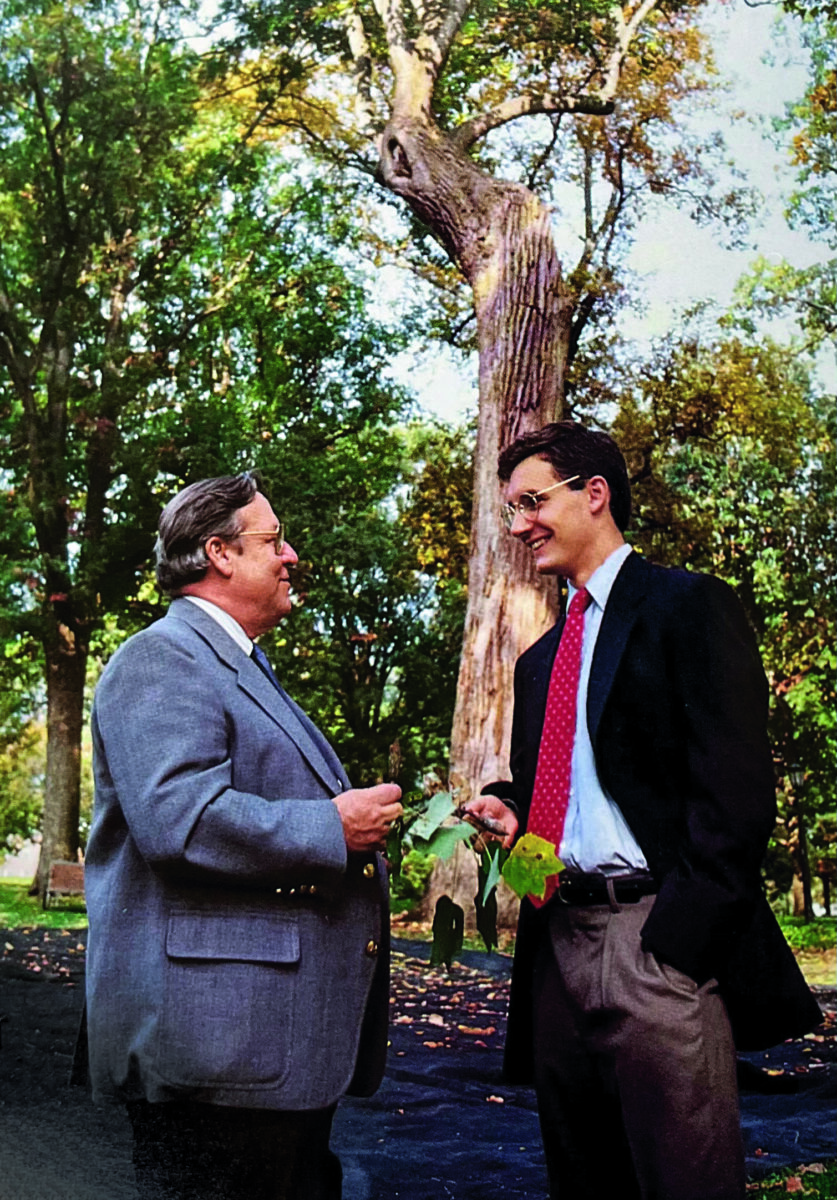
Tepper and political science professor Dick Richardson at Carolina’s Bicentennial celebration in 1993.
For the 1989 Commencement, Tepper secured Roger Mudd ’53 (MA) as speaker. The journalist challenged graduates to question the cultural norms that made it OK for U.S. leaders to break the law. “After 30 years of watching government, I am regularly caught by surprise by the influence of a single person or a small group,” Mudd told the graduates.
At the time, a small group of individuals was coming together to orchestrate the University’s 200th birthday party. What had begun as a planning committee in the early 1980s had grown into the Bicentennial Observance Office, with William Massey ’68, associate vice chancellor for University relations, running the show. Massey recruited the newly graduated Tepper for his team, and the four-year sprint to pull off the celebration would change the course of Tepper’s life.
When Massey left the University in 1991, two years before the 200th anniversary, Tepper worried that a search for Massey’s successor would require staff to start over with a new director and a new plan. Tepper made his case to then-Chancellor Paul Hardin. “I went into his office and said we cannot go out to hire a new director,” Tepper said. “I told him, ‘We have a plan. Just let me run it.’ Everything is possible when you’re that age. There was youthful, endless energy.”
On the spot, Hardin put Tepper in the executive director role and accepted Tepper’s recommendation for the popular political science Professor Dick Richardson to serve as faculty chair. The office would grow to 20 staff members and a $4.5 million budget. Unfolding before the interposition of technology and social media, the bicentennial experience was intensely human, and on campus, Tepper was moved by the generosity directed toward him. “The bicentennial could have been a really political thing,” he said. “But everyone wanted to help this young guy. There was support everywhere I turned.”
From August 1993, two months before the bicentennial was celebrated, to May 1994, seven months after, Tepper and his team produced 132 events. All in, more than 300,000 people participated in bicentennial programs. In hindsight, Tepper notes that it mattered for his future that none of the events was conducted over Zoom. He attended in person and witnessed a close-up look at how the power of culture fosters human connections in ways that build community. “His UNC experience was absolutely critical to him in that role, making sure UNC made sense to the state,” Ivey said. “Considering his time at Harvard, Princeton and other places, nothing was as important as his time at UNC.”
His bicentennial highlight reel includes 1993’s University Day. On that October afternoon, Dean Smith arrived at McCorkle Place to present Davie Poplar saplings to sixth-grade students who would carry them home to plant in every one of the state’s 100 counties. Later that evening in Kenan Stadium, Charles Kuralt ’55 asked the question that sticks with us still, “What is it that binds us to this place as to no other?” President Bill Clinton, a speaker at the event, talked about prepping for his Chapel Hill visit by spending an evening with James Taylor and asking Taylor to sing “Carolina in My Mind.”
Then came Carolina Saturday. On April 9, 1994, six months after the bicentennial celebration, 35,000 people showed up to the University’s open house. As cool as it was to have Clinton in Kenan Stadium a few months earlier, the public’s desire to connect with the wonders that the University’s creative minds could produce was equally as intoxicating. People stood in long lines to see a digital mapping lab and a virtual reality demo. “It affirmed to me the appetite, love and curiosity for the University,” Tepper said. “It made me ask: Why is University life cloistered? The campus is full of artists, scientists and professors from all disciplines. Why are their voices not part of everyday life in the state?”
High expectations
Tepper left Carolina for graduate school in fall 1994 and earned a master’s in public policy at Harvard’s Kennedy School, but the school never felt like a fit. When he learned Princeton sociologists Paul DiMaggio and Stan Katz were launching the Center for Arts and Cultural Policy Studies, he knew he’d found his path and moved to Princeton to work at the center and study sociology.
To develop the creative campus idea, Tepper led summer retreats with practitioners and scholars to reimagine cultural policy for the country. He advised a think tank on ways to position artists as key assets for universities. He published a 2004 cover story for The Chronicle of Higher Education, proposing a new creativity index to track “where creativity is flourishing and where it is languishing.” The response to the article pulled him into roadshows, talks and workshops, and the Doris Duke Foundation awarded grants to universities to experiment with creative campus innovations. “In traveling the country, it was evident to me that faculty and administrators were seeking something different — a catalyst to get people working in new ways to unleash possibility and to get beyond what increasingly felt like institutions driven by metrics and not by possibility,” Tepper said.
Years later, when Tepper was at Vanderbilt’s art, enterprise and public policy center, Ivey, the founding director of the center, witnessed how Tepper turned potential competitors into collaborators. “Steven is willing to put himself in challenging situations and then work his way out with some kind of larger consensus. He’s great at that,” Ivey said. “He has a lively, disciplined imagination. He’s patient, respectful and doesn’t bow up.”
Dan Nye, a Hamilton College trustee and member of the school’s presidential search committee that settled on Tepper, described Tepper as “a persuasive optimist with contagious enthusiasm and positive energy. Steven’s colleagues want to follow his lead because he has an exciting vision, collaborates well with others, has a terrific sense of humor and genuinely cares about his mission, the institution, the students, the faculty and making a difference. We have very high expectations for the role Steven will play at Hamilton College over the next decade.”
Quentin Messer III, a junior at Hamilton and a student representative on the presidential search committee, is a believer in the creative campus model but said skeptics may treat the idea “as all fluff with little grounding. The critical question is how we can convince the next generation of college-goers that this model will ultimately translate into career success and personal growth beyond their time at Hamilton?”
Going all-in on the creative campus is a gamble. There’s the risk of overreaching, perhaps ruining a good thing. Experimentation over the last two decades would seem to remove any doubt that the creative campus model holds value as a nice-to-have management tool. Maybe it’s most effective when it’s matched to particular situations.
Indeed, if the creative campus is the shiny object that holds more appeal than the current day-to-day drudgery, is it even possible for it to hold its appeal when it becomes the one and only thing? Maybe it’s swapping out one daily grind for another. The most clear-eyed risk assessment expert might argue that complex problems by their nature resist interventional forces. Maybe some stuff is just hard to change, whether administrators use a command-and-control model or the creative campus model.
Having incubated the creative campus model, Tepper is now in a position to adopt it as the operating system for Hamilton College — and possibly show other universities an approach that could begin to find common ground among polarized students, faculty and administrators.
Tepper acknowledged there has been no systematic review of his high-profile experiments, saying “programmatic initiatives have to be baked into the structure of the organization for them to yield long-term transformative change. I think there have been long-term changes, but they have been harder to measure.”
Messer is confident Tepper’s manner and message will fuel enthusiasts and bring along doubters, and ASU’s Crow said Tepper’s gifts include “a skill set for collaboration-based leadership that is as evolved as I have ever seen in anyone. He is a naturally collaborative intellectual leader of the highest order.”
In a sector marinating in miasma, Tepper’s viewpoint is distinctive: “You can doomscroll your way through life or ask what else we can imagine.” It is not that he manages to be joyful despite higher education’s sclerotic systems. It is that he’s filled with joy by the potential for the creative process to transform the systems.
Tepper has an image in his mind of what success looks like. In it, graduates will be “explorers and storytellers. They can imagine and empathize. They are super curious about others, especially others from different backgrounds. They embrace complexity.”
At a time when university trustees, administrators, faculties and students often don’t trust one other enough to come together to solve problems, and are wrestling with perceived threats and meddling, the creative campus model may ripple across the country. If so, Tepper foresees higher education answering its highest calling: to increase human flourishing. “Universities are the most amazing things we’ve ever built in this democracy,” he said. “If we don’t do this at universities, where’s it going to happen?”
John Bare, a writer and photographer based in Concord, is the author of My Biscuit Baby, a novel set in Chapel Hill. His latest Review article, “Rival Royalty,” told the story of the tradition of UNC’s Beat Dook Queen.
Thanks for reading the Carolina Alumni Review
Carolina Alumni members, sign in to continue reading.
Not yet a member? Become one today.