Carolina Football Comes of Age
Posted on Oct. 13, 2025The name-image-and-likeness era of Tar Heel football under famed head coach Bill Belichick is now underway, and the Review is taking the opportunity to look at the little-known history of the program. Part 1 of this three-part series focused on the origin of UNC football. (See “A Bit of Hair or Blood,” July/August 2025 Review.) Part 2 tells the story of the growth and the evolving professionalism of the amateur game during tumultuous times in American history and how they influenced Carolina football.
UNC football was on a roll in 1929,the same year a scathing report questioned whether profit-oriented college sports were anathema to academia.
by Kenneth Joel Zogry ’97 (MA, ’08 PhD)
Listen to this story as read by ElevenLabs AI.
On Thanksgiving Day 1925, when a crowd of more than 15,000 fans arrived in Chapel Hill to watch the Tar Heels take on rival Virginia at Carolina’s Emerson Field, where the Pit and surrounding buildings are today, only 3,000 attendees could find seating in the concrete stands built less than a decade earlier. The University had expected more fans, so workers had erected temporary wooden bleachers and placed chairs and benches wherever they could, according to The Chapel Hill Weekly. But thousands were left standing. The newspaper reported that Chapel Hill had never seen such a large crowd gather for any event, let alone a football game.
After UNC beat Virginia 6–0, University leaders knew they needed a much larger stadium. The sudden increase in spectators wasn’t due only to rising interest in football but occurred in tandem with expansion of the student body and campus during the 1920s.
UNC President Edward Kidder Graham (class of 1898) initiated the plans, and his successor Harry Woodburn Chase carried them out, adding new departments and disciplines and tripling the student body from approximately 1,000 in 1920 to 3,000 by 1930. (See “Harry Who?” September/October 2014 Review.)
To accommodate the growth, a campaign by school administrators and alumni led to a landmark $11.5 million appropriation from the State Legislature in 1921. The University retained the renowned firm of McKim, Mead & White to develop a master plan, and they in turn recommended architect Arthur Nash to design the principal buildings in a cohesive neoclassical style. By January 1922, The Tar Heel reported that “accompanied by the sounds of clanking machinery operating late into the night beneath the full glare of high powered electric lamps the new dormitory quadrangle at the University is proceeding according to schedule.”

Postcard of original Kenan Stadium entrance with dedication plaque (sideview, ca. 1930)
Nash, who designed Wilson Library, Memorial Hall, several dormitories, classroom buildings and The Carolina Inn, was asked to design a new stadium to be located in a wooded area south of the new library. The initial concept called for a group of alumni to donate funds to pay for a horseshoe-shaped arena that would seat 33,500 people, with provisions for future expansion, at a cost approaching $500,000.
When the effort to raise funds from multiple alumni failed, William Rand Kenan Jr. (class of 1894) stepped in to foot the entire bill for a somewhat smaller, less grandiose structure. Kenan’s wealth came from several successful business ventures, including his early involvement with the Union Carbide Corp., founded in part on discoveries he and John Motley Morehead III (class of 1891) made as students with chemistry Professor Francis Venable. Kenan inherited additional wealth from his sister, Mary Lily Kenan Flagler Bingham, who was also a major benefactor to UNC.
Construction began in November 1926, and as the stadium rose, Kenan decided to add a 20,000-square-foot field house for permanent training facilities and locker rooms for visiting teams. The stadium was completed in time for the 1927 season. Fixed capacity topped out at 24,000 with temporary bleachers in the end zones adding 16,000 more seats when needed. The total cost of the project was $303,000 (about $5.6 million today).
The new facility was named Kenan Memorial Stadium in honor of Kenan Jr.’s parents, William Rand Kenan Sr. (class of 1864) and Mary Hargrave Kenan, part of a prominent family in eastern North Carolina who maintained an antebellum-era plantation, where as many as 50 enslaved people had worked. In 2018, researchers discovered that after the Civil War, Kenan Sr. participated in the 1898 Wilmington Coup d’etat, which forcibly removed duly elected Black and white political opponents from the city council and left at least 25 people dead. Following the revelation, and in consultation with the Kenan family, UNC Chancellor Carol Folt announced in 2018 that the father’s name would be removed from the stadium. In its place, Kenan Jr. would be honored for his generous support of the University over many years.
“The highly profitable enterprise”
On the field of play, UNC’s football team, which had struggled at the start of the decade, had winning records throughout the later 1920s, culminating in a 9-1 record and coming in third in the confrence in 1929. Its lone loss came against Georgia. Carolina’s average margin of victory that year was 28.6 points, including a 48–7 blowout of Duke at the rival’s brand-new stadium. Southern California was the only team nationwide to score more points than the Tar Heels’ 346. Team captain Ray Farris ’30, an offensive lineman, was named second-team All-America by the Associated Press.
Carolina was now a bona fide football school. But as the popularity of football grew, so did concern that the sport didn’t fit well with the educational mission of the University. In 1929, the Carnegie Foundation for the Advancement of Teaching issued a scathing independent study titled American College Athletics. Commonly referred to as The Carnegie Report, it detailed the history, growth and commercialization of college athletics, especially “the highly profitable enterprise” of football primarily through revenue generated from ticket sales. The report’s authors accused universities of recruiting athletes and described the practice in unflattering terms as “a businesslike procedure.” In addition, some colleges paid student-athletes or found them “cushy jobs,” both of which were illegal.

Kenan Stadium was officially dedicated at the annual Thanksgiving Day matchup of the “Oldest Rivalry in the South” with UVA on Nov. 24, 1927. A crowd of some 28,000, exceeding official capacity, watched the Tar Heels defeat the Cavaliers, 14-13.
The report, which was widely covered in the press, questioned the very fabric of college athletics, calling it “profoundly deleterious” and a “noxious influence on higher education.” The authors also said the ideal of amateurism was in peril. To them, collegiate sports were organized for the enjoyment and development of the student-athlete, not for financial gain of universities.
“The question is not so much whether athletics in their present form should be fostered by the university, but how fully can a university that fosters professional athletics discharge its primary function,” the report stated. “Can it concentrate its attention on securing teams that win, without impairing the sincerity and vigor of its intellectual purpose?”
The report claimed most football players appear to enjoy playing, “but their enjoyment seems to arise from more intangible rewards — the atmosphere surrounding competition, the notoriety that success brings, and the like.” Most players said that for actual fun, they preferred less formal intramural games to intercollegiate.
Schools in the Big Ten conference, specifically the University of Michigan, were cited as major violators of conference rules. Michigan administrators defended the school claiming the report’s authors “cherry picked” its evidence. Carolina is mentioned three times in the report but in a relatively positive light: first as an example of a university where faculty control the regulation of athletics, which the report said was “salutary;” second as an example of a state school that keeps “an excellent account of all student athletic activities;” and third as an example where the head football coach “assumed and maintained an authority which was vested theoretically in a director of physical education.”
The report claimed most football players appear to enjoy playing, “but their enjoyment seems to arise from more intangible rewards — the atmosphere surrounding competition, the notoriety that success brings, and the like.” Most players said that for actual fun, they preferred less formal intramural games to intercollegiate.
Any immediate action by the University to address the 1929 Carnegie Report was delayed by the onset of the Great Depression. In 1935, however, president of the newly formed Consolidated UNC System, Frank Porter Graham (class of 1909 and Carolina’s first official cheerleader), devised a series of regulations known as the Graham Plan to keep college sports strictly amateur. No gifts or favors could be given or promised during recruiting. No scholarships were to be awarded except for academic merit. All players had to be students in good standing. And no one — including alumni — could subsidize players publicly or privately.
The response to the Graham Plan was swift and loud from Carolina students and alumni, who feared other schools would “wink” at the rules and leave UNC at a distinct disadvantage. According to the Yackety Yack, alumni in particular “raised hell” about Graham’s proposal, and a serious effort was mounted to remove him from his new position as president of the three-campus system. In the end, the plan lasted only four months, though the fallout led to UNC’s then football coach Carl Snavely accepting the position of head coach at Cornell in 1936.
Gone bowling
From 1902 to 1935, college football had only one bowl game, the Rose Bowl, and Carolina never played in it. UNC, however, did play a bit part in the 1942 contest. After the attack on Pearl Harbor just weeks before the scheduled New Year’s Day game, Rose Bowl organizers were concerned about a possible Japanese invasion of the West Coast. For the first and only time in Rose Bowl history, the game was moved from its usual venue in Pasadena, California, to Durham, as Duke was to face off with Oregon State. The game was to be played in Duke’s stadium, and the Oregon State team took up residence at The Carolina Inn. UNC students and alumni were ecstatic when the Beavers beat the Blue Devils, 20–16.
The Orange Bowl, Sugar Bowl and Cotton Bowl were added in the mid-1930s, though Carolina, which had four one-loss seasons in that decade, was not invited to participate in any of these postseason games. In hopes of securing bowl invitations, Carolina welcomed back head coach Carl Snavely following World War II. Known as “The Grey Fox” for the gray suits he wore on game days, Snavely had a long coaching career that included stints at Cornell and Bucknell, and he achieved an impressive overall record of 180–96–16. During his second stint at Carolina, an eight-year span, the Tar Heels achieved their highest rankings in the program’s history, due in no small part to a halfback from Asheville — Charlie “Choo Choo” Justice ’50.
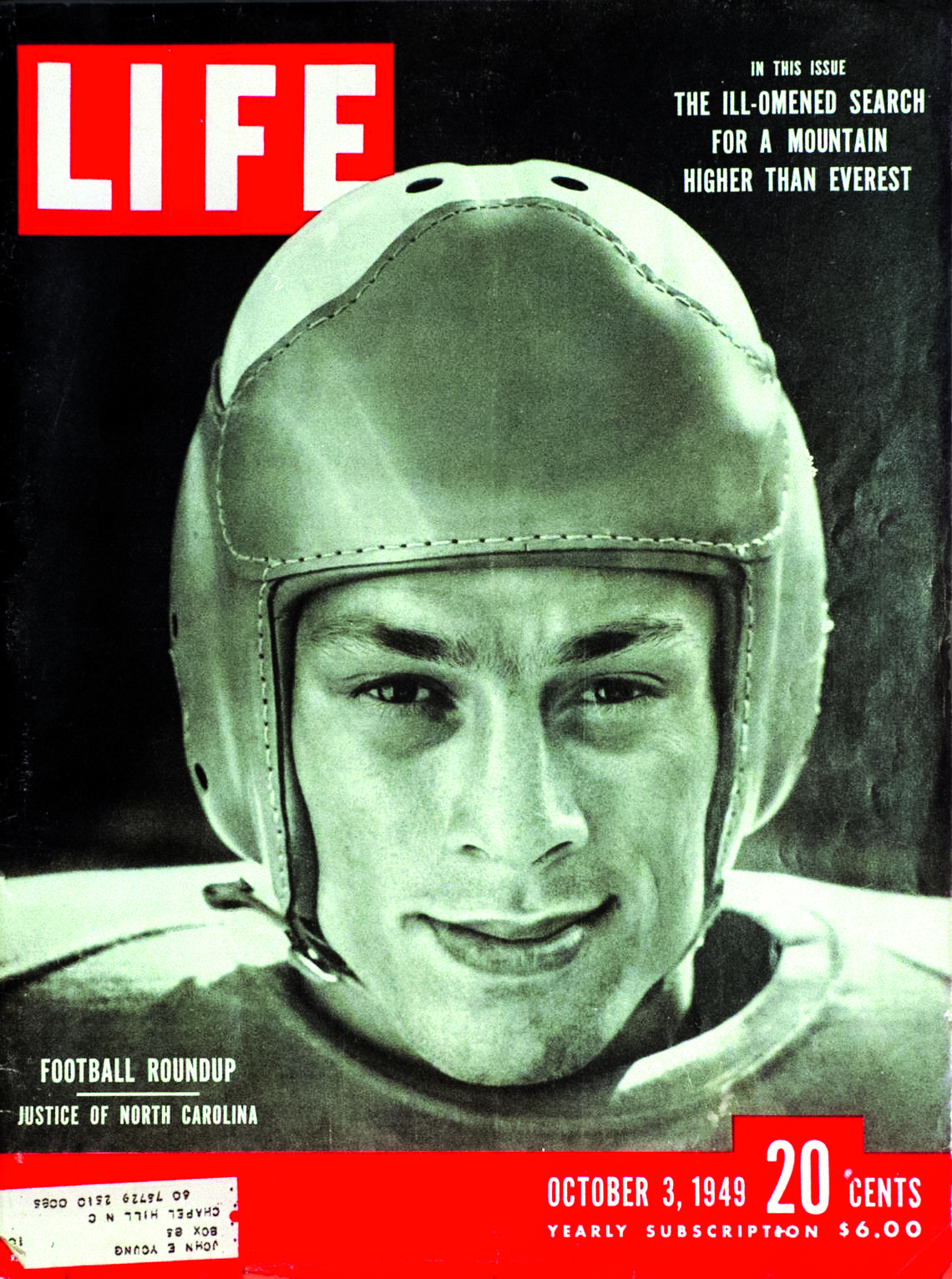
“Choo Choo” Justice on the cover of Life magazine, Oct. 3, 1949
With a nickname derived from his speed and drive on the field — steaming past opponents like a runaway train — Justice was twice nominated for the Heisman Trophy (coming in second both times). He led Carolina to two Southern Conference championships during his playing career and a No. 1 national ranking at one point during the 1948 season, the only time Carolina football has claimed the top position thus far in its 136-year history. Overall, UNC finished that season ranked third with a 9-0-1 record.
Carolina football reached a fever pitch in the late 1940s, with attendance records peaking at 44,500. Songs were written about Justice (“All the Way Choo Choo”), and he appeared on the cover of Life magazine. Aside from the hype, Justice, who served in the Navy during World War II, represented well the young men returning to college after four years of life-changing war. Like many vets, Justice, at age 22, was an older freshman and married. He chose UNC over other offers, in part because the GI Bill of Rights covered his tuition and the University agreed to transfer his full football scholarship to his wife, Sarah Hunter Justice ’50.
Carolina played three games during the Justice era that attracted national attention, including two Sugar Bowl appearances, in which the Tar Heels lost 20–10 to Georgia in 1947 and 14–6 to Oklahoma in 1949. The 1947 contest was nationally televised, marking the first UNC football game seen on TV.
The third was a regular season game Nov. 12, 1949, when an estimated 2,000 students and some 30,000 alumni flooded into New York City to see Carolina play No. 15 Notre Dame in Yankee Stadium. For weeks in advance, The Daily Tar Heel published stories touting preparations for the big game, including speculation about whether injured star Justice would play. In a jubilant mass exodus from Chapel Hill, students arrived in New York by plane, train and automobile. The DTH, under the banner “NYC Bureau: Statler Hilton,” put out two special air mail editions of the newspaper that were flown from Manhattan to Chapel Hill.
Students crammed into hotel rooms and caused a ruckus when they built a bonfire in the middle of Times Square and staged a pep rally that shut down traffic. With 32,000 Carolina fans in the city, a reporter for The DTH quipped: “Hotel space is more scarce than tickets to South Pacific,” which was a sold-out hit musical on Broadway at the time. Despite exuberant support from the Carolina Nation, Justice remained sidelined with his injury and UNC lost the game, 42–6.
After the height of the Justice era, which concluded with a 27–13 loss to Rice University in the 1950 Cotton Bowl, Carolina football faded from the national spotlight. The team did not make another bowl appearance for 13 years, during which time another popular sport rose in prominence on campus.
Part 3 of this series will cover the 1950s, a turbulent decade for Carolina football, when basketball overtook it as the school’s premier varsity sport, head coaches clashed, and scandals made headlines.
Kenneth Joel Zogry ’97 (MA, ’08 PhD) is a historian and preservation consultant in Raleigh who has researched and written extensively about UNC history. His books include Print News and Raise Hell: The Daily Tar Heel and the Evolution of a Modern University (UNC Press: 2018) and The University’s Living Room: A History of the Carolina Inn (UNC: 1999).
The Color Line
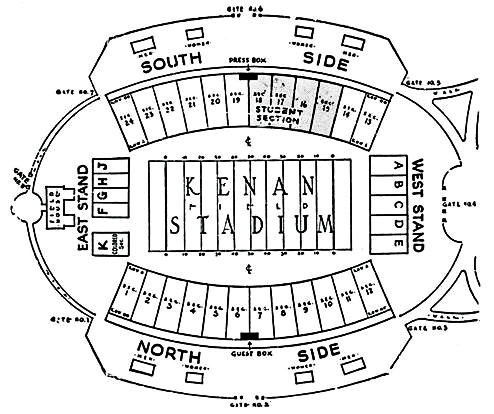
1961 seating plan for Kenan Stadium, showing Section K as physically separated from the other stands and marked “Colored Sec.”
In September 1951, law student James Walker Jr. (’52 LLB), one of the first Black students admitted to UNC, told The Daily Tar Heel that he refused his home-season football tickets because “they were marked colored and entitled me to a seat in section ‘K’ [behind the end zone] which is reserved for colored persons” instead of regular student seating. “I feel that I am part of the student body and want to cheer and express school spirit as part of the student body,” he stated, “not be set apart in an undignified and humiliating manner as proposed by the administration.”
At this time, all enrolled students were sent packets of tickets for home games in a special section of Kenan Stadium. Realizing the handful of newly admitted Black students also received these tickets, then-Chancellor Robert House called the small group into his office and told them he needed to exchange those tickets for seats in the segregated “Negro” section of the stadium. House’s logic, reported The DTH, was that there was “a distinction between educational services and social recognition,” adding that Kenan Stadium was paid for with donated nongovernmental funds and run by the Athletic Association, a private entity.
Student body president Henry Bowers ’52 was appalled and “challenged the right of the University Administration to place Negro students in the colored section of the stadium,” The DTH reported. A DTH editorial was even more unequivocal:
“There should be no second-class student at the University of North Carolina. Any person who gains admission here is entitled to be a student first class. To admit students, and then to discriminate against them because of race, religion, creed, or economic circumstances is thoroughly repugnant to the cardinal principle for which this venerable citadel of democracy and freedom has so long stood — equal treatment for all students, special privileges to none.”
The NAACP joined the protest and filed suit. Ultimately, the racial segregation was stopped, and all enrolled students were given tickets in the designated student section.
A Torn Jersey’s Journey

In November 1948, 16-year-old diehard Carolina football fan C.D. “Dick” Spangler ’54, then a student at Woodberry Forest School in Virginia, attended the annual Thanksgiving Day game between the Tar Heels and Virginia at Scott Stadium in Charlottesville. During the game, Justice’s jersey was torn, and he went back to the bench where he swapped it for a fresh one. The torn jersey was put in the equipment box to be discarded, but an enterprising Spangler bribed a cheerleader $10 (about $132 today) to retrieve it for him.
On the way out of the stadium Spangler was offered up to $100 for the jersey, but he declined. Spangler kept the jersey tucked away as a prized possession for decades, during which time he built a highly successful career as a businessman and banker. In 1986 he was named president of the UNC System and later donated the jersey to Carolina. It is now on display in the Carolina Hall of Honor at Kenan Stadium.
Justice played in the NFL for the Washington Redskins, his career cut short by injuries. He returned to western North Carolina and opened a business. He and his wife, Sarah ’50, also gave their time to charities and to support the University. “I’d like to be remembered more for what I’ve done for humanity and the state of North Carolina than for my athletic abilities,” Justice told a reporter in 1987. UNC President Emeritus William Friday ’48 (LLB) said of Justice: “I have never seen anybody that did as much as he did for causes from the American Heart Association to Crippled Children to Christmas Seals to the University itself.”
Flying Dixie
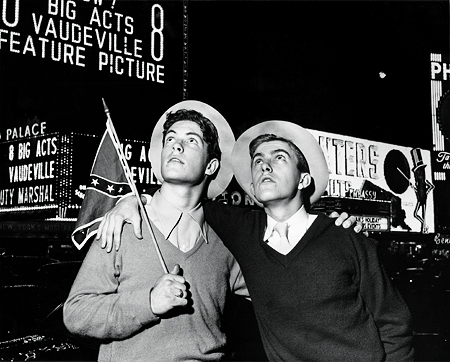
During Carolina football’s jubilant Golden Age of UNC head coach Carl Snavely and Charlie “Choo Choo” Justice ’50, a fan tradition began: the waving of thousands of small Confederate “stars and bars” battle flags by Carolina students and alumni to show spirit during games.
Although no photographs are known to exist of this practice, there are several well-publicized images of UNC students and alumni brandishing the flags around Manhattan in the lead-up to the much-anticipated 1949 game with No. 1-ranked Notre Dame, which would go on to claim the national championship. Also, in the late 1940s, the marching band began breaking into an upbeat version of “Dixie” after a good play and during halftime. This ceased after several Black UNC athletes protested in the late 1960s.
While the playing of “Dixie” was not criticized initially, the waving of the miniature Confederate battle flags was condemned by a few students in the pages of The Daily Tar Heel. In November 1948, an editorial appeared headlined “Put Away the Stars and Bars,” calling for abolishment of the new practice. It was written by Bill Robertson (class unrecorded), one of a dozen or so purported Communist Party members among the approximate 4,500 students on campus. The DTH editor hired Robertson to write alternative perspective editorials during the so-called Red Scare, which followed World War II. “The Confederate flag is a banner of a government which defended the barbarous institution of slavery,” Robertson wrote, and the South “engaged in an armed rebellion against the fundamental principles of American democracy.” Angry letters poured in, one calling Robertson a “Kremlin Stooge.” A fellow Communist student came to Robertson’s defense writing: “The Civil War was not a football game, in which every Southerner must cheer his team. It was a war fought over the issue of slavery; in that war, there was a right side and a wrong side.” Ultimately student and alumni outrage prevailed, and Robertson was fired from The DTH staff.
Thanks for reading the Carolina Alumni Review
Carolina Alumni members, sign in to continue reading.
Not yet a member? Become one today.