Clear Communication
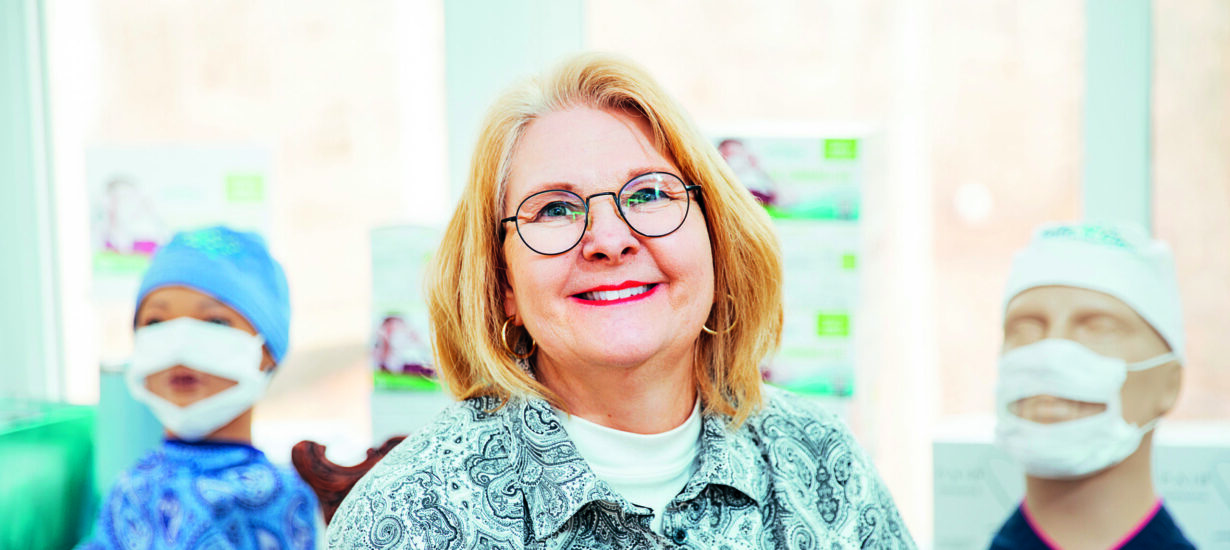
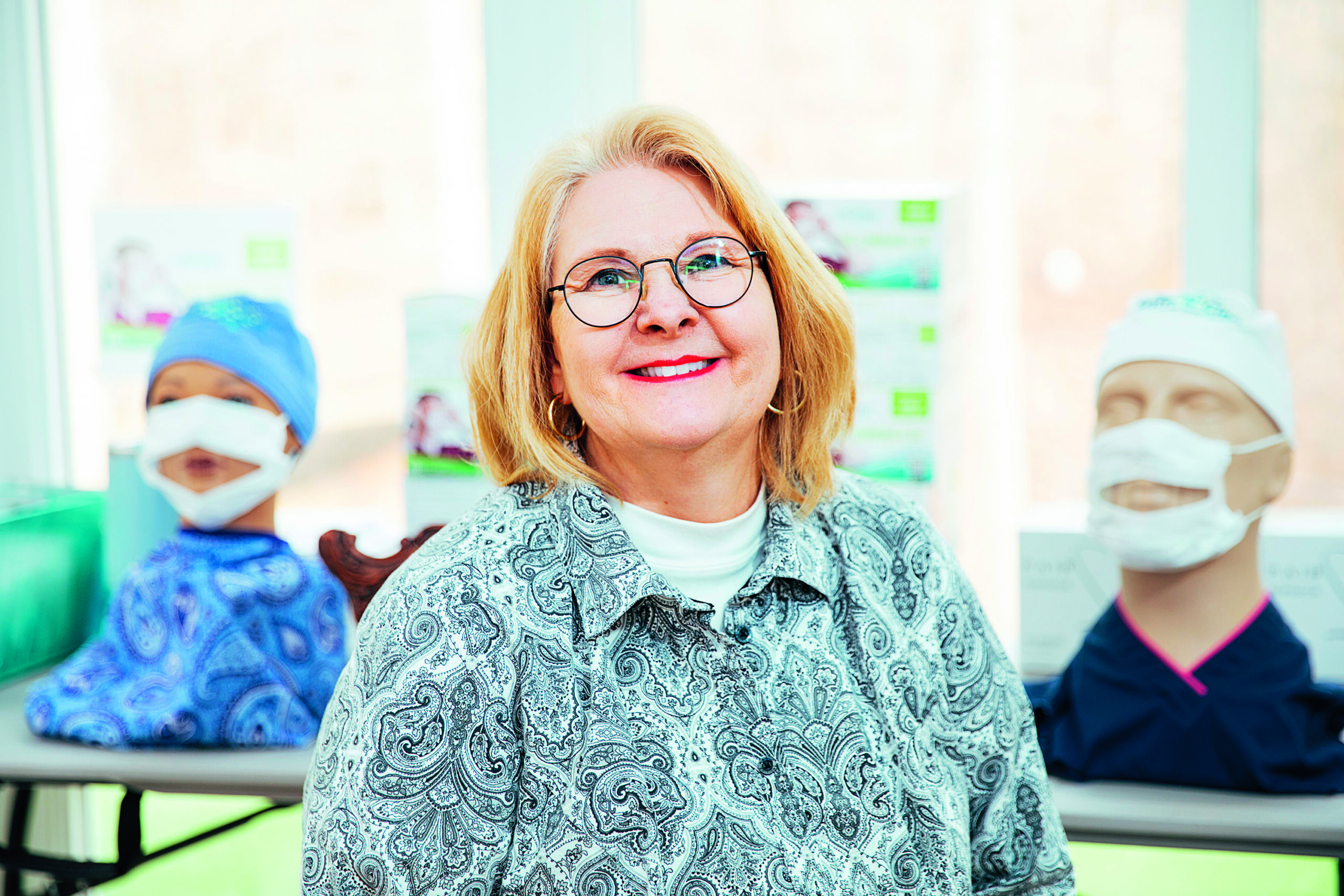
“I’m deaf, but I’m a good listener,” Anne McIntosh ’88 said. She got advice from friends at church before working with a mask manufacturer. (Photo: Carolina Alumni/Ira Wilder ’24)
Anne McIntosh ’88 has been deaf since she was about 6 weeks old. But she “mainstreamed” her way through her early life, attending public school in Mecklenburg County, reading lips to get by. “I sucked it up,” she said.
She didn’t learn sign language until she was an undergraduate at Carolina, hiking from Spencer Residence Hall on Franklin Street to the medical school for the class.
Though she never let her disability define her, it did inspire her life’s passion: communication. She received her master’s in interpersonal and intercultural communication from the University of Montana in 1990 and her doctorate in communication sciences and disorders from the University of Texas at Austin in 1995. Since then, she’s been a professor of communication at Central Piedmont Community College and the University of Maryland.
In 2001, she and her husband, Wayne Puckett, were excited to welcome their first daughter into the world. She did all the prenatal training and read all the pamphlets, researching everything she could to prepare herself for what she assumed would be a natural delivery. But after 25 hours of labor, she learned she’d need a C-section.
She was moved from a labor and delivery room, where no one wore a mask, to an operating room, where she couldn’t see anyone’s face or read any lips. She felt helpless, confused and scared, especially since the health of her daughter was at stake.
“My world changed,” she said. “I said, ‘You know what? I’m a college professor, and I have three degrees in communication, and I can’t communicate. This is not good for business.’ ”
Though the birth was successful, her mind spiraled. What if she needed blood? Her husband didn’t know her blood type. What if the doctors needed to treat an infection and didn’t know she was allergic to penicillin? She felt temporarily suspended from actively participating in her own health care.
“It wasn’t that I didn’t know the answers to the question, I just did not know what the question was,” she said.
McIntosh knew she wasn’t alone. About 11 million people in the United States consider themselves deaf, according to the American Community Survey, and countless others struggle to understand masked clinicians in high-stress environments.
The solution was obvious to her. If she had been able to read the doctor’s lips, she would have made it through with ease. So she embarked on a mission to create a clear mask.
About 11 million people in the United States consider themselves deaf, and countless others struggle to understand masked clinicians in high-stress environments.
McIntosh founded Safe ‘N’ Clear in 2012, years before the pandemic would put masks on everyone’s minds and in front of their mouths. She continues to lead the company, which markets the world’s first FDA-approved medical face mask with a clear window, according to its website. Its customers include hundreds of hospitals and clinics.
McIntosh said she never dreamed of being an entrepreneur or “the mother of all invention.” She loved teaching college students, but the problem she encountered while delivering her daughter, Sophia, was too staggering to ignore.
It took years to get the venture off the ground, but she eventually collaborated with a mask manufacturer that helped her navigate the lengthy patent and approval processes necessary to bring a medical product to market.
McIntosh said, even for well-hearing people, each year mask-related miscommunication costs insurance companies and hospitals millions of dollars in unsafe discharges, additional diagnostics and pharmaceutical instructions.
And she knows accessibility is good for business. The Return on Disability Group estimates differently abled people account for about $18 trillion in annual spending globally. Companies focused on disability inclusion report 60 percent higher revenue and 160 percent higher net income than other companies, according to the consulting firm Accenture and the nonprofit advocacy organization Disability:IN.
Wider adoption of McIntosh’s masks benefits her bottom line, but that aligns with her broader goal to make communication clearer in settings where miscommunication carries serious consequences.
The clear mask is just one result of McIntosh’s mission, which is inspired by a lesson she learned in a botany class at Carolina: Heterogenous groups outperform homogenous ones. It’s a thesis that’s shaped her life’s work. She has taught officers of the Charlotte-Mecklenburg Police Department how to communicate autopsy results and incident reports to the families of victims. And as part of the University of Maryland’s Global Campus, she teaches active-duty soldiers around the world how to see the heterogenous world through someone else’s eyes.
She serves on the board of Disability:IN North Carolina, the state chapter of one of the world’s largest disability nonprofits. It connects businesses with employees who have disabilities, cultivating inclusion in the workplace by matching individuals to jobs.
McIntosh now puts most of her energy toward marketing the masks and potentially developing a clear N95 mask, which is more protective than a regular surgical mask.
Her philosophy remains consistent across classrooms, operating rooms and warzones: Better outcomes emerge when communication is crystal clear.
—Ira Wilder ’24
Thanks for reading the Carolina Alumni Review
Carolina Alumni members, sign in to continue reading.
Not yet a member? Become one today.