For the Love of Sharks
Posted on April 10, 2026Chelsea Black is prepared to spend the rest of her life swimming against the current.
by Mark Derewicz
Sharks, healers. Two words few humans would put together, but Black does so on purpose in her quest to demythologize sharks as dangerous. (PHOTO: Tanner Mansell)
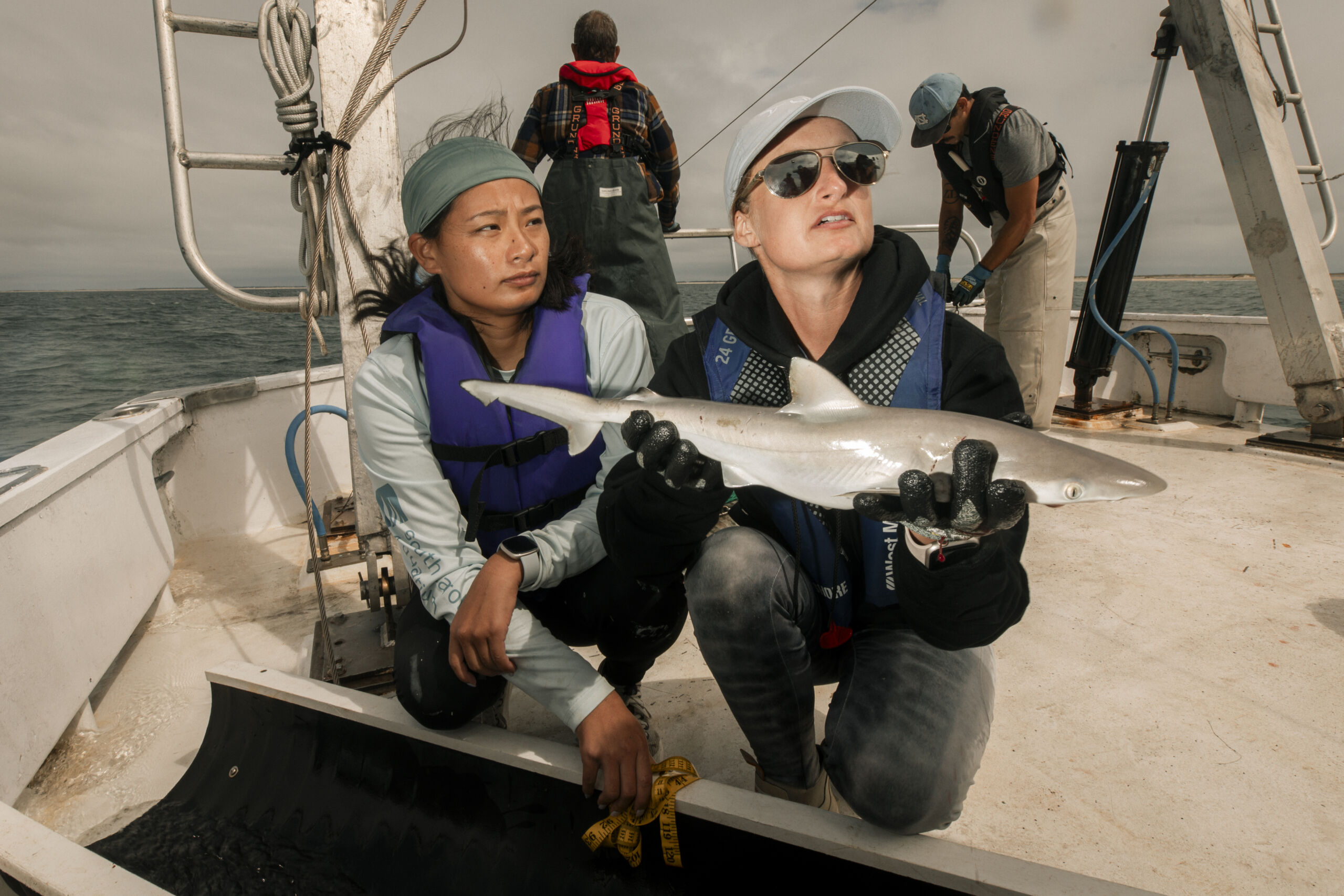
On a 48-foot boat drifting on calm waters near Cape Lookout, marine biologist Chelsea Black pressed down on the snout of a 4-foot Atlantic sharpnose shark, releasing a clear gel from tiny pores as water washed through its gills.
“See that jelly? It’s part of the shark’s sensory system called ampullae,” she said. “It’s how sharks sense electromagnetic impulses from the Earth for navigation or from other sea life, especially prey.”
That pretty much sums up what humans think they know about the weird jelly, and that wasn’t good enough for Black, a UNC postdoctoral researcher obsessed with sharks. She thought maybe there’s more to the ampullae, which she described as a direct line for saltwater, which is full of nasty bacteria and viruses, to enter the shark’s body. Yet, sharks are rarely, if ever, found in ill health, unlike other marine life.
“I think I’m the first person to squeeze out this jelly from a live shark and culture the bacteria in it ,” said Black, matter-of-factly, who is working on this project with UNC microbiologist Alecia Septer. “We found that the jelly is full of good bacteria, and we think that helps sharks fight off infections. It’s another line of defense against their environment. They evolved over millions of years to do this. They are incredible healers.”
Sharks, healers. Two words few humans would put together, but Black does so on purpose in her quest to demythologize sharks as dangerous. “It’s not that you’ll never get bitten by a shark,” she said, “but … if sharks thought of us as prey, we would see 100-fold more attacks.” And yes, she blames our fear on the 1975 blockbuster Jaws, in which a 25-foot great white shark killed a few people and then seemed intent on eating three particular humans, who, to be fair, were trying to kill it.
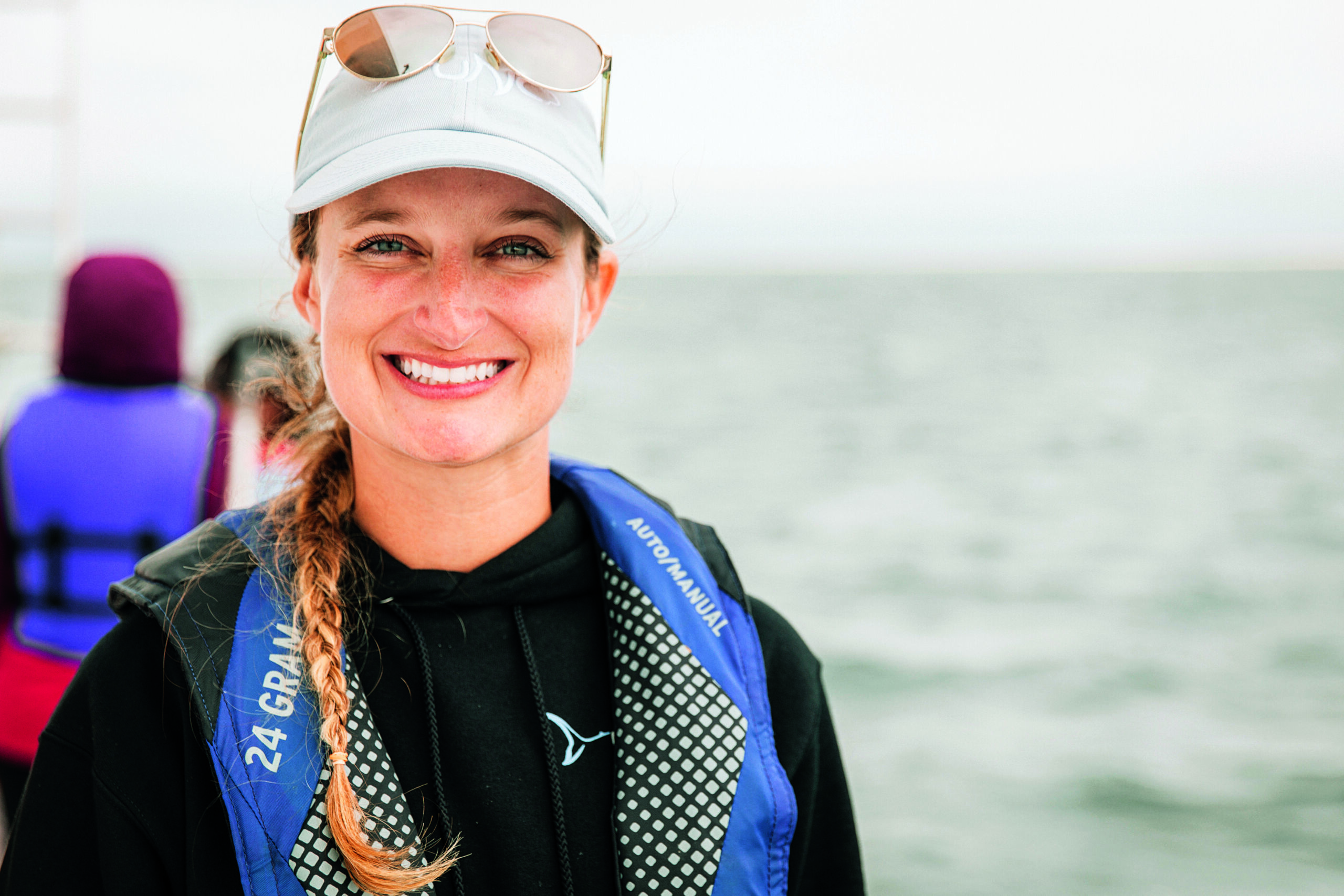
Off North Carolina’s coast, Black leads a shark survey that began more than 50 years ago. She’s also the only person tagging and tracking tiger sharks in the middle of the Indian Ocean to limit the number of sharks that become soup. (PHOTO: Ira Wilder ’24)
In defense of sharks, Black says they investigate the underwater world with their mouths, and as nature would have it, their mouths are full of super sharp teeth. Humans are not the meaty fish or fatty seals that sharks love to eat. We’re mostly bone and water. “It’s like us eating celery,” she said. Black would prefer people understand the vital role sharks play in a healthy ecosystem, which humans also depend on. Without sharks as apex predators, there is no balanced ecosystem. We need them.
Off North Carolina’s coast, Black documents species diversity and water temperatures as part of a survey that began more than 50 years ago at the UNC Institute of Marine Sciences in Morehead City. Her other work is that of a pioneer. She’s the only person tagging and tracking tiger sharks in the middle of the Indian Ocean to limit the number of sharks that become soup. That goal, too, is ultimately for the health of ocean habitats, a cause she took up as a child.
Born like this
Black, 31, was born in Miami, and her first word was “agua.” The word “sea” is in her name and she’s an Aquarius. “I was born drawn to the ocean,” she said, and her parents noticed, sending her to a marine biology camp each summer. She swam with sea turtles in Costa Rica, whales in Canada and manatees in Florida. Her parents thought she’d grow out of it, but Black only grew more fascinated with marine life, even when her family moved to Asheville when she was 3. For college she chose UNC-Wilmington to pursue undergraduate work on the ocean. She took a course with a shark expert professor and watched a documentary on the global threat to sharks, especially in Southeast Asia. Indonesia, she learned, has by far the most shark diversity on Earth.
“I realized that if I helped protect sharks, then I am helping the ocean as a whole,” she said.
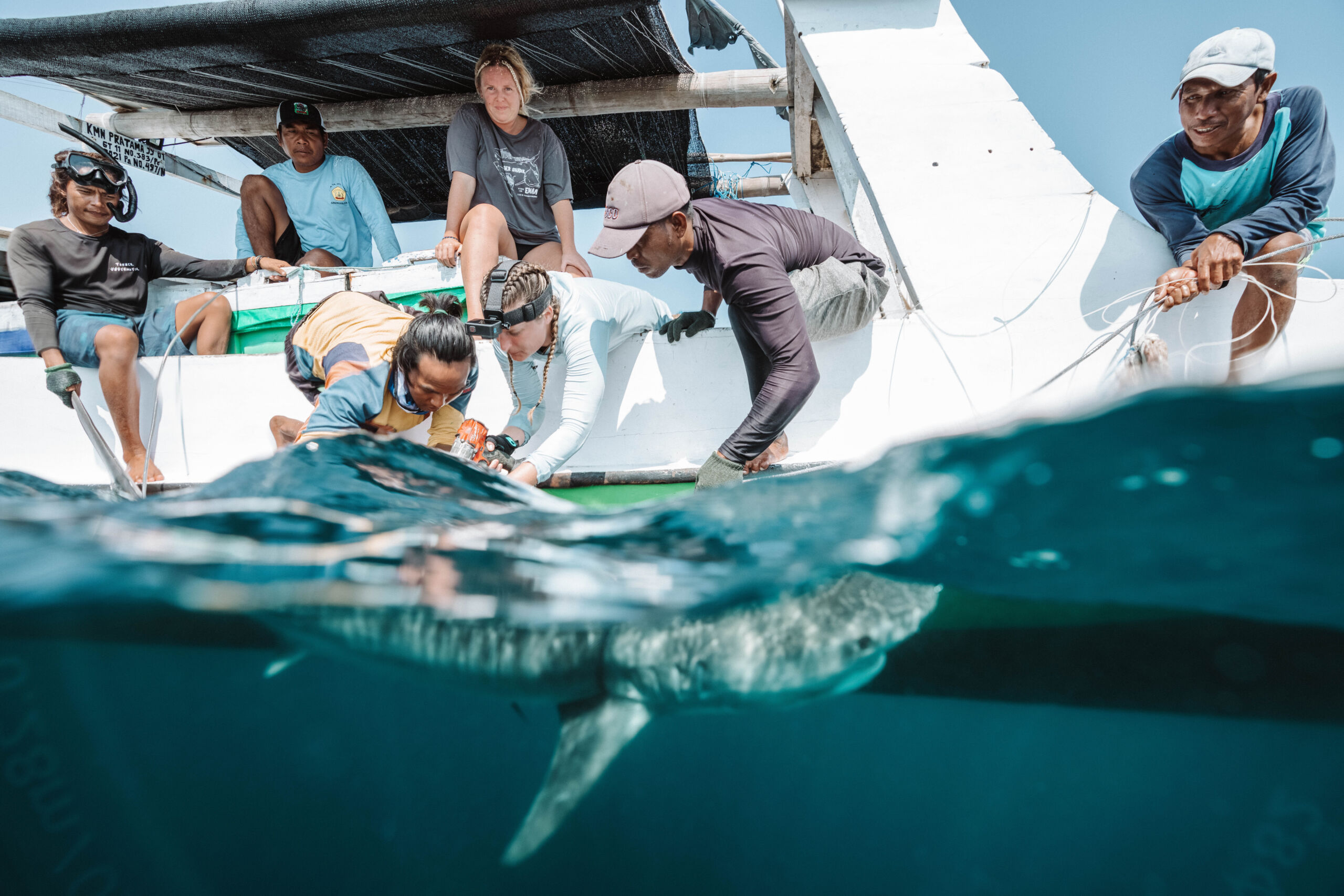
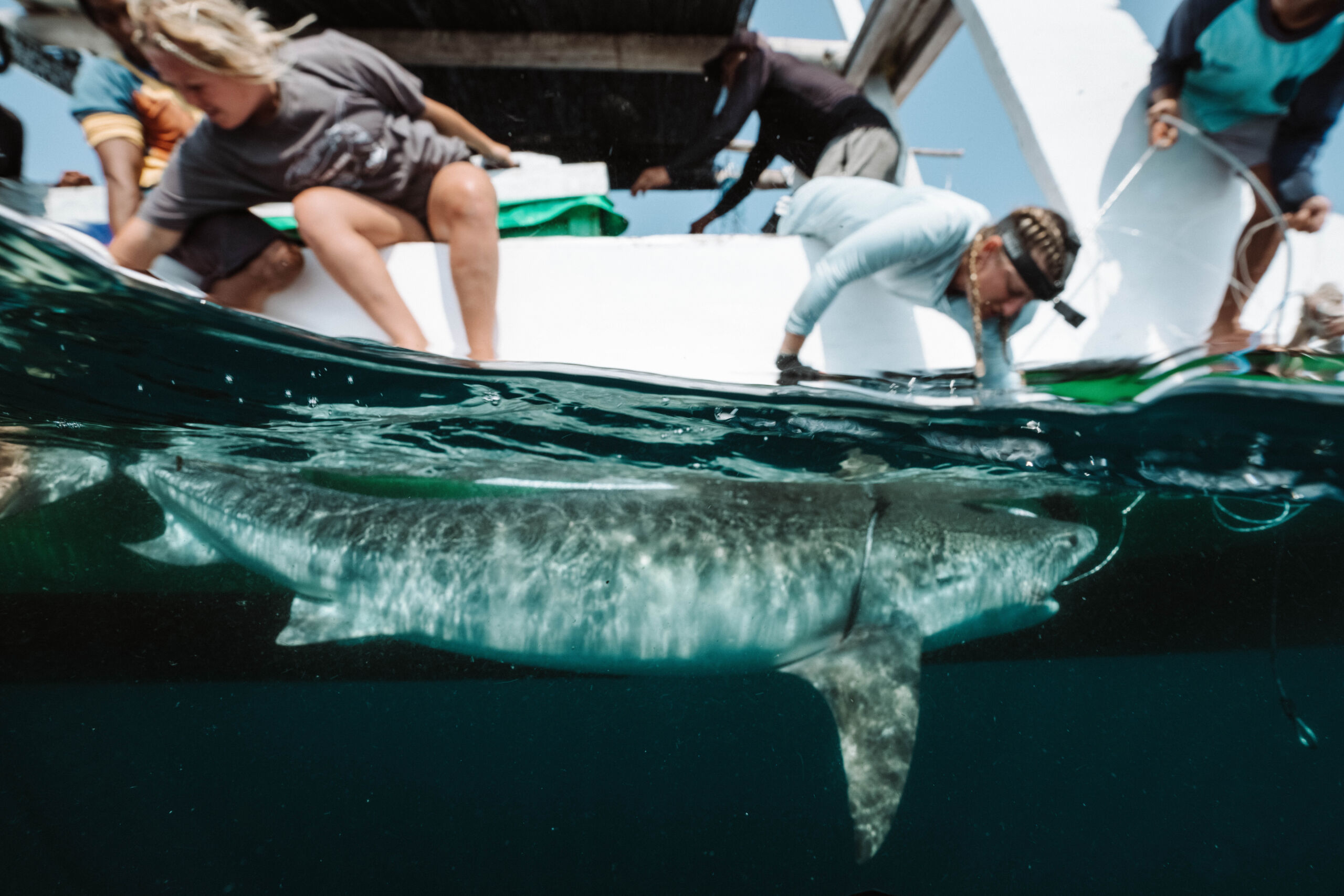
Chelsea Black (center, holding impact driver tool) reaches to tag a tiger shark with a tracking device. Project Hiu founder Madison Stewart (in the water) hired Black as the nonprofit’s science officer in 2023. (PHOTO: Tanner Mansell)
The summer after her junior year she dove off the coast of Fiji to swim with 80 bull sharks, a vulnerable species, and study their behaviors. “They could not care less about us being there,” she said. “They would just swim on by. This is what got me hooked on sharks. I wanted to study them forever.”
She interned in South Africa to study great whites the summer before attending the University of Miami for graduate school. Then she chose Carolina for her postdoctoral work largely because UNC manages the longest-running shark survey in the country, dating back to 1972, when it was spearheaded by the marine zoologist Frank Schwartz. Black now leads it, with oversight from institute director Joel Fodrie ’99.
Back in the 1970s, the survey revealed North Carolina’s diversity of sharks, including a lot of great whites and tiger sharks, both of which can grow to be longer than a 1975 station wagon. But in the past 10 years, the survey has documented a sharp decline in biodiversity and a substantial rise in Atlantic sharpnose sharks. “We’re not sure why,” Black said, “but I think it’s because we’ve lost the large predators that eat smaller sharks.” And that is largely due to overfishing, a problem that is far worse on the other side of the globe, as Black would experience firsthand.
A five-hour tour
Black leads a survey crew by boat every other week from April through November in Onslow Bay and farther into the Atlantic off Cape Hatteras. In September, her crew departed Morehead City at 7 a.m. and an hour later netted hundreds of fish to bait a hundred hooks on a kilometer-long buoyed steel cable. They methodically released the cable into the water and waited another hour before steadily reeling the cable back and hauling onto the boat dozens of small sharks, one by one. They repeated the work at a second location before returning to port around 1 p.m.
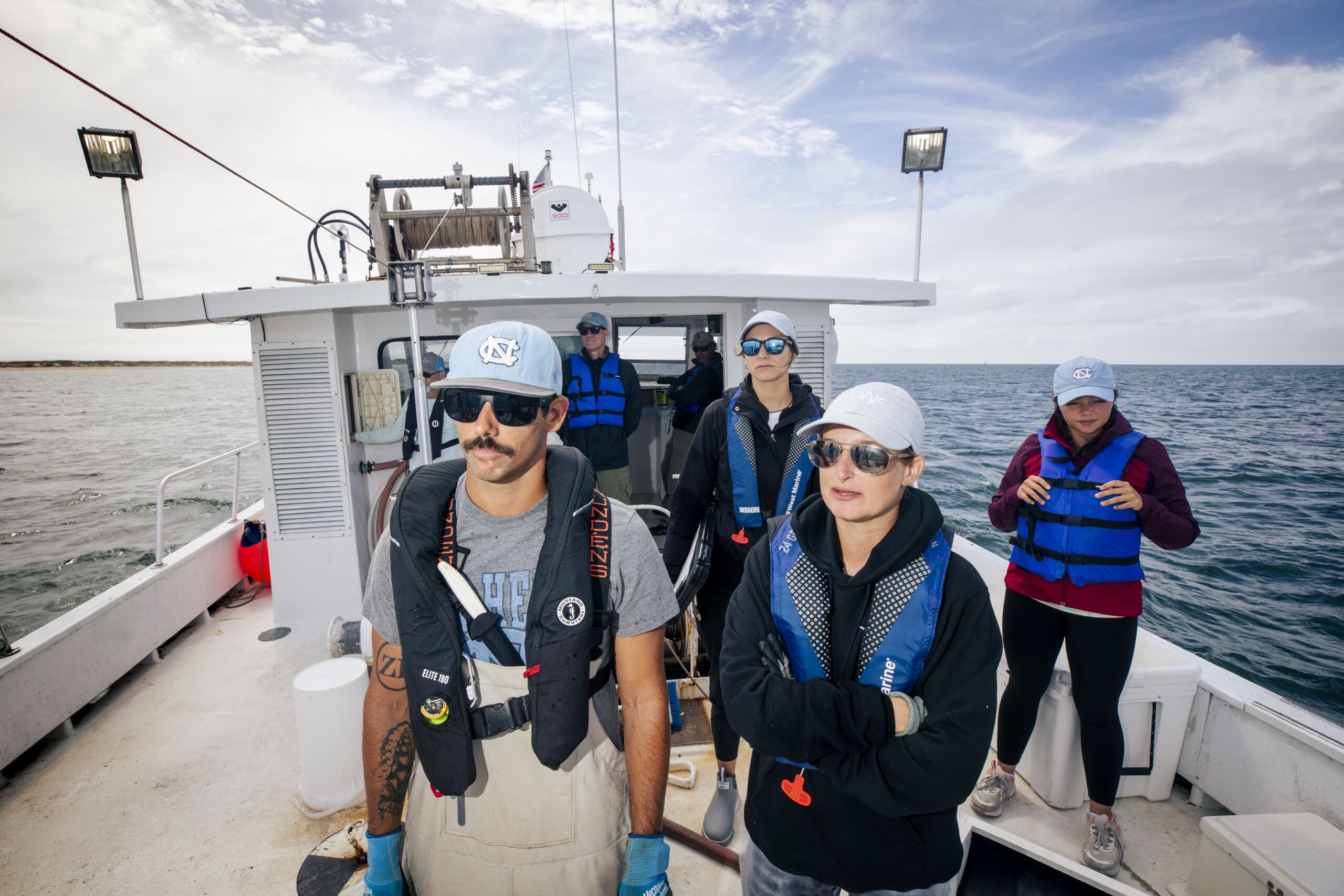
Left to right: Off the coast of Cape Hatteras, IMS facilities technicians Phil Herbst and Holly Doerr, Black, and Carolina junior Mikayla Warguez wait to see what kind of sharks their longlines bring in. (PHOTO: Ira Wilder ’24)
The team caught mostly native Atlantic sharpnose sharks, each about 4 feet long. What her team had hoped to catch were hammerheads, a bunch of which they caught on a previous trip. Scalloped hammerheads can grow up to 10 feet, but Black’s team caught so many 3-footers that it seemed the sharks were schooling. “Juveniles don’t usually school,” she said, “and so this got me to question if they were actually adult Carolina hammerheads.”
Through a genetic sequencing project she leads, Black and fellow UNC postdoc Steph Smith ’16 (’20 MS, ’23 PhD) confirmed the two species are mating and creating a hybrid shark. “We could see a new species of hammerhead in our lifetime, due to this divergent lineage,” Black said.
The distinction between species is important for management purposes, she said. Scalloped hammerheads are a global species and are managed as such. Carolina hammerheads are not. Knowing the location of species helps determine what sorts of protections are enacted. “Some countries allow the hunting of sharks,” Black said. “This has a ripple effect on healthy reef ecosystems, which are heavily reliant on sharks.” Without them there is no such thing as a healthy reef ecosystem. And without a reef, other marine species suffer and there is no dive tourism, which in some places is a huge economy.
What’s also a huge economy, especially in Asia, is fishing. And in the case of shark fishing — whether legal or not — the prize remains their fins.
Project Shark
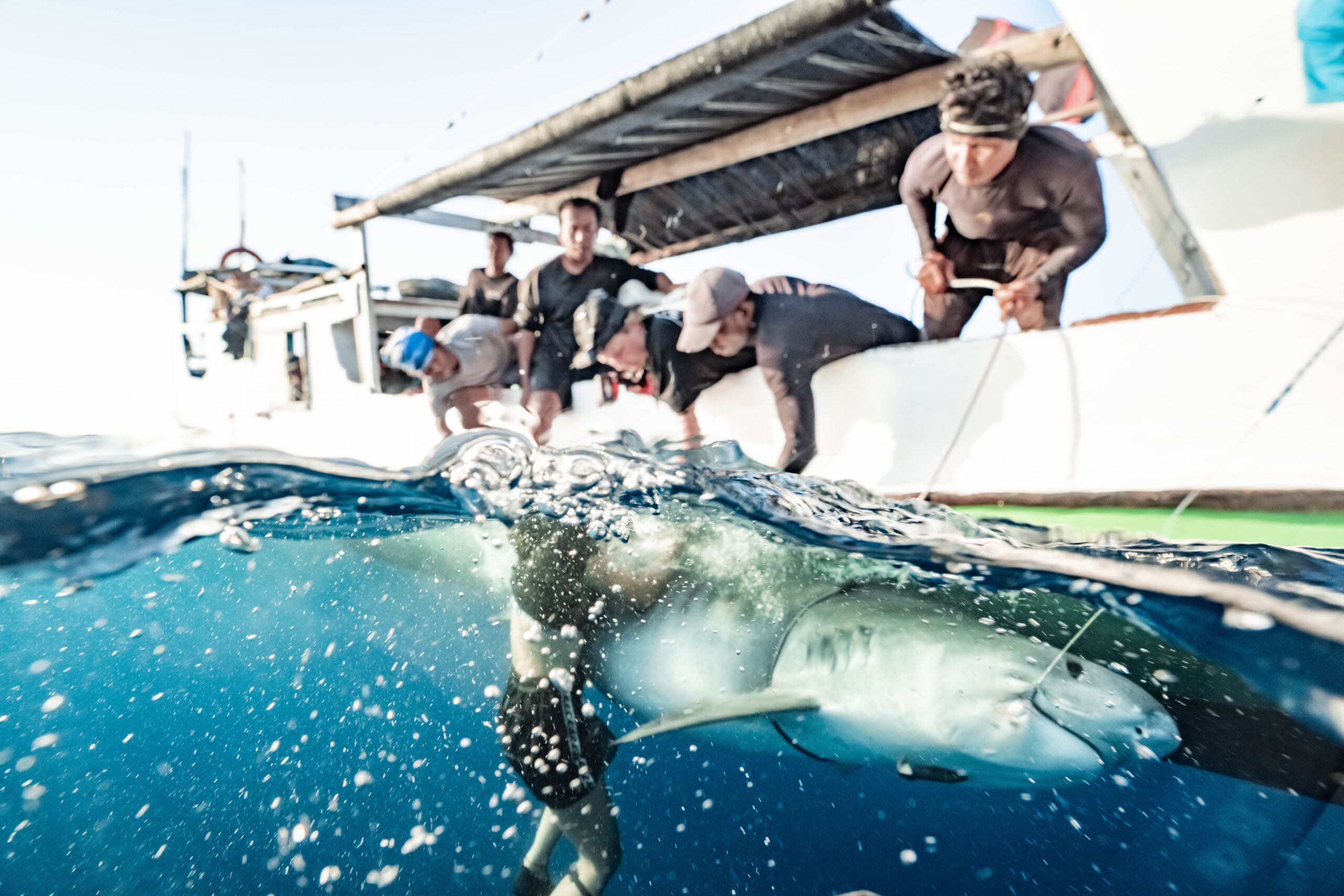
Black is tagging tiger sharks to track their movements with the goal of showing the Indonesian government which waters they ought to protect during certain times of year to decrease fishing of imperiled species. (PHOTO: Tanner Mansell)
In December, on a 40-foot homemade wooden boat off the coast of Indonesia’s Lesser Sunda Islands, Black was eating eggs and rice at sunrise. It’s the same food she’d eat every meal for two weeks at sea. It took her three days to sail to this spot in the open Indian Ocean, sleeping on a mat on the deck each night, until she arrived where she suspected tiger sharks congregate. There’s no internet or cell reception or technology of any kind except an emergency satellite telephone and the tracking devices she hoped to attach to tiger sharks.
Black was there as the research officer for Project Hiu, a conservation nonprofit founded by Madison Stewart, a 32-year-old Australian professional surfer who first dove with sharks at age 11 and saw her first dead shark on the floor of an Indonesian market during the filming of the 2017 documentary Blue, about imperiled ocean life. Stewart had befriended a young fisherman named Odi, who spoke English and helped Stewart sell her plan to hire fishermen for tourism expeditions instead of fishing. Hiu means shark in Indonesian, and the project’s goal was equally simple: The less time fishermen spent on the water hunting for sharks, the better for the sharks and the ocean.
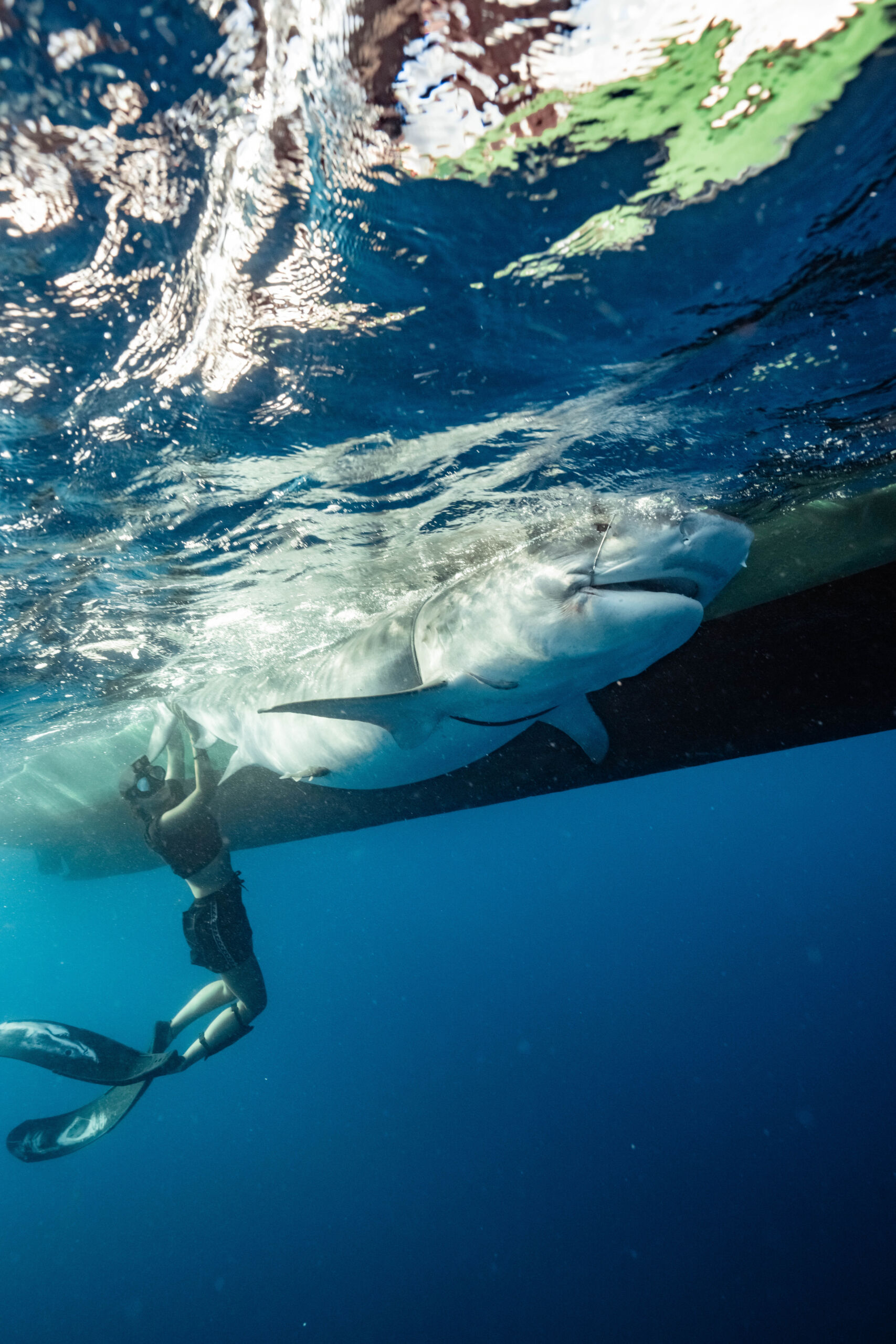
Black first heard of Project Hiu in 2018 and chanced into involvement when she met Stewart’s boyfriend, Tanner Mansell, on a shark research expedition in Jupiter, Florida, in 2022. A year prior, Stewart had noticed Indonesian fish markets featured tiger sharks and little else. She thought tiger sharks must be congregating in specific areas that time of year. She raised money and hired Black to tag tiger sharks and track their movements throughout the year, with the goal of showing the Indonesian government which waters they ought to protect during certain times of year to decrease fishing of imperiled species.
After her eggs and rice, Black helped direct a crew of 20 fishermen on three other boats to reel in fishing lines by hand. When they caught one large enough to be tagged — longer than 6 feet — they would attach the fishing line to a buoy and guide it to Black, who would lean over the low-lying boat to tag the shark with a piece of technology that costs between $1,800 and $4,000. Sometimes fishermen from another boat would paddle over on a Styrofoam float to help her.
Black is tagging tiger sharks to track their movements with the goal of showing the Indonesian government which waters they ought to protect during certain
times of year to decrease fishing of imperiled species. (PHOTO: Ira Wilder ’24)
The crew repeated that process — casting a line with 35 baited hooks, waiting an hour or two, and then retrieving the line — several times a day until sunset, passing the down time mostly by teaching each other English and Indonesian. By the end, Black tagged 14 tiger sharks, and when she returned to Morehead City, she began tracking them. On the morning of Jan. 7, a few days after Black returned from Indonesia, data from two tags were released to her, which should not have happened. Black had programmed the tags to release data in six months. The only other reason the tags would release data was if the sharks stayed at the same depth for 72 hours, meaning they were likely dead. As the morning progressed, the verdict was clear: The two 8-foot male sharks were on the same boat. They were headed to market, where their fins would be harvested, put in a large bucket and driven by scooter to a warehouse for drying before being shipped to Hong Kong. Black had seen this scene play out before.
“Legally, fishermen are allowed to fish many species of sharks [including tiger sharks],” Black said. But Project Hiu has an agreement stipulating that if fishermen catch a tagged shark, they could take photographs and video, send them to Black and be guaranteed payment if they released the shark. But that agreement is with fishermen on one island. So the sharks must have been on a boat from a different island, she said, “and they were not aware of what we were doing.” On the tag is a message in Indonesian about a reward, should anyone hook the shark, but the message apparently didn’t register with the fishermen.
A tiger shark garners between $100 and $200 at the market. Other species are more highly prized. For instance, Black’s team caught a white-spotted wedge fish, a type of ray that can grow up to 10 feet and sells for $500.
Shark Sisyphus
“When we contract these fishermen to do research, they are not out fishing for those months,” Black said. “And at least it’s one fishing community that’s agreed not to fish those sharks.” (PHOTO: Tanner Mansell)
Shark fin soup historically was considered a delicacy in China, though conservation efforts in the late 1990s and throughout this century have significantly lessened its appeal in most of that country. But in Hong Kong, a city of 7.5 million, and in much of Southeast Asia, the shark fin trade still thrives. Black said Indonesia has regulations in place to limit fishing of certain species, but enforcing such laws is challenging, to say the least. For instance, manta rays are protected; no one is allowed to ship one out of Indonesia. But Black said if one is brought to market, it takes just one person to write it down as a different species for the ray to be sent to Hong Kong. “White sharks are protected,” she said, “but they’re often written down as mako sharks. Thresher sharks are supposed to be protected, but I’ve seen them being off-loaded from boats. No matter how endangered or protected, they are being fished.” Thousands of tons of banned fish and sharks are shipped across Indonesia and to China, Japan, Thailand and other countries each month, Black said.
Black understands she’s playing the long game. “When we contract these fishermen to do research, they are not out fishing for those months,” she said. “And at least it’s one fishing community that’s agreed not to fish those sharks.” Project Hiu is trying to raise more money to divert interest in fishing toward research and tourism that would send adventure seekers to the remotest parts of the planet.
As Stewart wrote on her website, “These [fishermen] deserve a secure future that doesn’t rely on the fishing of these apex predators. The goal of Project Hiu is to improve conditions above and below the surface, and enforce the idea that one person, and one shark fisherman, can make a difference.”
Still, the game is rigged against them. In 2023, Black reeled in a shark she could not identify. Neither could Stewart or the fishermen. She took photos, but no other shark experts could identify the species. Indonesian law prohibited Black from taking a sample home to Morehead City for analysis. “We’ll probably never know what it was,” she said.
Meanwhile, with the slip of a pencil, fish markets continue to misidentify sharks on purpose, flouting regulations meant to protect the sharks once destined to fulfill their role in upholding the ocean’s fragile ecosystem.
“It’s really frustrating,” Black said. “But this is why I want to work in this area.”
In December, the first tiger shark Black tagged was 13 feet long and pregnant. “I’m always hesitant to say you can visually tell a shark is pregnant,” she said, “but she was so obviously ready to give birth, so disproportionately large.” Black measured it, tagged it and unhooked it, then stood up and watched the mother-to-be swim away.
That’s one less adult shark to make it to market that day, and it was on the verge of giving birth to pups, possibly 30 or more.
Thanks for reading the Carolina Alumni Review
Carolina Alumni members, sign in to continue reading.
Not yet a member? Become one today.