Meet the Dream Makers
Posted on July 15, 2026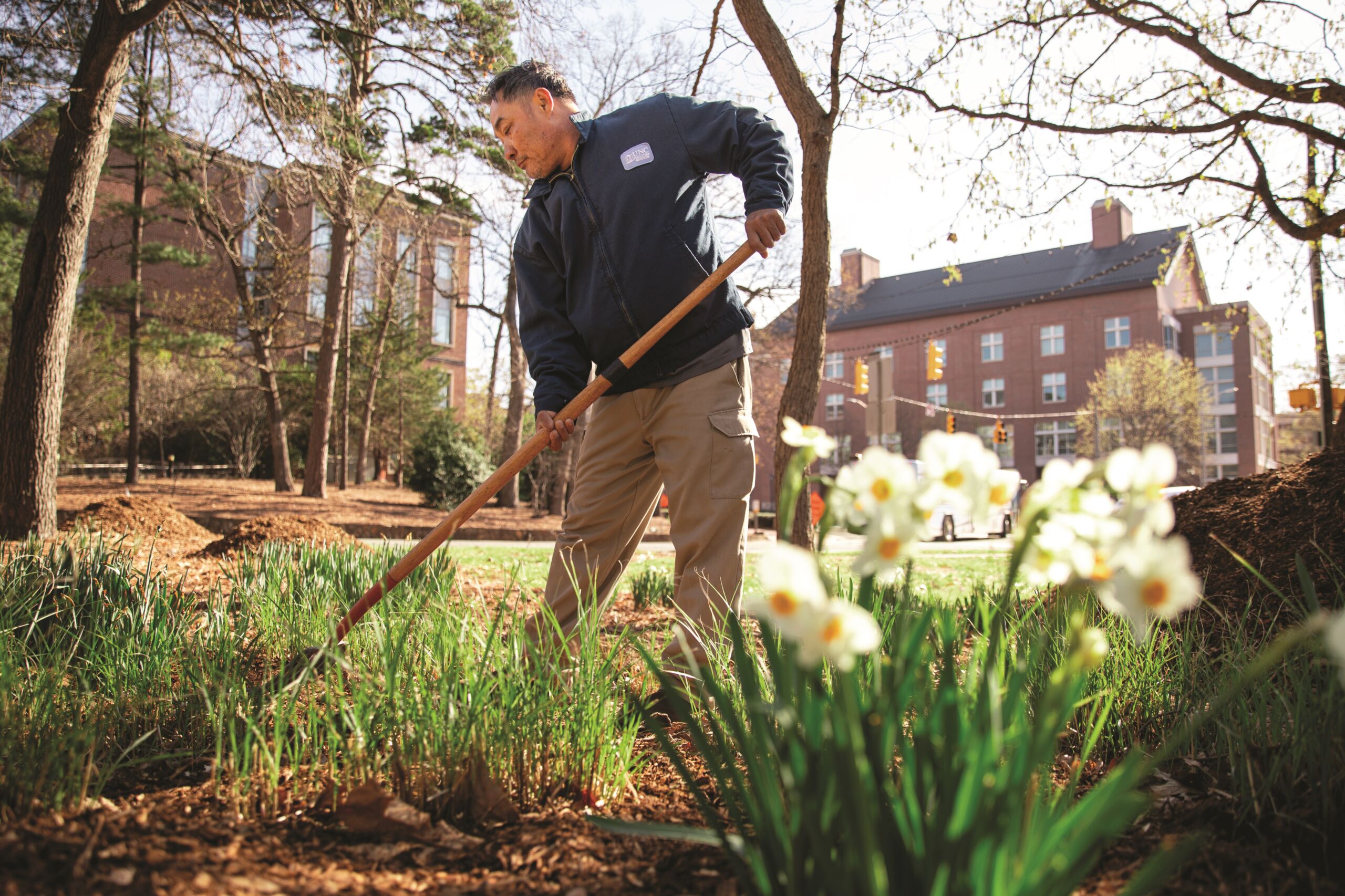
Even on patches of land one may only glimpse through the window of a car, Carolina’s groundskeepers work to ensure every natural area of campus looks its best, all year long. This year, construction, cold snaps, heat waves and drought have made that especially challenging. (Photo: Carolina Alumni/Ira Wilder ’24)
It’s mid-March and beautiful outside — the kind of spring afternoon on Carolina’s Polk Place that punctuates the end of winter and brings Tar Heels into the sunshine. Tom Bythell, UNC’s arborist and forester, is checking updates to the quad’s ground irrigation systems and spies a pair of students unraveling a fluorescent yellow slackline between two trees.
He approaches them with a friendly wave. He doesn’t want to spoil their fun. Far from it. He’s happy to see students enjoy the outdoors again after such a long winter. But he does want to talk to them about the trees.
“Hey guys, you can’t use the trees for anything but sitting under,” he said. He pointed to the smaller of the two trees, a persimmon, and explained that walking on a slackline between them could be harmful.
“No worries,” said one student, as the other added, “We understand. We don’t want to hurt the trees.”
As UNC’s Grounds Services prepared campus for the more than 30,000 pairs of feet that would descend upon it for May’s Commencement exercises, the work of planting, seeding, mulching, watering, pruning and maintaining the landscape, all while people use the grounds day in and day out, felt a bit like playing whack-a-mole. On this day, tall piles of fresh mulch and grounds crew members waited patiently for a quieter moment when the afternoon foot traffic would die down and the beds that line campus buildings could be mulched.
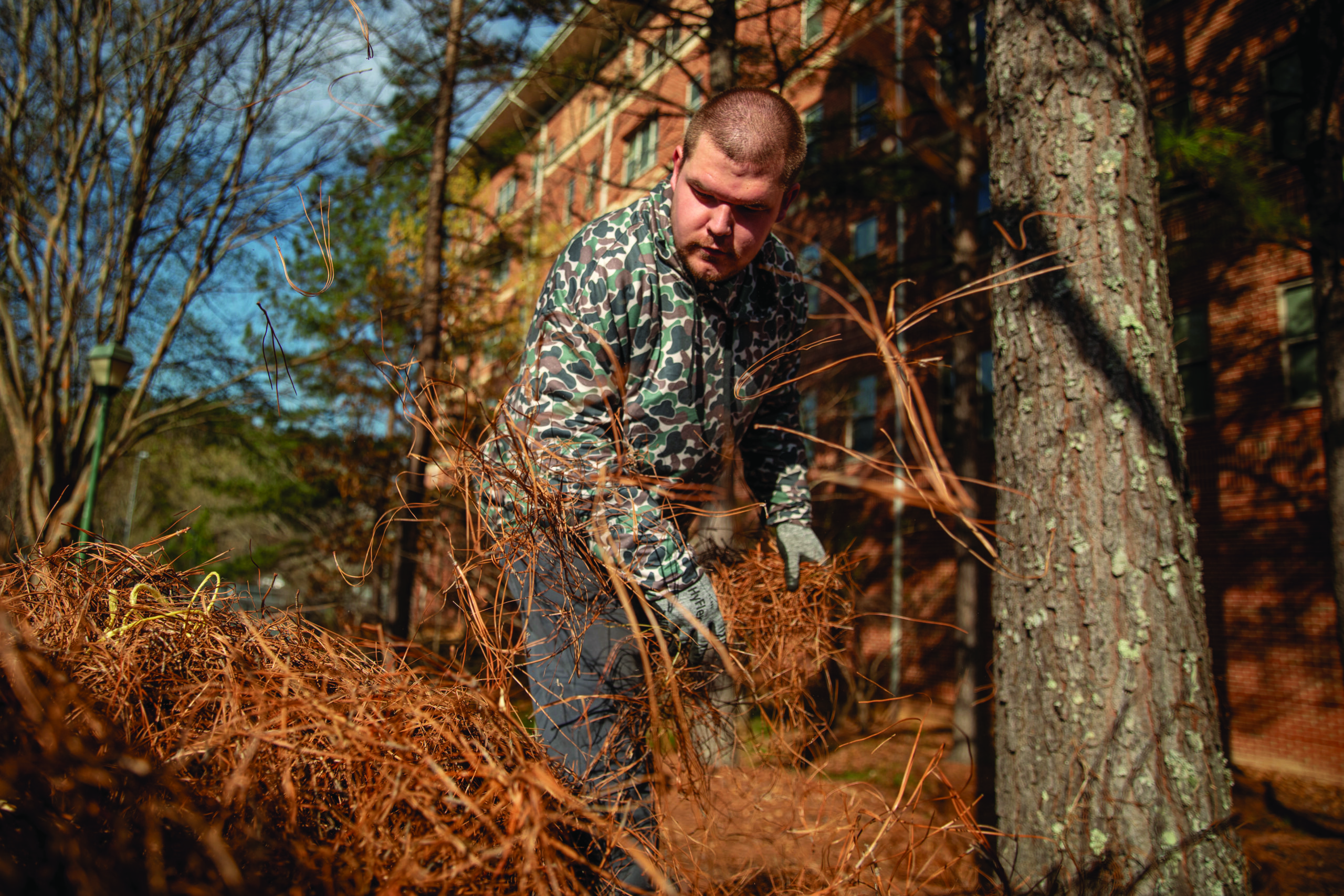
Pine straw prevents erosion on steep slopes, like those surrounding Ram Village. (Photo: Carolina Alumni/Ira Wilder ’24)
“You want it to be gorgeous, but you also want them to enjoy it,” Bythell said in March. “We’re really under the microscope this time of year.”
Campus is gorgeous, as anyone who has visited well knows. The fescue grass was reseeded in February so it could germinate at just the right time and fatten the blades for peak spring beauty. Dead tree limbs were removed and branches pruned. The oaks filled with green again. The brick paths to Kenan Stadium were frequently swept and cleared.
It takes a lot of work, skill, heart and patience, said Steve Gooch ’87, grounds services director. But, he said, “That’s the most important day of our year.”
Mother’s Day weekend is a tricky time in North Carolina for flowering trees, bushes and plants. By then, the forsythias and magnolias have already bloomed, and the summer plants, such as hydrangeas, don’t bloom until June. In late April, Grounds Supervisor Mark Moon said his team planted about 100 flats of annuals to add color to the beds along the most traveled paths on campus.
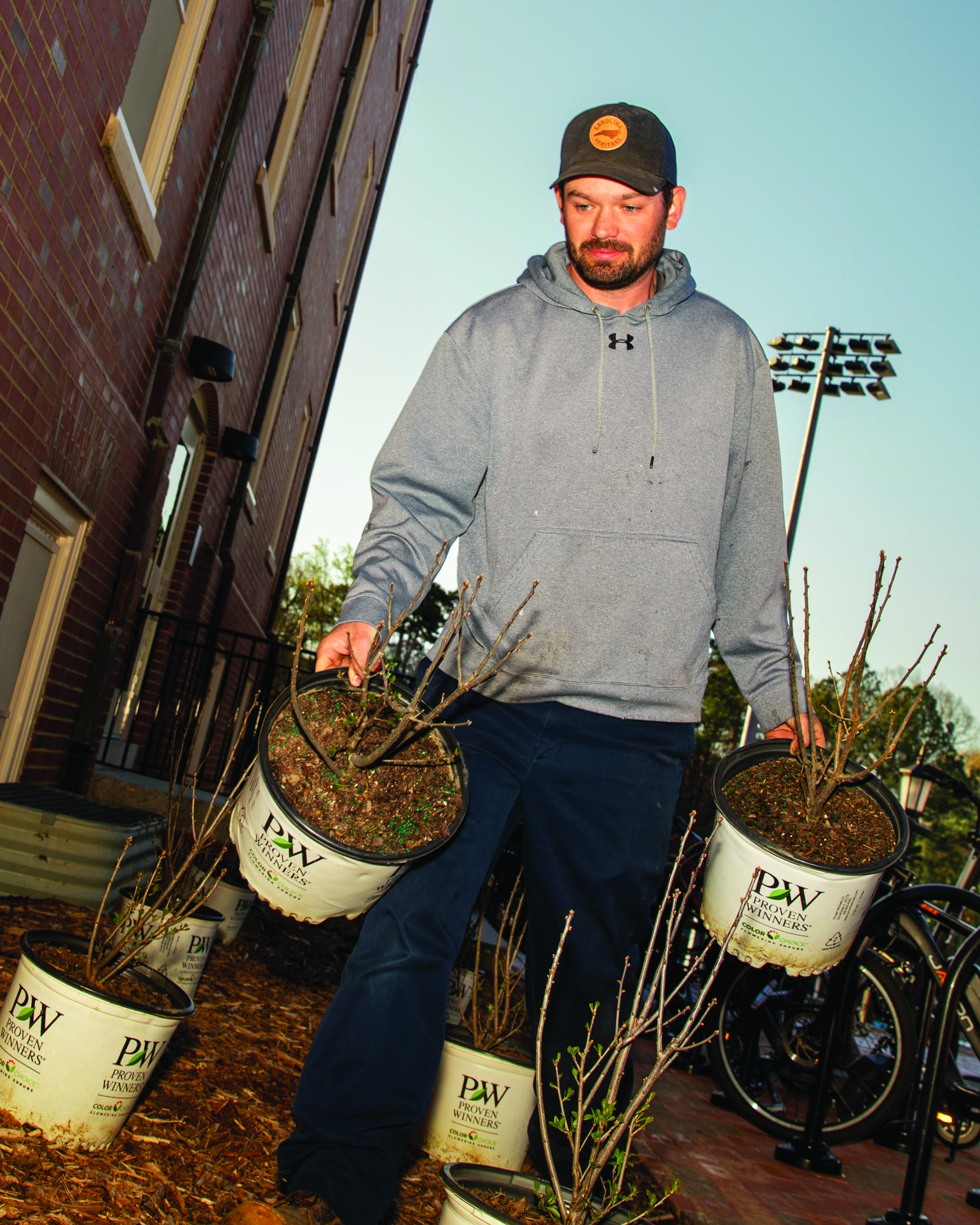
Holly bushes are one of many shrubs planted around campus, like these at Avery Residence Hall. Grounds crews intersperse male bushes with female bushes to encourage flowering. (Photo: Carolina Alumni/Ira Wilder ’24)
Carolina’s beauty belongs to everyone, Gooch said, and as one of the most often photographed college campuses, it has to be camera-ready every day. The grounds always serve as the pristine backdrop for the professional cap-and-gown photo shoots scheduled at the Bell Tower, the University seal in front of South Building and the Old Well. Those sessions are daily occurrences for nearly a month, and some begin at the crack of dawn to catch the first light. The crew in charge of the historic campus works to keep it as perfect as possible every day and often works weekends.
Gooch, who got his start at Carolina as grounds supervisor for Carolina Housing a little more than two decades ago and became the department’s director eight years ago, sees Commencement as a “full-circle moment” in the department’s mission.
“When the family pulls up to drop their student off, and the grounds look immaculate, it eases their mind,” Gooch said. “If [we] put this much effort into keeping the grounds, then you know your child is going to be taken care of.” And then, usually four years later, parents admire the stunning conditions of the grounds at graduation.
The 90 employees in Grounds Services maintain about 758 acres of campus grounds and more than 700 acres of forest land and trails. A big challenge is keeping campus in top shape for students, faculty, staff, parents and visitors, amid shifting construction projects, outdoor events and day-to-day trampling in all kinds of weather. This was especially true this year, as an uncharacteristic cold snap brought ice that took some time to melt. A new roof for South Building kept scaffolding climbing along three stories of brick walls longer than planned. All that meant Gooch’s crew was busy with new landscaping installations all spring. Then, in March, a warm string of days forced a few things to bloom a little quicker than expected. Nature’s schedule is not in his team’s control, so they have to adapt.
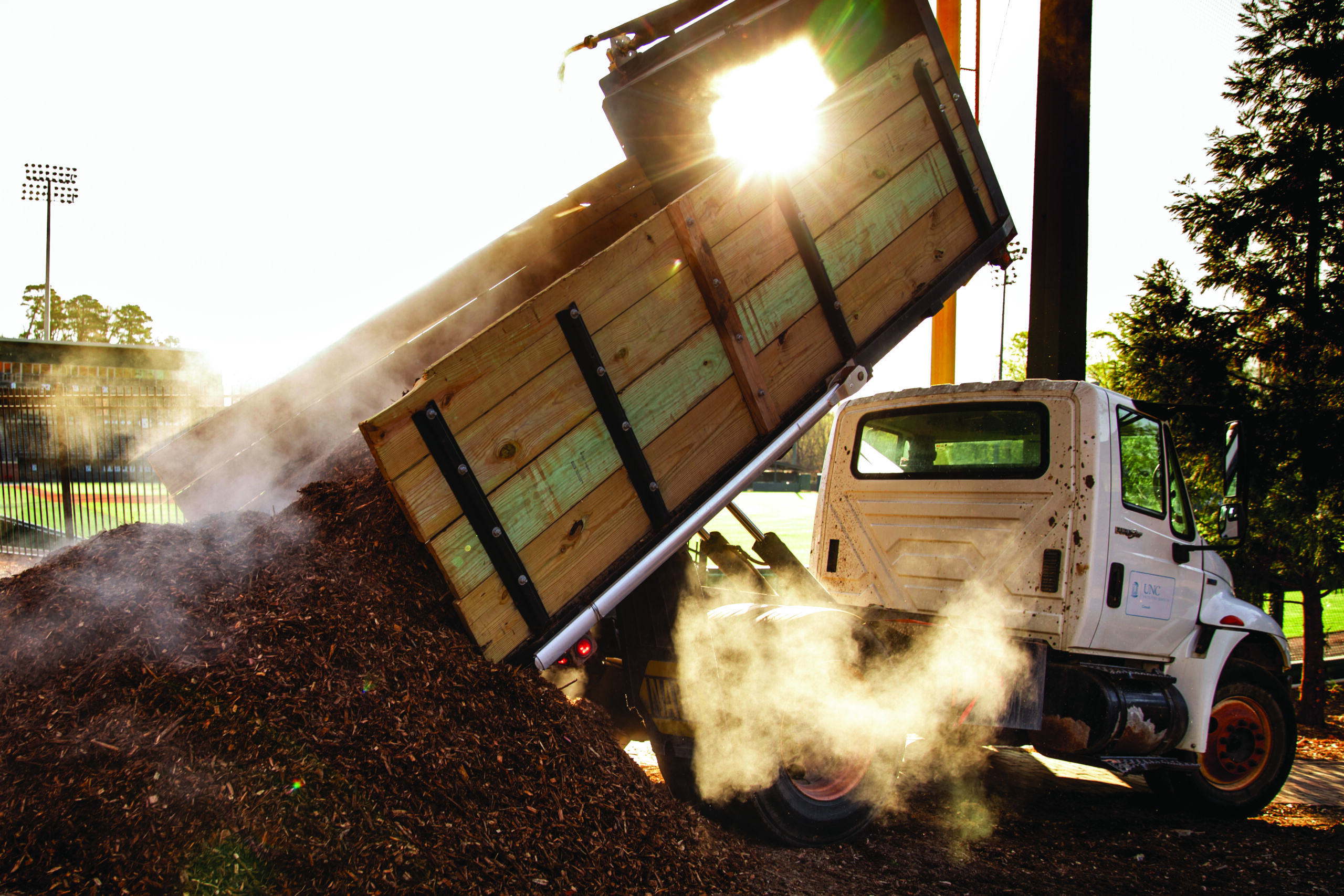
Grounds Services produces and uses about 2,850 cubic yards of mulch each year. (Photo: Carolina Alumni/Ira Wilder ’24)
“The switch is never off,” Gooch said. “You never know who’s coming to campus or what will be photographed by someone every day.”
Though everyone who loves Carolina feels a unique attachment to its beauty — to a certain spray of blooms, the shade of a favorite tree or the softness of a particular patch of grass — no one is caring for it quite as deeply as the staff whose hands shape it.
It means something to them, Gooch said. And so he reminds them to bring their families to campus on a day off so they can truly enjoy it, too: Have a picnic, bring the dog, let the kids run around, throw a ball. Grounds Services takes seriously the stewardship of Carolina’s natural beauty, he said, because it’s their job to pass it on to not only the next generation who will enjoy it, but also the next group of caretakers who will maintain it.
“It’s part of our mission to be dream makers here,” Gooch said. “I know the sacrifice my parents made for me to come to school here. For a lot of people, this is a dream come true. We just hope that they’ll be successful, and they’ll be able to, in some way, pay it back and help the next group.”
—Courtney Mitchell ’01
Thanks for reading the Carolina Alumni Review
Carolina Alumni members, sign in to continue reading.
Not yet a member? Become one today.