Meet the Provost
Posted on May 29, 2026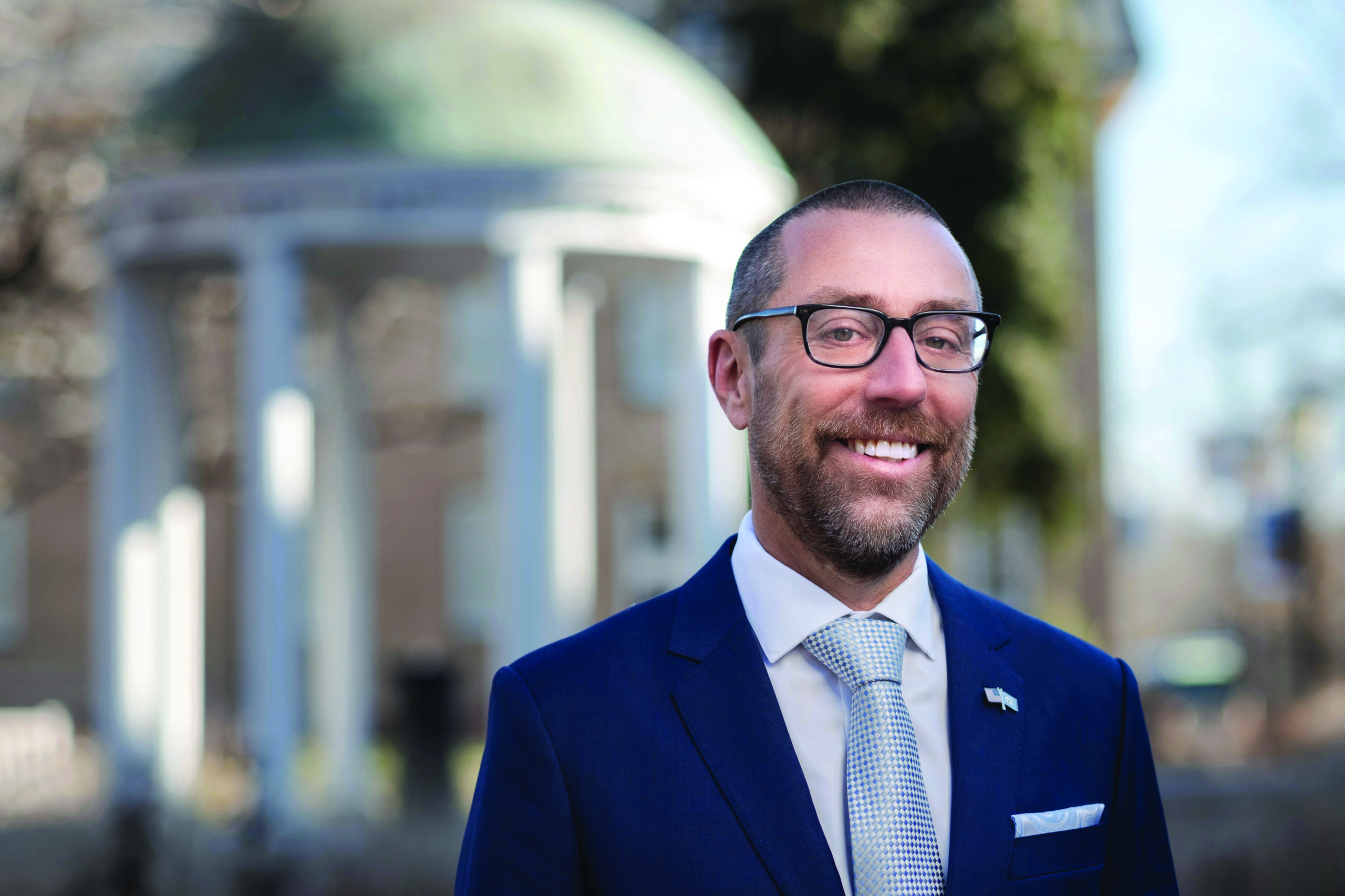
Magnus Egerstedt began as Carolina’s executive vice chancellor and provost March 2. He was formerly the dean of engineering at the University of California at Irvine. (PHOTO: UNC/Jon Gardiner ’98
Like many European children, Magnus Egerstedt — who became Carolina’s provost March 2 — wanted to be a professional soccer player. When that wasn’t in the cards, he turned to punk rock, playing drums in bands for a decade. Thinking about a possible career, he considered becoming a physician, so after high school he trained as a medic in the Swedish army for a year before realizing that wasn’t for him.
He eventually found a home in academics, earning a pair of bachelor’s degrees in 1996 — one in philosophy from Stockholm University and another in engineering physics from the KTH Royal Institute of Technology, also in his hometown. This choice took hold, and while Egerstedt was pursuing his master’s in engineering, his adviser suggested he study under a colleague and friend at Texas Tech University in Lubbock. “I loved it,” Egerstedt said. “It was amazing. It looked exactly like in the movies — West Texas. Prairie and pickup trucks and football games. It was all exciting and new. I also didn’t hate leaving Lubbock when I was done. Six months was perfect.”
When he turned to robotics for his PhD, his Swedish adviser pushed him to another American colleague, this one at the University of California, Berkeley. About halfway through earning a PhD, he met a poet named Danielle Hanson, and they began dating.
“That’s how I decided to stay in the United States,” Egerstedt said. “Fast forward to today and she’s my wife and mother to our children.” Hanson, the current Poet Laureate of Costa Mesa, California, will join Carolina’s creative writing faculty this fall. As for her husband, the Review sat down with Egerstedt to ask how he views his role as provost, the future of Carolina academics and working with faculty.
You’ve pursued leadership positions in engineering at other universities. What drew you to this broader position as provost at Carolina?
My leadership journey in general has been driven not so much by ambition to have titles, but things I wanted to do. When I ran the robotics institute at Georgia Tech, I loved pulling people together around big questions. Engineers, computer scientists, physicists, philosophers, psychologists, economists, all working together. But I wanted to be more plugged in to the undergraduate experience, so I became a department chair. Then I started to feel there are large questions requiring more than just electrical engineering. I started looking for a bigger platform at a more comprehensive university. So, when I had the opportunity to become dean of Henry Samueli School of Engineering at UC Irvine, I took that. It gave me the ability to connect with medicine, law, the arts. The next logical step is to have a broader influence over all these disciplines, which is the provost role.
But I was careful about the places I considered. I needed a place that was an academic powerhouse in education and research. I made a decision to spend my time in the public university system because I love the idea of the university not being an ivory tower but being plugged in to the communities around it. And I also wanted a place that seemed hungry and willing to innovate. I didn’t know this about Carolina, but during the interview process, I realized this is not only a storied powerhouse, but also hungry. Ultimately, this is what made me take this job. Carolina is historic and hungry. And that’s powerful.
What has informed your thinking behind your desire to be “out there as a real presence on campus,” meeting people?
First of all, we do a lot of things on this campus. But the main reason we exist as an institution is students. Everything we do has to be informed by that simple fact. A big part of my role has to be to empower students, to make sure their voices are heard, to make sure students are served so they are prepared for whatever comes their way when they graduate. So, even though research is critical to our identity, I recognize the number one thing we’re about is our students. So, I am on a listening tour right now. I’m going to schools, meeting with faculty and students. I’m going to the rec center just to hang out. I’m doing a popsicle party in the Pit. Partially I’m doing this because the administration is this weird abstraction. First among the abstract things is the provost; no one knows what a provost is or [sometimes] who the provost is. I want to change that. I don’t want to be an abstraction. I want faculty and students to know who the provost is and maybe even what a provost does.
“We do a lot of things on this campus. But the main reason we exist as an institution is students. Everything we do has to be informed by that simple fact. A big part of my role has to be to empower students, to make sure their voices are heard, to make sure students are served so they are prepared for whatever comes their way when they graduate.” — Magnus Egerstedt
So what does the provost do?
Ultimately, I’m the chief academic officer. I oversee everything traditionally associated with the University — teaching, students, faculty, research. Things such as the dining hall, transportation, parking, athletics, I don’t oversee. I spend a lot of time helping deans solve problems. I spend quite a bit of time helping — for example, fundraisers — to articulate the vision for where we are going as a university. I spend time working with the office of the vice chancellor for research to be sure we are strategically investing our scarce resources in the right directions.
What are your top priorities for the University’s academic future over the next 3-5 years?
Number one priority is making sure we tell our story. There is so much important work happening on this campus. We are changing people’s lives through their educational experiences. Not only individuals, but their families and entire communities. What we do in the education space matters big time. Also, what we do in service to the state matters big time. And research that happens in our lab is deeply impactful but somehow gets lost. My number one priority is that we articulate loudly and proudly to the world that what we do matters.
Second, big priorities are applied science, engineering, AI and industry engagement. And third, growth. We are growing enrollment, and we can’t just add 5,000 students and not change anything. We have to make sure we grow in a way that makes sense with classrooms and dorms and instructors.
The University talks a lot about STEM, biomedical research, AI and industry partnerships. What do you consider the role of the humanities in the life of students and society in general?
I love that question. First, with what is happening with AI right now, skills that used to be highly sought after, like computer programming, are almost becoming commodities. It’s not the ability to write code that matters anymore, it’s the ability to ask the right questions. It’s things like storytelling, problem-solving, creativity, intellectual curiosity. Jensen Huang, president of NVIDIA, talks about the future belonging to those who can see around corners. And in my mind, where do you learn to see around corners? Where do you learn problem-solving, creativity, curiosity? It’s in the humanities; it’s the liberal arts. And I think there is something deeply important and powerful happening at the intersection of the liberal arts and AI and technology right now. This is going to be an emerging field, and I see no reason why it shouldn’t start on this campus. In fact, I think we will see a renaissance of the liberal arts because of this. That’s terribly exciting. I think it’s quite interesting, and I can’t wait to see this play out.
Also, 31 percent of students graduate with a double major. That’s a big number. It’s not fields that are closely related. It’s poetry and physics. It’s public policy and philosophy. And I believe this says something about our students, that they are curious and nimble. Letting students choose their own adventure is not a bad idea because they are the ones who are going to be not only living that future but defining that future. The humanities and liberal arts will play a major role.
What’s your approach to making difficult decisions?
I really don’t like the “squeaky wheel gets the grease” approach to decision-making. I try to be extraordinarily clear about how decisions are made. I have said I don’t write checks on the spot. I like pulling people together and having a deliberate process for making decisions. A lot of times there is a disconnect between the decision and the process. Also, there’s a need to communicate what those processes look like because sometimes what’s failing is the communication around the process. I’ve started working with Faculty Chair Beth Moracco [’92 (MPH, ’99 PhD)] on a shared governance set of principles for how to make decisions. To me, this was a very productive step in the right direction because there have been some tensions on this campus, sometimes around decisions but more often around processes and communication surrounding the decisions.
What would you say to faculty who are worried their traditional role in governance is being diminished?
First thing I’d say is I may be provost, but I’m also a faculty member. The title throughout my career I’ve been most proud of is professor, and that hasn’t changed when I moved into the provost office. I also believe strongly there are some questions that are unquestionably on the side of the faculty. Undergraduate curriculum questions, for instance. And there are questions that reside on the administrative side. They have to. Budgetary questions, for instance. But that doesn’t mean you can’t engage with faculty around those decisions.
The shared governance approach I developed, together with chair of faculty council, isn’t an abstract declaration of governance. It’s a user-friendly implementation strategy for what goes where. When do we need a full committee? When do we need to inform faculty? And when, if there are legal or HR reasons, are decisions just made by administration and then shared? Now we have a set of guidelines. Now I have to show up day in and day out and show I’m living this rather than just talking about it, because to me it always comes down to trust. And trust takes time to build, and it erodes very quickly. We have a few examples where I have asked faculty to weigh in on things that traditionally they didn’t get to weigh in on. For instance, we have programs that are under-enrolled. What metrics should we use to evaluate them? What data do we need to make sure we are serving our students? So instead of someone sitting in an office in South Building dictating this, we now have a faculty group working on what the metrics should be. That’s a beautiful example, I think, of a decision that ultimately resides in the provost’s office, but there’s absolutely no reason why we shouldn’t listen to the faculty.
—Mark Derewicz