Mic Man
Posted on April 3, 2025Jim Lampley ’71 talks about his new memoir, a life of surprises and regrets and his uniquely lucky career as a TV sportscaster.
By Ira Wilder ’24
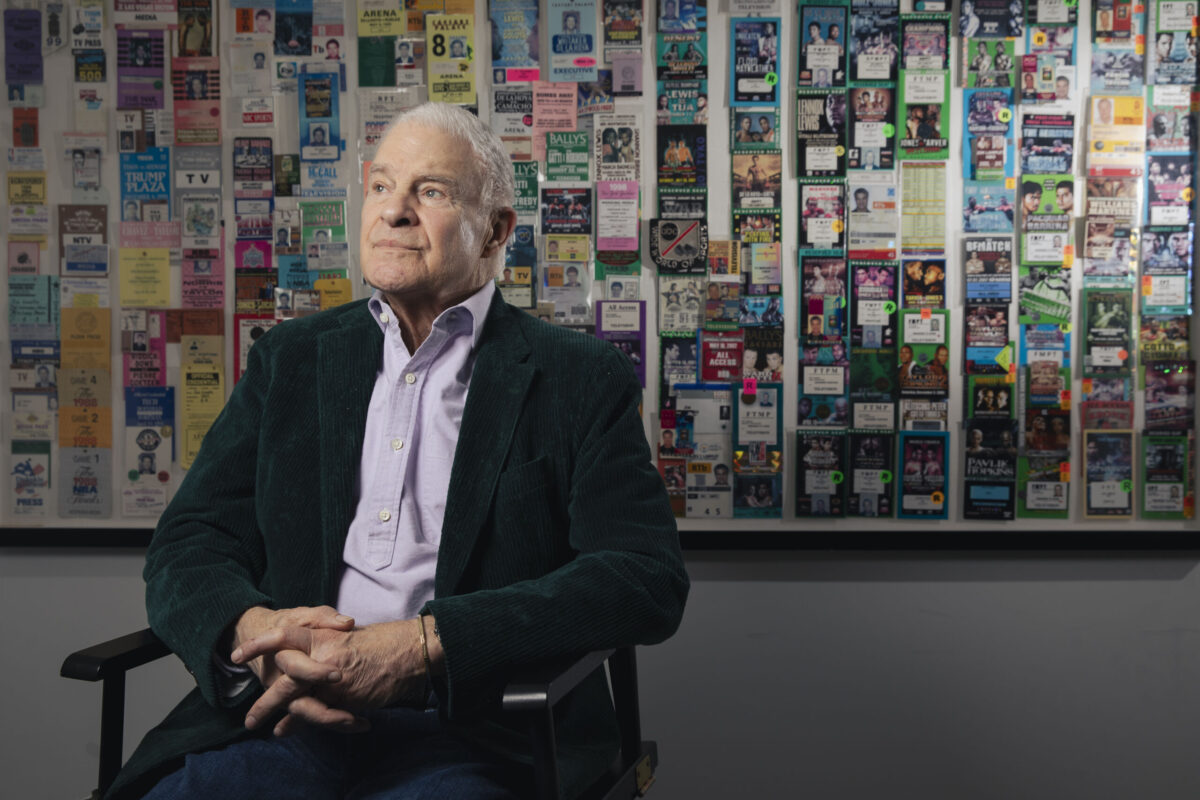
“Chapel Hill is a mythically charmed place for me — ever since my mother drove me from Hendersonville in 1959 to come to a football game. … Decades later, I was in a bar in Hollywood talking basketball with somebody, and a woman tapped me on my shoulder and said, ‘What is it about you Carolina people, you people from Chapel Hill, you’re obsessive.’” (Photo: Carolina Alumni/Ira Wilder ’24)
In 1968, Jim Lampley ’71 was on the verge of expulsion from Carolina, what he called his “dream alma mater.” He had a habit for sleeping through class, and he had lost his mom’s ’64 Oldsmobile and a collection of rhythm-and-blues LPs at all-night poker games at the Sig Ep fraternity house.
After he’d spent a year working a monotonous bank job and earning good grades in two correspondence courses, the University readmitted him, and Lampley went on to graduate with an English degree. He was a thesis short of a master’s degree in radio, television and motion pictures when he left Carolina to cover college football for ABC Sports, the result of beating 432 young reporters in a national talent hunt.
Lampley’s resume more than five decades later is an encyclopedia of sports in America. As a broadcaster for ABC, CBS and NBC, he’s seen sports journalism flourish into the modern era. In 1974, with a battery pack strapped around his waist and a microphone in his hand, Lampley became the first television reporter to report on a college football game from the sideline. He covered 14 Olympic Games between 1976 and 2008, more than any American broadcaster. If you watched any boxing match on HBO between 1988 and 2018, you probably heard him call the blows.
His autobiography, It Happened! A Uniquely Lucky Life in Sports Television, written with Art Chansky ’70, hits shelves April 15. In January, the Review sat down with Lampley at his Chapel Hill farmhouse and talked about the happy accidents that carried him from Carolina to the world. The interview has been edited for brevity and clarity.
Your memoir is titled It Happened!, which was what you said when George Foreman knocked out Michael Moorer in 1994. Why that title?
Everything about my life feels like a happy accident. At the moment when 45-year-old Foreman knocked out the 26-year-old unbeaten Moorer to win the heavyweight championship, that, too, felt like an unpredictable and spontaneous accident.
As the referee was counting to 10 with Moorer flat on the canvas, I was sitting at ringside, thinking, Why did I not stay up last night and think up exactly the right line for this? So, I just said, “It happened.” Actually, I said it twice. It became a calling card. It’s the culmination of my highly inexplicable and unexpected arc as a network television sportscaster.
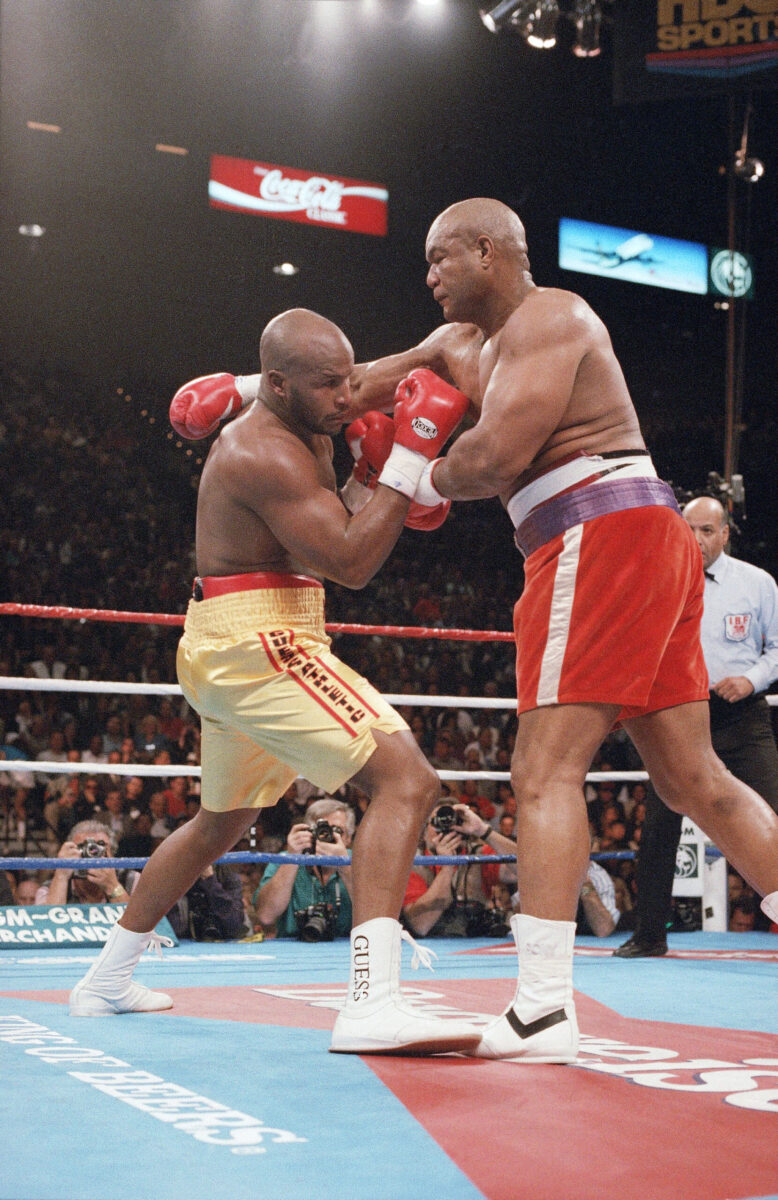
Forty-five-year-old George Foreman, who had been making a living selling tabletop grills and calling boxing matches alongside Lampley for HBO, was very much the underdog when he faced unbeaten 26-year-old Michael Moorer for the WBF and IBA heavyweight championship Nov. 5, 1994. Lampley was ringside, calling the fight for HBO. When Foreman knocked Moorer out in the 10th round, Lampley shouted, “It happened! It happened!” In his memoir, Lampley wrote that it was “by far the most famous call I delivered. … It happened, and boxing fans I don’t know still yell that to me in airports, on the streets of New York, and along the Vegas Strip.” (Photo: AP Images/Lennox McLendon)
You’re very candid about your mistakes as a student at Carolina — poor academic performance and an “uncontrollable appetite for beer.” How did you overcome those mistakes?
I’m a guy who flunked out with a 1.44 academic average. I went to a menial job in a bank mortgage loan department in a room with 2,500 feet of file cabinets. Somewhere in that purgatory, I said to myself, “You know what? There ought to be a way for you to get out. Why don’t you muster the courage and the nerve to do that?” I wound up slogging through the brutal passage of making A’s on two correspondence courses to get back into school. I came back to Carolina and made another 22 A’s.
When I was trying to get into graduate school, the [radio, television and motion pictures] department was run by a dictatorial chairman named Dr. Wesley Wallace [’54 (MA)]. In order to get into the graduate program, you had to have a meeting with him. I had a hunch he would have my transcript on his desk. He did. I knew that on that transcript he would find that I had taken his signature undergraduate course, and of course, I had skipped all of the classes and probably didn’t take the final, and that was an F. I saw his eyebrows go up briefly, and it was just one F among a sea of them. He finally looked up and said, “Well, looks like being in the Army did you a world of good?” And I thought, How do I answer that? So, I gave it a kind of a shrug, didn’t say a word, and along we went and he admitted me to the program.
“I’m a guy who flunked out with a 1.44 academic average. I went to a menial job in a bank mortgage loan department in a room with 2,500 feet of file cabinets. Somewhere in that purgatory, I said to myself, ‘You know what? There ought to be a way for you to get out.’ “ — Jim Lampley ’71
While you were covering the Ironman Triathlon in 1982, leader Julie Moss collapsed yards before the finish line, and you didn’t say anything. Tell me about how you know what to say when, and when to stay quiet.
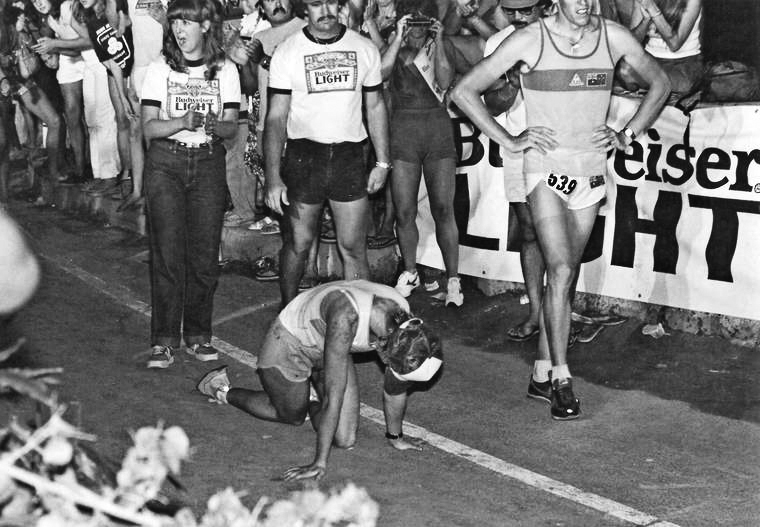
Julie Moss crawls to the finish line of the 1982 Ironman Triathlon in Hawaii. (Photo: Bob Fewell/West Hawaii Today)
I grew into that. I think there were a fair number of situations early in my career when I probably talked too much. Sometimes, the audience would like a little reprieve and a little vacation from how much you know. I had several tugs of war with producers about letting it play silent, and if ever I won my case it was with Julie Moss. There was nothing anybody could have said as she lay on the street in Kailua flapping back and forth on the pavement like a fish with thousands of people watching her, yelling at her, hoping that she’s going to get up and make it to the finish line. Unbelievable moment in time and in the annals of human competition.
You wrote that as a recent graduate you interviewed Dean Smith “constantly and repeatedly.” What did you learn from him?
I learned that though winning is important, the human development of the players is far more important, and there’s no scorecard for that. An All-American forward named Bill Chamberlain [’72] was on the 1972 Carolina team that went to the Final Four and was expected to play UCLA in the championship, though [Carolina] wound up losing the semifinal to Florida State.
One of the reasons for the loss was that Coach Smith suspended Bill Chamberlain, who had been the most valuable player in the Eastern Regional one week before, for the first half because Bill had been two or three minutes late to the pregame meal.
After the game, Coach Smith’s line was, “Tonight was one night. We coach every player for four years.” That was all he would say about the Chamberlain suspension. I was bereft. I wanted to see us play UCLA for the championship, but I thought about it and realized, Oh, that’s why we win 30 games every year. That’s why the program is what it is, because he’s willing to put this human development principle above the near-term goal of winning the game.
Lampley: “I learned [from Dean Smith] that though winning is important, the human development of the players is far more important, and there’s no scorecard for that.”
The most consistent theme in your memoir is how your mother’s views affected your life, politically and socially. How did those views shape the way you approached sports?
I can’t put any kind of quantification on what it meant to have been raised ardently anti-racist. That ultimately influenced my entire career. The greatest boxing trainer of all time, Emanuel Steward, was a product of the New York streets, a product of poverty, an orphaned Black man. We were preternaturally close during the height of my career at HBO.
I once asked Emanuel, “I honestly believe I get along better and have more in common with Black athletes than with white athletes, and with Black people than with white people. Why do you think that is?” He looked at me and said, “Jim, real knows real.” He was saying to me, “I can feel that you’re genuine, even though you were raised in the South, even though you may have seen and felt racism around you in your development as a human being. You don’t have to say it out loud. You don’t have to explicitly express it. It’s your body language; it’s the way that you move around us; it’s the things that you say; it’s the things that you do apologize for, and the things that you don’t apologize for.”
After being in the spotlight so many years, rubbing shoulders with so many famous people, why settle back in Chapel Hill?
Well, I had my time. I first went to New York in 1976. It’s not as if there’s some new thrill out there that is going to top the thrills I’ve already had.

The only things Lampley saved from a career that spanned decades were the press passes that gained him entry into the events he called. (Photo: Carolina Alumni/Ira Wilder ’24)
But, why Chapel Hill specifically?
Chapel Hill is a mythically charmed place for me — ever since my mother drove me from Hendersonville in 1959 to come to a football game. Carolina beat Duke 50 to nothing in a driving rainstorm, and we gleefully stood in Kenan Stadium throughout.
Decades later, I was in a bar in Hollywood talking basketball with somebody, and a woman tapped me on my shoulder and said, “What is it about you Carolina people, you people from Chapel Hill, you’re obsessive. You’re nonstop. It’s as though you’re members of a cult.” I said, “No, it’s not as though we’re members of a cult. We are members of a cult.” She said, “So why?” I said, “Well, you’d have to go there. You’d have to meet some people. You’d maybe have to spend time in a classroom. I don’t know what you would have to do to get it, but almost everybody I ever knew who went there got it.”
I went away for more than 40 years, and then I was conjuring, I’m not going to be talking into cameras and microphones anymore, where am I going to talk? And one thing that came to me was, You could teach. I became really close friends with Patricia Parker, who was the chair of the communications department, and with [then-] Chancellor Kevin Guskiewicz, with whom I share a birthday. I wrote up a whole course, COMM 490: ‘Evolution of Storytelling in American Electronic News Media,’ and I taught for five semesters.
Time after time, I would say to the students, “If you get up every morning and before you come to class you go to your preferred social media feed, you’re asking to be colonized, to be subdivided, to be lied to.” Well, they wouldn’t listen, and eventually I got frustrated. So after five semesters, I was finished teaching.
Other than teaching and writing a memoir, what have you been up to since walking away from the cameras?
Grandkids.
Other than that, I’m back to communicating. Boxing is the most logical place for me to talk. I now do a live ringside chat, a brand new medium. I often said in my COMM 490 classrooms, “It’s very important for you to understand that evolution in technology will lead to changes in storytelling.”
The memoir spans more than 44 years on camera, and you say you had plenty of regrets. Was anything overwhelming or cathartic to revisit?
I’ve already weathered the regrets, night after night on my pillow, looking back, recollecting. You know, the regrets are too many to mention, but I’m fine.
I’m an incredibly lucky person. The things that I did, the things I got away with, no human being should have that kind of leeway, and I can’t figure out or describe [why]. Maybe because my father died when I was 5 years old? Or maybe because my mother had to battle a heart condition to get my brother and me raised? Maybe because of challenges like that I was getting paid back. But more likely, the world is an unpredictable place. And that’s just it.
And, it happened.
That’s exactly right.
Thanks for reading the Carolina Alumni Review
Carolina Alumni members, sign in to continue reading.
Not yet a member? Become one today.