Mr. Modernism
Posted on Oct. 13, 2025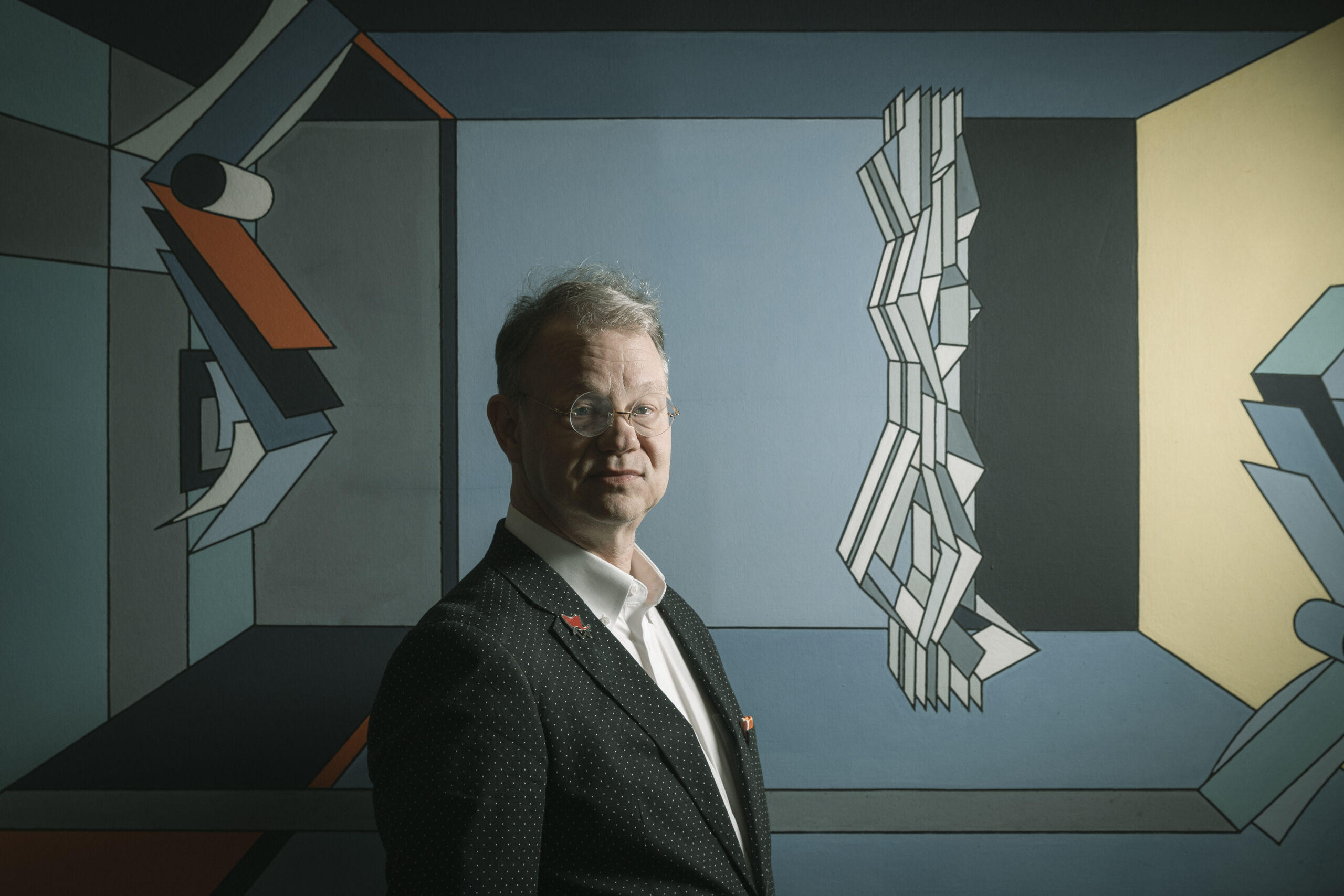
“Our aim is to make Modernism interesting to people for whom it’s their ninth or tenth interest in life, not their first or second,” said George Smart Jr. ’83, the man behind NCmodernist.org, which provides “information and organization to document, preserve and promote North Carolina’s legacy of exceptional residential Modernist architecture.” (Photo: Carolina Alumni/Ira Wilder ’24)
In 2007, George Smart Jr. ’83 decided to build a new house for his family. But not just any house. He drew inspiration from a visit to Fallingwater, an iconic Frank Lloyd Wright-designed home (now a museum) in southwestern Pennsylvania. The house features several terraces extending horizontally from a chimney, above a waterfall on Bear Run stream. “There’s no videos or photos that can do it justice,” Smart said. It was that impressive to him.
When he returned home, Smart bought Styrofoam blocks and carved out a model of his house. He hired Tonic, a Raleigh architecture firm now called Katherine Hogan Architects, to make his Modernism vision a reality on a plot of land abutting Parkwood Lake in Durham. In 2010, Smart and his wife, Eleanor Stell, moved in.
Smart’s home project was personal, but it also alighted his fascination with architectural Modernism writ large. He has turned his love of Modernist architecture into a passion for celebrating and promoting the preservation of now-historic homes.
The Modernist style was an outgrowth of construction technologies that emerged toward the end of the 19th century — drywall, reinforced concrete, steel frames and plate glass. Architects such as Le Corbusier, Ludwig Mies van der Rohe and Wright were among the most well-known practitioners of the form, though none had formal architecture training. Before the 1890s, architecture imitated Greek, Roman and Gothic styles. Modernists moved away from the formality of traditional homes, creating large family spaces binding the kitchen, living room and dining room. They replaced traditional gables with a flat roof.
Smart, a Research Triangle-based management consultant, began visiting Modernist homes and set up a website to catalogue them. In 2013, he expanded his work statewide with NCmodernist.org, and later he launched USmodernist.org to include homes across the country. What began as a hobby turned into a full-time second career, with Smart and his small staff producing a podcast and a weekly newsletter with 40,000 subscribers.
While archiving thousands of architectural photographs, blueprints and magazines, Smart realized he had been inside many Modernist homes as a child thanks to his father, George Smart Sr., who had been a Raleigh-based architect, designing mostly post offices, schools and office buildings. “Like 99 percent of architects, he wasn’t famous,” Smart said. Smart’s mother, Ann Seltman Smart, was one of the first female DJs in the state, working for Raleigh’s WPTF station.
Even as a student at UNC, he gravitated toward the campus’s Modernist buildings, such as Hamilton Hall, Kenan Labs and the old Chase Hall cafeteria. His appreciation, though, didn’t inspire him to pursue studying architecture in his youth. Instead, he majored in business and computer science and later received a master’s from Duke University. For about 30 years, he was a consultant and one of the first executive coaches in North Carolina.
For the past decade, Smart has worked full time on USModernist. “I haven’t won the lottery yet, so it’s not self-funded,” Smart said. Instead, the nonprofit enterprise relies on paying members, donors and revenue-generating conferences at Modernist meccas, such as Palm Springs, California, and New Canaan, Connecticut.
“George is doing a great job promoting historic preservation,” said Alan Hess, a California-based architect and prolific architectural historian. “He’s filled a niche that didn’t exist before.”
While Smart records podcasts with famous architects, designers and historians, his target audience is much broader. “Our aim is to make Modernism interesting to people for whom it’s their ninth or tenth interest in life, not their first or second,” Smart said.
Phil Szostak, a Chapel Hill-based architect who has designed many Modernist homes and cultural spaces in the Triangle, including the Durham Performing Arts Center, said Smart has grown the language of Modernism in North Carolina, which has a strong history of early Modernist homes. Szostak pointed to the Greensboro-based architect Ed Lowenstein, who designed many Modernist homes in the 1950s and 1960s and was the first white architect in North Carolina to hire African American architects. “A lot of modern houses are behind a long driveway or otherwise out of sight from the public,” he said. “But George has catalogued them so people can see them.”
Preservation is a priority for Smart. In the 1980s and 1990s, many Modernist homes were torn down, often replaced with McMansions or otherwise indistinctive, larger homes as a result of homebuyers trying to get the most out of property values, according to Alan Hess, a California-based architect and prolific architectural historian. Modernist architects had built modest-sized homes for middle-class buyers. The Case Study houses — 25 homes commissioned by Arts & Architecture magazine for major architects to design — were built in the 1940s through the 1960s, primarily in California, and are the most notable. “But in California, those lots alone are [now] worth one or two million dollars or more, and people [who] bought these houses often tear them down,” Hess said.
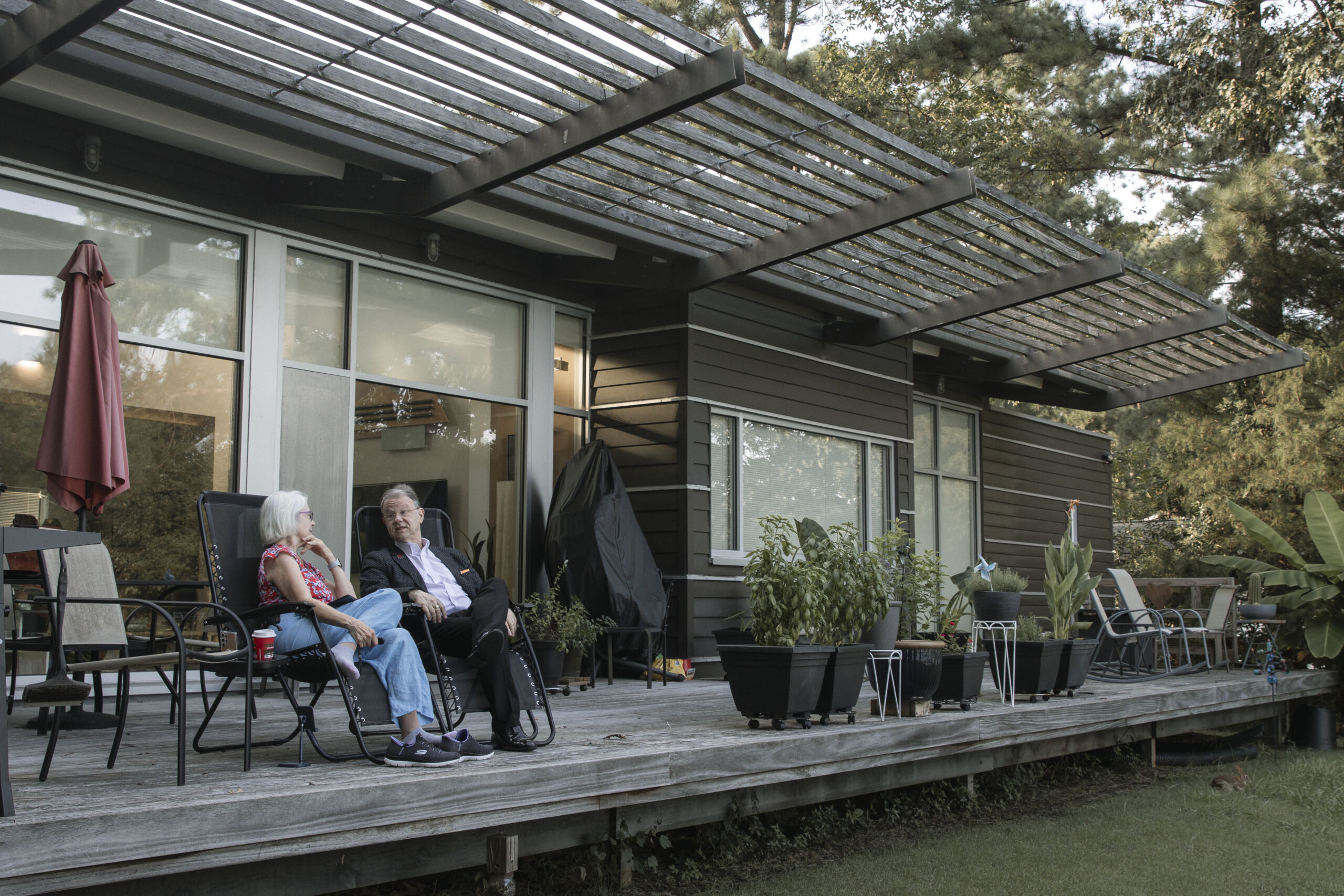
After visiting Frank Lloyd Wright’s Fallingwater, Smart carved a model of his dream house out of Styrofoam blocks. He hired an architecture firm to make his vision a reality on a plot of land abutting Parkwood Lake in Durham. In 2010, Smart and his wife, Eleanor Stell, moved in. (Photo: Carolina Alumni/Ira Wilder ’24)
Fortunately for preservationists, Smart said, the demolition trend for these houses has slowed down. He cited as major factors a renewed appreciation for Modernist architecture and climate awareness. (Smaller houses use less energy.) Now, when an iconic home is destroyed, there’s often public outcry.
In 2023, the actor Chris Pratt (star of blockbusters Guardians of the Galaxy and Jurassic World) and his wife, Katherine Schwarzenegger, paid $12.5 million for the Zimmerman House, a famous Modernist home designed by the influential midcentury architect Craig Ellwood, known for his use of steel and glass. The 2,770-square-foot home in the posh Los Angeles neighborhood of Brentwood was built in 1950 and had five bedrooms and three bathrooms on a one-acre lot, but Pratt and Schwarzenegger demolished it and are building a 15,000-square-foot “modern farmhouse” in its place. The demolition sparked a public backlash, while professional critics lamented the loss of another iconic home. “It’s tragic when fine examples of Midcentury Modern architecture are destroyed,” said Elizabeth Smith, author of Case Study Houses.
A regular feature in the USModernist weekly newsletter highlights Modernist homes at risk. “George is doing a great job promoting historic preservation,” Hess said. “He’s filled a niche that didn’t exist before.”
In addition to hosting events in California and New York, USModernist organizes group visits to Modernist and Modernist-inspired homes in the Triangle, as well as monthly “Thirst4Architecture” happy hours for fans, who are dubbed “the Mod Squad.” Durham-based architect Ellen Cassilly and her husband, Frank Konhaus, have hosted several events at their home, Cassilhaus, which also serves as an artist studio and residency.
“George is such a resource for the community,” said Cassilly, who met Smart after taking swing dance classes alongside his father. “He’s doing work that one thinks would be done — but isn’t — by the American Institute of Architects or North Carolina State [University],” which has the state’s top architectural school. “When I’m doing a renovation of a Midcentury Modern house, the first thing I do is go to the USModernist website to see if there are pictures or architectural plans in the archive,” she said.
Smart said he hasn’t located records of every Modernist house nationwide, but he receives tips on houses about every week. “Since buying and selling real estate is a public act, when an interesting home comes on the market we take note and do research,” he said.
Smart’s Modernist evangelism extends to all facets of his life — his Mini Cooper boasts a vanity plate: “MODERNST.” An unexpected and rewarding part of his second career, Smart said, is commemorating architects who pass away. A family will reach out to him when an architect dies, and Smart can point them to the archives of the deceased architect’s work. “And I’ve even had the privilege of doing several eulogies,” he said.
Smart said he wants to continue to expand USModernist. Because of the podcasts, Smart’s Modernist architecture appreciation reaches listeners worldwide, with the strongest followings in Italy, Australia, the United Kingdom, Germany and Brazil.
At 63, Smart has no plans to retire from his second career. “My wife refers to this project as an 18-year seizure,” he laughed.
Paul Wachter is a freelance writer based in Chapel Hill.
Thanks for reading the Carolina Alumni Review
Carolina Alumni members, sign in to continue reading.
Not yet a member? Become one today.