Newmark at the Helm
Posted on July 15, 2026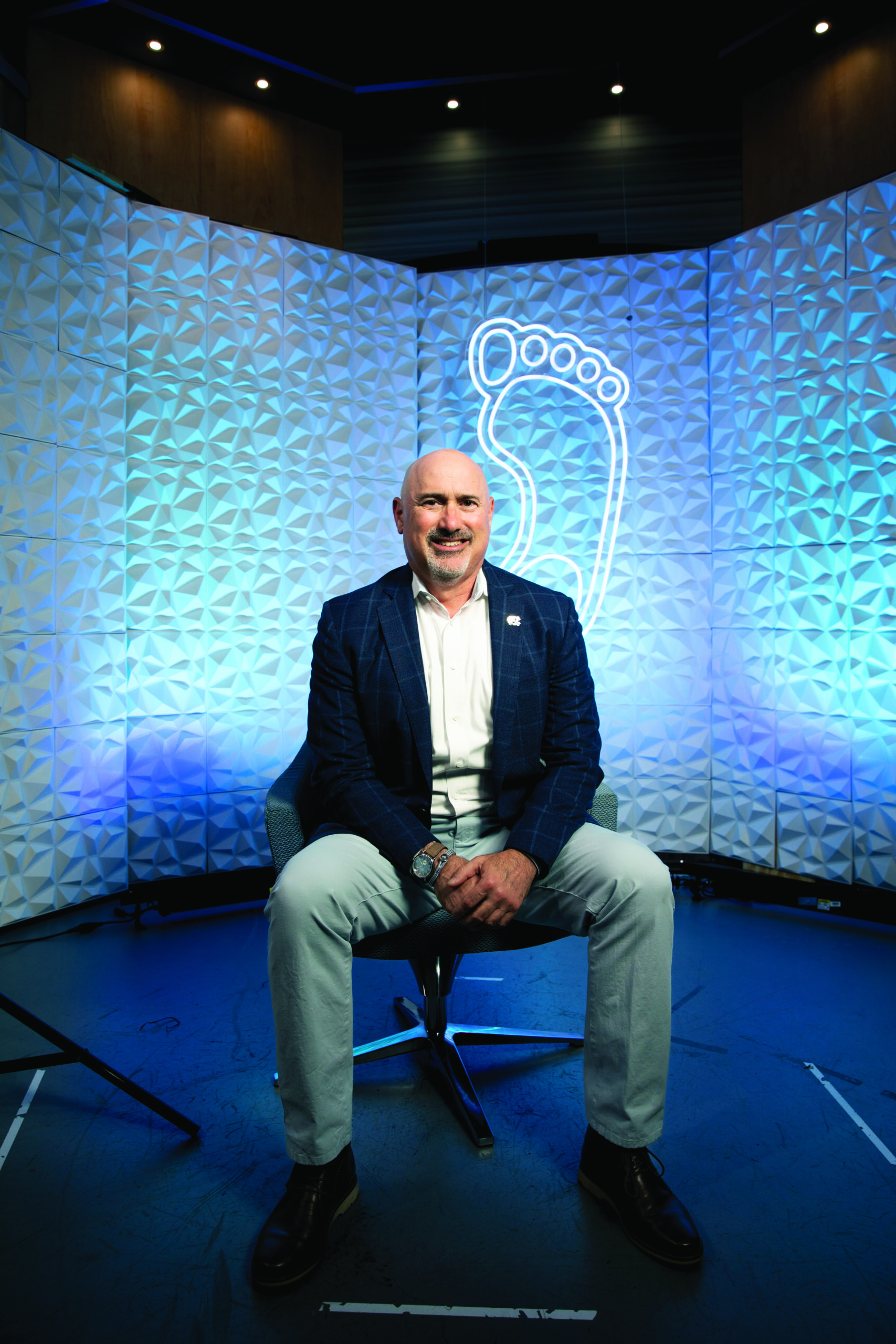
“The cost of collegiate athletics has never been higher. There’s going to be a tension of allocation of resources within an academic institution, particularly a public one. I also don’t think it’ll be this chaotic in the future. ” — Steve Newmark (Photo: Carolina Alumni/Ira Wilder ’24)
NIL and revenue sharing. Transfer portal and roster management. Title IX and legal compliance. Media rights deals and revenue generation. Coaching retention and program success. The challenges facing an athletic director at a top-tier school in 2026 are … numerous. And the list continues to grow, as does criticism from some passionate fans.
Athletic Director Steve Newmark might be new to collegiate athletics administration, but prior to his yearlong stint as Carolina’s executive associate athletic director, he found success in a different high-octane sports environment.
Following his undergraduate years at William & Mary and law school at UVA, Newmark joined a Charlotte law firm, working primarily in mergers and acquisitions and intellectual property — but not in sports. Several of his colleagues, though, worked with NASCAR teams and Conference USA, and Newmark stepped in when those co-workers needed help. That led to a role at Fenway Sports Group’s RFK Racing, where he served as president for nearly 15 years. Newmark liked his job so much he thought he’d retire at RFK Racing, until former Carolina Athletic Director Bubba Cunningham asked him to take over one of the most successful athletic programs in the history of the NCAA.
The Review sat down with Newmark in mid-March to talk about what it means to step into the AD role at such a chaotic time in college sports. (The interview has been edited for length and clarity.)
How did your hire come about?
I had worked with Dean Jordan, who works in global sports media rights at Wasserman Media Group, on some charter negotiations. He asked if I’d help on a steering committee looking at the new revenue-generation commercialization at UNC. Then, a couple summers ago, Bubba brought several people to the race shop in Charlotte. We walked them through the sponsorship sales processes, how we monetized the intellectual property. This was before [UNC] had a chief revenue officer. Bubba and I struck up a friendship. They asked me to be on the search committee for the new football coach. Then, [in] December [2024], Bubba asked if I would be interested in a role at UNC.
It hadn’t been on my radar. I really liked being part of the Fenway group; it’s a great organization. But my passion has always been Carolina athletics. You can’t get it out of you. Everybody in the NASCAR space thought I went to Carolina, and they referred to me as the Carolina guy. When we would travel for a Sunday race, my staff would look at UNC’s Saturday schedule before they scheduled a dinner. They knew if there was a Carolina game, I was going to watch the game instead of going to dinner.
I imagine your experience and knowledge in commercialization is key.
Bubba is unbelievably bright. He could figure out all this revenue generation stuff. To me, a big appeal was the overlap [between the AD and executive associate AD role]. I had a lot of very smart business folks who said, ‘I wouldn’t do that — you can’t have four hands on the steering wheel.’ In a lot of circumstances, you can’t, but Bubba doesn’t have much of an ego. He’s very measured. He’s probably one of the most respected ADs, if not the most well-respected. So, that was appealing to me — to learn from him and watch him operate.
I didn’t know the nuances of compliance, admissions, those things. So, it’s been beneficial. This is a well-oiled machine on that side of the house. What is changing the most is the external commercial side, with the chaos of NIL and the increased focus on revenue generation.
So far at Carolina, what has surprised you the most?
Probably 90 percent of what the group here does, which is 200-plus employees, is focused on support systems that you and I would have expected [to see] before NIL and revenue sharing existed — whole legions of people trying to make sure student athletes get admitted and get acclimated, ensuring they have academic support, mental health support and career development.
That is refreshing because that’s part of the core mission here: inspiring and educating through athletics. There’s no doubt that a component of professionalism has crept in, and it grabs the headlines with the dollars being paid. But we’ve got 750 student athletes and 28 teams. Maybe 10 percent are being compensated.
But then there are the challenges: The cost of collegiate athletics has never been higher. There’s going to be a tension of allocation of resources within an academic institution, particularly a public one.
I also don’t think it’ll be this chaotic in the future. I think we will get to a place where, whether it’s collective bargaining, whether it’s some type of congressional solution, it’ll stabilize. Because this is not a sustainable business model.
How are media rights driving revenue?
It’s massive. The media rights are driving it. That’s why there’s such a renewed emphasis on football, because [it] generates the lion’s share of those media dollars.
How do you navigate what the fans want versus what you think the “right” fiscal choices are?
Carolina fans take pride in the athletic programs. You take pride in things that are successful and [done] the right way and represent the University in the right way. There’s no doubt you need dollars to be successful. One thing I’m most proud of is that part of UNC’s DNA is having broad-based Olympic sports programs. That’s something we must figure out how to preserve.
But it’s a hard balance. If you look at the budgets, some schools have $250 to $350 million budgets, and ours is $180 million, which is very healthy, and it [generates] a lot of money as well. But you have to figure out a way to maintain those sports, and nobody is going to be satisfied with just maintaining. Those 28 athletic programs all have national championship aspirations. The reason they do is because most of them have won national championships.
I’ve heard people say, “Oh, we should do it the way Dean Smith did it in the ’80s.” But I think … most people who recognize how Dean Smith operated see that he was an entrepreneur, an innovator. I firmly believe if he was in today’s environment, while he [might] not like all the rules and he [might] lobby to change some, he’d still figure out what the rules were and how to be the most competitive. That’s what we have to do: figure out how to use all the resources here, because we have a unique advantage, not only with the national brand, but the academics and the Chapel Hill setting. We don’t necessarily need to always have the most dollars, but we have to have enough resources to ensure that we can attract the right people.
Does that feel daunting or exciting?
Both. There’s no doubt the chaos is not something we would prefer. It’s just the Wild West in NIL, on compensation, transfer portal. We’d much rather there be a level set of the rules, because that’s where we feel [our] inherent advantages will shine. A lot of those advantages have been our coaches. We’ve had so many iconic coaches who come here, put an anchor down, build a program and do it the right way.
Now that the business side is so much in the forefront, do you feel like that changes the relationship-building aspect of the job?
I don’t. I think the relational aspect continues to be critical. It’s still about trust and developing relationships [among] sport administrators, coaches and assistants and making sure they feel comfortable and they’re supported in a way that allows them to succeed. I’m fortunate to come into this position and be able to get advice, not just from Bubba, but from Dickie [Baddour ’66, ’75 (MA)], who … it has taken me quite a bit of time not to call Mr. Baddour, because he’s known me since I was 3. Even having conversations with [former UNC women’s soccer head coach] Anson [Dorrance ’74], who I probably hadn’t seen since I was his daughter’s camp counselor at the faculty club when I was 15. It still comes down to relationships, particularly when you’re asking so much of these coaches.
Has that been a big focus in this apprentice-style year?
That was important for me. I had breakfast with all of our head coaches, and I’ve tried to continue to develop that dialogue. I’ve done that with Rams Club board members, Board of Trustees, Board of Governors, big donors. We have so many people that are passionate about UNC and UNC athletics. It’s very easy to reach out and say, “Hey, I’d love to get your perspective. You were the Rams Club board chair 10 years ago,” or, “You were dean of this school.” It’s refreshing to get a different perspective, because it’s very easy to get tunnel vision when you’re within the athletic department.
What’s your take on fan opinion, particularly in light of the ongoing Smith Center conversations?
Our mission is to serve our student-athletes, coaches and the Carolina community, and you can’t be successful unless you have a vibrant, energetic fan base. I do get lots of opinions, and lots of completely contradictory opinions. Half the people are going to say X, half the people will say Y; so , you’re going to make half happy and half unhappy no matter what you do. It’s an occupational job hazard. I’m also only on Twitter, not any other social media. My kids will tell me occasionally that people are questioning my intellect. I knew I was getting into that.
What have you learned about yourself throughout your career that will help you as AD?
One of the things you must do in the sports world is make sure you look through a lens that isn’t just, “How is this going to impact us tomorrow?” A friend gave me a suggestion that when something comes on your desk, think about, “Will this be important in six months?” [This] allows you to take a deep breath and say, “OK, this may not be ideal, but in the scheme of things, this isn’t a critical piece.” Because there are so many little fires that if you get emotional around each one, you will lose focus on the true North Star. That’s not always the easiest to do in the sports world, right? You win a game, everything is great. You lose a game, and the world is ending. We used to talk about it in the racing world: In racing, you get a scorecard every weekend. Here, it’s every day, and it’s a very public scorecard.
In five years, looking back, what do you hope to have accomplished?
To me it’ll be deemed successful if the athletics department continues to provide the resources to our coaches and student athletes for them to excel. We need to be more entrepreneurial, more aggressive, nimbler in how we operate. We also have to recognize that some of the things we try, they’ll fail. And that’s OK. But all this needs to be geared towards making sure we can remain competitive in 28 sports.
Can your experience with Fenway Sports Group help solve for that?
I hope so. I think it’s fair to say that professional sports have done a better job of figuring out how to commercialize IP than college sports. But we’re undergoing a transformation. Rick Barakat [’96], the new chief revenue officer, is going to have a key role. There are a lot of people excited about pushing the envelope, because societal norms in sports have changed. It gives us license to try different things.
What might those different things be?
It’s the full suite: figuring out how to generate content that you can monetize, how to tell more stories about student-athletes. Selling more sponsorships. One of my favorite things I saw when I was announced [as incoming AD] was a meme of a football jersey with corporate logos like a NASCAR fire suit. I don’t think we’ll quite get there, but we do need to figure out how we unlock our corporate partnerships better [to] help [financially] support our programs — staffing, coaches and, now, the players. If you want to survive, you have to be more forward thinking on commercialization because … you’re not going to be able to cut your way to prosperity. You have to figure out new and creative revenue streams. We’re fortunate the University is extremely supportive of athletics while recognizing that the primary mission is an academic one. We’ve all heard the quote from Dean Smith about [sports being] the [University’s] front porch. We’ve got to make sure that what we do supports the overall academic reputation and mission of the school.
— Anna Katherine Clemmons
Evolution of the AD
The athletic director role has changed over the years, to put it mildly. The Review spoke with the three most recent ADs about the issues they faced. (Interviews have been edited for length and clarity.)
JOHN SWOFFORD ’71 (AD: 1980–97)
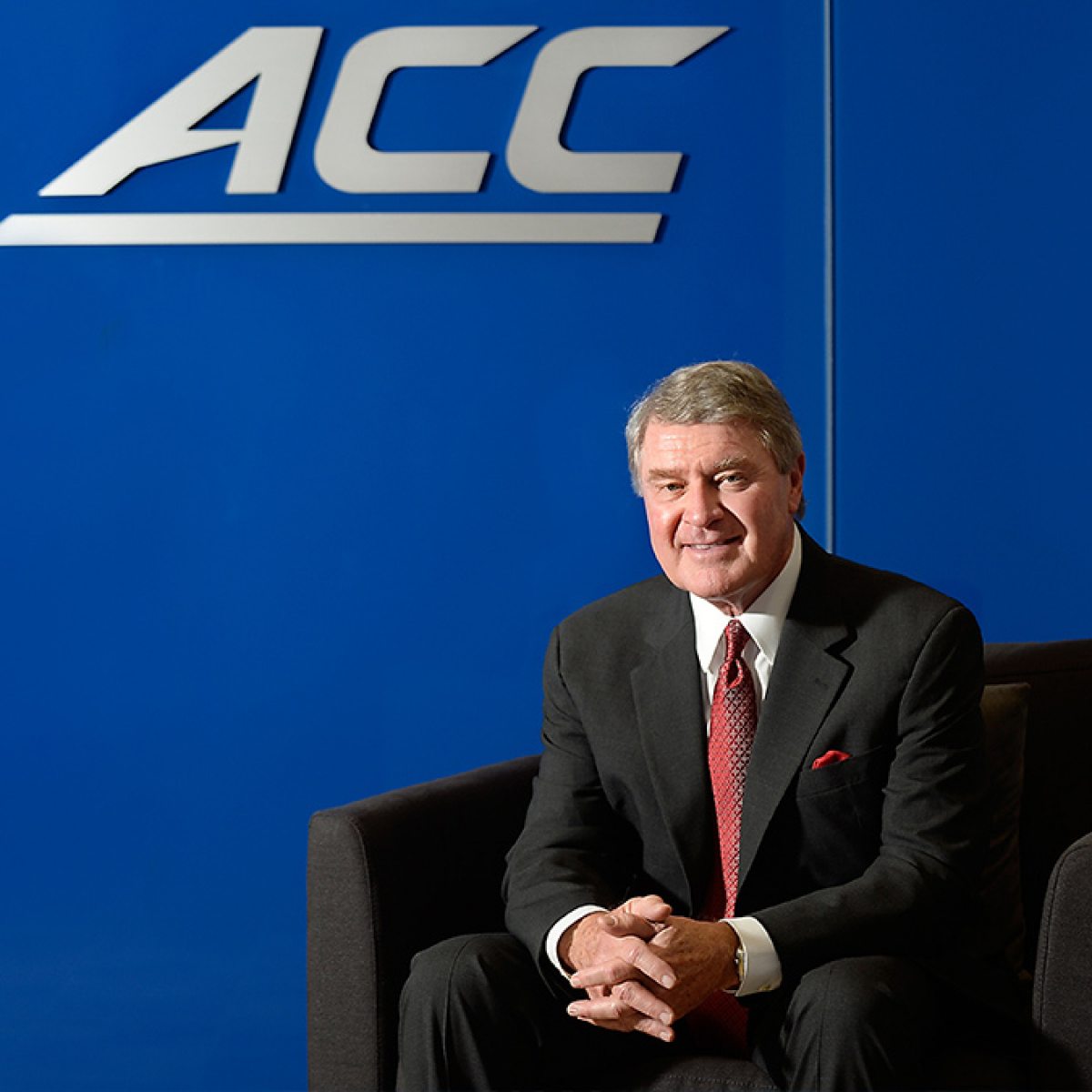
John D. Swofford ’71
Swofford became AD in 1980 at age 31 — the youngest AD in major college sports at the time.
“We had a lot of success competitively. We were able to bring in some terrific coaches. And in 1994, we were named the best overall athletic program in college sports.
“From a national standpoint, the most significant thing to happen was Title IX. There was a fair amount of resistance to it at some places. Not at Carolina, I’m proud to say.
“From a Carolina perspective, right before I was named athletic director, the University went through a full evaluation of the basketball arena question. Basketball was having so much competitive success that there were so many people that wanted to see the team play. The first step we took was to take out all the chair seats [in Carmichael Arena] and put in bench seats. But that didn’t solve the problem, so the next thing on my agenda was the Smith Center. As a [young] athletic director, I lost a lot of sleep [over it].
“We had to build it with private money. The biggest gift to that fundraising drive was that in its first two years, our basketball team went to the Final Four and then the National Championship game and won.
“We also did a lot to Kenan Stadium in terms of adding lights, which was almost as big a challenge as the Smith Center. Also, we were required to be financially self-sustaining as an athletic program. While the zeros at the end of the numbers were different then, it was the same challenge.
“I hired five or six coaches that won national championships. It was just a great group of people. We were trying to build a national fandom. As you saw it come into reality, it was gratifying.
“I loved where I was. I had wonderful people around me. I don’t mean to make it sound like every day was a piece of cake, because it wasn’t; but generally speaking, it was a great job at a great university.”
DICK BADDOUR ’66 (’75 MA) (AD: 1997–2011)
Dick Baddour ’66
“When I came in, I had relationships, a ton of support from faculty and coaches. John had done such a good job that it wasn’t like a ton of stuff needed fixing.
“The biggest problem was the budget. The perception was that we had all we needed, and it was easy. That wasn’t the case. In my first year, we lost over $1.5 million. I made a pledge to myself and the staff, that was never gonna happen again.”
Balancing the budget became the responsibility of the athletic department. Baddour maintained a balanced budget throughout his tenure and spearheaded corporate sponsorship with Nike and Learfield. For him, one of his biggest legacies was the Carolina Leadership Academy.
“John had preached three principles: academic success, doing things the right way and competing. I added a fourth: the student-athlete experience. In my meetings with head coaches in 1997, I said, ‘What’s the most important ingredient you need to be successful?’ And everyone said student-athlete leadership.
“Several years later, I’m on an elevator with several team captains. I had served 30 years in the Army Reserves, and I went to officer school in Kansas. And in my training, the core principle of leadership was that leaders are made, not born. On that elevator, I’m thinking, if that’s true, we can do something.
“So, we invented this leadership academy. The first year was core values: You believe in the institution; you believe in what we’re doing. The second year was leadership by example, and the third and fourth years were vocal. We also started a program for coaches.
“People say, ‘You had a really tough job.’ My attitude is you choose your kitchens; you choose where you’re gonna cook. I really enjoyed what I was doing. I was very relationship-based. [UNC baseball coach] Mike Fox [’78, (’79 MAT)] said that in my first meeting with him, I said, ‘Coach, I wanna understand your world. And if I care about your world, and I understand it, then you’ll trust me when I have to make decisions that are not in your favor that you’ll understand.’
“I told Bubba [Cunningham], at UNC, it’s hard to be a national leader and be a local leader. You’re called on nationally, and you want to support the profession, but I also wanted to be here on Sunday afternoon rather than being on a train. I wanted to be at field hockey and baseball.”
BUBBA CUNNINGHAM (AD: 2011–26)
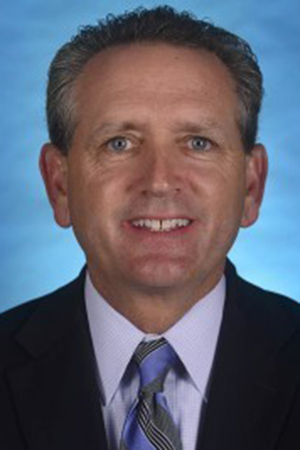
Cunningham
Cunningham witnessed 24 Tar Heel national championships, but when he arrived, things weren’t so rosy.
“The state of things nationally was relatively calm, but what was happening here was a little more problematic. We had just fired the football coach, Butch Davis, and Dick [Baddour ’66, (’75 MA)] had retired. Taylor Branch [’68] had just written the article The Shame of College Sports. So, we had the tension between educational exploitation, and collegiate football in particular, which I find ironic now. We had agents, we had amateurism issues, and so we had to spend a lot of time working on building a bridge back to campus and working with the NCAA.”
Prior to UNC, Cunningham had worked at Tulsa, Ball State and Notre Dame.
“The scale is different, but the issues are the same: We don’t win enough, and we don’t have enough money. If you could solve those two, you’d be a hero everywhere. You’re always competing for students’ time. How much do you practice? How much do you go to school? How do you balance the resources? Resource allocation is probably the biggest responsibility of the AD.”
Recent years have introduced new strains: NIL, pay-for-play and revenue sharing. The 2025 House v. NCAA antitrust settlement established a revenue-sharing model allowing Division I schools to directly pay student-athletes up to an annual cap of roughly $20.5 million per school.
“Up until last year, we could manage our budget and basically break even. Football and basketball could support everybody else. But when you get to the $20.5 million, and you allocate almost 90 percent to [the sports] that generate it, [that] puts a real strain on your budget.”
While some schools across the country have cut Olympic sports, UNC has not.
“Olympic sports are really the pride of the institution, particularly on the women’s side. They’ve won over 60 percent of our national championships. That started with an early investment in field hockey, lacrosse and soccer, and that has really paid dividends.
“[Our mission is] to educate and inspire through athletics. But you still have to finance it. And we’re seeing that challenge. [We] try to bring people together and have pride in the institution through the sports programs. We obviously aren’t the most important thing, but we are a big part of how people feel about this place.”
—Anna Katherine Clemmons
Thanks for reading the Carolina Alumni Review
Carolina Alumni members, sign in to continue reading.
Not yet a member? Become one today.