Recycled Folks
Posted on Oct. 13, 2025
Ann Hobgood ’67 inside of her studio in Hillsborough (Photo: Carolina Alumni/Ira Wilder ’24)
When Ann Hobgood ’67 walks to her art studio a few steps from her Hillsborough home, there’s often a box or bag of junk blocking the door. Except to her it isn’t junk. It’s the stuff of art. She turns it into fanciful collages of metal, wood and plastic.
After four-plus decades working various jobs, Hobgood, 80, has been spending retirement as a folk artist, and a successful one at that. She was featured last year on PBS North Carolina, and this past winter she sold her wares at the Fearrington Folk Art Show, a premier event for artists in the South and collectors nationwide.
Hobgood, who also finds junk for art at yard sales and thrift shops, was pleasantly overwhelmed for three days at Fearrington Village, between Chapel Hill and Pittsboro, as a never-ending stream of friends and art aficionados came to buy her latest works. “I can sell everything I make,” she said. “It’s just insane.”
While most people would be annoyed to find an old typewriter or rusted metal pipes on their porch, Hobgood uses those castoffs to create whimsical creatures and charming human-like characters. She can transform a rusted old spice tin into a funky torso. She can fashion discarded forks and drawer handles into arms. Upside-down measuring spoons are perfect for feet, and a spray-painted toilet flush ball makes for a handsome head. Hobgood calls the finished products “recycled folks,” built to give the junk new life.
It’s not hard to know when you’ve arrived at Hobgood’s Hillsborough studio — a small house she painted in horizontal rainbow stripes. Large flowers are painted on the side, and objects sit on the front porch. Inside, the studio is packed. Finished art pieces are at the front, her primary workspace in a back corner, and an organized chaos of gadgets and, well, junk fill the majority of the space. This is Hobgood’s happy place. “I feel like I have joy in my life every day, and I’m so grateful for that because I’m afraid most people my age do not have that,” she said. “I plan to do this until I’m 100.”
Hobgood’s biggest challenge these days is finding the time to keep pace with the demand for her creations.
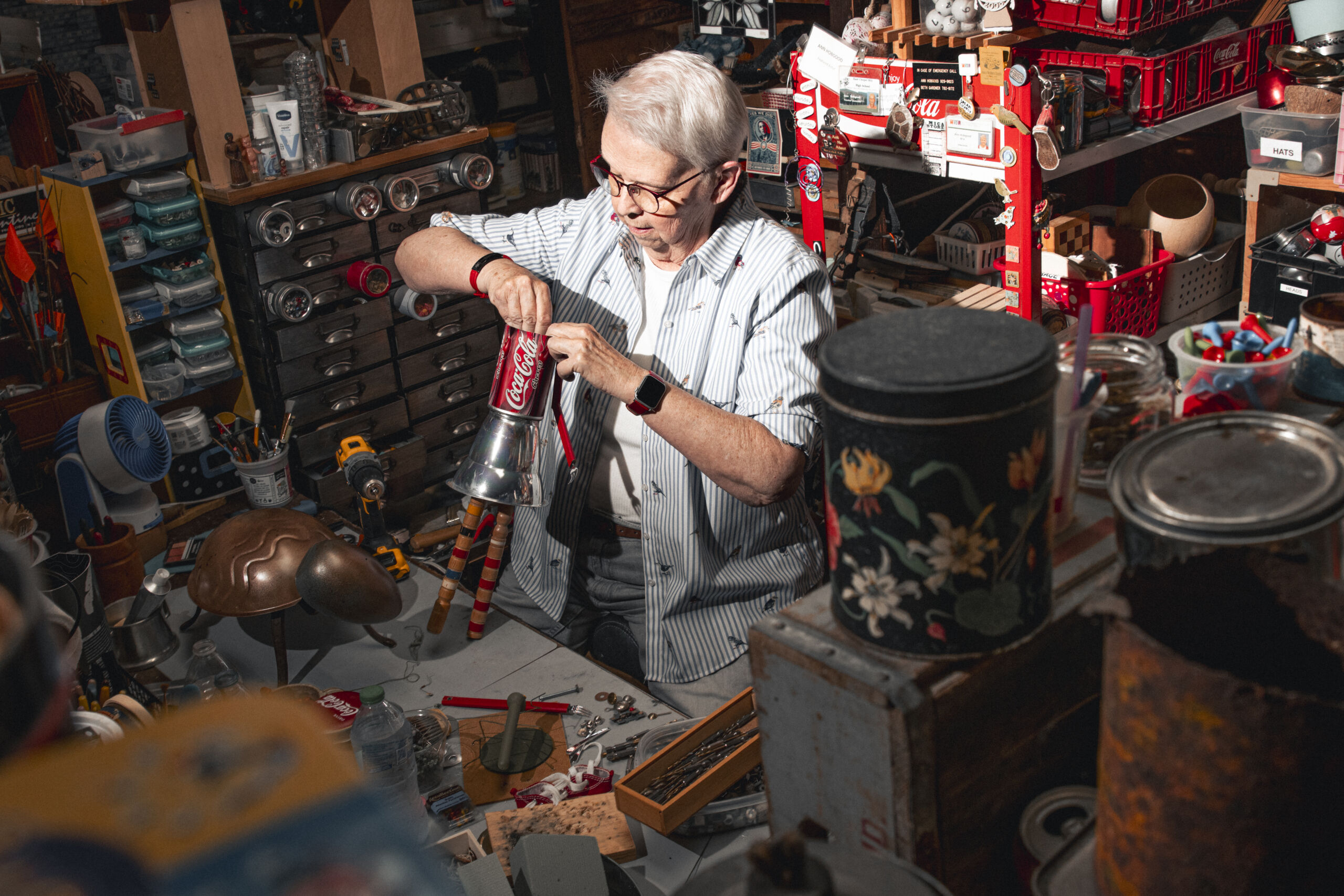
Hobgood’s studio is her happy place. “I feel like I have joy in my life every day, and I’m so grateful for that because I’m afraid most people my age do not have that,” she said. “I plan to do this until I’m 100.” (Photo: Carolina Alumni/Ira Wilder ’24)
Nancy Espersen, a retired market researcher who lives in Hillsborough, said she has about 10 of Hobgood’s creations in her house and yard. One was made with an old copper tea kettle that Hobgood flipped upside down, turning the spout into a nose, before adding other bits of metal and wood to create eyes, ears and a mouth. She used part of an old weather vane for arms, and then she set it atop a bell-shaped block of various materials. “To have her look at something I would consider trash, and then make a person out of it, or a dog out of it, it’s just so whimsical,” Espersen said. “You look at it, and you smile.”
While Hobgood can assemble her individual characters over a few days, it took a lifetime for her to become the artist she is now. It was never for lack of interest. She remembered a small box of crayons and a coloring book she had as a young child, and she still has a painting she made from a paint-by-numbers kit she received when she was 6. Hobgood grew up in a Winston-Salem household where there was no money for extravagances like art supplies or easels.
Hobgood, a good student, was the first member of her family to go to college. She started at Salem College in Winston-Salem before transferring to UNC at a time when few women, aside from nursing and education students, attended Carolina. Hobgood majored in art, ran for student office and attended campus protests.
Following graduation, Hobgood’s life took its share of twists and turns. Marriage. Children. Divorce. Moving from place to place. Bouncing from job to job. But Hobgood persisted and sometimes fell back on her interest in art to pay the bills. She ran a needlepoint store in Chapel Hill for 10 years. Never mind she didn’t know how to do needlepoint. She drew designs for customers in need of things as varied as seat cushions and Christmas tree skirts. She relocated the store for two years to Fearrington Village, where she lived above the shop.
When business declined, Hobgood always found other work to make ends meet. She worked as an assistant in an art gallery, a teaching assistant, a teacher and a tutor. She worked with deaf students and eventually earned a graduate degree in deaf education. She taught basic word processing to other teachers and oversaw a school art center. She worked as a nonprofit administrator and as a learning specialist for kids with developmental challenges. She even flipped houses, using construction skills she had picked up from her father, whom she said never went to high school but could fix or build anything. No matter her job, Hobgood always liked helping others. “There’s nothing better,” she said, “than making other people feel good.”
As Hobgood approached retirement age, her son, Ted Hobgood, encouraged her to do a self-portrait for an art competition in Chapel Hill. Hobgood was intrigued but didn’t have painting supplies. She looked around her house at the various bits of paper, plastic and other junk and decided to do a collage instead. She used a clock face for her own face, adding a pair of glasses. She used toy train tracks — a nod to a childhood interest in trains — for one arm. She incorporated plastic snakes and caterpillars, reflecting another childhood fascination. She attached a paintbrush to one arm and used a plastic coil for hair.
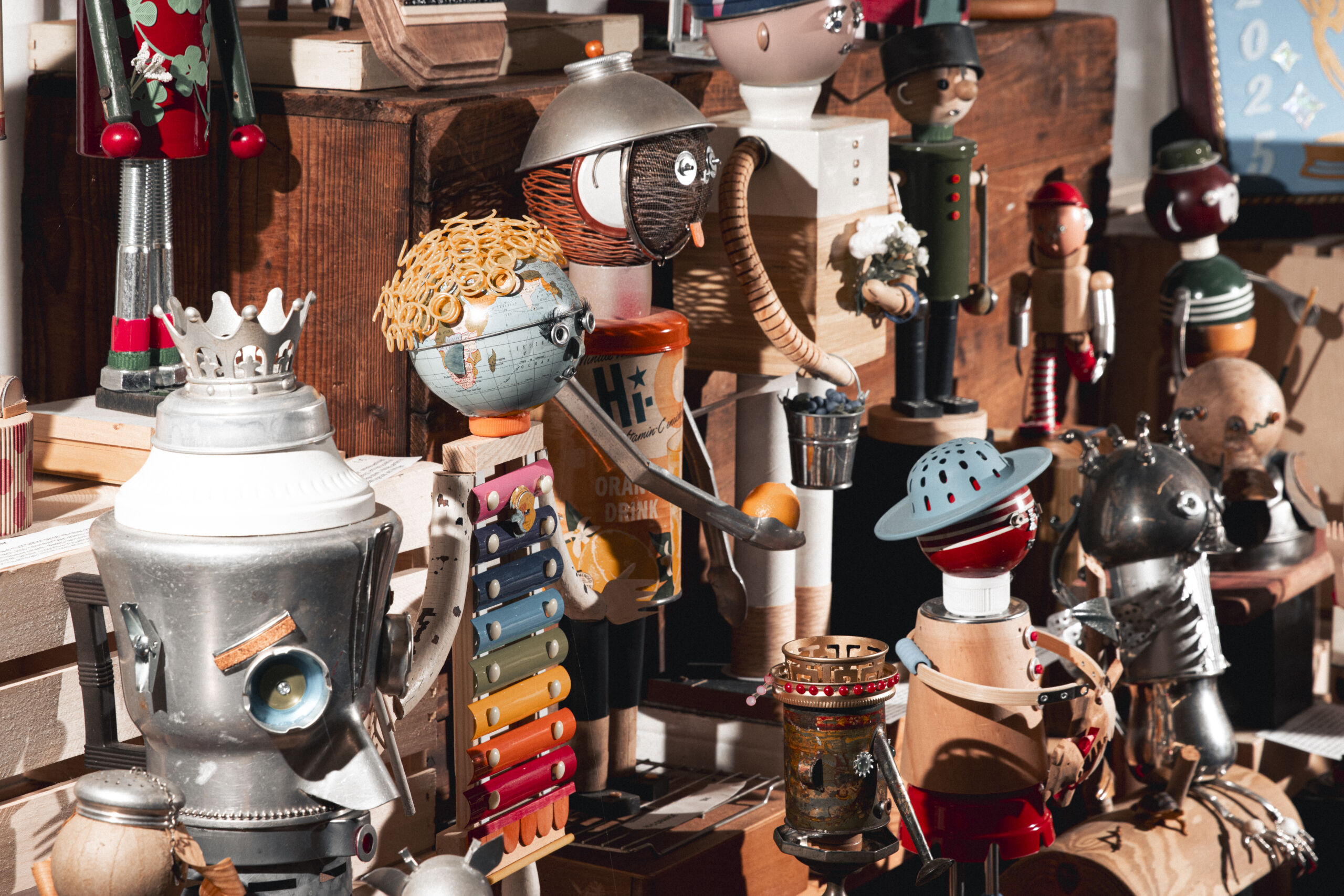
Making things that make people smile became Hobgood’s retirement. “I love people coming through the door,” she said, “and just going, ‘Oh, my God, I love this.’ ” (Photo: Carolina Alumni/Ira Wilder ’24)
Artists have long created abstract self-portraits but none quite like this. The piece struck a chord with friends and neighbors and ended up being featured in an issue of Chapel Hill Magazine. The piece now hangs in her studio, one of a few she’s unwilling to sell.
Hobgood was hooked on folk art and continued to receive praise from people, many of whom wanted to buy her art. Making things that make people smile became her retirement. “I love people coming through the door,” she said, “and just going, ‘Oh, my God, I love this.’ ”
Kim Freeman, who manages a gallery for the Hillsborough Arts Council that often features Hobgood’s art, said Hobgood creates personal items that mean something different to everyone. Freeman said she overhears customers talking about memories sparked by seeing an old spice tin or a shoe polish container, something their parents or grandparents may have used, incorporated into one of Hobgood’s creations. “It’s so brilliantly done,” Freeman said. “It evokes feelings and memories.”
After nearly two decades making art out of flotsam, Hobgood still never knows what she’ll create until she’s in the middle of making it. Often, her art depends on the junk she finds at her front door when she shows up for work in the morning.
Bill Krueger is a freelance writer in Raleigh.
Thanks for reading the Carolina Alumni Review
Carolina Alumni members, sign in to continue reading.
Not yet a member? Become one today.