Reporting for Duty
Posted on July 15, 2026Averi Harper ’13 knows her job is to center the truth, no matter the moment.
story and photos by Ira Wilder ’24
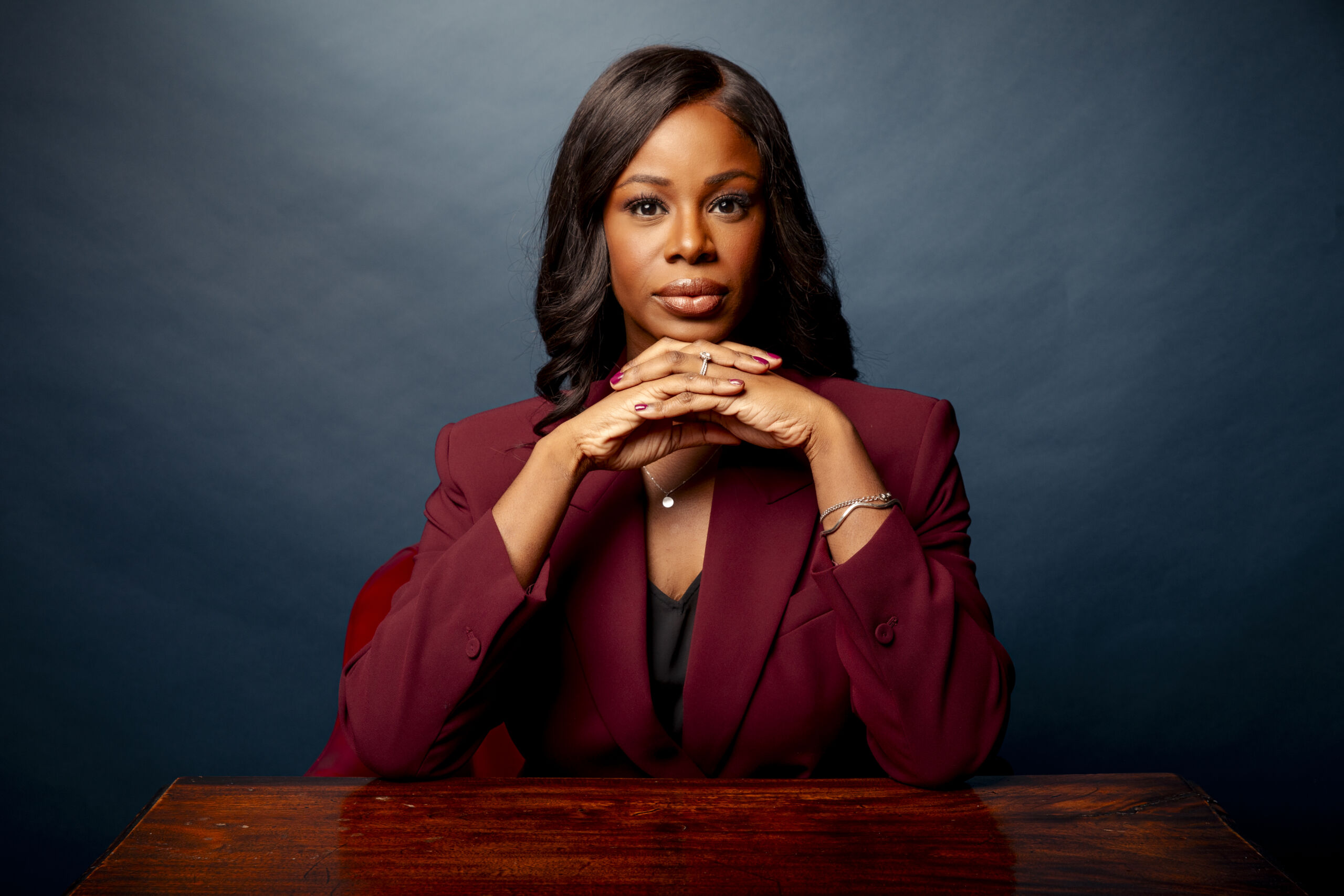
Averi Harper ’13 starts her day before dawn, poring over major newspapers, absorbing every piece of political reporting she can get her eyes on. (Photo: Carolina Alumni/Ira Wilder ’24)
Averi Harper ’13 starts her day before dawn, poring over major newspapers, absorbing every piece of political reporting she can get her eyes on.
“With a news cycle that moves as fast as this one does, while you’re sleeping, a lot of things happen,” Harper said.
As the political director of ABC News, she provides on- and off-air political analysis for ABC News, ABC News Live, ABC News Digital, ABC News Radio and the network’s local affiliates, reaching tens of millions of viewers each week. By the time she gets to the office, she is well-versed in the latest news and already learning what to watch for next. She leads editorial meetings and decides how best to cover the day’s news for an audience that stretches across many demographics and multiple platforms.
It’s her job to dispatch reporters, photographers, podcasters and videographers to the places where national political decisions are made. Television news production requires something of a sixth sense to know when and where to have cameras and reporters in position to cover a breaking story, a trickier endeavor than just writing a story based on a wire report.
Through that intuition, Harper keeps an engine of correspondents and editors running across the country, thoughtfully and carefully. In the November midterm elections, she’ll be responsible for deploying reporters on the campaign trails, ensuring proper coverage of each candidate.
In most meetings throughout her career, Harper has been among the youngest, sometimes the only woman and sometimes the only person of color.
“I don’t even think about it anymore, to be quite honest with you,” she said, “because I know that every single experience I’ve had has prepared me for the moment I’m in.”
Harper said she doesn’t feel pressure to prove herself because of her age or anything else; she feels pressure because the political moment requires a level of seriousness she knows she can meet.
A 2025 Gallup survey reported that just 28 percent of Americans have at least a fair amount of trust in legacy media. At the political helm of one of the most watched broadcast news networks in the country, Harper said she feels immense responsibility to deliver the news accurately and fairly.
“We talk to voters on both sides of the aisle,” she said. “Our viewers, listeners and readers continue to come back to us, because our North Star is ensuring that folks understand what’s at stake. It is not to have an agenda. It’s not to tell people what to think or who to vote for.”
Harper said she covers the news in an honest, pragmatic way, as though she’s conversing with her grandmother. That straightforward approach — a focus on issues, such as gas prices, that affect large swaths of people across the country — has become even more necessary as the political divide continues to grow.
Her work reaches a fever pitch on election night — “our Super Bowl,” she calls it — the culmination of months of campaign reporting and policy tracking. On election night in 2024, she was on air until after 5 a.m. She said she shut her eyes for about 15 minutes before returning to the newsroom.
Journalism chose her
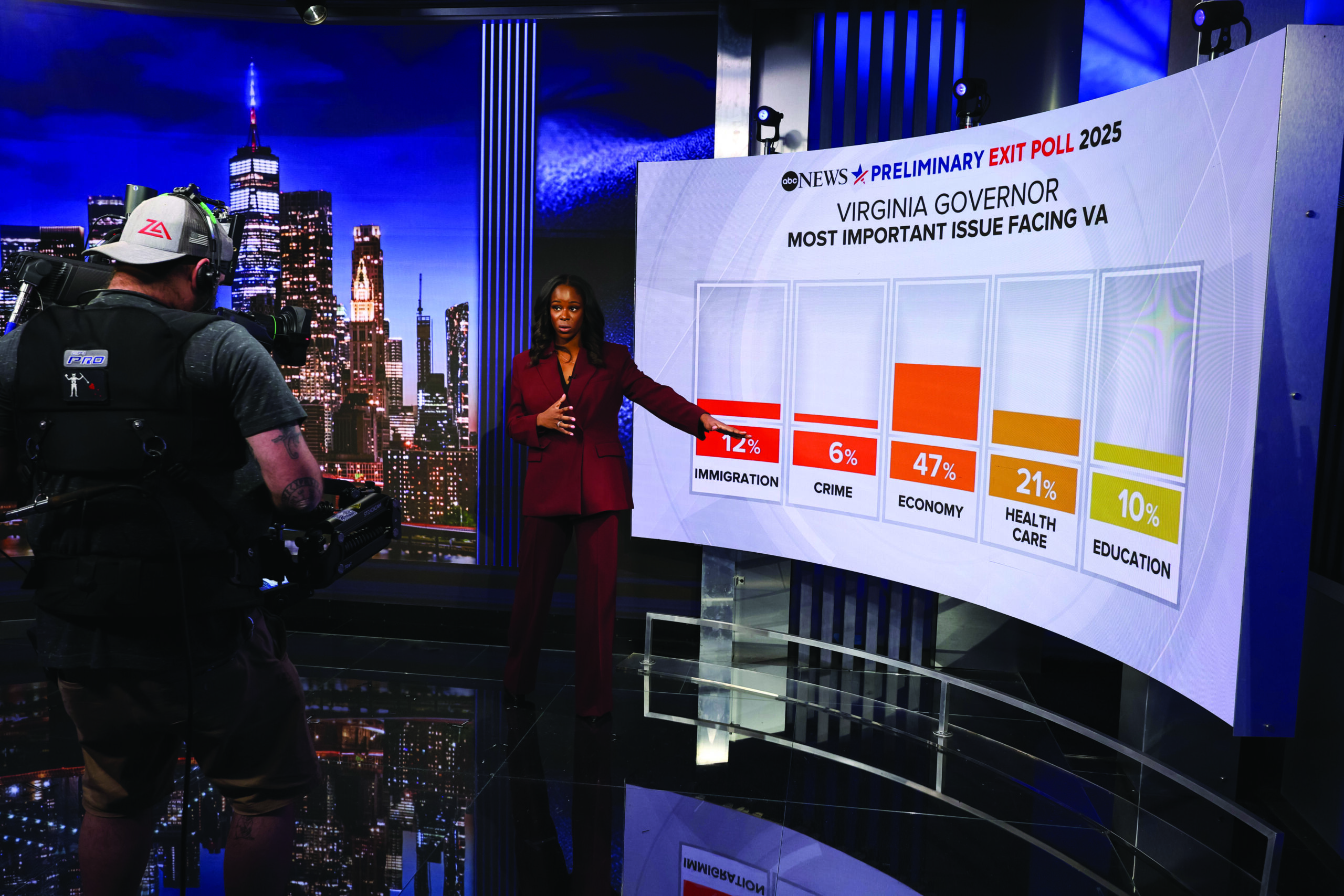
ABC News Election Night 2025 coverage. Election night is like the Super Bowl for news teams, Harper said. It’s the culmination of months of campaign reporting and policy tracking. (ABC/MICHAEL LE BRECHT II)
CREW, AVERI HARPER
Harper’s instinct to hunt for information has followed her since she was in high school, collecting stacks of magazines and working as a contributor for her high school newspaper, The Charger, on Long Island. Her father was the chief medical officer at a cancer care center in Harlem, and her mother was a real estate agent.
Harper was ambitious and adventurous, once spending an entire summer studying in Australia as a high schooler. “I was somebody who was interested in learning and very curious about the things that I didn’t know,” she said.
That pursuit of the unknown would guide the rest of her life. And even as she worked her way up to editor-in-chief of The Charger, she didn’t think she would study journalism in college. She was more interested in science, but she was just too good at asking questions to ignore what those around her thought was her obvious talent — reporting.
Once she accepted her fate as a journalist, she considered prestigious schools such as Columbia University, New York University, Barnard College, Northwestern University and others near magazine headquarters where she wanted to intern. She applied to distant Carolina because she learned it had a well-regarded journalism program.
During Harper’s first visit to UNC, Professor Jock Lauterer ’67 spotted her and her mother curiously peering into a student radio studio. He wound up walking the pair around the journalism school, a kind gesture that stuck with Harper. She ultimately chose Carolina for its award-winning journalism school and its beautiful campus. She became a columnist at The Daily Tar Heel, editor-in-chief of Black Ink Magazine, an anchor and a reporter for student newscast Carolina Week and vice president of the Carolina Association of Black Journalists.
Harper said Jan Johnson Yopp ’70, the former associate dean for undergraduate studies at the journalism school who led the Carolina Association of Black Journalists for nearly 30 years, was a treasured adviser. Yopp sent students, including Harper, to the National Association of Black Journalists convention each summer. There, Harper established connections that led to internships and jobs after graduation.
She also credited Trevy McDonald ’92 (MA, ’95 PhD), Lois Boynton ’97 (MA, ’01 PhD) and Jim Hefner ’72 as early mentors who challenged her to grow as a journalist.
McDonald, who has been a professor at the Hussman School of Journalism and Media since 2010, first met Harper when Harper enrolled in McDonald’s MEJO 101 course. Though the course was an introductory carousel to many areas of journalism, McDonald recalled that Harper was determined to work in broadcast news.
Like Harper, McDonald is a member of the National Association of Black Journalists. McDonald recalled at one convention Harper was one of a team of students who covered the events, broadcasting coverage packages on the televisions throughout the hotel.
“The news directors there could see them, and I remember a few of the mentors coming to me, just being really impressed with Averi, saying that she knew everything to do the minute she stepped into the project,” McDonald said. “They didn’t have to coach her and train her like they do other students.”
McDonald said, above all in class, Harper was focused on building relevant experience to achieve her dreams, and she was unafraid to voice her opinions.
Partisan peril
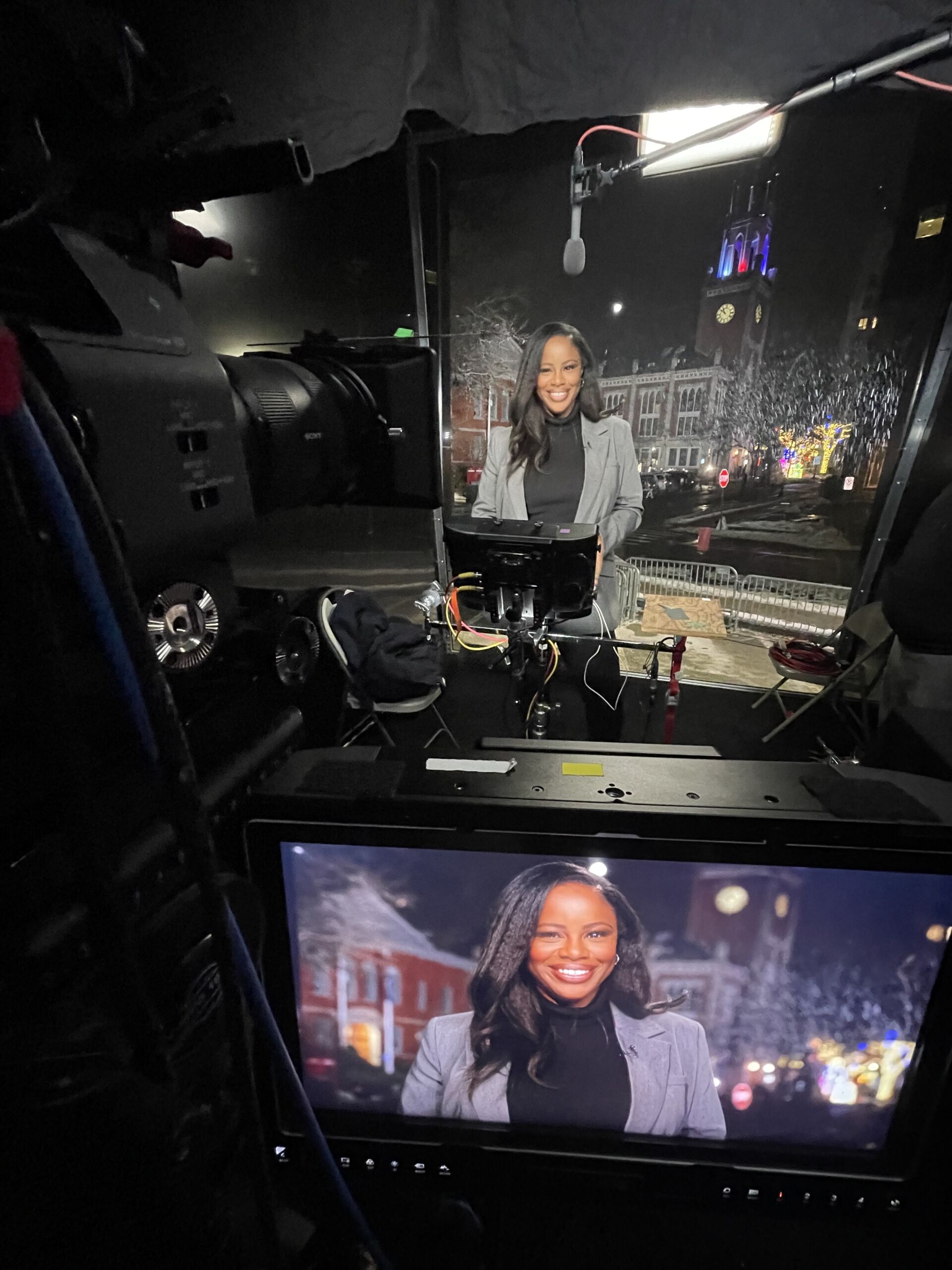
Harper said she doesn’t feel pressure to prove herself because of her age or anything else; she feels pressure because the political moment requires a level of seriousness she knows she can meet.
Another of her mentors at Carolina, Hefner, taught her to always ask of her stories, “Why should I care?” It’s a question that reminds journalists to keep their audience in mind.
Throughout her career, that question has never changed, Harper said, even though society has. Journalists are now “put in peril,” she said, simply for doing the tough job of asking hard questions to powerful people.
She said nobody knows her personal political opinions besides her husband and her mother. In March, Harper returned to campus for the Frank A. Daniels Jr. Lecture to give a talk titled “The Work of Telling the Truth: What It Means to Do This Work Well.” Leyla Santiago, a visiting professor of the practice at the journalism school who moderated Harper’s lecture, asked her, “Is that true you don’t talk to your friends [about your political opinions] in a conversation? Not over coffee, you don’t say, ‘This person’s crazy’?”
“No,” Harper said. “I’ve seen too many people burned.”
She cited Project Veritas, an organization that seeks out journalists and insiders at nonprofits and corporations to record them saying “untoward” things and undermining their credibility. She tells her team to keep their personal political views to themselves.
“I try and separate my political views from anything that I’m doing,” she said. “Maybe I’m just really good at compartmentalizing, but I don’t have trouble doing that.”
Harper said when she was a student, she couldn’t conceive of the pressure that working journalists, particularly those who cover politics, would face today.
“That is something I only thought of in a foreign or historical context,” she said during her remarks on campus. “But that is something that journalists here in this country, and particularly those who cover government and politics, have to deal with every single day.”
At ABC News, she said her team has remained steadfast in delivering straightforward news. “Our aim is never to become the story,” Harper said. “It’s always to just get the answers we know our audience is seeking.”
Journalism and the media industry are “in upheaval or even in jeopardy,” said Harper during the Frank A. Daniels Jr. Lecture, citing a federal raid on a Washington Post reporter’s home, the arrests of journalists covering protests in Minneapolis — both of which occurred in January — and when elected officials hurl insults at reporters or try to intimidate news organizations into providing coverage they like.
Citing threats of personal harm journalists have faced from the public, Harper said, “It feels as though the work of telling the truth has become a minefield.”
Still, the hunt for answers to keep citizens informed is what keeps her going, despite the tension and exhaustion that often accompany the head-spinning pace of political developments. She said it’s incredibly important that her job allows her “to ask questions on behalf of those who might not have access to their elected officials.”
No camera necessary
Harper worked as an adjunct journalism professor at New York University from 2019 to 2025 and at East Carolina University in 2015. She joined ABC News in 2019 after stints as a reporter at local news stations in Greenville, North Carolina; San Francisco and New York City.
After Harper earned her master’s degree in journalism at Columbia University, McDonald said some Carolina journalism school faculty and students were a bit shocked that Harper began working in local news in eastern North Carolina; McDonald and others believed she had the chops to land any journalism job she wanted at any big city in the country.
But her experiences in Greenville, at a smaller program, charged her to excel at every step of news development, giving her skills that would prove indispensable as she made what McDonald called “a meteoric rise” through the first decade of her career.
Harper thought she would stay in local news forever; there are reporters who work their entire careers hoping to get back to New York.
At each local station, at different edges of the country, she learned that people are more alike than they are different. “I interviewed people on the worst days of their lives, because I was a general assignment reporter,” Harper said. “I covered crime, and sometimes I would cover disasters, mass casualty events, shootings. I think people are looking for a listening ear, someone to try at least to understand what they’re going through.”
The hunt for answers to keep citizens informed is what keeps her going, despite the tension and exhaustion that often accompany the head-spinning pace of political developments.
In local news she created entire packages by herself — writing her own stories, editing them, filming on-camera content and b-roll, clipping the videos together and submitting a nearly finished product to her editor. That self-sufficiency served her well as a presidential campaign reporter, a role in which she was an information gatherer, the eyes and ears for the network. She was a reliable force her bosses never had to worry about.
Rick Klein, vice president and D.C. bureau chief for ABC News, hired Harper as an embedded campaign reporter in 2019, when Klein served as the network’s political director. Klein said he was surprised by Harper’s interest in the role, which is typically off camera, because “she was a little more polished and senior than most of the folks who typically look for a job like that.” Klein said Harper had an on-air-ready persona, poise and ample experience that proved her news chops.
“When I get applications like [hers], my ears perk up a little bit, and I’m extra intrigued,” Klein said. “I understood her desire to do something different, to shake things up and to have an opportunity to work at the network in a much different capacity.”
Harper recalled telling Klein she would be OK if she was never on television again, “because the opportunity meant more to me than my ability to be on camera.” She simply felt an overwhelming call of duty to inform voters.
She covered the presidential election in 2020 as a campaign reporter and producer, traveling the country to follow candidates such as U.S. Sen. Bernie Sanders and former President Joe Biden during the primaries and Vice President Kamala Harris during the general election, finding new angles to stories that had already been oversaturated.
“You have to get scoops and find out information that other people don’t know,” Harper said. “The cherry on top is some of the more interesting stories that really differentiate yourself from your competitors.”
For instance, in 2020, while following Harris, who shares Harper’s Caribbean heritage, Harper noticed and reported on Democratic Party organizers using Harris in South Florida, where, uniquely, Harris spoke to several Caribbean American radio stations, mobilizing voters who hadn’t historically been directly spoken to.
Klein said, “[Harper is] always seeking out different voices and perspectives and different ways of tackling stories, looking to include voices of regular people and stories and talk about the impact political decisions and races have on individuals.”
When Harper was an embedded reporter, Klein rarely had to check on her. She was a self-starter who solved her own problems, putting in countless hours and doing the job well, quietly confident and relentless in her hunt for information.
“Our job isn’t to tell people what to think or who to vote for, but it’s to ensure that they understand the stakes when they head into the polls,” Harper said.
Klein recalled Harper’s 2020 campaign coverage. “There was a whole lot of drama going on around the presidential debates,” he said. With the COVID-19 pandemic raging, one debate was canceled, and then-candidate Trump was hesitant to participate in debates hosted by the Commission on Presidential Debates. Trump eventually requested the commission move the debates to an earlier date.
“As I recall it, she found a phone number for someone on the debate commission, called them up and got on-the-record information that pushed us forward,” Klein said. “No one asked her to do it. She just jumped on it, and it wasn’t an obvious lane of hers. It was just taking the initiative, and that impressed me.”
When ABC’s deputy political director vacated the role in 2021, Klein thought Harper was the perfect fit. And again, when Klein moved up from political director to bureau chief last year, Harper was “the obvious choice” to replace him, Klein said. He added that Harper is “a very worthy successor and a great partner.”
The two work just one floor away from each other and meet multiple times a day. Klein said Harper is the best at what she does because she’s well-organized, thoughtful and measured, traits which bring a “very, very steady hand to our political coverage,” even as the news cycle demands rapid answers and quick reactions.
“Our job isn’t to tell people what to think or who to vote for, but it’s to ensure that they understand the stakes when they head into the polls,” Harper said.
At UNC in March, a student asked Harper, “How should journalists cover news and disinformation in a way that serves their duty to the public but doesn’t amplify falsehoods?”
Harper responded, “That’s one that we wrestle with quite often. I will say … we just cover the news.” She said ABC News tries to not confuse viewers. She cited the bold red disclaimer the network uses whenever it broadcasts an image generated by artificial intelligence. She added not every opinion deserves airtime. When the network airs a quote that is a blatant lie, it will be described as such, citing factual evidence to counteract the lie.
“Adding that context to our coverage is incredibly important to ensure that people understand the real from the fake,” Harper said. “It’s an art more than a science.”
Family ties
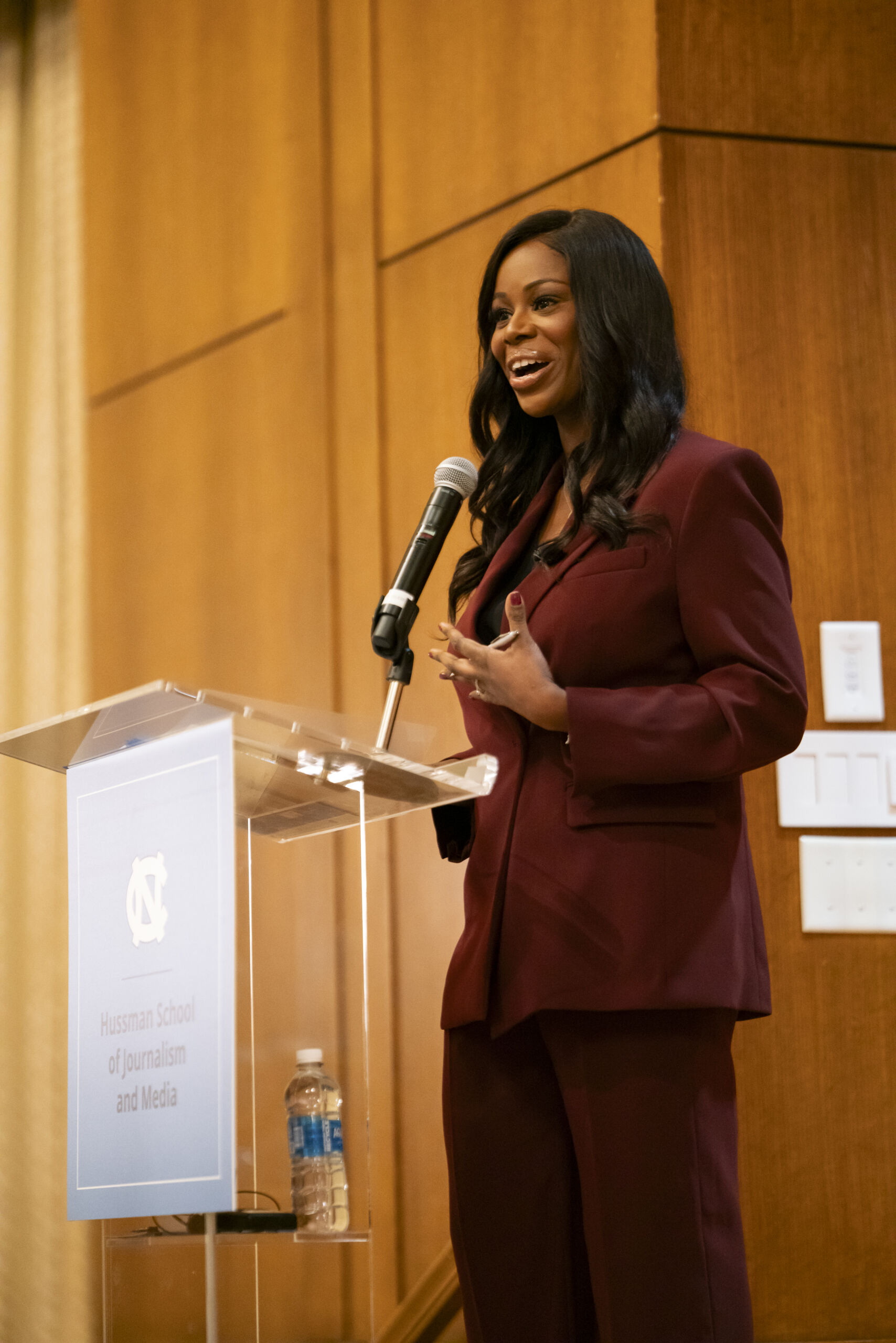
Harper delivered the Frank A. Daniels Jr. Lecture at Carolina March 9. “I spent a couple of days with sharp, curious students who are asking the right questions about what journalism should be in this moment,” Harper posted on Instagram. “The future is bright (and Carolina blue)!”
Harper married chef Kenneth Robinson in 2021, whom she met on a train in San Francisco in 2015. The two welcomed their daughter, Saige, in 2024. How does she manage being a young mother and working a demanding job? “I’m still figuring it out,” Harper said. “It’s the support of my husband.” But a chef’s life isn’t exactly depressurized either.
Her mother worked throughout her childhood, and both her grandmothers were working moms, so she never knew anything else. Harper said she’s grateful to have a few aunts in the capital area she can call to watch her daughter if she has to travel for work or to stay in the field late for breaking news. And her colleagues have paved the way.
“I am so lucky to be surrounded by other women here at ABC News who are mothers and who have done this for way longer than I have,” Harper said. “I look to Martha Raddatz and Mary Bruce, our chief White House correspondent, who sometimes drives past me as I’m walking to the metro, and she’s dropping her kids off at school before she hits the White House. Elizabeth Schulze, who is one of our correspondents, helped me find a babysitter last weekend.”
Klein said Harper’s ability to do it all is a testament to her dedication and her sense of purpose. And because Klein graduated from Princeton University, “I say this in jest, but perhaps her most endearing characteristic is that she hates Duke as much as I do, if not more.”
Harper hopes, in the decades ahead, her daughter will be proud she held power to account in a precarious moment in the nation’s history and that she didn’t let important perspectives “fall through the cracks” even as the political marketplace of ideas is more overwhelming than ever, especially within partisan media.
To Harper’s dismay — as she readies for the 2028 presidential campaign — every likely candidate has a podcast and a newsletter, leaving her with even more information to digest when she wakes up in the morning. Although the political spin machine is more dizzying than ever, her quest to center the truth remains paramount to her, just as it does for the voters.
Thanks for reading the Carolina Alumni Review
Carolina Alumni members, sign in to continue reading.
Not yet a member? Become one today.