Research Under Threat
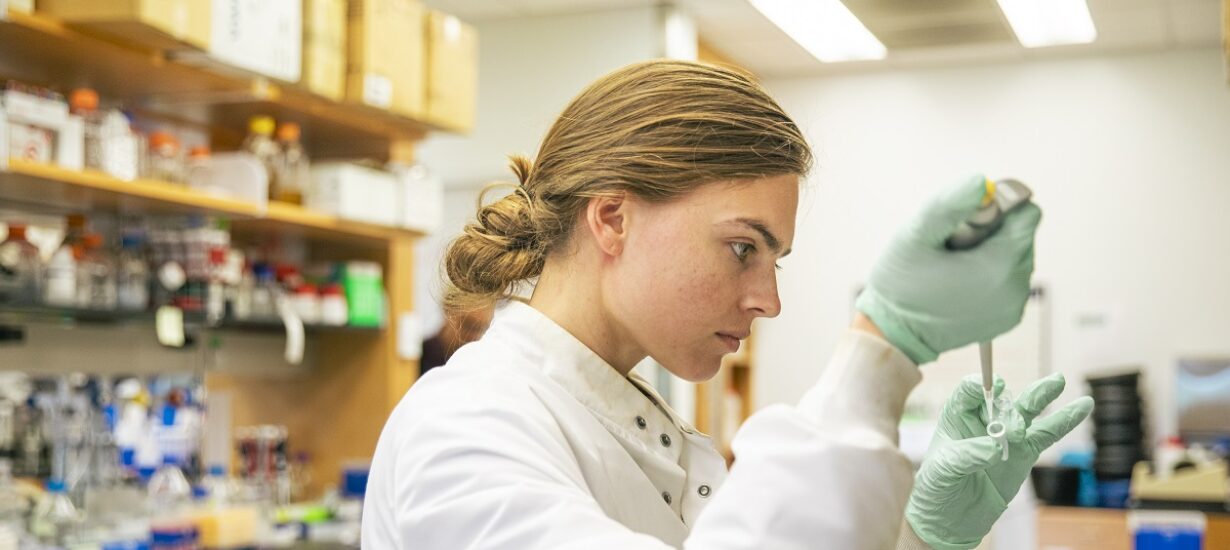
If the National Institutes of Health cuts research funding, North Carolina stands to lose hundreds of millions of dollars, jobs across the state and scientists searching for treatments for diseases.
by Mark Derewicz
Listen to this story as read by ElevenLabs AI.
UNC Research is NC
This week, the University is promoting a “research takeover” of all UNC social media channels and websites as part of a larger “UNC Research is NC” campaign. Read “Carolina Campaigns for Research” to learn why the University is doing this. Carolina Alumni is featuring stories from its archives to salute the importance of inquiry and discovery in campus life.
In early March, neuroscientist Bryan Roth, considered one of Carolina’s top scientists, gathered his lab staff at the Genetic Medicine Building. He said he may have to lay off people if the previously promised National Institutes of Health grant money is withheld … or if federal agencies continue to postpone meetings in which they select the grants they will fund … or if the NIH deeply cuts payments the University needs to cover operating costs for a large research institution. All three were being considered earlier this year.
As Roth spoke to his team, he was thinking of an NIH grant that had been renewed late last year. The money was scheduled to be deposited in a UNC account in January. It had yet to show up. The next day, Roth decided he would have to tell his third-year graduate student and others he didn’t have the money to keep them. But later that day the NIH notice of award arrived in his inbox.
Roth, a Distinguished Professor who’s been at Carolina for 20 years, also runs the National Institute of Mental Health’s Psychoactive Drug Screening Program on UNC’s campus, the only independent lab in the world solely dedicated to parsing the biochemical effects of compounds on brain cells. The Food and Drug Administration also relies on Roth’s lab to find out how approved medications affect brain cells. His scientific methods and discoveries have been validated and used by hundreds of scientists striving to understand complex brain chemistry and to make better, less toxic medications. Roth regularly publishes in top scientific journals, served as editor for the Journal of Clinical Investigation, put in 15 years at NIH reviewing grant applications, trained scientists who are now renowned in their own right and earned a multitude of awards for his contributions to science. This year, he was nominated for a Nobel Prize. (See “The Receptor Scientist,” January/February 2022 Review.)
But this spring, Roth was scared to hire postdoctoral fellows or admit graduate students — the people who do the research. “I’m getting two or three emails a day from people who want to work in my lab, including some spectacular postdocs,” Roth said, “and I just have to tell them I’m not hiring.”

Bryan Roth, a Distinguished Professor who’s been at Carolina for 20 years, also runs the National Institute of Mental Health’s Psychoactive Drug Screening Program on UNC’s campus, the only independent lab in the world solely dedicated to parsing the biochemical effects of compounds on brain cells. (Photo: Grant Halverson ’93)
Carolina and universities nationwide are grappling with the NIH’s proposal to cut so-called indirect costs, a portion of research grants that pays for things such as energy, heat, air conditioning, maintenance and much more. How much universities receive is part of a byzantine process negotiated between the U.S. Department of Health and Human Services and each university, and while many researchers agree the process needs reforming, they warn that cutting too deeply may stifle scientific discovery and jeopardize biomedical progress. It could reduce Carolina’s funding by hundreds of millions of dollars and cut University jobs and those across North Carolina as well.
“If the University accepts grants with a lower indirect cost rate, then it would be more difficult for us to do research,” Roth said. “Ultimately, I will have less money for my lab. This is the fear everybody has.”
Still, Roth’s hiring decision was his own, not his department’s or the School of Medicine’s or the University’s. UNC’s Vice Chancellor for Research Penny Gordon-Larsen said hiring and admissions decisions are left up to the schools, departments and units. At a UNC Faculty Council meeting in late February, Chancellor Lee Roberts said he was not a believer in across-the-board hiring freezes. Duke University, N.C. State University and other research institutions had put them in place by March in response to an uncertain funding future.
But some Carolina professors put some positions on hold in March. Mark Zylka, director of the UNC Neuroscience Center, said he paused interviews for a research faculty position he was about to fill. “I need to save that money in case we need it for faculty already here,” he said in mid-March.
In reaction to possible cuts in funding, the UNC School of Medicine, which receives well above half of what the University accepts in NIH funding each year, reduced the number of graduate student admissions by 25 percent this year. UNC received $598 million in funding in 2024. The medical school now has put in place two cost-monitoring processes it used during COVID: a labor review committee to focus on evaluating new unbudgeted positions at the school, and administrators to evaluate expenses such as renovations, events and business entertainment.
“I’m getting two or three emails a day from people who want to work in my lab, including some spectacular postdocs, and I just have to tell them I’m not hiring.” — Bryan Roth, UNC neuroscientist
On March 20, the Board of Trustees approved UNC’s budget, including a $50 million sequestration of budgetary spending it had proposed “to offset the potential impact of possible reductions in federal funding,” Nate Knuffman, vice chancellor for finance and operations and chief financial officer, told University communications. The move requires UNC administrators to find $50 million in recurring savings for fiscal 2026 with a focus on fiscal responsibility and return on investment to the state. He described federal funding as “increasingly unpredictable, with potential cuts looming on the horizon.”
The uncertainty has the University planning for a future in which research funding could be dramatically different than it has been for decades. Certain programs could be cut, leading to jobs lost at UNC and other research universities and within the biotech industry, which depends on university-trained scientists. As many researchers told the Review, the nation’s reputation as the best place to do biomedical research, which includes the Triangle area, could be in question.
The third rail
 The financial problem is not the NIH budget, which is set by Congress. Rather, it’s how NIH uses its allocation. Three major disruptions occurred this winter. First, in response to a number of presidential executive orders, NIH froze research awards that had been approved for funding in 2024. Many researchers stopped hiring postdocs and accepting graduate students. By late March, NIH began sending notices of awards that it typically would have sent in January. But UNC received less money. Between Feb. 1 and April 1, Carolina was given less than $84.2 million in NIH funds, compared with $106.4 million during the same period in 2024 and $109.9 million in that two-month period in 2023.
By April 10, the Department of Health and Human Services, which houses NIH, had canceled more than 600 NIH grants. UNC was the primary institution or a sub-recipient on 37 of them. The grants supported research into antiviral medication discovery, racial and gender health disparities, mental health, substance abuse, tobacco cessation and COVID.
Second, the NIH, which is composed of 27 institutes and centers, postponed meetings in which scientists review grants to recommend for funding and other meetings in which institute leaders choose which recommended grants to fund. The postponements meant new grant applications would not be considered, putting future lab funding in jeopardy. Some of the meetings resumed in March.
The third issue is the most important and complex, with immediate and long-term implications, researchers said. Grants cover two kinds of costs. Some are called direct costs, which is what most people think the grants are for, such as lab equipment, supplies, and salaries and benefits of established researchers and lab personnel. The second is indirect costs, also known by the mundane phrase “facilities and administration,” or F&A for short. Simply put, it pays for overhead, such as electricity, maintenance, security personnel, internet access, high-speed data processing, national security protections, hazardous waste disposal, janitorial services and legal support, to name a few. It also covers costs — including salaries and benefits of many people — to stay in compliance with federal regulations.
Carolina is home to a couple dozen or so buildings where housing biomedical research is the primary function, though several more buildings with offices and classrooms also house research programs and faculty and staff who run them. Operating these facilities is expensive. For example, in 2019, the latest year data is available from the Office of the Vice Chancellor for Research, electricity for the Genetic Medicine Building cost $1.3 million; steam and heat, $2.3 million; chilled water and cooling, $1.1 million — a total of $7.4 million. That didn’t include other maintenance costs, such as the personnel, supplies and equipment to maintain animal facilities.
The Trump administration, through interim leadership at NIH in February, announced it was substantially cutting F&A support. The announcement was a shocker because F&A is the “third rail of grant funding,” said Ned Sharpless ’88 (’93 MD), a professor of cancer policy and innovation at UNC and a former director of NIH’s National Cancer Institute. “If I said when I was NCI director that I wanted to lower indirects, I would’ve been shot,” quipped Sharpless, who is also a co-founder and managing director at the research capital firm Jupiter Bioventures. “It’s an extremely unpopular opinion, and, generally, the feds don’t like talking about it. But I will tell you, most people who work at NIH think the indirects are too high.”
But are indirect costs so high that they should be cut dramatically and set at the same low rate, which is what NIH has proposed for all research institutions? Sharpless, Roth and Gordon-Larsen said no.
In February, the NIH issued what it called “guidance,” effective immediately, that it was cutting F&A payments on current and future grants to 15 percent. Researchers nationwide were shocked and confused. At UNC, the negotiated indirect rate is 55.5 percent. A decrease of 40 percentage points would equate to a loss of hundreds of millions of dollars a year. It would decimate research at Carolina, researchers said. “This caused tremendous uncertainty and anguish,” Roth said.

Ned Sharpless ’88 (’93 MD), a professor of cancer policy and innovation at UNC and a former director of NIH’s National Cancer Institute. (Photo: Carolina Alumni/Ira Wilder ’24)
In response to the guidance, 22 states, including North Carolina, sued the federal government. The Association of American Universities followed, as did the Association of Public and Land-Grant Universities. In the lawsuits, plaintiffs said the NIH funding guidance violated a federal law. A judge temporarily blocked NIH’s move. The courts had not ruled on the suits as of publication. In April, the Department of Energy also announced it was cutting F&A to 15 percent, and it now faces lawsuits. Carolina has about 50 grants from the Department of Energy and would lose out on $2.5 million a year in indirect costs, according to UNC’s Office of Research Communications.
But if the courts side with universities, Roberts said NIH and Congress could still change the indirect cost structure in the future. Roberts said the University was modeling what funding decreases would mean for Carolina. In March, Gordon-Larsen said her team was still working on the model while asking hard questions, such as, are there programs and activities where the return on investment is not worthwhile, and what do we shutter if a major funding decrease becomes a reality?
Calculating indirect costs isn’t as straightforward as one might think. For example, the NIH guidance capping indirect cost rates at 15 percent didn’t indicate 15 percent of what. Is it 15 percent of the total amount awarded to UNC or 15 percent of the direct costs of the grant or 15 percent of modified costs, which are the direct costs minus certain expenditures, such as tuition, travel and subcontracts? For instance, at a negotiated F&A rate of 50 percent, a grant of $1 million would mean the total amount, including F&A, would be $1.5 million. Therefore, the $500,000 in F&A accounts for 33 percent of the total $1.5 million.
“If I said when I was NCI director that I wanted to lower indirects, I would’ve been shot … It’s an extremely unpopular opinion, and, generally, the feds don’t like talking about it. But I will tell you, most people who work at NIH think the indirects are too high.” — Ned Sharpless ’88 (’93 MD)
For NIH training grants, which UNC receives each year to train graduate students and early-career researchers, the indirect cost rate is 8 percent. Some grants have zero F&A costs included. In real dollars, of the nearly $600 million UNC received from NIH in fiscal 2024, F&A did not account for 55.5 percent. It was more like 26 percent, Sharpless said. But even if the NIH cuts the indirect-costs rate from 26 percent to 15 percent, it would be “a hellacious haircut, a huge decrease,” he said.
Gordon-Larsen said indirect costs live within an ecosystem that’s hard to parse out. For instance, F&A can be used for faculty recruitment, retention and new lab startup funds. It can be used for strategic initiatives, such as data science and precision health programs or for internal grants and seed funding to spur research and help faculty earn larger grants. F&A is like the credits at the end of a movie — pretty boring but important. (See “What’s F&A?,” page 57.) If faced with an NIH audit, Gordon-Larsen said her office could show that every dollar goes to supporting research at Carolina.
Transparent, auditable, saner
Determining how much NIH should pay research institutions has always been complicated and confusing, even to researchers. It’s also been fluid throughout its long history. Before World War II, when private research institutions outnumbered public ones and were smaller than today, research funding came largely from private foundations and philanthropists. Universities were leery of taking federal money for fear the government would interfere with academic curricula, governance and research — a result many researchers say has played out today.
The UNC System stated in February that Carolina needed to be in compliance with executive branch directives lest it jeopardize federal funding. (See “Carolina Adjusts to Trump’s DEI Crackdown,” March/April 2025 Review.)
In the 1930s, Congress wanted to appropriate money to university research. The NIH created the National Cancer Institute and for the first time allocated research grants to university scientists. Until 1937, all NIH research had been conducted on the NIH campus in Bethesda, Maryland, by government-employed scientists. (Today, about 11 percent of the NIH budget is for research conducted within the agency.) In the late 1930s, the federal government reimbursed all direct and indirect costs universities incurred. In 1940, federally funded university research was ramped up in the name of national security, and philanthropic funding accordingly decreased. Competition with Nazi Germany, which was making advances in aeronautics, also fueled federal research expenditures.
In 1941, the Office of Scientific Research and Development, and the National Defense Research Committee, both led by engineer Vannevar Bush, set F&A rates at 50 percent, whereas the government’s industrial partners were still charging 100 percent F&A rates. Bush, an inventor and researcher at the Massachusetts Institute of Technology who would later be instrumental in overseeing the project that led to the development of the first atomic bomb, assumed universities didn’t have the same amount or types of expenses as private companies.
In 2017, Kelvin Droegemeier, vice president for research at the University of Oklahoma, testified at an appropriations subcommittee hearing in Washington, telling lawmakers that Bush “also believed, and argued persuasively, that although the indirect cost rate may have been overly generous, the most important issue was maintaining the health and well-being of the nation’s higher education enterprise, and thus the research it brought forth for the war effort. As an additional argument, knowing that universities were still somewhat reluctant to accept the federal government as a patron, generous indirect costs would soften that position.”
In the years immediately following the war, some universities were receiving more F&A payments than they were spending on research, according to Droegemeier’s testimony. Some used the funds however they wanted, which universities can still do today.
From 1950 to 1966, the indirect-cost rate depended on the funding agency; it was as low as 8 percent before rising to 20 percent in 1963 for all federal funding agencies. Three years later, the F&A caps were lifted, and agencies, including NIH, entered the era of negotiated F&A rates at the same time health-related research exploded and research campuses grew exponentially. Carolina’s current research expansion plan centers on a translational research building for imaging and virology research, as well as vaccine development programs, basic science, precision cancer research, and therapeutic and pre-clinical drug development. The board of trustees approved the building’s design in January, but Gordon-Larsen announced in March the project was on hold.
Carolina’s negotiated F&A of 55.5 percent is in line with peer public institutions, according to Gordon-Larsen. Duke’s rate is 61.5 percent. Some private schools have much higher rates, such as Harvard at 69 percent and Scripps Research Institute at 89.5 percent. Reasons for the discrepancy include the type of research conducted. For instance, large animal research is more expensive than experiments with cells. The square-footage of research facilities matters, too. Harvard is larger than the University of Oklahoma, and the cost of living in Boston is higher than in Norman, Oklahoma. The costs of maintaining buildings and the prices of energy, water and personnel vary campus by campus. The amount of debt universities carry on research infrastructure varies a lot.
“This is why the indirect rate should be flexible,” Sharpless said. But he also said it’s debatable whether taxpayers should cover costs of state-of-the-art earthquake-proof buildings at private institutions, for example.

UNC’s Vice Chancellor for Research Penny Gordon-Larsen said hiring and admissions decisions are left up to the schools, departments and units. (Photo: Carolina Alumni/Cory Dinkel)
In 1991, Congress capped the administrative component of F&A at 26 percent, where it has remained. That means UNC can use just 26 percent of indirect costs on personnel, office space, computers and a host of other items for administrative support. But from 1991 to 2014, the government added nearly 100 federal regulations, according to Gordon-Larsen, with more added during the past 10 years, including complying with required security measures to protect American research from foreign interference. “This takes skilled experts, a whole team, to do this kind of security work,” she said.
Gordon-Larsen said if NIH changes what it will pay for indirect costs, then the agency should create a new F&A model to reduce regulations. “My desire is to create a model that is fully transparent and auditable and saner in terms of the regulatory burden,” she added.
Sharpless said, “No one became a scientist to spend half their lives dealing with NIH paperwork.” Zylka described much of the NIH administrative work as “superfluous.”
An argument for decreasing F&A is that it would free up money to fund direct costs of additional research, possibly increasing the 20 percent approval rate of grant applications, many of which researchers said are good proposals that go unfunded. But Gordon-Larsen and others countered that lowering Carolina’s F&A would make it difficult, if not impossible, to house and support the researchers who would potentially get those new grants from the increase in direct funding.
Another argument for reducing F&A is that universities, in theory, could tap into large endowments to cover the cost of running research campuses. Gordon-Larsen said most of Carolina’s endowment, which had a market value of $5.6 billion in June 2024, according to the University, is earmarked for specific uses, and she doesn’t believe UNC could tap into most of it. To cover F&A costs, Carolina would need to raise far more than an additional $100 million annually, Gordon-Larsen said. In 2024, UNC raised about $422 million to support all aspects of the University’s mission. It raised $126 million for research projects across the University, not just in biomedical sciences.
“My desire is to create a model that is fully transparent and auditable and saner in terms of the regulatory burden.” — Penny Gordon-Larsen, Vice Chancellor for Research
The Review spoke with several researchers who said NIH reform is needed. “I don’t think anyone is saying it’s a bad idea to find inefficiencies or redundancies at NIH and rectify them,” Roth explained. “That said, NIH is one of the few government programs that actually delivers way more than it costs.”
Roth pointed to an example from his own lab, which — thanks to an NIH grant — discovered a compound called BMB101 that his research showed wasn’t toxic for lab animals but wasn’t effective enough to treat schizophrenia or depression. Though disappointed, Roth sent BMB101 to the only lab in the world dedicated to screening anti-seizure compounds — an NIH-funded lab at the University of Utah. BMB101 showed such great promise against epileptic seizures that Roth and his colleague Alan Kozikowski at the University of Illinois-Chicago licensed the compound to Bright Minds Biosciences. It is currently in clinical trials. UNC and UI-Chicago own the patents. Bright Minds now has a market cap of $300 million. Roth said if the compound comes to market, it could be a multibillion-dollar drug, and royalties from this one project would go to Roth, Kozikowski, their departments and their universities.
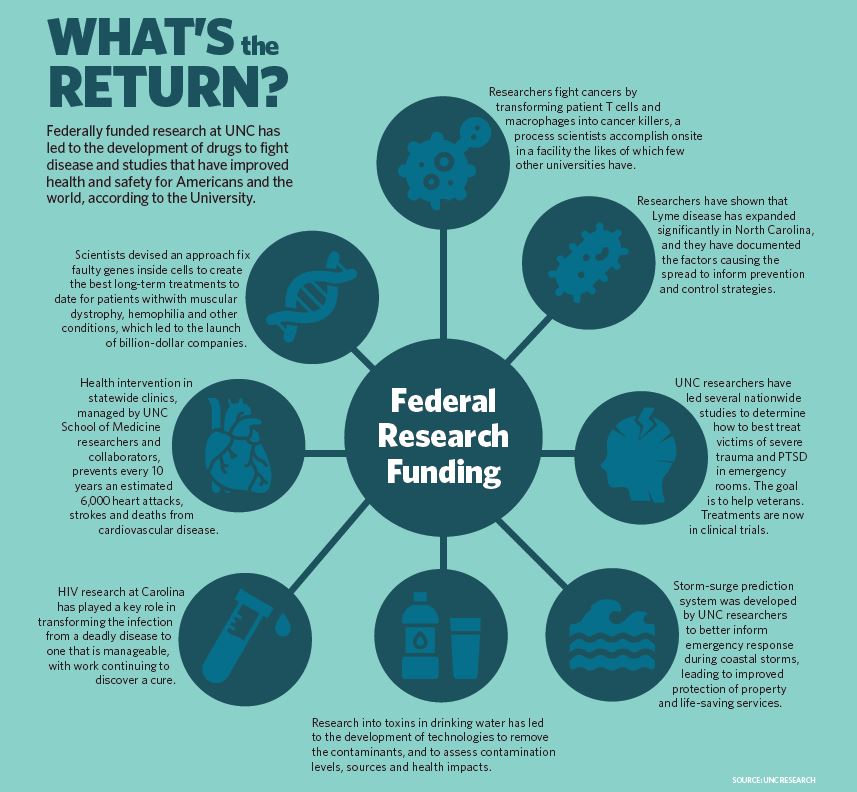
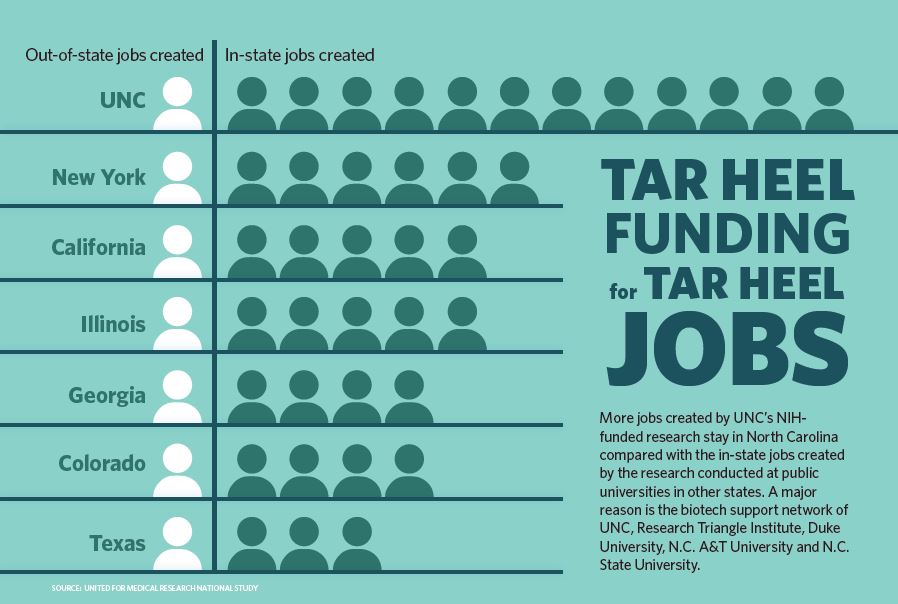
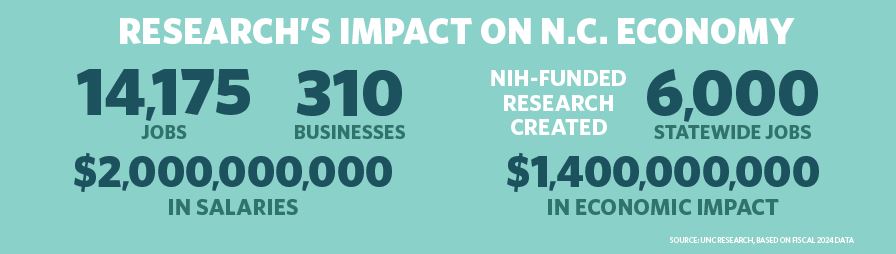
“A lot of money would come back to North Carolina,” Roth said. “And it would be way more than was ever spent on developing these compounds.” Discovering the compound, he added, would have been impossible without the initial investment from NIH. Such impact is not unique. (See “Tar Heel Funding for Tar Heel Jobs,” page 59.)
“The truth is,” Sharpless said, “NIH-backed labs are making the critical discoveries in biomedical research. This system works. It’s been validated. American biomedical research is the envy of the world. And, it’s fair to say, it can be improved.”
What’s F&A?
Conducting research requires more than paying for lab equipment, mice and scientists’ salaries. It also requires electricity, buildings, administrators, security officers, lawyers and a slew of other experts and services.
The list is long:
- Accounting and finance
- Purchasing office
- Human resources
- Graduate student and postdoc services
Training, seminars, career support - Office of Sponsored Programs
Grant review/management; negotiations on F&A, industry
partnerships, confidential agreements - Office of Human Research Ethics
Administrative support for ethical review of all research on
human subjects - Office of Animal Care & Use
Inspections, investigations, training, education, reviews all
animal care applications - Conflict of interest oversight
- Information technology
- Environment, Health & Safety
- Central administration
Oversees all research administration including financial managements, budgets, accounting and record-keeping; manages research infrastructure; sets strategy and priorities - Department administration
Clerical, communications, other support inside each campus unit conducting research - Office of University Counsel
- Office of Clinical Research
Ensures regulatory compliance and standards for clinical trials in health care settings - Campus security
- Risk management services
- Office of Research Communications
Leads communications needs for all units under VC for research, publicizes research news on campus and externally - Facilities Planning
- Facilities renovation and maintenance
- Facility debt service
- Rent
- Utilities
- Custodial services
- Transportation
- Library services
- Division of Comparative Medicine
Responsible for care and management of all vertebrate research animals